

2025 China Benzene Capacity Continues Rising
In 2025, China’s total benzene capacity continued to grow to 27,017kt/a, representing a net increase of 2,635kt/a compared to 2024, a YoY growth of 10.81%. This growth solidifies China’s position as the world’s largest producer of benzene. The capacity scale has doubled since 2018, primarily driven by the concentrated commissioning of integrated refining and petrochemical projects.
In 2025, ten newly-added or expanded units were brought online, including projects from Yulong Petrochemical, CNOOC Ningbo Daxie Petrochemical, and Zhejiang Petroleum & Chemical, contributing a total of 3,025kt/a of new capacity. Concurrently, two units with a combined capacity of 390kt/a were retired according to the methodology.
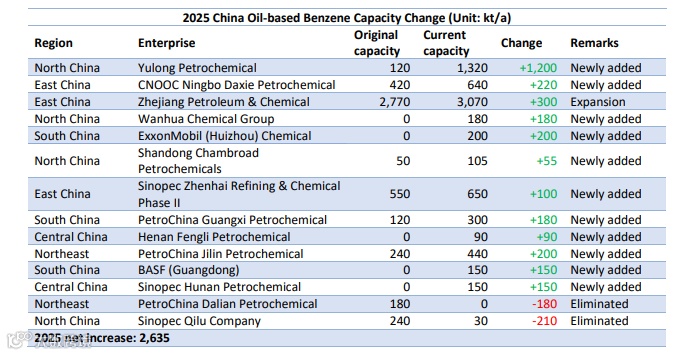
From a production process perspective, the capacity structure exhibits clear diversification. Oil-based benzene remains the dominant type, with catalytic reforming contributing 47.6% of the capacity, ethylene cracking accounting for 18.06%, toluene disproportionation at 32.61%, and toluene dealkylation making up 1.73%. Key suppliers include Sinopec, PetroChina, as well as Zhejiang Petroleum & Chemical, Hengli Petrochemical, and Shenghong Petrochemical. Meanwhile, the coal-based benzene sector faces constraints due to high feedstock costs and environmental regulations, resulting in low operating rates and limited growth potential.
The regional layout demonstrates high concentration. East China, leveraging its robust industrial chain support, has consistently maintained a capacity share of over 30%, with leading projects such as Zhejiang Petroleum & Chemical and Sinopec Zhenhai Refining & Chemical clustered in the region. In 2025, North China saw its share rise to 20.55%, driven by newly added capacity from Yulong Petrochemical. Meanwhile, South China, supported by the Daya Bay Petrochemical Park, accounts for approximately 20.14% of total capacity, with potential for further growth in the future.
Since 2019, the concentrated commissioning of large-scale integrated refining and chemical projects has led to a substantial increase in oil-based benzene capacity. In contrast, the growth of coal-based benzene capacity has been relatively slow during the same period. Constrained by factors such as normalized environmental production restrictions in the upstream coking industry, unstable supply of crude benzene, and fluctuating production costs, its capacity expansion has been significantly lower than that of oil-based benzene. Between 2023 and 2025, the range of feedstock routes further diversified. As the market price of toluene consistently remained below that of benzene, creating a cost arbitrage opportunity, enterprises like Shandong Lihuayi Group and Longjiang Chemical added new toluene dealkylation units to produce benzene. This approach, which optimizes resource allocation to expand benzene feedstock sources, became a key feature of the feedstock structure adjustment during this phase.
All information provided by SCI is for reference only, which shall not be reproduced without permission.
Please click "Read more" for the full article.