

E-China and S-China to See Lacking Styrene Arbitrage Chances
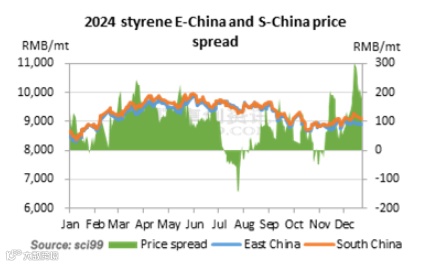
Since early December, the inventories in East China and South China influenced the styrene price differently. As of December 13, the price spread between the Guangdong and Jiangsu markets hit the highest point in 2024 at RMB 210/mt. However, the arbitrage opportunities between the two regions are limited, with no heard of cargo movement besides long-term contracts. With the Spring Festival holiday approaching, the market may lack transactions, making it difficult for new resources to emerge.
In December, the styrene price spread between South China and East China first widened and then narrowed. By December 13, the spread had widened to RMB 210/mt, which was a record high for 2024. The widening in the first half of December was mainly due to the continuous drawdown of stocks at ports in South China, which supported higher prices. However, ports in East China saw inventory build-up with expectations of further accumulation, putting pressure on prices. In the latter half of December, the spread gradually narrowed as ports in South China received new shipments, easing the tightness in spot supply. Moreover, bearish market sentiment and lukewarm restocking willingness by downstream players created a supply-demand imbalance, leading to a greater price decline in South China’s styrene market than in East China.
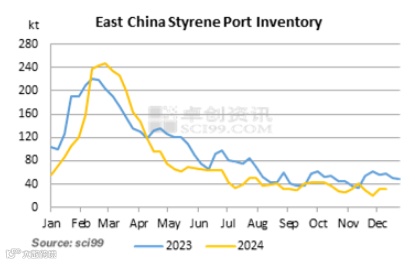
Since early December, the inventory in South China declined from a low level, which supported the styrene price in South China. On one hand, some downstream plants had completed their annual import feedstock contracts, leading to a lack of new import shipments at the ports. On the other hand, a unit at CNOOC and Shell Petrochemicals was slightly cut operating rate and downstream players mainly relied on port stocks. In East China, the units at Zhejiang Petroleum & Chemical, Anhui Jiaxi New Material and CNOOC Ningbo Daxie Petrochemical were gradually restarted. In addition, the port inventory accumulated since early December. As of December 15, inventory at East China’s ports was maintained at 30.8kt due to robust downstream demand, with no further increase. Nevertheless, there may be import shipments to supplementary. Additionally, the unit at Shandong Yulong Petrochemical resumed stable operation, which will send cargo to the East China market. Therefore, there remains a likelihood of further inventory build-up, which may put downward pressure on styrene prices in East China.
Since mid-December, as 77,000kt cargos from PetroChina Guangdong Petrochemical, Fujian Gulei Petrochemical and Hainan Eastern Petrochemical arrived at Dongguan commercial storage area, the tight supply in East China was alleviated. This led to an increase in offers from holders of resources at lower prices. Meanwhile, market buyers and downstream plants held a bearish sentiment on the future market, showing weak enthusiasm for restocking, with transactions mainly consisting of small, rigid-based orders. Consequently, styrene prices in South China began to decline. In East China, however, major downstream players continued to bid for feedstocks and the demand from buyers remained passable, resulting in a smaller price decrement than in South China.
Although the price spread between South and East China reached an annual high in December, the arbitrage window lasted only two days. Besides the normal circulation of long-term contract cargo, there was no heard of new cargo movements between the two regions. In January 2025, on the supply side, the restart of units at Zhejiang Petroleum & Chemical (PO/SM unit), Huatai Shengfu, and SP Chemicals in East China will increase supply, putting pressure on styrene market prices. In contrast, CNOOC and Shell Petrochemicals in South China still plan to reduce its operating rate in early January, which will support prices in the region. On the demand side, major downstream players in East China are likely to maintain a high operating rate before the Spring Festival, while smaller downstream players in South China may be the first to reduce their operating rate or shut down for the holiday. The styrene price in South China may continue to be higher than that of East China. After Jan 10, the load cut of CNOOC and Shell Petrochemicals will come to an end, which may lead to South China’s prices gradually declining. With the Spring Festival holiday approaching, the lack of market transactions is likely to prevent any new cargo movements between the two regions.

All information provided by SCI is for reference only, which shall not be reproduced without permission.
Please click "Read more" for the full article.