

Propylene Import Volume Increased in August amid Temporary Supply-Demand Imbalance
Introduction: In recent years, China’s propylene import volume has generally shown a downward trend, with the import dependency degree decreasing. However, affected by Sino-US tariff policies, downstream plants intensively purchased imported resources in May-June 2025, driving propylene import volume to a two-year high. Although import volume declined in July-August, frequent fluctuations in China’s propylene units and temporary supply-demand imbalance led some downstream plants to continue sourcing from the international market, keeping import volume at a relatively high level for the year. Meanwhile, the export dependency degree remained low, with limited volume. In January-August 2025, propylene cumulative import volume reached 1,492.8kt, up 19.38% YoY, while export volume was 21.5kt, down 66.34% YoY.
In August, propylene import volume increased by 4.15% MoM, while export decreased by 56.57% MoM. During this month, China’s propylene units saw relatively frequent startups and shutdowns. The planned maintenance and unexpected shutdowns led to periodic reductions in propylene market supply. At the same time, the USD to RMB exchange rate showed a downward trend, so exchange rate costs for procuring imported propylene decreased. In this context, some downstream plants purchased imported propylene resources, so propylene import volume inched up MoM in August, remaining at a relatively high level compared to the past two years. In terms of the export, propylene export saw a small volume with significantly declining MoM. However, the actual volume remained limited, with sporadic sales to neighboring regions as the primary outlet.
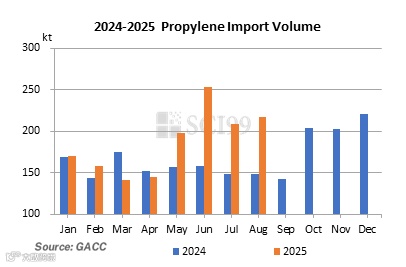
In August, propylene import volume increased by 4.15% MoM.
Propylene import volume inched up in August, though the growth pace remained limited. According to GACC, propylene import volume reached 217.3kt in August, up 4.15% MoM. Propylene cumulative import volume for January–August stood at 1,492.8kt, up 19.38% YoY.
The marginal rise in August import volume can be attributed to the following factors. On the one hand, China’s propylene units saw relatively frequent startups and shutdowns, and units were intensively shut down for maintenance during certain periods, so downstream plants increased procurement from the international market. On the other hand, imported propylene prices rebounded after a decline in July–August. As prices reached a relatively low and the USD to RMB exchange rate declined, exchange rate costs for procuring imported propylene decreased, leading to a slight increase in purchasing volume. According to SCI, the downstream operating rate index was 68.68% in August 2025, up 0.33 percentage points MoM.
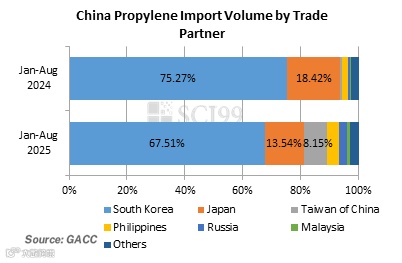
In terms of import by trade partners, South Korea and Japan remained the dominant sources of propylene import in the first eight months of the recent two years, with no significant structural changes observed. According to the GACC, from January to August 2025, cumulative import volume from South Korea reached 1,007.8kt, accounting for 67.51% of the total, while the import from Japan stood at 202.2kt, representing 13.54%. In August 2025, the import from South Korea totaled 144.7kt, accounting for 66.56%, and those from Japan were 25.4kt, accounting for 11.70%.
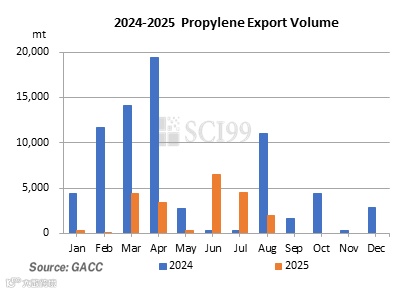
Propylene export volume decreased by 56.57% MoM in August.
Propylene export volume declined significantly in August. According to the GACC, China’s propylene export volume in August totaled 1,937.33mt, down 56.57% MoM and 82.43% YoY. Cumulative export volume from January to August reached 21,538.34mt, down 66.34% YoY. In August, China’s propylene supply was primarily directed toward meeting domestic demand, leading to a notable decrease in export volume. Actual export volume remained persistently low, with the monthly volume dropping significantly from July. According to the GACC, export volume in August originated mainly from East China and Shandong province.
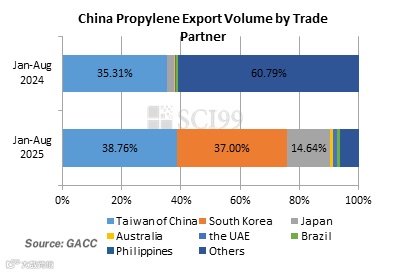
From the perspective of export trade structure, certain shifts have occurred in trade partners over the past two years. From January to August 2025, propylene export trade partners were relatively diversified, with major partners including Taiwan of China, South Korea, Japan, Australia, the UAE, Brazil, and the Philippines. Among these, Taiwan of China, South Korea, and Japan ranked as the top three destinations, with cumulative export volume totaling 19,469.56mt, accounting for 90.40%.
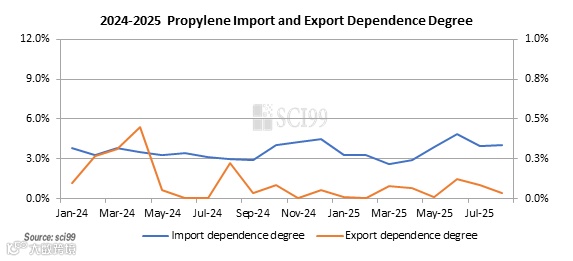
The import and export dependency degree of propylene remained relatively low.
Over the past five years, both the import dependency degree and export dependency degree of propylene have remained at relatively low levels, with the import dependency degree consistently higher than that of export. From 2021 to August 2025, the import dependency degree fluctuated within the range of 2.63% to 5.80%, while that of export remained relatively low, fluctuating between 0.002% and 0.45%.
In recent years, new propylene units in China have been continuously put into operation, and China’s propylene output is expected to increase. Over the past five years, the propylene import dependency degree has shown a declining trend, and reliance on imported propylene resources is projected to further decrease in the future. In terms of export, at present, most of China’s propylene units are integrated with downstream products, meaning propylene is primarily consumed domestically, and export volume is likely to remain limited. In the long term, although the commissioning of new propylene units may continue, most may be equipped with downstream products, which is unlikely to significantly boost propylene export volume.
In September, the US dollar exchange rate remained relatively low, reducing the import cost of propylene from the international market. However, frequent shutdowns and restarts of China’s propylene and downstream units, especially the major downstream industry, PP, led to reduced demand for propylene. Meanwhile, some upstream propylene units continued operating, resulting in increased propylene supply. This combination of weaker demand and higher supply may squeeze the market share of imported propylene. Therefore, propylene import is expected to decrease in September. On the export side, China’s propylene supply may continue to prioritize meeting domestic demand, and short-term export volume is unlikely to see significant growth.
All information provided by SCI is for reference only, which shall not be reproduced without permission.
Please click "Read more" for the full article.