

Policy Pulse Checks Lift PE Market Sentiment, But Caution Lasts
China’s “anti-involution” policy has provided short-term support to the PE market sentiment, yet fundamental headwinds persist in capping price upside. Market focus now shifts to policy implementation clarity, capacity rationalization progress, and tangible demand recovery signals.
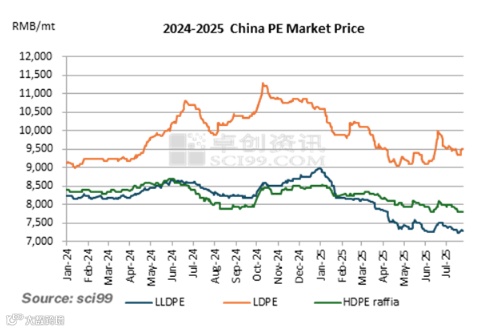
China’s PE market prices entered into a downward trajectory overall in late July. However, recent support from the “anti-involution” policy narrative, coupled with notices like the National Energy Administration’s coal inspection directive, has fostered market expectations of potentially easing future supply pressure. As a result, PE prices across various grades showed narrow fluctuations. As of July 24, mainstream prices for domestic LLDPE were in the range of RMB 7,180-7,650/mt, representing an increase of RMB 20-150/mt from last week.
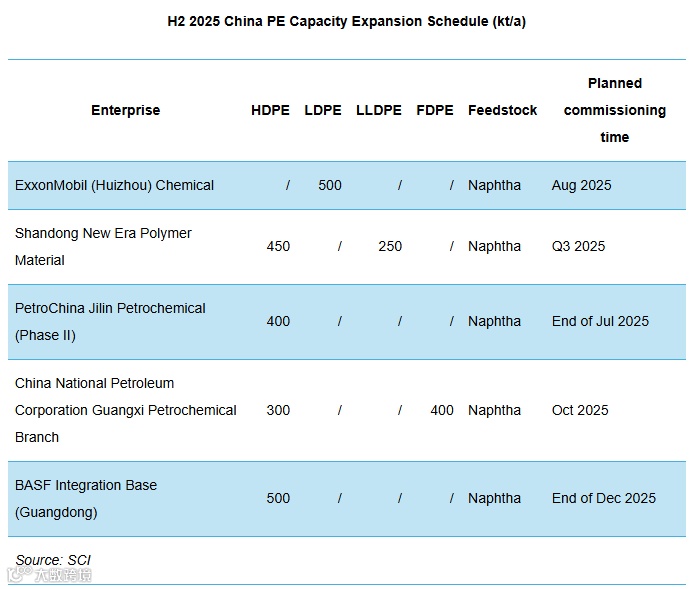
In the future, supply-side pressure within the PE market may persist. New capacity is set to continue coming online, while maintenance-related output loss keeps declining. Compounding this, downstream demand remains weak, with downstream producers mainly purchasing feedstock on a need-to basis and inventory pressure lingering across the industrial chain. Although the "anti-involution" policy has provided a short-term lift to market sentiment, supply-demand fundamentals still hinder sustainable price gains.
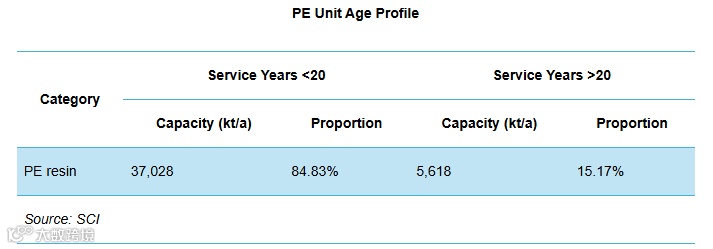
According to SCI, PE units operating for over 20 years represent combined capacity of 5,618kt/a. This includes 100kt/a from units already in long-term shutdown, and 820kt/a from units potentially facing long-term shutdown, though uncertainty remains. Additionally, 400kt/a of capacity comes from units operating for less than 20 years that are currently in long-term shutdown, with their future operational status also uncertain.
Currently, some old units face higher energy consumption and costs compared to new ones and lack the capability to produce high-end grades like mPE or UHMWPE. If forced to reduce or halt production due to low-price competition, it may boost the PE market price in the short term. However, the long-term impact may be relatively limited for two key reasons. First, China’s PE units operating beyond 20 years account for only 15.17% of total PE capacity. The process from evaluating older units for maintenance to their eventual phase-out is lengthy and dependent on specific policy enforcement. Second, the PE industry is currently experiencing a peak period for new capacity additions. Over the next three years, China is slated to add over 18,000kt/a of new PE capacity. This sustained capacity expansion is likely to dilute any support generated by the potential exit of older capacity.
In summary, macro-level news has provided short-term support to market participant sentiment, triggering some price fluctuations. However, supply-demand fundamentals continue to present resistance to a sustained market uptrend. Going forward, close attention must be paid to the details and execution of relevant policies, the pace of capacity clearance, and tangible signals of improvement in downstream demand.

All information provided by SCI is for reference only, which shall not be reproduced without permission.
Please click "Read more" for the full article.