

Oct China Propylene Import Dropped amid Weaker Downstream Demand
Introduction: In recent years, China’s propylene import volume has generally shown a downward trend, with the import dependency degree decreasing. However, in 2025, affected by Sino-U.S. tariff policies and frequent startups and shutdowns of domestic propylene units, the propylene market experienced periodic supply-demand mismatches. From May to September, propylene import volume reached relatively high levels compared to the previous two years. In October, import volume declined significantly due to weak domestic demand and reduced operation rates at some overseas propylene units. Meanwhile, China’s propylene export volume hasn’t achieved a breakthrough in volume, and the export dependency degree has remained low. In January-October 2025, propylene cumulative import volume reached 1,834.7kt, up 14.97% YoY, while export volume was 26.9kt, down 61.64% YoY.
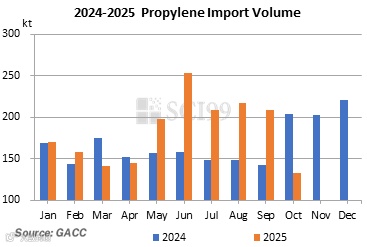
In October, propylene import volume decreased by 36.17% MoM, and export volume decreased by 44.17% MoM. During this month, some propylene units were restarted, so the propylene market supply increased, which somewhat squeezed out imported propylene resources. Additionally, the theoretical gross profit for most downstream products was in negative territory, leading to sluggish restocking enthusiasm. As a result, propylene import volume in October experienced a MoM decline. In terms of the export, propylene export saw a small volume with a significantly decreasing MoM, with sporadic sales to neighboring regions as the primary outlet.
In October, propylene import volume decreased by 36.17% MoM.
Propylene import volume significantly decreased in October. According to GACC, propylene import volume reached 133.2kt in October, down 36.17% MoM. Propylene cumulative import volume for January-October stood at 1,834.7kt, up 14.97% YoY. The fluctuation in October import volume can be attributed to the following factors. First, some of China’s propylene units were restarted, leading to an increase in overall supply. Propylene prices continued to decrease, so China’s downstream plants engaged in bargain-hunting in the nearby market. Second, downstream plants saw weaker profitability, so their restock positivity was insufficient. Besides, some propylene units in South Korea and Japan ran at lower loads, so the export volume to China decreased. According to SCI, the downstream operating rate index was 67.56% in October 2025, up 0.14 percentage points MoM.
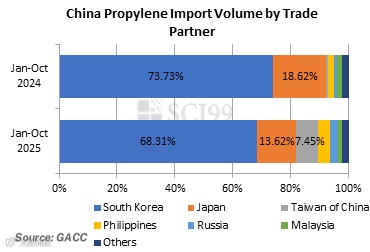
In terms of import by trade partners, South Korea and Japan remained the dominant sources of propylene import in the first ten months of the recent two years, with no significant structural changes observed. According to the GACC, from January to October 2025, cumulative import volume from South Korea reached 1,253.3kt, accounting for 68.31% of the total, while the import from Japan stood at 249.8kt, representing 13.62%. In October 2025, the import from South Korea totaled 106.8kt, accounting for 80.21%, and those from Japan were 14.5kt, accounting for 10.92%.
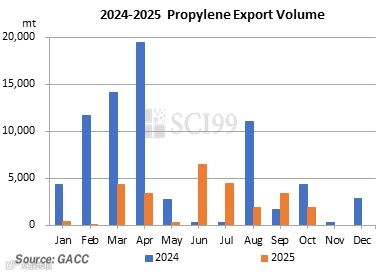
Propylene export volume decreased by 44.14% MoM in October.
Propylene export volume decreased notably in October. According to the GACC, China’s propylene export volume in October totaled 1,917.68mt, down 44.14% MoM and 56.20% YoY. Cumulative export volume from January to October reached 26,879.8mt, down 61.64% YoY. In October, China’s propylene supply was primarily directed toward meeting domestic demand. Export volume decreased notably, and actual export volume remained persistently low, exerting a negligible impact on China’s propylene market. According to the GACC, export volume in October originated mainly from East China and Shandong province.
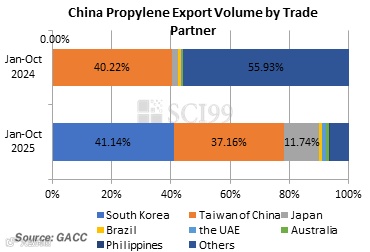
From the perspective of export trade structure, certain shifts have occurred in trade partners over the past two years. From January to October 2025, propylene export trade partners were relatively diversified, with major partners including South Korea, Taiwan of China, Japan, Brazil, the UAE, Australia, and the Philippines. Among these, South Korea, Taiwan of China, and Japan ranked as the top three destinations, with cumulative export volume totaling 24,204.33mt, accounting for 90.04%.
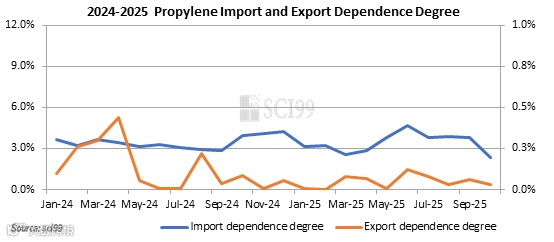
In November, the US dollar exchange rate inched down, reducing the import cost of propylene from the international market. However, China’s most propylene units continued to run at higher loads, sustaining supply pressure on the propylene market. China’s propylene prices hit the floor temporarily, weighing on imported propylene prices. Meanwhile, unit operating rates at Northeast Asian plants were relatively low, which limited propylene export volume to China to a comparatively low level for the year. Consequently, China’s propylene import volume in November is likely to see a modest decrease. On the export side, China’s propylene supply may continue to prioritize meeting domestic demand, and short-term export volume is unlikely to see significant growth.
All information provided by SCI is for reference only, which shall not be reproduced without permission.
Please click "Read more" for the full article.