

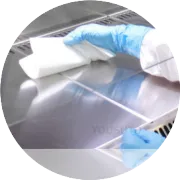
In the pharmaceutical and high-clean manufacturing industries, cotton swab sampling is a common method for verifying equipment cleanliness. Choosing the right swab is crucial, as it directly affects sampling recovery, the accuracy of test results, and overall validation efficiency. Here are some key points to consider:
Choose based on the equipment surface
For flat surfaces, standard flat-head swabs are sufficient to cover the area;
For grooves, gaps, or complex shapes, pointed or small-head swabs are better for reaching tight spaces and avoiding missed residues.
Consider the type of residue
Water-soluble residues can be sampled with polyester or blended swabs, which have good absorption and recovery;
For oily or non-polar residues, choose swabs compatible with the solvent to ensure high recovery;
For trace residues, ultra-fine fiber swabs have stronger absorption, improving detection sensitivity.
Pay attention to cleanliness level
In high-clean environments (Class 100–1000), use lint-free, powder-free, or pre-sterilized swabs to avoid cross-contamination;
In general environments, conventional swabs are acceptable but should still minimize particle shedding and be solvent-compatible.
Ensure solvent compatibility
Swab material should not react with the sampling solvent or release impurities;
Choose low-ionic, low-soluble-impurity swabs based on the subsequent analytical method (e.g., HPLC, TOC).
Ease of use and standardization
Swab length and handle design should be comfortable for operation and avoid contaminating the surface;
Single-use packaging or easy retrieval designs help ensure consistency and traceability;
Standardized swabs reduce human error and improve repeatability.
Summary
Choosing the right cotton swab makes sampling easier and more efficient, while ensuring reliable validation results that meet industry regulatory requirements. Considering surface type, residue type, cleanliness level, solvent compatibility, and usability helps select the most suitable swab.