
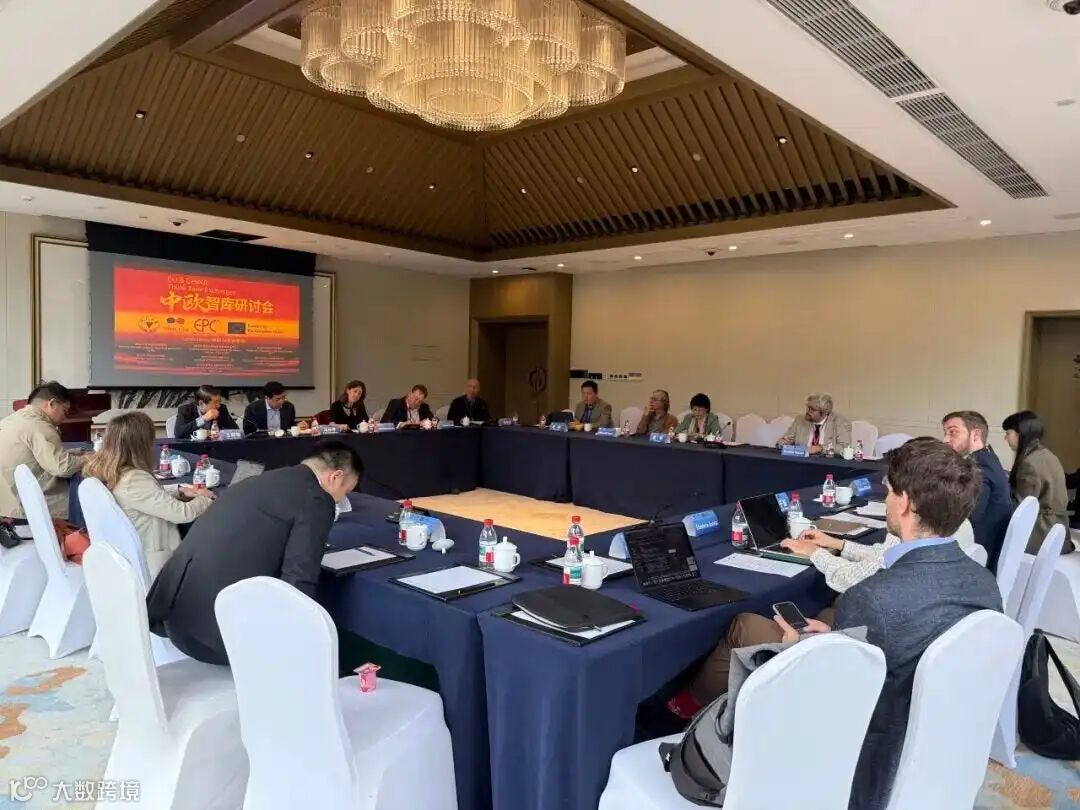
CCG President joined European and Chinese thinktankers and scholars in the EU-funded programme last week
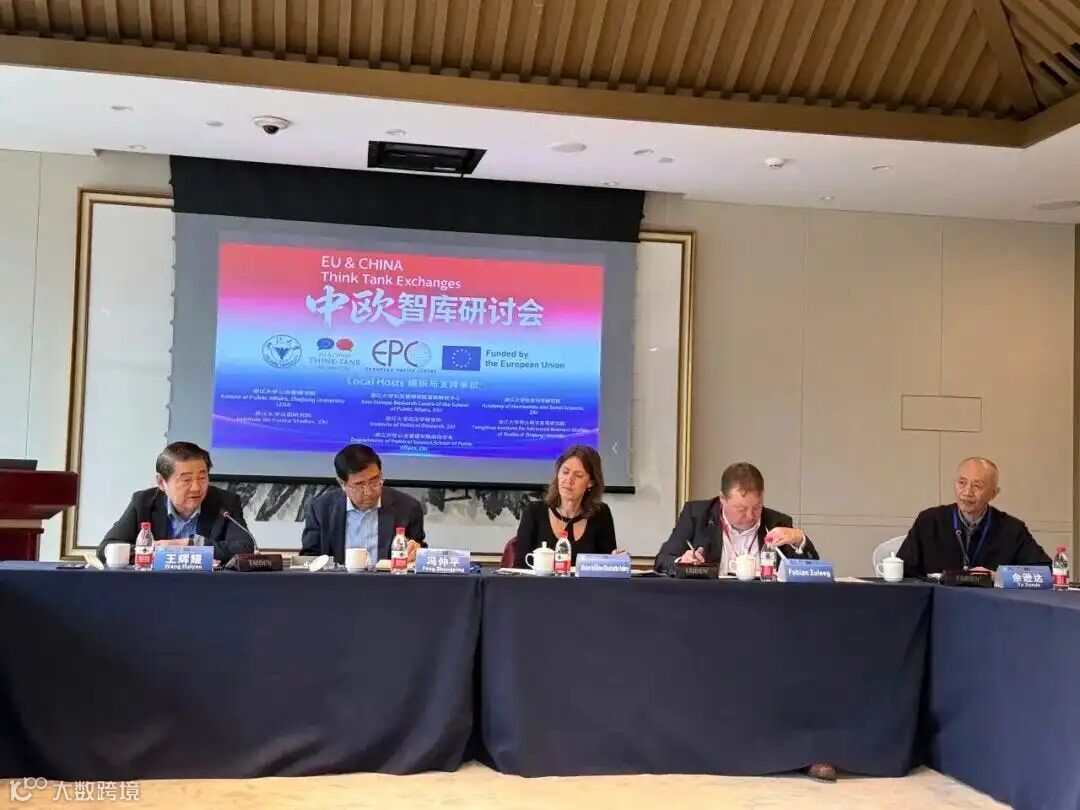
Henry Huiyao Wang, Founder and President of the Center for China and Globalization (CCG), spoke at the closing session on November 7, which was moderated by Yu Xunda, Professor at the Department of Government Administration, Zhejiang University.
Henry Huiyao Wang was joined by:
Feng Zhongping, Director of the Institute of European Studies at the Chinese Academy of Social Sciences (CASS)
Fabian Zuleeg, Chief Executive and Chief Economist of the European Policy Centre (EPC)
Elvire Fabry, Senior Researcher at the Jacques Delors Institute.
Zichen Wang, CCG Research Fellow and Director of International Communications, spoke at a roundtable on November 6, moderated by Ivano di Carlo, Senior Policy Analyst at EPC. He was joined by:
Jiang Feng, Professor and Chair of the Shanghai Academy of Global Governance and Area Studies at Shanghai International Studies University
Elvire Fabry, Senior Researcher at the Jacques Delors Institute.
Yan Shaohua, Associate Professor and Deputy Director of the Center for China-Europe Relations at Fudan University.
The “EU‑China Think Tank Exchanges” is implemented by EPC. Its aim is to strengthen and stimulate an open and frank conversation between think tanks and research institutes across the EU and China and explore in which areas both parties’ interests are still aligned.
As the core Chinese partner in the project, CCG has organised and co‑hosted multiple in‑person seminars in Beijing and Tonglu, Zhejiang, and has participated in Europe‑based events, including exchanges in Brussels in June 2024 and June 2025, and Madrid in April 2025.
The seminar in Hangzhou was hosted by the School of Public Affairs at Zhejiang University. Chinese scholars from the China Institute of International Studies, Shanghai Institutes for International Studies, and Zhejiang University also participated. European participants also include the Elcano Royal Institute, the Central European Institute of Asian Studies (CEIAS), etc.
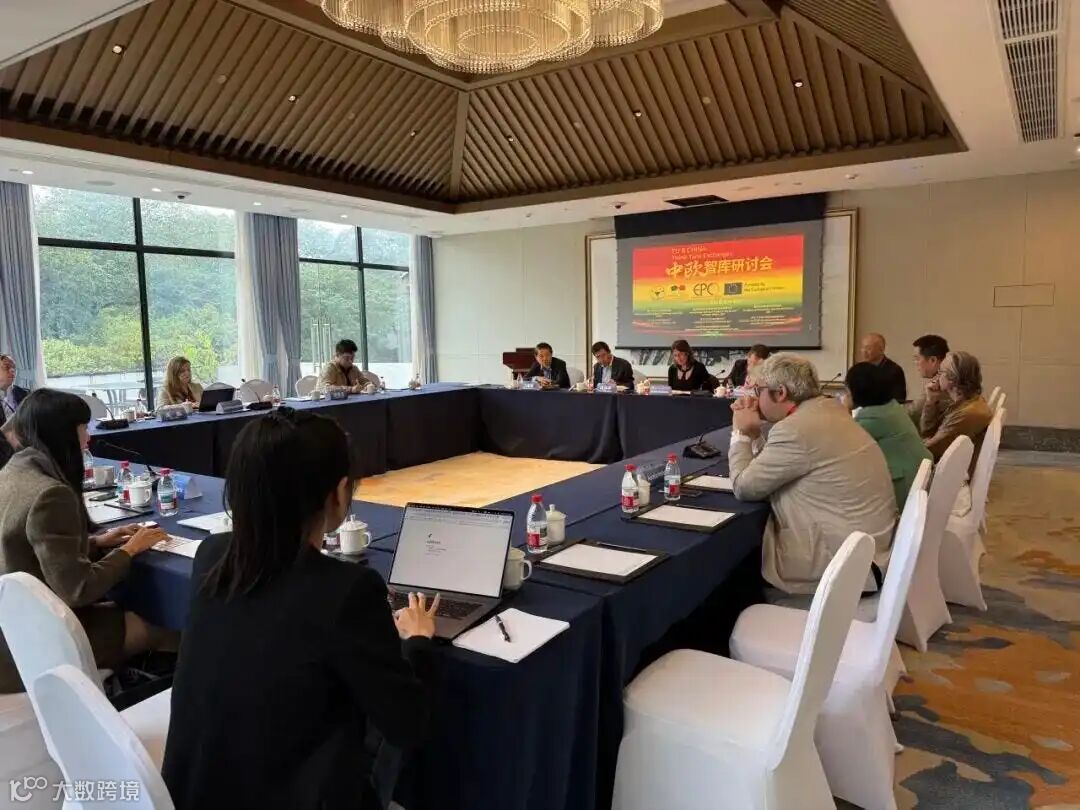
Below are remarks by Henry Huiyao Wang at the closing session. It has been slightly edited.
Closing session remarks by Henry Huiyao Wang
I’m really pleased to see so many old friends today, and I would also like to thank the European Policy Centre (EPC) and, of course, Zhejiang University for hosting this event. I’m also very glad to see that Professor Feng mentioned China-EU relations. Over the past five years, since we started this EU-China think tank exchange Program with so many participating think tanks from both countries, I think a lot of mutual understanding has been promoted and enhanced. We are now in a much better position compared to when we started on Zoom—I still remember that [during COVID pandemic]. It was a very tense moment, but now we’re achieving a deeper and better mutual understanding. So I would like to congratulate all the participants for making contributions to that.
On this topic, I think I will also follow Professor Feng and Fabian, and talk a bit on several fronts. First, on the political relations between China and the EU. I think the China-EU relationship has really fallen behind. It is actually below many people’s expectations, because since Trump came up, suddenly China has been improving its relations with Australia, with Canada, with India, and with so many other countries. Yet the relationship with the EU has really fallen behind now, and everybody on both sides is frustrated.
So what is the fundamental cause? I think the fundamental cause is that every time there is a Chinese delegation, a Chinese foreign minister, or Chinese top leaders meeting with European counterparts, China always gets blamed: “Oh, you didn’t do anything on the Ukraine-Russia war, you didn’t stop Russia, you didn’t do this, you didn’t do that,” as if this war was started by China. That was really a bad start.
I was talking to Mikko—he came here [to Beijing] from MERICS—he was preparing for the summit. I told him, Look, can we start with something positive, like people-to-people exchanges or tourism? A lot of visa-free arrangements. Let’s find some small talk, maybe not about the weather, but at least something good to talk about, rather than every time starting with Russia on top of that. So I think we probably need to change this approach a bit. That’s really the point.
But then there is something that can actually be done on the Russia-Ukraine issue, where China can do much more. I noticed that President Trump said again and again that we should freeze the conflict along the front line and send peacekeeping forces, and that the U.S. will not put boots on the ground, as Trump has repeatedly vowed. And Macron said, Okay, let’s get 26 EU contract troops there. But I think that’s not enough.
I was at the Valdai Discussion Club Conference this year, and apparently, Russia likes to say that if the UN Security Council has a new resolution of some kind, and if China is involved, they are willing to calm down. So I think we would be stuck there because it’s [would be] only a European and U.S. guarantee.
U.S. Secretary of Defense Pete Hegseth has said any security guarantees offered to Ukraine “must be backed by capable European and non-European troops.”
Without China, India, Brazil, and other BRICS countries’ guarantees, this problem is not going anywhere, because I think we need to involve those third parties to really make progress.
I was actually talking to the ambassador of Ukraine about this and also talking to BRICS countries—India, Brazil, Turkey, and many more recently—and they all seemed interested in this idea. So I would recommend that if we can go through the UN Security Council, if the U.S., Russia, China, and the EU can work together, we could put forward a new UN proposal or hold a UN peace summit to solve this issue.
I also noticed that recently, President Trump and President Xi spent a lot of time talking about Ukraine. President Trump wants President Xi to help on that—he wants to get a Nobel Peace Prize. So I really think that by providing peacekeeping forces not only from Germany, France, Italy, Spain, or Poland, but also from the UK, China, India, Brazil, South Africa, and Turkey, we could probably secure peace. That would greatly improve the China-EU relationship, because the root problem is this issue. If we do not solve it, it will always hang there, and China will always be a scapegoat of some kind and get all the blame.
Of course, China maintains relations with all other countries, including India. We may think that relations with Russia are close, but that is just normal economic relations. It is a big economic relationship, but it does not mean China is fully supportive of Russia. So I think we need to change the mindset. Let’s say, okay, if we get NATO, the EU, and the U.S. guarantees, but on top of that, we also get China, India, Brazil, and South Africa guarantees, maybe we can get this issue resolved. I think if there is a peacekeeping force from China stationed along the Russia-Ukraine battle line, and if Russia dares to cross over Chinese soldiers, you could see the sentiment in China changing overnight. So I think it would be great advice to involve China in that. I wrote an article in Foreign Policy on this issue just before the Alaska summit. There will be more details there.
So my first point is to get China and the BRICS countries involved in these peacekeeping efforts, which will greatly help secure peace in Europe. Now the U.S. is interested, and China is probably interested, too—it’s the European countries that seem divided on this. I haven’t heard any open invitation for China; there is only blame toward China. But let’s invite China to participate in this peacekeeping exercise. China is the largest peacekeeping troop contributor among UN Security Council members, and India is the largest peace keepers-sending country. We can do a better job by having a new guarantee mechanism for that. So I think that is probably the way to solve the root problem between China and the EU relationship. That’s my first point.
The second point is economic relations. We are talking a lot about oversupply, subsidies, and claims that China is going to destroy Europe’s economy and things like that. I just got back from Europe. I was at the Paris Peace Forum, and earlier I was in Munich and other places. I found that if we have good relations, there will be massive Chinese investment there. For example, Hungary has a good relationship with China—40% of Chinese investment in Europe actually goes to Hungary. BYD, CATL, and many others have big factories there. So why don’t we do that? And of course, Serbia too has good investment from China. Even Spain gets a lot of investment from China. We had the Spanish Prime Minister come to China twice in two years, and now the King of Spain is coming in the next few days. So you can see that between China and Spain, there is a lot of investment traffic going on…
So why don’t we really start a good relationship? As I said at the beginning, if we have more positive dialogue, Chinese investment would come massively, creating jobs, generating tax revenues, and benefiting politicians. That’s how the Japanese resolved their disputes in the early 1980s and 1990s with the rest of the world, especially with the U.S. [by expanding investment and manufacturing] So I think that’s probably a good way to do it.
We can also promote tourism, expand student exchanges, and address all these challenges. China keeps doing that. Just last week, China renewed visa-free entry for most of the 27 EU countries for another year and added Sweden as a new visa-free country. So China is continuously updating these policies. I think, you know, we had meetings with Pascal Lamy and Justin Vaïsse and others at CCG last year, and we also had BMW and other German manufacturers. Another thing is that we can JV with European countries—Volkswagen, BMW, Mercedes—to reinvest back into Europe and into third countries like those in Africa. That is another way to address this kind of oversupply concern. I was in the UK last month. The UK doesn’t impose any tariffs on Chinese EV cars. Ten per cent of double-decker buses in London are now BYD clean buses, and most Uber cars in London are clean Chinese automobiles. And now Prime Minister Starmer is talking about coming to China. So I think political relations are really important to help economic relations. That’s another point I can share.
Thirdly, on the cooperation between China and the EU, I think, given that the U.S. is so wild and Trump is so unpredictable, we still have to defend this multilateral system that emerged after the Second World War. For example, on the WTO, we still have a very good relationship. Yesterday, at my event at the Shanghai Import Expo, Pascal Lamy and Long Yongtu, China’s chief negotiator in joining the WTO, met, and they hadn’t met for quite a few years. We were so excited together. So let’s support the WTO and talk about green globalisation, green transition, and all the cooperation we can have.
And then on the WHO, you know, after Trump pulled out of the WHO, China announced it would donate $500 million to the WHO. And of course, we are now having COP30 in Brazil. I just got back from Brazil. On climate change, that’s something, you know, Trump said [it] is fake news, but the EU and China are strong believers. The Paris Agreement was signed ten years ago, so let’s really stick to that. China and the EU should find all those common grounds. When we talk, we should really identify all these common areas rather than blame each other.
Also, on UN reform, I recently wrote a piece in Foreign Policy on how to reform the UN Security Council. I suggested that instead of 15 UN Security Council member countries, we could bring in the G20 or G21 into the Security Council, so that the EU and the African Union are represented, and more reforms can be done. We also have to reform the unilateral veto, which the U.S. and Russia have abused over 100 times, while France, Germany, China, and the UK have used it only 10 or 20 times. So we really have to reform that. So there is much common ground for China and the EU to safeguard this global reform. And as President Xi put forward the Global Governance Initiative, we can discuss it—it’s a proposal—but let’s talk about how we can really work together on that.
And finally, my comment on another issue in resolving relations with China is about Taiwan. You see, recently, the German Foreign Minister’s visit to China was cancelled, and he said something very bluntly about Taiwan, something like, “Oh, we have a one-China policy, but we have our own means to do whatever we want.” Something like that. Somehow, that visit was postponed. But basically, recently, there has been great momentum in Taiwan-mainland peaceful reunification. You see, this time when Trump and President Xi met in South Korea, they did not talk about Taiwan at all. It used to be that when Biden met President Xi, the one-China policy was always reiterated as part of the U.S. position on China, but this time, nobody talked about Taiwan, which means Taiwan is an internal matter of China and does not have to be discussed with foreign leaders all the time. And Trump actually refused to sell $400 million worth of weaponry to Taiwan. So there is good momentum.
Recently, the KMT elected a new chairwoman, and she said she is Chinese; she wants to talk with China and to meet President Xi a hundred times. So there is positive momentum now, and China is also relaxing. Recently, China opened the number of ports for Taiwanese entry from 58 to 100, and there is tremendous integration going on. I think if something like that happens, it could greatly improve China-EU relations, because every time a European or German foreign minister wants to show toughness, it is always about Taiwan. So perhaps it’s better to leave it.
Recently, I attended a commemoration at the Great Hall of the People marking 80 years since the restoration of Taiwan from Japanese occupation, where Chinese top leaders announced seven extra benefits for Taiwan: no taxes, multiple [foreign] consular offices to be established in Taipei if unified, and more guarantees from the central government—overall, a very good package for peaceful unification. So I think there is good momentum, and maybe our European friends can support that. China is now emphasising peaceful reunification more strongly. Actually, when I attended the meeting at the Great Hall of the People, there was no talk about military action, only that we would leave space for other means, but strongly promote peaceful reunification. That’s a great message. If the U.S. does not keep taking this as a top priority and talking about it all the time, that will help.
Recently, I also attended a reception at the U.S. Embassy in Beijing, and an American diplomat said, rather than seeking strategic rivalry, let’s seek strategic stability—as [Marco] Rubio said in July, we should “achieve some strategic stability.” I think that’s a good sign. Even though Trump has many things to be blamed for, he has actually improved China-U.S. relations, calming down tensions over rare earths, and lowering fentanyl-related tariffs to 10%. So I expect China-U.S. relations will stabilise with the two upcoming heads-of-state visits. Trump is coming to China in April.
I saw a report that Trump said he wanted to visit in January next year, and President Xi replied that January and February are too cold, so why not come in April? And Trump said, Okay, I’ll come in April. So he is coming in April, and we hope to have another meeting then. President Xi will also probably visit the U.S. for the G20. So I see there will be high-level visits that will ensure stability at lower levels. If Trump stays in the White House for the next three years, we will probably see a relatively stable China-U.S. relationship. But if China-U.S. relations are improving, and China’s relations with other countries are also improving—flights coming to China are now full of foreign visitors—yet China-EU relations are still stormy and slowing down, that’s very bad. So I hope we can greatly improve that with our think tank colleagues here and do our best.
So, thank you to the EPC and Zhejiang University for organising this. Thank you.
Q&A
Thank you, Richard, and also other colleagues. I think those are great questions. First, on the issue of the Ukraine-Russia war, China is actually trying to make some effort. For example, I wrote an Op-Ed in The New York Times when the war broke out, saying that China should be involved. Twelve months later, China proposed a 12-point peace plan, and then China and Brazil started the “Friends for Peace” group at the UN as well.
I think maybe our European friends should not judge whether the Chinese top leader is meeting Zelensky often enough as a criterion. On the foreign minister level, I think they have met quite a few times. The only thing is that China has to maintain some kind of relationship with Russia because it is a big neighbour. But on top of that, you can see that the West, particularly the U.S., has been pressuring and containing China so tightly and so strongly that China sometimes has to resist with any help it can get. That’s part of the reason there.
But I think now it is time, because U.S. President Trump has said several times that he wants China to be involved. I talked to the Ukrainian, Turkish, Indian, and Brazilian ambassadors—they are open for China to do that. But I haven’t heard any European countries say that. So I think it’s a two-way street. China has indicated all the time that it would like to see things resolved. And even at the BRICS summit, Foreign Minister Wang Yi said that the BRICS countries are the best mediators and promoters for peace. They said this several times, but it was not picked up by our European colleagues. So I hope that some European colleagues can pick up on that. China can come in again and again. So that’s my take.
And that’s your second point about the investment in Hungary. I’m just saying that if we have a good political environment, then there will be more investment coming, whether it’s with migrant workers or local workers. That’s a European domestic issue, and we don’t have much influence over that. But again, the money is coming, and technology can also be transferred. I agree that when European companies came to China, the strategy was “market for technology.” Now it’s the reverse—China can provide technology transfer to get access to the market. So absolutely, that can be done. I’m just giving examples of how well Spain is getting investment, and so are Serbia and Hungary. That investment can go to all the other European countries as well, especially if the relationship gets better and if we have better dialogue than the current situation.
And finally, there’s another question about Taiwan. I think on the Taiwan issue, absolutely. What I’m saying is that the U.S. is now taking the initiative of not mentioning Taiwan anymore in these high-level summits. For example, the German Foreign Minister, before coming to China, was ready to make a big statement on Taiwan. Of course, they all support the one-China policy, but he should not really make this a big issue just to show political correctness to the domestic audience. China prefers to discuss these issues internally. So later on, when the German Foreign Minister called, China’s Foreign Minister Wang Yi said, Let’s not do microphone diplomacy; let’s do roundtable diplomacy internally. So anyway, that’s just my brief comment. Thank you.
CCG Books
Other CCG News:
Recent CCG visits in Brazil & Ethiopia
Recent CCG visits in Germany & the UK
Global Talent Summit 2025 Holds in Beijing Sub-Center
300 Participants from 60 Countries Attend CCG Annual Forum
CCG Conducts Track Two Visit to US
CCG hosted the 9th China Global Think Tank Innovation Forum
2024 GYLD Annual Forum successfully held in Beijing
11th China Inbound-Outbound Forum Successfully Held @2024 CIFTIS
60 Countries’ Participants Joined China and Globalization Forum
CCG seminar on global governance & future of China and Africa
Senior Diplomats from 20 countries discuss China's green transition
Text of Pascal Lamy and Chinese trade experts @ CCG VIP Luncheon
Book Launch: Enhancing Global Governance in a Fragmented World
Transcript of CCG session in WTO Public Forum
20 US media leaders attended special dinner held to welcome CCG
Transcript of EU-China think tank exchange
Turkish Foreign Minister Hakan Fidan speaks at CCG
Wang Huiyao in Dialogue with Stephen Roach
CCG Holds 8th China Global Think Tanks Innovation Forum
Joseph Nye | Understanding Global Power Shifts in 21st Century
New Book | The Global Power Shifts in the 21st Century
Josep Borrell’s scheduled speech at CCG on EU-China relations
Justin Vaïsse speaks at CCG on the eve of Macron's visit
Brazilian Ministerial Visiting Event Held at CCG
CCG Global Dialogue:Building a floor for China-US relations
CCG President in Dialogue with CFR President Richard Haass
Video | 7th Annual China Global Think Tank Innovation Forum
CCG 2nd International Visit in Pandemic 2022
Wang Huiyao in Dialogue with Fred Bergsten
9th China Inbound-Outbound Forum
First Chinese Think Tank to Visit Europe since Pandemic
First Chinese Think Tank Visits Washington DC since Pandemic
New York: CCG Delegation's First Stop in the US
CCG Delegation of Experts Visits Singapore
Selected Video of CCG Global Dialogue (Ⅰ)
Selected Video of CCG Global Dialogue (Ⅱ)
CCG Book Launch Welcomes 20 Ambassadors to China
CCG and UN Women hold symposium on International Women's Day
CCG event on MNCs opportunities and challenges in China
Video | The rise of Asia and its implications
Fireside Chat with The Hon. Sec. Henry Paulson and Mr. WANG Shi
Text and Video: Wang Huiyao in Dialogue with Wolfgang Ischinger
Wang Huiyao in dialogue with Lawrence Summers on Global Economy
Wang Huiyao in Dialogue with Yale Professor Stephen Roach
Climate change, inequality, and sustainable development
CCG holds seminar on “Twenty years of China’s WTO membership
CCG holds Sixth Annual China Global Think Tank Innovation Forum
Wang Huiyao in dialogue with CSIS President John Hamre
Wang Huiyao in dialogue with Lord Jim O'Neill & Leslie Maasdorp
CCG Dialogue with David Lampton on China Laos Railway and BRI
Wang Huiyao in dialogue with Kishore Mahbubani
CCG holds Francophonie Ambassadors Symposium
Dialogue between Wang Huiyao and Carter Center on Sino-US Relations
CCG Dialogue with Neil Bush and David Firestein
Dialogue on trade among Wendy Cutler, Pascal Lamy & Wang Huiyao
CCG Dialogue with John Thornton, Stapleton Roy and Adam Posen
Dialogue among Susan Thornton, Ronnie Chan and Wang Huiyao
World Bank and CCG launching the latest World Economic Prospects
Dialogue Between Yale Historian Valerie Hansen & Dr. Wang Huiyao
CCG Dialogue with Nobel Laureate Sir Angus Deaton
Conversation with Martin Wolf, Chief Economics Commentator at FT
CCG Roundtable Commenmorating China's Accession to the WTO
CCG Dialogue with Harvard Professor Anthony Saich
CCG Dialogue with Joseph S. Nye Jr.
A Dialogue Between Graham Allison and Wang Huiyao
A Dialogue Between Thomas L. Friedman and Wang Huiyao
40 Ambassadors and Diplomats Attend CCG Open Day
Dr. Miao Lu posted the first question at the MSC 2021
CCG releases new book on global talent studies