
By Zhou Xiaoming | Senior fellow at the Center for China and Globalization(CCG), Former Deputy Permanent Representative of China's Mission to the UN Office in Geneva.
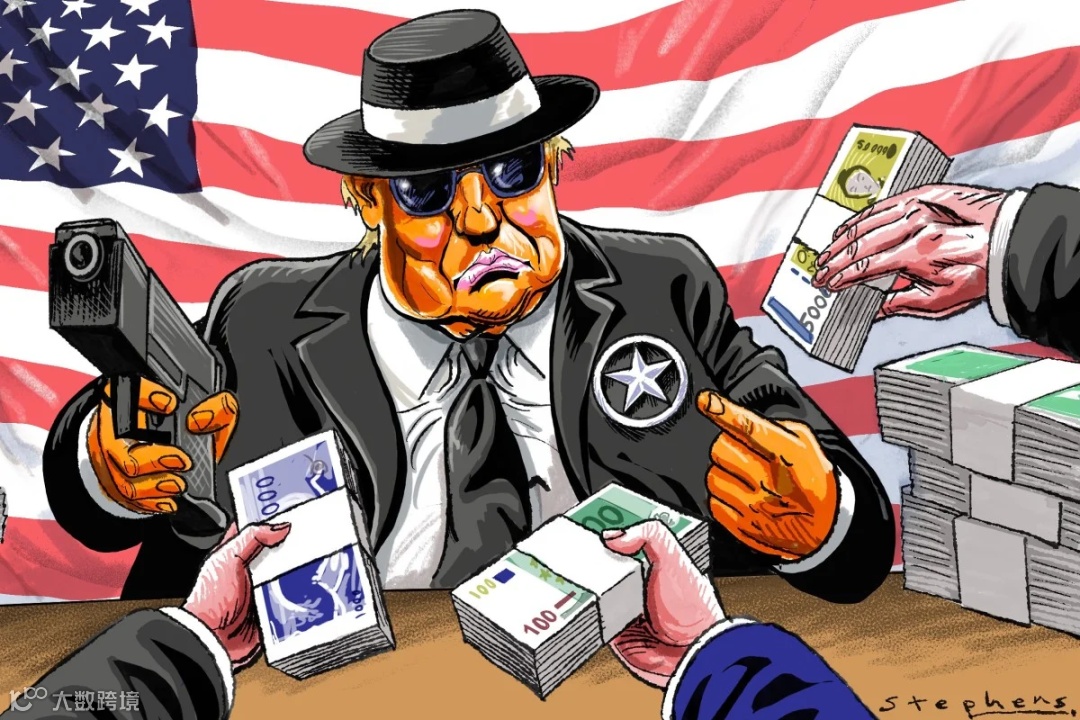
In what Martin Wolf at the Financial Times called “pure gangsterism”, US President Donald Trump has extracted pledged investments of at least US$1.5 trillion from America’s trading partners. This amounts to the Marshall Plan in reverse.
The scheme Washington initiated in 1947 essentially provided economic aid to Europe and later Japan. Of the US$13 billion provided, 90 per cent were grants. But in the US-Japan trade deal, seen as a political trophy for Trump, money will flow in the other direction: Tokyo has pledged an investment of US$550 billion.
Japan is being pressured to divert capital that is needed at home to the United States. So, it seems, is the European Union, which has agreed to invest US$600 billion, and South Korea, which has pledged US$350 billion in investments. Together, these economies are expected to transfer massive amounts of financial resources to the world’s richest country.
While the Marshall Plan was seen as the most notable economic assistance programme in the history of the West, Trump’s capital transfer scheme may well be remembered as the largest flow of free capital to any country the world has ever witnessed. America’s role has thus undergone an about-face: from aid provider to aid recipient.
The Marshall Plan emphasised European ownership of planning – although Washington had approval authority, Europe’s governments set the priorities, and all programmes and projects came from them. But, as is emerging with the US deal with Japan, Trump is demanding that the projects be driven by his administration’s priorities and that he review the investments. Tokyo may refuse at the pain of additional tariffs.
While negotiations are ongoing, they set a disturbing precedent for South Korea, the EU and all other US trading partners that have pledged investments.
In addition, the US is demanding a much larger chunk of the profits from Japan. According to Commerce Secretary Howard Lutnick, the US wants 50 per cent of profits before the investment is recouped and 90 per cent afterwards – the same terms have reportedly been presented to South Korea.
Yet Uncle Sam runs no investment risk. It will neither contribute financially to projects nor be obliged to bear any losses. This looks like plunder, plain and simple.
Compare this to the Marshall Plan, which at least bore a philanthropic spirit of sorts. It was instrumental in getting war-devastated western Europe back on its feet and kick-started a process of rehabilitation and growth, enabling economic success in much of the continent.
While White House spokesman Kush Desai has declared that Japan’s pledged investments “will be key to fuelling America’s next Golden Age”, Trump’s capital transfer scheme aims to boost strategic American manufacturing at the cost of a potentially unbearable economic burden and loss to Japan.
At US$550 billion, the trade deal dwarfs Japan’s current annual direct investment into the US. And, as the US siphons huge sums from Japan, questions are likely to be raised, if the money could be better aligned with Japan’s strategic interests. One thing is for sure though: there will be a further hollowing out of the Japanese economy while its economic dependence on the US is exacerbated.
The same fate awaits South Korea. US trade negotiators are pushing Seoul to accept a “Japan-style” deal. What is more, Trump has demanded the US$350 billion investment pledge be provided “upfront” – which Seoul has rejected outright as simply impossible. At US$350 billion, the sum is bigger than South Korea’s foreign direct investments (FDI) over the past five years – and about US$100 billion more than South Korea’s cumulative FDI in the US.
Putting it all upfront in cash would mean draining 80 per cent of the country’s foreign exchange reserves – South Korean President Lee Jae-myung has warned that this could trigger an economic crisis rivalling the meltdown in the 1997 Asian financial crisis, when South Koreans donated their gold jewellery to help pay off the country’s debt.
Unlike Trump’s capital transfer scheme, the Marshall Plan was ideologically driven, focusing on America’s long-term geopolitical interests. Its strategic intent was to contain Soviet influence by stabilising western Europe and building alliances. The plan was also designed to work with America’s productive capacity – the US was producing more than half the world’s manufactured goods.
To this end, the bulk of the financing was tied to purchases of US goods and services. The plan also stressed policy reforms such as the removal of trade barriers, paving the way for US companies to break into new markets and expand.
In contrast, Trump’s scheme prioritises short-term financial returns in its aim to rebuild the US manufacturing sector. In the hot pursuit of economic benefits, geopolitics has largely been forgotten and allies are increasingly left to languish.
The divergence mirrors the changed times. The US emerged from World War II as the undisputed global power. Its economy churned out half the global output. Uncle Sam was ambitious and aggressive. Fast forward to the 2020s and Washington now finds itself unable to do things abroad that it used to do, and lives in constant fear of being toppled as the global hegemon. Mass infusions of capital are seen as critical to revive the good old days.
In spite of all this, the two schemes do have one thing in common: Washington’s ultimate goal, then as now, is the maintenance of US hegemony. But given how times have changed, how likely is it that America will make itself great again?
CCG Books
Other CCG News:
Global Talent Summit 2025 Holds in Beijing Sub-Center
300 Participants from 60 Countries Attend CCG Annual Forum
CCG hosted the 9th China Global Think Tank Innovation Forum
2024 GYLD Annual Forum successfully held in Beijing
11th China Inbound-Outbound Forum Successfully Held @2024 CIFTIS
60 Countries’ Participants Joined China and Globalization Forum
CCG seminar on global governance & future of China and Africa
Senior Diplomats from 20 countries discuss China's green transition
Text of Pascal Lamy and Chinese trade experts @ CCG VIP Luncheon
Book Launch: Enhancing Global Governance in a Fragmented World
Transcript of CCG session in WTO Public Forum
20 US media leaders attended special dinner held to welcome CCG
Transcript of EU-China think tank exchange
Turkish Foreign Minister Hakan Fidan speaks at CCG
Wang Huiyao in Dialogue with Stephen Roach
CCG Holds 8th China Global Think Tanks Innovation Forum
Joseph Nye | Understanding Global Power Shifts in 21st Century
New Book | The Global Power Shifts in the 21st Century
Josep Borrell’s scheduled speech at CCG on EU-China relations
Justin Vaïsse speaks at CCG on the eve of Macron's visit
Brazilian Ministerial Visiting Event Held at CCG
CCG Global Dialogue:Building a floor for China-US relations
CCG President in Dialogue with CFR President Richard Haass
Video | 7th Annual China Global Think Tank Innovation Forum
CCG 2nd International Visit in Pandemic 2022
Wang Huiyao in Dialogue with Fred Bergsten
9th China Inbound-Outbound Forum
First Chinese Think Tank to Visit Europe since Pandemic
First Chinese Think Tank Visits Washington DC since Pandemic
New York: CCG Delegation's First Stop in the US
CCG Delegation of Experts Visits Singapore
Selected Video of CCG Global Dialogue (Ⅰ)
Selected Video of CCG Global Dialogue (Ⅱ)
CCG Book Launch Welcomes 20 Ambassadors to China
CCG and UN Women hold symposium on International Women's Day
CCG event on MNCs opportunities and challenges in China
Video | The rise of Asia and its implications
Fireside Chat with The Hon. Sec. Henry Paulson and Mr. WANG Shi
Text and Video: Wang Huiyao in Dialogue with Wolfgang Ischinger
Wang Huiyao in dialogue with Lawrence Summers on Global Economy
Wang Huiyao in Dialogue with Yale Professor Stephen Roach
Climate change, inequality, and sustainable development
CCG holds seminar on “Twenty years of China’s WTO membership
CCG holds Sixth Annual China Global Think Tank Innovation Forum
Wang Huiyao in dialogue with CSIS President John Hamre
Wang Huiyao in dialogue with Lord Jim O'Neill & Leslie Maasdorp
CCG Dialogue with David Lampton on China Laos Railway and BRI
Wang Huiyao in dialogue with Kishore Mahbubani
CCG holds Francophonie Ambassadors Symposium
Dialogue between Wang Huiyao and Carter Center on Sino-US Relations
CCG Dialogue with Neil Bush and David Firestein
Dialogue on trade among Wendy Cutler, Pascal Lamy & Wang Huiyao
CCG Dialogue with John Thornton, Stapleton Roy and Adam Posen
Dialogue among Susan Thornton, Ronnie Chan and Wang Huiyao
World Bank and CCG launching the latest World Economic Prospects
Dialogue Between Yale Historian Valerie Hansen & Dr. Wang Huiyao
CCG Dialogue with Nobel Laureate Sir Angus Deaton
Conversation with Martin Wolf, Chief Economics Commentator at FT
CCG Roundtable Commenmorating China's Accession to the WTO
CCG Dialogue with Harvard Professor Anthony Saich
CCG Dialogue with Joseph S. Nye Jr.
A Dialogue Between Graham Allison and Wang Huiyao
A Dialogue Between Thomas L. Friedman and Wang Huiyao
40 Ambassadors and Diplomats Attend CCG Open Day
Dr. Miao Lu posted the first question at the MSC 2021
CCG releases new book on global talent studies