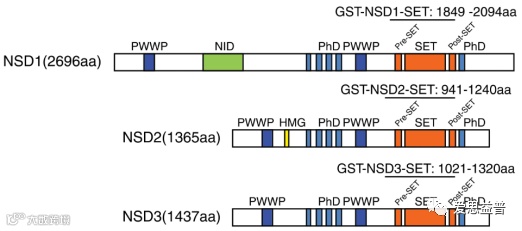
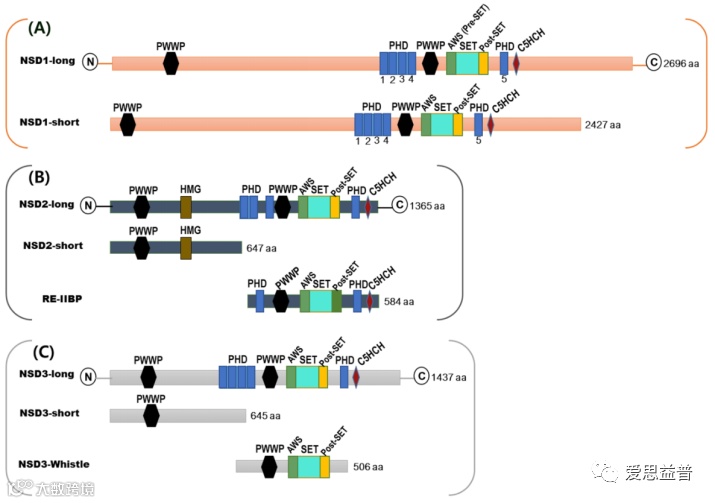
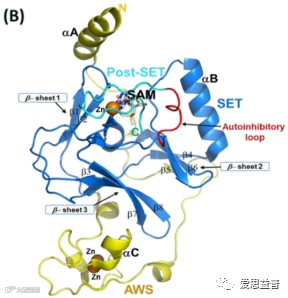
1.1 NSD蛋白家族的结构NSD蛋白家族结构十分相似,都是由几个关键结构域构成(图1.1)。共同的结构域有SET结构域(suvar, enhancer of zeste, trithorax)、2个PWWP结构域(脯氨酸-色氨酸-色氨酸-脯氨酸结构域)和5个PHD结构域(plant homeodomain,植物同源结构域),以及NSD特异性的富含半胱氨酸组氨酸(C5HCH)的基序(图1.2)。不同的结构域为NID结构域(NSD1),一个HMG (high-mobility group) DNA结合域(NSD2)[3-4]。
图1.1 NSD蛋白家族结构结构示意图[4]
NSD1、NSD2和NSD3在氨基酸残基703和1409之间有55%-68%的相同序列。高度保守的催化SET结构域和PHD结构域在转录调控和染色质重组中发挥关键作用。PWWP结构域对NSD与甲基化的组蛋白H3和DNA的结合至关重要[5-6],而PHD结构域在NSD与其他甲基化的组蛋白的相互作用中发挥着关键作用[7-8]。NSD1、NSD2和NSD3蛋白分别有2、3、3个结构亚型(图1.2)。以NSD2为例,NSD2是NSD家族中最短的蛋白,具有复杂的表达模式。NSD2有3种亚型:第1种长型NSD2,由1365个氨基酸组成。第2种短型NSD2,由647个氨基酸组成。第3种RE-IIBP(response element II-binding protein),由584个氨基酸组成。长型NSD2包含两个PWWP结构域、一个HMG DNA结合域、四个PHD结构域、AWS、SET和post-SET结构域。短型NSD2由一个PWWP结构域和一个HMG结构域组成。RE-IIBP由两个PHD结构域、一个PWWP结构域和一个SET结构域组成,不含HMG结构域[4,30]。
参考文献[1] Morishita, M.; di Luccio, E. Cancers and the NSD family of histone lysine methyltransferases. Biochim. Biophys. Acta, Rev. Cancer 2011, 1816, 158−163.[2] Greer, E. L.; Shi, Y. Histone methylation: a dynamic mark in health, disease and inheritance. Nat. Rev. Genet. 2012, 13, 343−357.[3] Bennett, R. L.; Swaroop, A.; Troche, C.; Licht, J. D. The Role of Nuclear receptor-binding SET domain family histone lysine methyltransferases in cancer. Cold Spring Harbor Perspect. Med.2017, 7, No. a026708.[4] Li Yan,Trojer Patrick,Xu Chong-Feng,Cheung Peggie,Kuo Alex, E. The target of the NSD family of histone lysine methyltransferases depends on the nature of the substrate[J]. The Journal of biological chemistry,2009,284(49).[5] Wang Y, Reddy B, Thompson J, et al. Regulation of Set9- mediated H4K20 methylation by a PWWP domain protein[J]. Mol Cell, 2009, 33(4):428-437.[6] Wu H, Zeng H, Lam R, et al. Structural and histone binding ability characterizations of human PWWP domains[J]. PLoS One, 2011, 6(6):18919.[7] Shi X, Kachirskaia I, Walter KL, et al. Proteome- wide analysis in Saccharomyces cerevisiae identifies several PHD fingers as novel direct and selective binding modules of histone H3 methylated at either lysine 4 or lysine 36[J]. J Biol Chem, 2007, 282(4):2450-2455.[8] He C, Li F, Zhang J, et al. The methyltransferase NSD3 has chromatinbinding motifs, PHD5- C5HCH, that are distinct from other NSD (nu‐clear receptor SET domain) family members in their histone H3 recognition[J].J Biol Chem, 2013, 288(7):4692-4703.[9] Saugier-Veber P, Bonnet C, Afenjar A, et al. Heterogeneity of NSD1 alterations in 116 patients with Sotos syndrome [J]. Hum Mutat, 2007,28(11): 1098-1107.[10] Li Y, Trojer P, Xu CF, Cheung P, Kuo A, Drury WJ, et al. The target of the NSD family of histone lysine methyltransferases de-pends on the nature of the substrate[J].Bio Chem 2009; 284(49):34283-95.[11] Thol F, Kolking B, Hollink IH, Damm F, van den Heuvel-Eibrink MM, Michel Zwaan C, et al. Analysis of NUP98/NSD1 translo-cations in adult AML and MDS patients. Leukemia 2013; 27(3):750-4.[12] Berdasco M, Ropero S, Setien F, Fraga MF, Lapunzina P, Losson R, et al. Epigenetic inactivation of the Sotos overgrowth syndrome gene histone methyltransferase NSD1 in human neuroblastoma and glioma. Proc Natl Acad Sci USA 2009; 106(51):21830-5.[13] Keats JJ, Maxwell CA, Taylor BJ, Hendzel MJ, Chesi M, Bergsagel PL, et al. Overexpression of transcripts originating from the MMSET locus characterizes all t(4;14)(p16;q32)-positive multiple myeloma patients. Blood 2005; 105(10): 4060-9.[14] Lauring J, Abukhdeir AM, Konishi H, Garay JP, Gustin JP, WangQ, et al. The multiple myeloma associated MMSET gene contributes to cellular adhesion, clonogenic growth, and tumorigenicity.Blood 2008; 111(2): 856-64.[15] Kuo AJ, Cheung P, Chen K, Zee BM, Kioi M, Lauring J, et al. NSD2 links dimethylation of histone H3 at lysine 36 to oncogenic programming. Mol Cell 2011; 44(4): 609-20.[16] Oyer JA, Huang X, Zheng Y, Shim J, Ezponda T, Carpenter Z,et al. Point mutation E1099K in MMSET/NSD2 enhances its methyltranferase activity and leads to altered global chromatinmethylation in lymphoid malignancies. Leukemia 2014; 28(1):198-201.[17] Jaffe JD, Wang Y, Chan HM, Zhang J, Huether R, Kryukov GV,et al. Global chromatin profiling reveals NSD2 mutations in pediatric acute lymphoblastic leukemia. Nat Genet 2013; 45(11):1386-91.[18] Hudlebusch HR, Santoni-Rugiu E, Simon R, Ralfkiaer E, Rossing HH, Johansen JV, et al. The histone methyltransferase and putative oncoprotein MMSET is overexpressed in a large varietyof human tumors. Clin Cancer Res 2011; 17(9): 2919-33.[19] Kassambara A, Klein B, Moreaux J. MMSET is overexpressed in cancers: Link with tumor aggressiveness. Biochem Biophys Res Commun 2009; 379(4): 840-5.[20] BENNETTR L,SWAROOP A,TROCHE C,et al. The role of nuclear receptor-binding SET domain family histonelysine methyltransferases in cancer[J]. Cold Spring Harbor Perspectives in Medicine,2017,7(6):a026708[21] YUANG,FLORES N M,HAUSMANN S,et al. Elevated NSD3 histone methylation activeitydrives squamous cell lungcancer[J]. Nature,2021,590(7846):504[22]Angrand PO, Apiou F, Stewart AF, Dutrillaux B, Losson R,Chambon P. NSD3, a new SET domain-containing gene, maps to 8p12 and is amplifi ed in human breast cancer cell lines. Genomics 2001; 74(1): 79-88.[23] Zhou Z, Thomsen R, Kahns S, Nielsen AL. The NSD3L histone methyltransferase regulates cell cycle and cell invasion in breast cancer cells. Biochem Biophys Res Commun 2010; 398(3): 565-70.[24] Mann KM, Ward JM, Yew CC, Kovochich A, Dawson DW, Black MA, et al. Sleeping Beauty mutagenesis reveals cooperating mutations and pathways in pancreatic adenocarcinoma. ProcNatl Acad Sci USA 2012; 109(16): 5934-41.[25] Husmann, D. & Gozani, O. Histone lysine methyltransferases in biology and disease.Nat. Struct. Mol. Biol. 26, 880–889 (2019).[26] Worden, E. J. & Wolberger, C. Activation and regulation of H2B-ubiquitin-dependent histone methyltransferases. Curr. Opin. Struct. Biol. 59, 98–106 (2019).[27] Li Wanqiu,Tian Wei,Yuan Gang,Deng Pujuan,Sengupta Deepanwita,Cheng Zhongjun,Cao Yinghua,Ren Jiahao,Qin Yan,Zhou Yuqiao,Jia Yulin,Gozani Or,Patel Dinshaw J,Wang Zhanxin. Molecular basis of nucleosomal H3K36 methylation by NSD methyltransferases[J]. Nature,2020.[28] QIAOQ,LI Y,CHEN Z,et al. The structure of NSD1 revealsan autoregulatorymechanism underlying histone H3K36 methylation[J]. The Journal of Biological Chemistry,2011,286(10): 8361[29] LIY,TROJER P,XU C F,et al. The target of the NSD Family of histone lysine methy-ltransferasesdepends on the nature of the substrate[J]. The Journal of Biological Chemistry,2009,284(49): 34283[30] Shrestha Aarajana,Kim Nayeon,Lee SuJeong,Jeon Yong Hyun,Song JiJoon,An Hongchan,Cho Sung Jin,Kadayat Tara Man,Chin Jungwook. Targeting the Nuclear Receptor-Binding SET Domain Family of Histone Lysine Methyltransferases for Cancer Therapy: Recent Progress and perspectives[J]. Journal of medicinal chemistry,2021.








 爱思益普
爱思益普