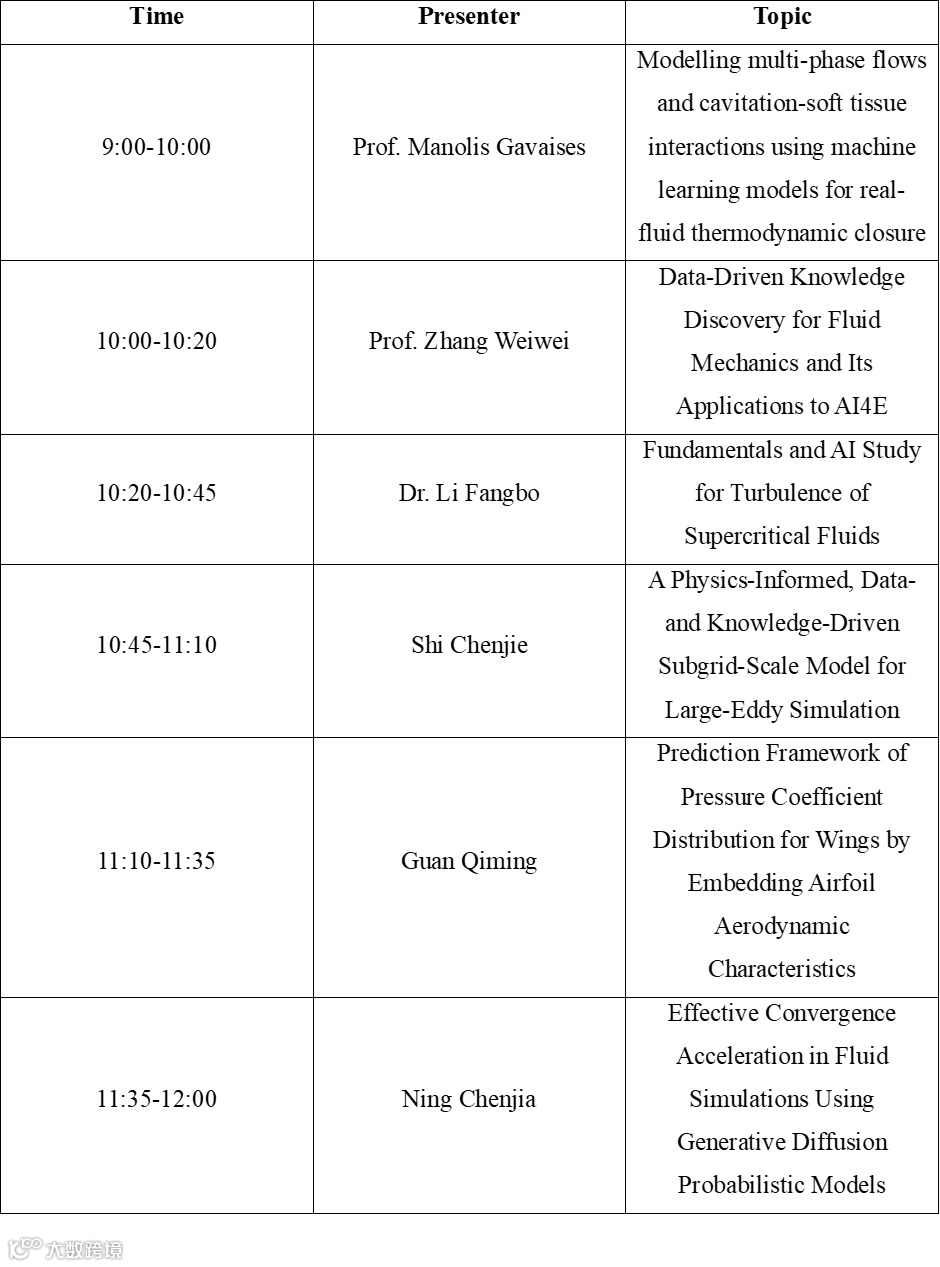
Prof. Manolis GavaisesModelling multi-phase flows and cavitation-soft tissue interactions using machine learning models for real-fluid thermodynamic closureBIO:Prof Gavaises obtained his PhD from Imperial College London in 1997, receiving the Richard Way Memorial Prize for the most outstanding doctoral thesis on internal combustion engines in the UK. His academic career began at City University London in 2001, with early research on electrification and NZE technologies supported by Toyota Motor Europe. He was appointed to the Delphi Technologies (UK) Research Chair in 2009 and holds honorary professorships at Sorbonne University and the University of Magdeburg, while also served as a visiting professor at EPFL (Switzerland) and the Von Karman Institute for Fluid Dynamics (Belgium). His research focuses on developing CFD tools for various multiphase flows, contributing to the design and commercialization by industry leaders of durable high pressure fuel injectors, novel additised fluids with tailored thermal and rheologicalproperties and electrification technologies where multiphase flows play a key role. ABSTRACT:Understanding and modelling of multi-phase flows with phase-change and heat transfer processes are realised in a number of engineering applications, various biomedical applications as well as physical environments. For example, design of modern low-carbon powertrains, particularly for the hard-to-abate transport sectors will require utilisation of ammonia, hydrogen, biofuels, e-methanol, and LNG. Increasingly, these fuels are being deployed in dual-fuel and flexible-fuel engine architectures. In parallel, the role of thermal management fluids is expanding across electrified propulsion and energy systems. Specialised heat-transfer and dielectric fluids are used for automotive battery thermal control, electric motor cooling, and the management of power electronics. In the case of biomedical applications, various ultrasound-based cure methods where cavitation-soft-tissue interactions take place, are actively explored.Modelling of such systems often requires accurate description of the physical and rheological properties of the involved fluids, over a wide range of pressure and temperature conditions and their composition. Appropriate thermodynamic closure involving accurate equations-of-state and soft or viscoelastic material’s constitutive equations in case of non-Newtonian formulations are required. Crucially, modern data-driven formulations combining high-fidelity CFD with machine-learning-based surrogate modelling and large-scale experimental datasets—enable improved prediction of multiphase flow behaviour. The presentation provides examples of relevant computational models, applied to the simulation of high-pressure fuel injectors, various configurations of cavitation bubble dynamics relevant to biomedical applications and physical environments, as well as heat transfer enhancement fluids. These hybrid modelling frameworks reduce computational cost while increasing accuracy, allowing rapid evaluation of design variations and operational conditions.Fundamentals and AI Study for Turbulence of Supercritical FluidsDr. Fangbo LiBio: Dr. Fangbo Li is currently a specially funded postdoctoral fellow at Northwestern Polytechnical University (2023-2025) and received his Ph.D. from Xi’an Jiaotong University (2023). His research focuses on numerical simulations, CFD models and machine learning for turbulent heat transfer and chemical reactions of supercritical fluids. He has published over 15 papers in top-tier fluid mechanics journals such as the Journal of Fluid Mechanics and Physical Review Fluids and has led five research projects, including grants from the National Natural Science Foundation of China and the China Postdoctoral Science Foundation.Abstract: The physical properties of fluids at supercritical pressures differ from those at subcritical conditions. At these conditions, the interface between the liquidlike and vaporlike phases disappears into a continuous transition. The thermophysical properties, including density, specific heat capacity, viscosity, and thermal conductivity, vary significantly across the Widom line, which demarcates the state of maximum constant-pressure specific heat at a given pressure. Variations in density and viscous-diffusive properties result in substantially modified turbulence statistics and structural behavior when compared to wall-bounded flows at atmospheric pressures. The physical understanding of turbulence and heat transfer of wall-bounded flows at these conditions is crucial for developing reliable computational models. In this presentation, we introduce our progress on turbulence fundamentals and AI modeling for supercritical fluids: i)Developed a DNS methodology for supercritical fluid turbulence, achieving high-precision predictions of statistical properties in single-component wall-bounded turbulence, binary mixing layers and reacting flows; ii) Elucidated the impact of the significant variable-property effects (density/viscosity fluctuations) on turbulent transport and coherent structures, revealed both universality and deviations in small-scale turbulence scaling compared to incompressible flows; iii) Developed RANS modeling for supercritical fluid turbulence with incorporating key physics of variable-density compressibility effects into TKE transport, significantly improved prediction accuracy for supercritical wall-bounded turbulent heat transfer. iv) Proposed a physics-informed AI framework for velocity scaling laws with strong interpretability and generalizability, achieving knowledge discovery on attached eddy structures in supercritical turbulence based on machine learning.A Physics-Informed, Data- and Knowledge-Driven Subgrid-Scale Model for Large-Eddy SimulationChenjie ShiBio: Shi Chenjie is a Master of Mechanics candidate at the School of Aeronautics, Northwestern Polytechnical University (NPU). His primary research focuses on Large-Eddy Simulation (LES) with an emphasis on coarse-grid Large-Eddy Simulation, data-driven modeling of subgrid-scale (SGS) eddy-viscosity models, and wall-modeled large-eddy simulation (WMLES).Abstract: Turbulence is a ubiquitous phenomenon in nature and engineering applications, representing one of the most complex challenges in fluid dynamics research. In recent years, data-driven approaches have made significant progress in turbulence modeling. Large Eddy Simulation (LES) is a high-fidelity method for turbulent flow simulation. It directly resolves eddies larger than the grid scale, while modeling the effects of subgrid-scale eddies through a subgrid-scale (SGS) model, which plays a critical role in the solution process. Traditional SGS models, often based on empirical assumptions, struggle to simultaneously ensure physical consistency and computational accuracy, exhibiting significant grid dependence under complex flow conditions.Symbolic Regression (SR), as a white-box machine learning technique, discovers mathematical relationships from data to generate interpretable expressions with clear physical meanings, offering a novel approach for turbulence modeling. This paper proposes a data- and knowledge-driven white-box subgrid-scale model for LES. The near-wall equivalent eddy viscosity is derived from DNS data of channel flow to reduce modeling complexity. Building on this, the model form is constrained and refined by incorporating near-wall SGS eddy viscosity theory and the eddy viscosity hypothesis. An accurate white-box SGS model is established through dynamic iterative coupling with the LES equations.Validation results for flow past a circular cylinder at the critical regime demonstrate the model's satisfactory generalizability and stability, with particularly outstanding performance in grid convergence. This modeling approach is applicable to different models and solvers, yielding accurate results even on relatively coarse grids, showing broad prospects for engineering applications.PredictionFramework of Pressure Coefficient Distribution for Wings by Embedding Airfoil Aerodynamic CharacteristicsQiming GuanBio: Guan Qiming, achieved Bachelor’s degree in Aircraft Design and Engineering at the School of Aeronautics, Northwestern Polytechnical University in 2020. Currently he is a second-year master's student in Fluid Mechanics at the School of Aeronautics, Northwestern Polytechnical University, with a primary research focus on deep learning-based flow field modeling. He has published one SCI journal manuscript and received the Northwestern Polytechnical University First-Class Academic Scholarship for the 2024–2025 academic year.Abstract:Conventional black-box models face high-dimensional challenges in predicting pressure coefficient distribution over wings, as they suffer from poor generalization and require prohibitively large amounts of three-dimensionaltraining data, ultimately hindering their engineering applications. As fundamental cross-section of a wing, airfoils significantly influences the overall aerodynamic characteristics, and theoretical formulations of wings are also derived from airfoil-level analyses. Building upon this idea, this work proposes a novel Transformer-based model for predicting pressure coefficient distributions over wings that embeds sectional airfoil aerodynamic characteristics. This approach enhances both prediction accuracy and data efficiency by fusing 2D airfoil aerodynamic characteristics with 3D wing geometry via a cross-attention mechanism. Validated across wing configurations with large geometric variations, the proposed model can reduce prediction errors by 40% using only half of the training data required by black-box models, thus substantially mitigating dependency on large-scale training datasets.Effective Convergence Acceleration in Fluid Simulations Using Diffusion Probabilistic ModelsChenjia NingBio: Chenjia Ning is a Ph.D. candidate at the School of Aeronautics, Northwestern Polytechnical University. Her research mainly focuses on efficient flow-field solving and reconstruction integrating generative AI, PDE-constrained spatio-temporal flow dynamics modelling, and multi-source aerodynamic modelling under few-shot learning. She has published over four SCI papers in journals such as the Aerospace Science and Technology, AIAA Journal, Structural and Multidisciplinary Optimization, among others.Abstract: Convergence acceleration has long been a central challenge in computational fluid dynamics (CFD), remaining essential for improving simulation efficiency and supporting industrial applications. Recent advances in deep learning have introduced highly expressive nonlinear models that offer new opportunities for enhancing traditional CFD solvers. This study presents a novel non-intrusive method for accelerating steady-flow convergence using a generative diffusion probabilistic model, achieving further acceleration in an open-source CFD solver. By integrating the diffusion model into the numerical solution process, the proposed hybrid framework substantially reduces the number of CFD iterations while maintaining stability and preserving the accuracy of the converged solution. Validation is performed on transonic shock flows with variable shapes through perturbation of the RAE2822 airfoil. Results show a speedup of up to 2.4× on the CFD solver with LU-SGS and demonstrate improved convergence robustness, enabling accurate solutions even for cases that previously failed to converge. These findings highlight the potential of generative diffusion models to advance AI-empowered enhancements in CFD.



 力学与人工智能