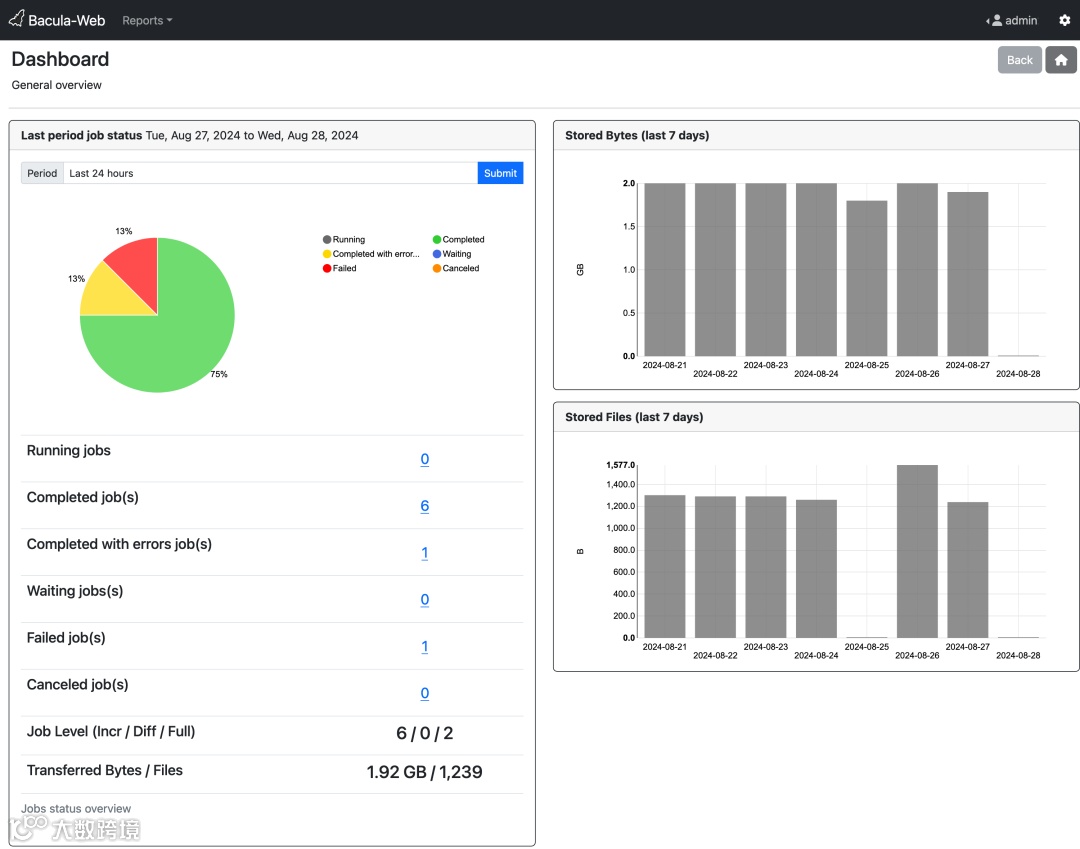
介绍开源备份软件Bacula

Bacula是由Kern Sibbald开发的一个企业级备份解决方案,支持多种操作系统和数据库。它基于客户端/服务器架构,通过独立的守护进程(daemon)实现备份、恢复和存储管理操作。Bacula的主要组件包括Director(控制备份和恢复流程)、Storage(管理存储设备)和Client(用于备份的服务器或工作站)
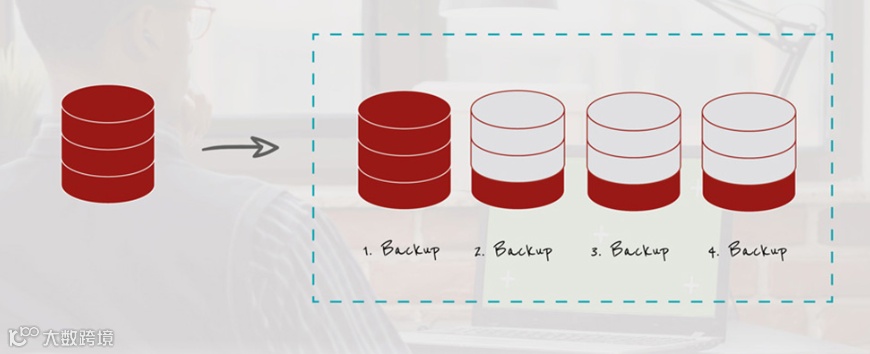
Bacula核心组件解析
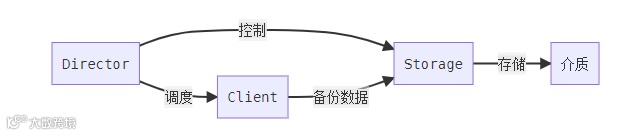
在Bacula备份系统的角色与功能中,三个核心组件之间相互协作共同完成备份任务。
• Director:
作为备份系统的中枢,Director负责调度备份作业,管理备份策略和计划。它通过读取配置文件来执行各种备份、恢复和验证任务,并且负责与Storage和Client通信。
• Storage:
此组件用于管理存储介质,例如磁带或硬盘上的备份数据。它根据Director的指令将备份数据写入或从存储介质中读取数据。
• Client:
在Bacula中指的是需要进行备份的机器或服务。每个Client运行一个名为bacula-fd(File Daemon)的守护进程,它处理与Director的通信,实际执行备份和恢复操作。
理解这三个组件的功能和交互是设置Bacula备份系统的基础。
配置文件的结构和作用 Bacula的配置文件是由Director管理和解释的。每台Director管理的备份任务都需要在配置文件中定义。
• bacula-dir.conf:定义Director的配置,包括备份策略、任务、存储池、客户端和消息资源等。
• bacula-fd.conf:配置Client端的File Daemon,定义它可以备份的文件系统和权限。
• bacula-sd.conf:配置Storage Daemon,描述备份存储的位置和方式。
• bacula-tray.conf:可选配置,用于在客户端显示一个托盘图标,以便监控备份状态。
Bacula系统架构的简图,展示了不同组件之间的交互关系
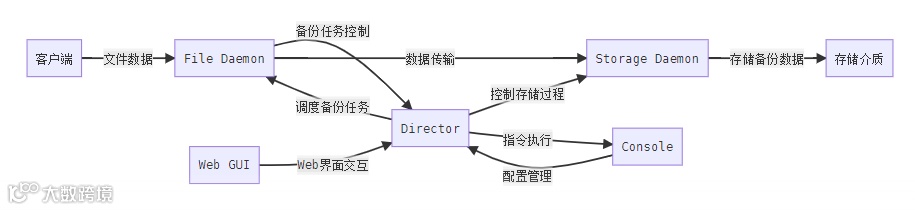
备份和恢复流程
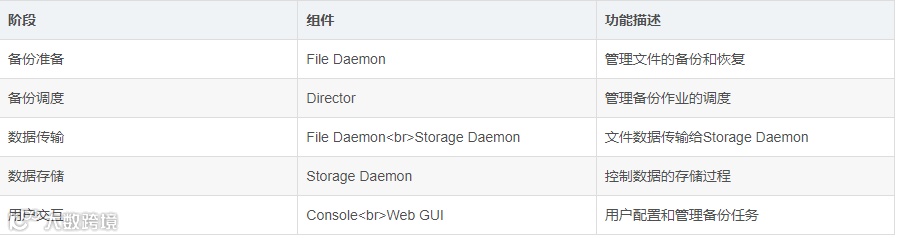
附-Bacula官网doc文档
What is Bacula?
Bacula is a set of computer programs that permits the system administrator to manage backup, recovery,and verification of computer data across a network of computers of different kinds. Bacula can also run entirely upon a single computer and can backup to various types of media, including tape and disk.
In technical terms, it is a network Client/Server based backup program. Bacula is relatively easy to use and efficient, while offering many advanced storage management features that make it easy to find and recover lost or damaged files. Due to its modular design, Bacula is scalable from small single computer systems to systems consisting of hundreds of computers located over a large network.
Bacula Components or Services
Bacula is made up of the following five major components or services: Director, Console, File, Storage, and Monitor services.
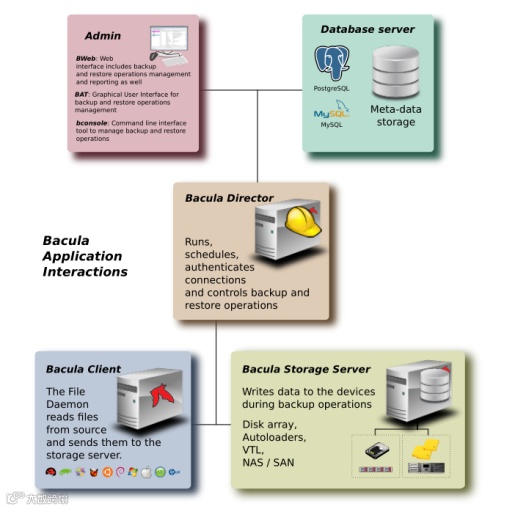
(thanks to Aristedes Maniatis for this graphic and the one below)
Bacula Director
The Bacula Director service is the program that supervises all the backup, restore, verify and archive operations. The system administrator uses the Bacula Director to schedule backups and to recover files.
For more details see the Director Services Daemon Design Document in the Bacula Developer’s Guide. The Director runs as a daemon (or service) in the background.
Bacula Console
The Bacula Console service is the program that allows the administrator or user to communicate with the Bacula Director Currently, the Bacula Console is available in three versions: text-based console interface, QT-based interface, and a wxWidgets graphical interface. The first and simplest is to run the Console program in a shell window (i.e. TTY interface). Most system administrators will find this completely adequate. The second version is a GNOME GUI interface that is far from complete, but quite functional as it has most the capabilities of the shell Console. The third version is a wxWidgets GUI with an interactive file restore. It also has most of the capabilities of the shell console, allows command completion with tabulation, and gives you instant help about the command you are typing. For more details see the Bacula Console Design Document (Chapter 1 on the preceding page) .
Bacula File
The Bacula File service (also known as the Client program) is the software program that is installed on the machine to be backed up. It is specific to the operating system on which it runs and is responsible for Bacula Version 9.2.2 3 providing the file attributes and data when requested by the Director. The File services are also responsible for the file system dependent part of restoring the file attributes and data during a recovery operation. For more details see the File Services Daemon Design Document in the Bacula Developer’s Guide. This program runs as a daemon on the machine to be backed up. In addition to Unix/Linux File daemons, there is a Windows File daemon (normally distributed in binary format). The Windows File daemon runs on current Windows versions (NT, 2000, XP, 2003, and possibly Me and 98).
Bacula Storage
The Bacula Storage services consist of the software programs that perform the storage and recovery of the file attributes and data to the physical backup media or volumes. In other words, the Storage daemon is responsible for reading and writing your tapes (or other storage media, e.g. files). For more details see the Storage Services Daemon Design Document in the Bacula Developer’s Guide. The Storage services runs as a daemon on the machine that has the backup device (usually a tape drive).
Catalog
The Catalog services are comprised of the software programs responsible for maintaining the file indexes and volume databases for all files backed up. The Catalog services permit the system administrator or user to quickly locate and restore any desired file. The Catalog services sets Bacula apart from simple backup programs like tar and bru, because the catalog maintains a record of all Volumes used, all Jobs run, and all Files saved, permitting efficient restoration and Volume management. Bacula currently supports three different databases, MySQL, and PostgreSQL one of which must be chosen when building Bacula.
The two SQL databases currently supported (MySQL, and PostgreSQL) provide quite a number of features,
including rapid indexing, arbitrary queries, and security. Although the Bacula project plans to support other major SQL databases, the current Bacula implementation interfaces only to MySQL, and PostgreSQL. For the technical and porting details see the Catalog Services Design Document in the developer’s documented.
The packages for MySQL and PostgreSQL are available for several operating systems. Alternatively, in-stalling from the source is quite easy, see the Installing and Configuring MySQL chapter of this document for the details. For more information on MySQL, please see: www.mysql.com . Or see the Installing and Configuring PostgreSQL chapter of this document for the details. For more information on PostgreSQL,
please see: www.postgresql.org .
Bacula Monitor
A Bacula Monitor service is the program that allows the administrator or user to watch current status of Bacula Directors, Bacula File Daemons and Bacula Storage Daemons. Currently, only a GTK+ version is available, which works with GNOME, KDE, or any window manager that supports the FreeDesktop.org system tray standard.
To perform a successful save or restore, the following four daemons must be configured and running: the Director daemon, the File daemon, the Storage daemon, and the Catalog service (MySQL, or PostgreSQL).
Bacula Configuration
In order for Bacula to understand your system, what clients you want backed up and how, you must create a number of configuration files containing resources (or objects). The following presents an overall picture of this:
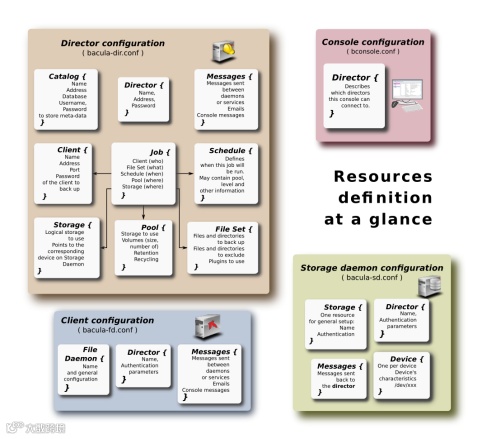
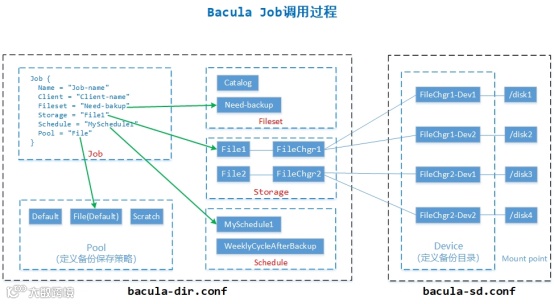
Bacula Job调用过程
官网(Interactions Between the Bacula Services)
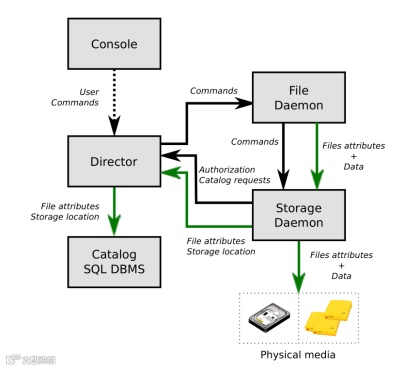
理解job调用的关系图
What is Bacula-Web ?
Bacula-Web is an open-source, web-based tool designed to provide a user-friendly graphical interface for managing and monitoring Bacula backups.
Bacula is a powerful, open-source backup solution for networks that allows the backup, recovery, and verification of data across a range of computers and devices.
While Bacula itself is command-line driven, Bacula-Web offers a more accessible way to visualize Bacula activities and system health.