



极市导读
GPT早已成为大模型时代的基础。国外一位开发者发布了一篇实践指南,仅用60行代码构建GPT。 >>加入极市CV技术交流群,走在计算机视觉的最前沿
60行代码,从头开始构建GPT?
最近,一位开发者做了一个实践指南,用Numpy代码从头开始实现GPT。
你还可以将 OpenAI发布的GPT-2模型权重加载到构建的GPT中,并生成一些文本。
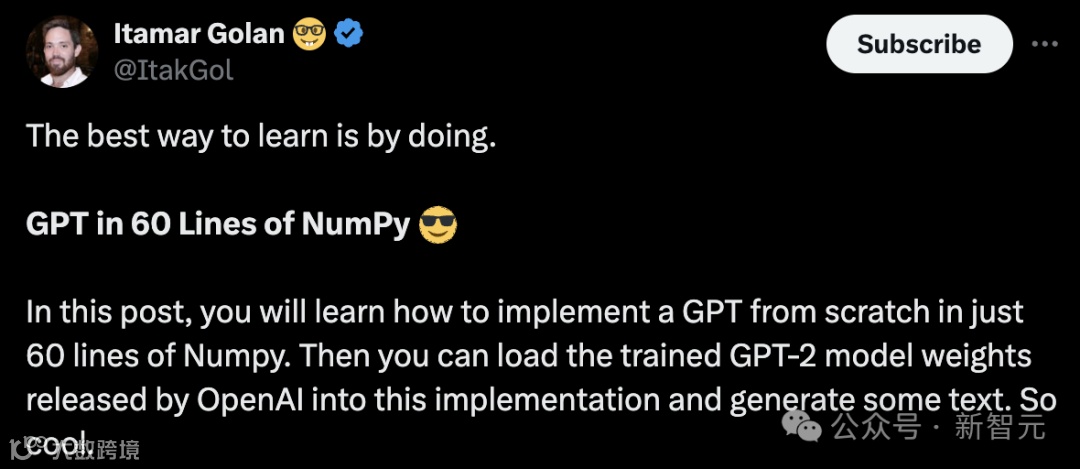
话不多说,直接开始构建GPT。

什么是GPT?
GPT代表生成式预训练Transformer,是一种基于Transformer的神经网络结构。
- Transformer:GPT是一种仅用于解码器的Transformer神经网络。
大模型,如OpenAI的GPT-3、谷歌的LaMDA,以及Cohere的Command XLarge,背后都是GPT。它们的特别之处在于, 1) 非常大(拥有数十亿个参数),2) 受过大量数据(数百GB的文本)的训练。
直白讲,GPT会在提示符下生成文本。
即便使用非常简单的API(输入=文本,输出=文本),一个训练有素的GPT也可以做一些非常棒的事情,比如写邮件,总结一本书,为Instagram发帖提供想法,给5岁的孩子解释黑洞,用SQL编写代码,甚至写遗嘱。
以上就是 GPT 及其功能的高级概述。让我们深入了解更多细节。
输入/输出
GPT定义输入和输出的格式大致如下所示:
def gpt(inputs: list[int]) -> list[list[float]]:# inputs has shape [n_seq]# output has shape [n_seq, n_vocab]output = # beep boop neural network magicreturn output
# integers represent tokens in our text, for example:# text = "not all heroes wear capes":# tokens = "not" "all" "heroes" "wear" "capes"inputs = [1, 0, 2, 4, 6]
Token是文本的子片段,使用分词器生成。我们可以使用词汇表将token映射到整数:
# the index of a token in the vocab represents the integer id for that token# i.e. the integer id for "heroes" would be 2, since vocab[2] = "heroes"vocab = ["all", "not", "heroes", "the", "wear", ".", "capes"]# a pretend tokenizer that tokenizes on whitespacetokenizer = WhitespaceTokenizer(vocab)# the encode() method converts a str -> list[int]ids = tokenizer.encode("not all heroes wear") # ids = [1, 0, 2, 4]# we can see what the actual tokens are via our vocab mappingtokens = [tokenizer.vocab[i] for i in ids] # tokens = ["not", "all", "heroes", "wear"]# the decode() method converts back a list[int] -> strtext = tokenizer.decode(ids) # text = "not all heroes wear"
- 使用词汇表将这些token映射为整数。
在实践中,我们会使用更先进的分词方法,而不是简单地用空白来分割,比如字节对编码(BPE)或WordPiece,但原理是一样的:
decode 方法,可以转换 list[int] -> str ([2])
输出
输出是一个二维数组,其中 output[i][j] 是模型预测的概率,即 vocab[j] 处的token是下一个tokeninputs[i+1] 。例如:
vocab = ["all", "not", "heroes", "the", "wear", ".", "capes"]inputs = [1, 0, 2, 4]output = gpt(inputs)
vocab = ["all", "not", "heroes", "the", "wear", ".", "capes"]inputs = [1, 0, 2, 4] # "not" "all" "heroes" "wear"output = gpt(inputs)next_token_id = np.argmax(output[-1]) # next_token_id = 6next_token = vocab[next_token_id] # next_token = "capes"
预测序列中的下一个逻辑词的任务称为语言建模。因此,我们可以将GPT称为语言模型。
生成一个单词很酷,但整个句子、段落等又如何呢?
生成文本
自回归
我们可以通过迭代从模型中获得下一个token预测来生成完整的句子。在每次迭代中,我们将预测的token追加回输入:
def generate(inputs, n_tokens_to_generate):for _ in range(n_tokens_to_generate): # auto-regressive decode loopoutput = gpt(inputs) # model forward passnext_id = np.argmax(output[-1]) # greedy samplinginputs.append(int(next_id)) # append prediction to inputreturn inputs[len(inputs) - n_tokens_to_generate :] # only return generated idsinput_ids = [1, 0] # "not" "all"output_ids = generate(input_ids, 3) # output_ids = [2, 4, 6]output_tokens = [vocab[i] for i in output_ids] # "heroes" "wear" "capes"
采样
我们可以从概率分布中采样,而不是贪婪采样,从而为生成的引入一些随机性:
inputs = [1, 0, 2, 4] # "not" "all" "heroes" "wear"output = gpt(inputs)np.random.choice(np.arange(vocab_size), p=output[-1]) # capesnp.random.choice(np.arange(vocab_size), p=output[-1]) # hatsnp.random.choice(np.arange(vocab_size), p=output[-1]) # capesnp.random.choice(np.arange(vocab_size), p=output[-1]) # capesnp.random.choice(np.arange(vocab_size), p=output[-1]) # pants
这样,我们就能在输入相同内容的情况下生成不同的句子。
如果与top-k、top-p和温度等在采样前修改分布的技术相结合,我们的输出质量就会大大提高。
这些技术还引入了一些超参数,我们可以利用它们来获得不同的生成行为(例如,提高温度会让我们的模型承担更多风险,从而更具「创造性」)。
训练
我们可以像训练其他神经网络一样,使用梯度下降法训练GPT,并计算损失函数。对于GPT,我们采用语言建模任务的交叉熵损失:
def lm_loss(inputs: list[int], params) -> float:# the labels y are just the input shifted 1 to the left## inputs = [not, all, heros, wear, capes]# x = [not, all, heroes, wear]# y = [all, heroes, wear, capes]## of course, we don't have a label for inputs[-1], so we exclude it from x## as such, for N inputs, we have N - 1 langauge modeling example pairsx, y = inputs[:-1], inputs[1:]# forward pass# all the predicted next token probability distributions at each positionoutput = gpt(x, params)# cross entropy loss# we take the average over all N-1 examplesloss = np.mean(-np.log(output[y]))return lossdef train(texts: list[list[str]], params) -> float:for text in texts:inputs = tokenizer.encode(text)loss = lm_loss(inputs, params)gradients = compute_gradients_via_backpropagation(loss, params)params = gradient_descent_update_step(gradients, params)return params
请注意,我们在gpt函数签名中添加了params (为了简单起见,我们在前面的章节中没有添加)。在训练循环的每一次迭代期间:
- 我们使用梯度来更新我们的模型参数,以使损失最小化(梯度下降)
请注意,我们不使用显式标记的数据。相反,我们能够仅从原始文本本身生成输入/标签对。这被称为自监督学习。
自监督使我们能够大规模扩展训练数据,只需获得尽可能多的原始文本并将其投放到模型中。例如,GPT-3接受了来自互联网和书籍的3000亿个文本token的训练:
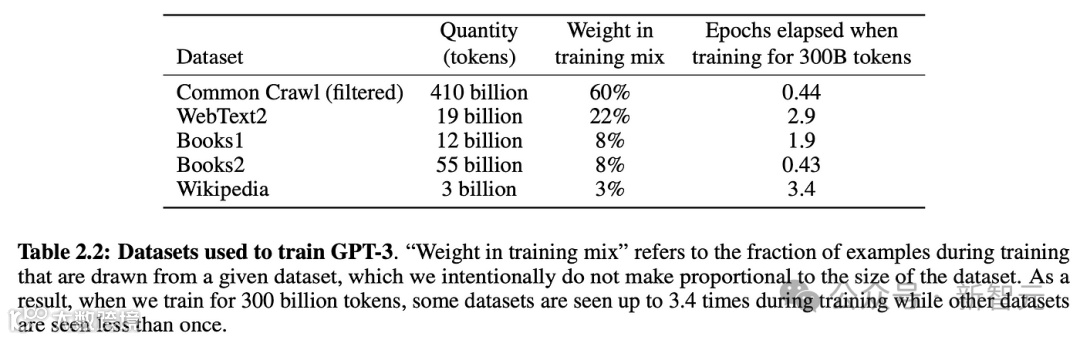
当然,你需要一个足够大的模型才能从所有这些数据中学习,这就是为什么GPT-3有1750亿个参数,训练的计算成本可能在100万至1000万美元之间。
这个自监督的训练步骤被称为预训练,因为我们可以重复使用「预训练」的模型权重来进一步训练模型的下游任务。预训练的模型有时也称为「基础模型」。
在下游任务上训练模型称为微调,因为模型权重已经经过了理解语言的预训练,只是针对手头的特定任务进行了微调。
「一般任务的前期训练+特定任务的微调」策略被称为迁移学习。
提示
原则上,最初的GPT论文只是关于预训练Transformer模型用于迁移学习的好处。
论文表明,当对标记数据集进行微调时,预训练的117M GPT在各种自然语言处理任务中获得了最先进的性能。
直到GPT-2和GPT-3论文发表后,我们才意识到,基于足够的数据和参数预训练的GPT模型,本身能够执行任何任务,不需要微调。
只需提示模型,执行自回归语言建模,然后模型就会神奇地给出适当的响应。这就是所谓的「上下文学习」(in-context learning),因为模型只是利用提示的上下文来完成任务。
语境中学习可以是0次、一次或多次。
在给定提示的情况下生成文本也称为条件生成,因为我们的模型是根据某些输入生成一些输出的。
GPT并不局限于NLP任务。
你可以根据你想要的任何条件来微调这个模型。比如,你可以将GPT转换为聊天机器人(如ChatGPT),方法是以对话历史为条件。
说到这里,让我们最后来看看实际的实现。
设置
克隆本教程的存储库:
git clone https://github.com/jaymody/picoGPTcd picoGPT
pip install -r requirements.txt注意:这段代码是用Python 3.9.10测试的。
每个文件的简单分类:
- encoder.py包含OpenAI的BPE分词器的代码,这些代码直接取自gpt-2 repo。
- utils.py包含下载和加载GPT-2模型权重、分词器和超参数的代码。- gpt2.py包含实际的GPT模型和生成代码,我们可以将其作为python脚本运行。- gpt2_pico.py与gpt2.py相同,但代码行数更少。
我们将从头开始重新实现gpt2.py ,所以让我们删除它并将其重新创建为一个空文件:
rm gpt2.pytouch gpt2.py
import numpy as npdef gpt2(inputs, wte, wpe, blocks, ln_f, n_head):pass # TODO: implement thisdef generate(inputs, params, n_head, n_tokens_to_generate):from tqdm import tqdmfor _ in tqdm(range(n_tokens_to_generate), "generating"): # auto-regressive decode looplogits = gpt2(inputs, **params, n_head=n_head) # model forward passnext_id = np.argmax(logits[-1]) # greedy samplinginputs.append(int(next_id)) # append prediction to inputreturn inputs[len(inputs) - n_tokens_to_generate :] # only return generated idsdef main(prompt: str, n_tokens_to_generate: int = 40, model_size: str = "124M", models_dir: str = "models"):from utils import load_encoder_hparams_and_params# load encoder, hparams, and params from the released open-ai gpt-2 filesencoder, hparams, params = load_encoder_hparams_and_params(model_size, models_dir)# encode the input string using the BPE tokenizerinput_ids = encoder.encode(prompt)# make sure we are not surpassing the max sequence length of our modelassert len(input_ids) + n_tokens_to_generate < hparams["n_ctx"]# generate output idsoutput_ids = generate(input_ids, params, hparams["n_head"], n_tokens_to_generate)# decode the ids back into a stringoutput_text = encoder.decode(output_ids)return output_textif __name__ == "__main__":import firefire.Fire(main)
- gpt2函数是我们将要实现的实际GPT代码。你会注意到,除了inputs之外,函数签名还包括一些额外的内容:
n_head是前向传递过程中需要的超参数。
加载分词器(encoder)、模型权重(params)和超参数(hparams)
使用分词器将输入提示编码为token ID
调用生成函数
from utils import load_encoder_hparams_and_paramsencoder, hparams, params = load_encoder_hparams_and_params("124M", "models")
这将把必要的模型和分词器文件下载到models/124M ,并将encoder、 hparams和params加载到我们的代码中。
ids = encoder.encode("Not all heroes wear capes.")ids[3673, 477, 10281, 5806, 1451, 274, 13]encoder.decode(ids)"Not all heroes wear capes."
使用分词器的词汇表(存储在encoder.decoder中),我们可以看到实际的token是什么样子的:
[encoder.decoder[i] for i in ids]['Not', 'Ġall', 'Ġheroes', 'Ġwear', 'Ġcap', 'es', '.']
请注意,我们的token有时是单词(例如Not),有时是单词但前面有空格(例如Ġall,Ġ表示空格),有时是单词的一部分(例如Capes分为Ġcap和es),有时是标点符号(例如.)。
[encoder.decoder[i] for i in encoder.encode("zjqfl")]['z', 'j', 'q', 'fl']
我们还可以检查词汇表的大小:
len(encoder.decoder)50257
词汇表以及确定如何拆分字符串的字节对合并是通过训练分词器获得的。
> hparams{"n_vocab": 50257, # number of tokens in our vocabulary"n_ctx": 1024, # maximum possible sequence length of the input"n_embd": 768, # embedding dimension (determines the "width" of the network)"n_head": 12, # number of attention heads (n_embd must be divisible by n_head)"n_layer": 12 # number of layers (determines the "depth" of the network)}
我们将在代码的注释中使用这些符号来显示事物的基本形状。我们还将使用n_seq表示输入序列的长度(即n_seq = len(inputs))。
import numpy as npdef shape_tree(d):if isinstance(d, np.ndarray):return list(d.shape)elif isinstance(d, list):return [shape_tree(v) for v in d]elif isinstance(d, dict):return {k: shape_tree(v) for k, v in d.items()}else:ValueError("uh oh")>>>print(shape_tree(params)){"wpe": [1024, 768],"wte": [50257, 768],"ln_f": {"b": [768], "g": [768]},"blocks": [{"attn": {"c_attn": {"b": [2304], "w": [768, 2304]},"c_proj": {"b": [768], "w": [768, 768]},},"ln_1": {"b": [768], "g": [768]},"ln_2": {"b": [768], "g": [768]},"mlp": {"c_fc": {"b": [3072], "w": [768, 3072]},"c_proj": {"b": [768], "w": [3072, 768]},},},... # repeat for n_layers]}
这些是从原始OpenAI TensorFlow检查点加载的:
import tensorflow as tftf_ckpt_path = tf.train.latest_checkpoint("models/124M")for name, _ in tf.train.list_variables(tf_ckpt_path):arr = tf.train.load_variable(tf_ckpt_path, name).squeeze()print(f"{name}: {arr.shape}")model/h0/attn/c_attn/b: (2304,)model/h0/attn/c_attn/w: (768, 2304)model/h0/attn/c_proj/b: (768,)model/h0/attn/c_proj/w: (768, 768)model/h0/ln_1/b: (768,)model/h0/ln_1/g: (768,)model/h0/ln_2/b: (768,)model/h0/ln_2/g: (768,)model/h0/mlp/c_fc/b: (3072,)model/h0/mlp/c_fc/w: (768, 3072)model/h0/mlp/c_proj/b: (768,)model/h0/mlp/c_proj/w: (3072, 768)model/h1/attn/c_attn/b: (2304,)model/h1/attn/c_attn/w: (768, 2304)...model/h9/mlp/c_proj/b: (768,)model/h9/mlp/c_proj/w: (3072, 768)model/ln_f/b: (768,)model/ln_f/g: (768,)model/wpe: (1024, 768)model/wte: (50257, 768)
下面的代码将上述TensorFlow变量转换为我们的params词典。
>>> import tensorflow as tf>>> tf_ckpt_path = tf.train.latest_checkpoint("models/124M")>>> for name, _ in tf.train.list_variables(tf_ckpt_path):>>> arr = tf.train.load_variable(tf_ckpt_path, name).squeeze()>>> print(f"{name}: {arr.shape}")model/h0/attn/c_attn/b: (2304,)model/h0/attn/c_attn/w: (768, 2304)model/h0/attn/c_proj/b: (768,)model/h0/attn/c_proj/w: (768, 768)model/h0/ln_1/b: (768,)model/h0/ln_1/g: (768,)model/h0/ln_2/b: (768,)model/h0/ln_2/g: (768,)model/h0/mlp/c_fc/b: (3072,)model/h0/mlp/c_fc/w: (768, 3072)model/h0/mlp/c_proj/b: (768,)model/h0/mlp/c_proj/w: (3072, 768)model/h1/attn/c_attn/b: (2304,)model/h1/attn/c_attn/w: (768, 2304)...model/h9/mlp/c_proj/b: (768,)model/h9/mlp/c_proj/w: (3072, 768)model/ln_f/b: (768,)model/ln_f/g: (768,)model/wpe: (1024, 768)model/wte: (50257, 768)
基本层

def gelu(x):return 0.5 * x * (1 + np.tanh(np.sqrt(2 / np.pi) * (x + 0.044715 * x**3)))
gelu(np.array([[1, 2], [-2, 0.5]]))array([[ 0.84119, 1.9546 ],[-0.0454 , 0.34571]])
Softmax

def softmax(x):exp_x = np.exp(x - np.max(x, axis=-1, keepdims=True))return exp_x / np.sum(exp_x, axis=-1, keepdims=True)
我们使用max(x)技巧来保证数值稳定性。
x = softmax(np.array([[2, 100], [-5, 0]]))xarray([[0.00034, 0.99966],[0.26894, 0.73106]])x.sum(axis=-1)array([1., 1.])
层归一化

def layer_norm(x, g, b, eps: float = 1e-5):mean = np.mean(x, axis=-1, keepdims=True)variance = np.var(x, axis=-1, keepdims=True)x = (x - mean) / np.sqrt(variance + eps) # normalize x to have mean=0 and var=1 over last axisreturn g * x + b # scale and offset with gamma/beta params
层归一化确保每一层的输入始终在一致的范围内,这会加快和稳定训练过程。
>>> x = np.array([[2, 2, 3], [-5, 0, 1]])>>> x = layer_norm(x, g=np.ones(x.shape[-1]), b=np.zeros(x.shape[-1]))>>> xarray([[-0.70709, -0.70709, 1.41418],[-1.397 , 0.508 , 0.889 ]])>>> x.var(axis=-1)array([0.99996, 1. ]) # floating point shenanigans>>> x.mean(axis=-1)array([-0., -0.])Linear
你的标准矩阵乘法+偏差:
def linear(x, w, b): # [m, in], [in, out], [out] -> [m, out]return x @ w + b
线性层通常称为映射(因为它们从一个向量空间映射到另一个向量空间)。
>>> x = np.random.normal(size=(64, 784)) # input dim = 784, batch/sequence dim = 64>>> w = np.random.normal(size=(784, 10)) # output dim = 10>>> b = np.random.normal(size=(10,))>>> x.shape # shape before linear projection(64, 784)>>> linear(x, w, b).shape # shape after linear projection(64, 10)
GPT架构

文本+位置嵌入
一种transformer解码器堆栈
def gpt2(inputs, wte, wpe, blocks, ln_f, n_head): # [n_seq] -> [n_seq, n_vocab]# token + positional embeddingsx = wte[inputs] + wpe[range(len(inputs))] # [n_seq] -> [n_seq, n_embd]# forward pass through n_layer transformer blocksfor block in blocks:x = transformer_block(x, **block, n_head=n_head) # [n_seq, n_embd] -> [n_seq, n_embd]# projection to vocabx = layer_norm(x, **ln_f) # [n_seq, n_embd] -> [n_seq, n_embd]return x @ wte.T # [n_seq, n_embd] -> [n_seq, n_vocab]
把所有放在一起
python gpt2.py \"Alan Turing theorized that computers would one day become" \--n_tokens_to_generate 8
它给出了输出:
the most powerful machines on the planet.
它成功了!
docker build -t "openai-gpt-2" "https://gist.githubusercontent.com/jaymody/9054ca64eeea7fad1b58a185696bb518/raw/Dockerfile"docker run -dt "openai-gpt-2" --name "openai-gpt-2-app"docker exec -it "openai-gpt-2-app" /bin/bash -c 'python3 src/interactive_conditional_samples.py --length 8 --model_type 124M --top_k 1'# paste "Alan Turing theorized that computers would one day become" when prompted
这应该会产生相同的结果:
the most powerful machines on the planet.
下一步呢?
GPU/TPU支持
import jax.numpy as np你现在可以使用代码与GPU,甚至TPU!只需确保正确安装了JAX即可。
import jax.numpy as np然后,计算梯度就像以下操作一样简单:
def lm_loss(params, inputs, n_head) -> float:x, y = inputs[:-1], inputs[1:]output = gpt2(x, **params, n_head=n_head)loss = np.mean(-np.log(output[y]))return lossgrads = jax.grad(lm_loss)(params, inputs, n_head)Batching
再一次,如果我们用JAX替换NumPy:
import jax.numpy as np然后,对gpt2函数进行批处理非常简单:
gpt2_batched = jax.vmap(gpt2, in_axes=[0, None, None, None, None, None])gpt2_batched(batched_inputs) # [batch, seq_len] -> [batch, seq_len, vocab]
推理优化
评估
def generate(inputs, eos_id, max_seq_len):prompt_len = len(inputs)while inputs[-1] != eos_id and len(inputs) < max_seq_len:output = gpt(inputs)next_id = np.argmax(output[-1])inputs.append(int(next_id))return inputs[prompt_len:]
GPT-2没有预训练EOS token,所以我们不能在我们的代码中使用这种方法。
def generate_unconditioned(bos_id, n_tokens_to_generate):inputs = [bos_id]for _ in range(n_tokens_to_generate):output = gpt(inputs)next_id = np.argmax(output[-1])inputs.append(int(next_id))return inputs[1:]
GPT-2预训练了一个BOS token(名称为<|endoftext|>),因此使用我们的实现无条件生成非常简单,只需将以下行更改为:
input_ids = encoder.encode(prompt) if prompt else [encoder.encoder["<|endoftext|>"]]然后运行:
python gpt2.py ""这将生成:
The first time I saw the new version of the game, I was so excited. I was so excited to see the new version of the game, I was so excited to see the new version因为我们使用的是贪婪采样,所以输出不是很好(重复),而且是确定性的(即,每次我们运行代码时都是相同的输出)。为了得到质量更高且不确定的生成,我们需要直接从分布中抽样(理想情况下,在应用类似top-p的方法之后)。
微调
--- Example 1 ---Text: I wouldn't rent this one even on dollar rental night.Label: Bad--- Example 2 ---Text: I don't know why I like this movie so well, but I never get tired of watching it.Label: Good--- Example 3 ---...
为了微调我们的模型,我们将语言建模头替换为分类头,并将其应用于最后一个token输出:
def gpt2(inputs, wte, wpe, blocks, ln_f, cls_head, n_head):x = wte[inputs] + wpe[range(len(inputs))]for block in blocks:x = transformer_block(x, **block, n_head=n_head)x = layer_norm(x, **ln_f)# project to n_classes# [n_embd] @ [n_embd, n_classes] -> [n_classes]return x[-1] @ cls_head
我们只使用最后一个token输出x[-1],因为我们只需要为整个输入生成单一的概率分布,而不是语言建模中的n_seq分布。
def singe_example_loss_fn(inputs: list[int], label: int, params) -> float:logits = gpt(inputs, **params)probs = softmax(logits)loss = -np.log(probs[label])return loss
我们还可以通过应用sigmoid而不是softmax来执行多标签分类,并获取关于每个类别的二进制交叉熵损失。
--- Article ---This is an article I would like to summarize.--- Summary ---This is the summary.
我们像在预训练中一样训练模型(优化w.r.t语言建模损失)。
--- Text ---I wouldn't rent this one even on dollar rental night.--- Label ---Bad
指令微调



公众号后台回复“数据集”获取100+深度学习各方向资源整理
极市干货

点击阅读原文进入CV社区
收获更多技术干货