

Opening
IoT is already changing how companies work. Studies show that over 50% of businesses plan to launch IoT initiatives, and the share of companies that do not understand IoT has dropped sharply in recent years. Why? Because the benefits are clear. Lower costs, faster workflows, and stronger customer engagement. For many, IoT is now a practical way to compete.
The Impact of IoT Solutions for Business
IoT is practical now. Teams use it to remove blind spots, automate routine checks, and act faster when something drifts from normal. One study indicates that 51% of companies plan to launch an IoT initiative in the coming year. It also finds that the top driver is cost reduction at 44%, while the top challenge is data or network security at 44%.
The Growth of IoT Solutions for Business
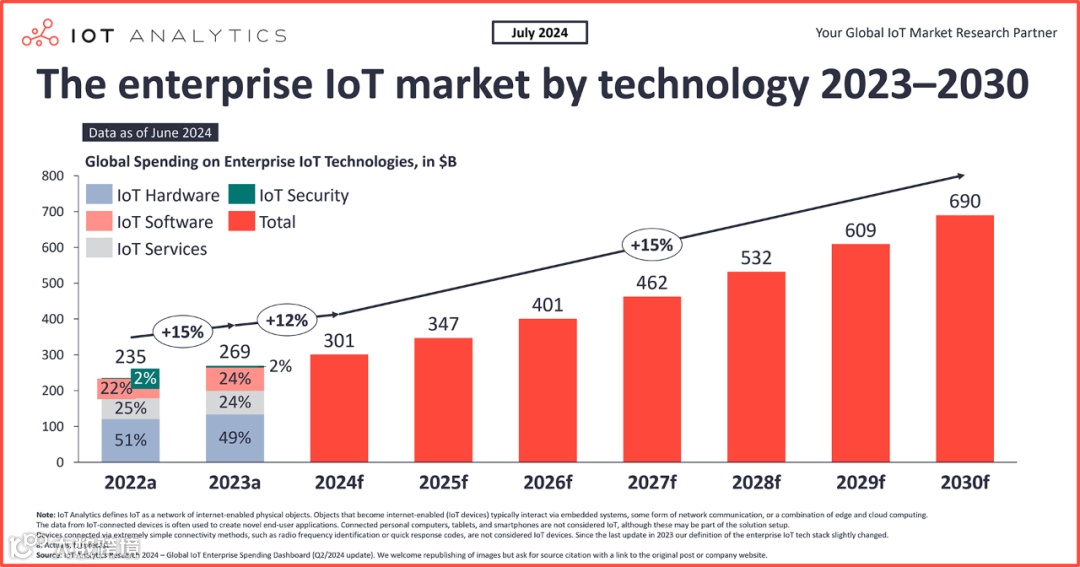
Enterprise IoT spending kept climbing. IoT Analytics reports 269 billion dollars in 2023, an actual figure with 15 percent year over year growth. For 2024, the firm expects 301 billion dollars and 12 percent growth. From 2025, growth is projected to reaccelerate, averaging around 15 percent annually to about 690 billion dollars by 2030.
Momentum is uneven. Software is set to grow faster than the overall market, helped by AI and cloud adoption. Regionally, China, India, and the United States lead the rise. By industry, automotive and process manufacturing are out in front as they modernize operations.
*Source: IoT Analytics
How IoT Works for Businesses
Devices & Sensors
IoT starts with IoT devices in the field. These include temperature and humidity sensors, motion detectors, cameras, beacons, asset trackers, and personnel tags. Each collects raw data, such as location, vibration, or environmental conditions. Some devices can even run basic checks locally before sending information onward, helping filter noise and improve reliability.
Connectivity
Collected data has to move. Depending on the use case, devices can connect through Wi-Fi, Bluetooth Low Energy, Zigbee, LoRaWAN, or cellular networks such as LTE-M and NB-IoT. Each option offers different balances of range, power consumption, and cost. Choosing the right mix ensures businesses get reliable coverage without overspending.
Edge & Gateway Processing
Gateways sit between devices and the cloud. They handle quick calculations or checks close to where data is created. This reduces latency and cuts bandwidth costs by preventing unnecessary uploads.
Data Analytics & Applications
Once data reaches the cloud, analytics tools and applications turn it into real insights. Dashboards show live conditions, reports highlight long-term trends, and alerts trigger automated actions. Businesses can monitor performance, predict failures, and refine operations in real time. Instead of raw numbers, companies get clear guidance they can act on immediately by IoT Analytics.
Key Benefits of IoT Solutions for Businesses
Improved Efficiency
Automate routine checks, reduce manual rounds, and surface the right task to the right person, so teams resolve issues faster and keep operations steady.
Cost Savings and Optimization
Use energy schedules, occupancy control, and predictive maintenance to cut utility waste, prevent unplanned repairs, and avoid overtime, turning small operational changes into measurable savings.
Scalability and Flexibility
Start with one site or line, then addIoT sensors, devices, and rules as needs grow, without rework, keeping costs predictable and deployments manageable across teams.
Enhanced Customer Experiences
Reduce stockouts, shorten wait times, and adapt spaces based on presence, creating smoother visits and faster service that customers notice, remember, and return for.
Data-Driven Sustainability
Measure energy, temperature, and air quality continuously, find waste, and automate fixes, so sustainability targets become practical daily habits backed by credible, auditable data.
Practical Use Cases of IoT Solutions for Businesses
Logistics: Track shipments and assets indoors and outdoors. Monitor temperature and light for cold chain. Alert on shock or door open events.
Healthcare: Log medicine storage conditions. Watch room occupancy and equipment status. Use staff badges or smart buttons for quick assistance.
Warehouse:Sense shelf inventory and bin movement. Guide pick paths. Measure dock activity to remove bottlenecks.
Office: Measure occupancy and air quality. Automate lighting and HVAC by schedule and presence. Simple buttons for service requests.
The Factors for Business to Consider IoT Solutions
Understand the Business Case
Define the pain, baseline, and the metric that proves improvement. Set a clear target and time frame. Identify owners and impacted teams. Separate essentials from extras. Drop features that raise complexity without delivering measurable value.
Hardware
Select devices rated for environment conditions. Confirm sensor accuracy, battery life, and replaceability. Choose power options such as battery, mains, or solar. Plan gateways for scale. Require remote firmware updates, tamper alerts, and secure provisioning.
Software
Use proven platforms for device management, rules, and storage. Decide cloud versus on-premises based on policy and scale. Model data flows into ticketing, messaging, and BI. Ensure role-based access, audit logs, and dashboards.
Connectivity
Pick protocols that match range and power. Use BLE for low-power, short-range, LoRaWAN for long-range and small payloads, and cellular for mobile assets. Validate coverage, set fallbacks.
Explore Minew IoT Hardware Solutions for Businesses
At Minew, we provide a wide range of IoT hardware built for real-world scenarios. Our product lines include beacons, asset trackers, personnel tags, IoT sensors, and gateways. These can be combined and scaled for different industries:
Logistics: Asset trackers and sensors to monitor goods, vehicles, and shipping containers.
Warehouses: Tags and gateways to manage inventory and equipment in real time.
Healthcare: Personnel tags and environmental sensors for safety, compliance, and patient support.
Construction Sites: Location and safety monitoring to protect workers and secure assets.
To make adoption easier, we also offer starter kits. These kits bring together the essential devices and a gateway so businesses can test and deploy quickly, without heavy upfront setup. Companies can start with a small deployment, see the results, and then expand into full-scale systems.