
2014年10月30日《自然》杂志封面文章:The Top 100 Papers,其揭示了世界排名前100的最高被引论文。
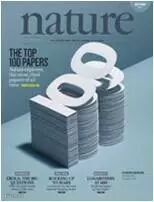
2014年,在SCI(科学引文索引)成立50周年之际,《自然》杂志的记者Richard van Noorden产生了撰写此专题文章的想法,并在汤森路透知识产权与科技事业部资深顾问David Pendlebury 及其同事 Chris King的大力支持下,运用汤森路透Web of ScienceTM科研平台的高质量数据及分析,历经数月甄选出了迄今(1900年至今)世界范围内排名前100篇的最高被引论文。
《自然》杂志The Top 100 Papers原文节选如下。
The discovery of high-temperaturesuperconductors, the determination of DNA’s double-helix structure, the first observationsthat the expansion of the Universe is accelerating — all of these breakthroughswon Nobel prizes and international acclaim. Yet none of the papers thatannounced them comes anywhere close to ranking among the 100 most highly citedpapers of all time.
Citations, in which one paper refers toearlier works, are the standard means by which authors acknowledge the sourceof their methods, ideas and findings, and are often used as a rough measure ofa paper’s importance. Fifty years ago, Eugene Garfield published the ScienceCitation Index (SCI), the first systematic effort to track citations in thescientific literature. To mark the anniversary, Nature asked Thomson Reuters,which now owns the SCI, to list the 100 most highly cited papers of all time.(See the full list at http://www.nature.com/news/the-top-100-papers-1.16224.)The search covered all of Thomson Reuter’s Web of Science, an online version ofthe SCI that also includes databases covering the social sciences, arts andhumanities, conference proceedings and some books. It lists papers publishedfrom 1900 to the present day.
Theexercise revealed some surprises, not least that it takes a staggering 12,119citations to rank in the top 100 — and that many of the world’s most famouspapers do not make the cut. A few that do, such as the first observation1 ofcarbon nanotubes (number 36) are indeed classic discoveries. But the vastmajority describe experimental methods or software that have become essentialin their fields.
The most cited work in history, forexample, is a 1951 paper2 describing an assay to determine the amount ofprotein in a solution. It has now gathered more than 305,000 citations — arecognition that always puzzled its lead author, the late US biochemist OliverLowry. “Although I really know it is not a great paper … I secretly get a kickout of the response,” he wrote in 1977.
The colossal size of the scholarlyliterature means that the top-100 papers are extreme outliers. Thomson Reuter’sWeb of Science holds some 58 million items. If that corpus were scaled to MountKilimanjaro, then the 100 most-cited papers would represent just 1 centimetreat the peak. Only 14,499 papers — roughly a metre and a half’s worth — havemore than 1,000 citations. Meanwhile, the foothillscomprise works that have been cited only once, if at all — a group thatencompasses roughly half of the items.
Nobody fully understands what distinguishesthe sliver at the top from papers that are merely very well known — butresearchers’ customs explain some of it. Paul Wouters, director of the Centrefor Science and Technology Studies in Leiden, the Netherlands, says that manymethods papers “become a standard reference that one cites in order to makeclear to other scientists what kind of work one is doing”. Another commonpractice in science ensures that truly foundational discoveries — Einstein’sspecial theory of relativity, for instance — get fewer citations than theymight deserve: they are so important that they quickly enter the textbooks orare incorporated into the main text of papers as terms deemed so familiar thatthey do not need a citation.
Citation counts are riddled with otherconfounding factors. The volume of citations has increased, for example — yetolder papers have had more time to accrue citations. Biologists tend to citeone another’s work more frequently than, say, physicists. And not all fieldsproduce the same number of publications. Modern bibliometricians thereforerecoil from methods as crude as simply counting citations when they want tomeasure a paper’s value: instead, they prefer to compare counts for papers ofsimilar age, and in comparable fields.
阅读全文敬请浏览:http://www.nature.com/news/the-top-100-papers-1.16224