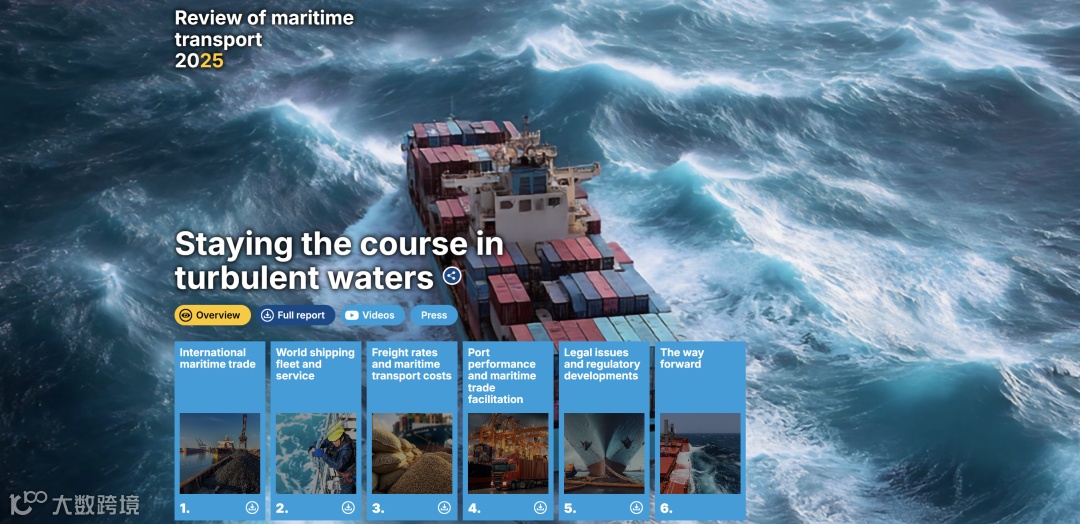
Review of maritime transport 2025:Staying the course in turbulent waters
Maritime transport and trade face daunting challenges. Ships that once passed through the Red Sea in days now sail for weeks around the Cape of Good Hope. Freight rates are high and volatile. Port disruption is becoming chronic. Supply chain reliability and resilience are being put to the test.
Longer routes have increased delays, costs and emissions, with developing countries hit hard by the disruptions and uncertainty.
Deep transitions are also reshaping the sector. Technological, environmental and geoeconomic shifts are converging at a speed that requires rethinking how maritime transport operates. Alternative fuel vessels now represent over half of the ship tonnage of new orders, yet over 90% of the active fleet still runs on conventional fuels. Automation and digitalization promise efficiency but also heighten cyber risks.
Maritime transport has weathered storms before. But never have so many transitions converged so quickly. The sector will adapt. The question is whether adaptation will be managed or chaotic, inclusive or divisive, sustainable or merely survivable.
The Review of Maritime Transport 2025 provides the framework needed for informed action and sound policymaking to keep trade flowing in a turbulent world.
“The transitions ahead – to zero carbon, to digital systems, to new trade routes – must be just transitions. They must empower, not exclude. Build resilience, not deepen vulnerability.” Rebeca Grynspan,Secretary-General of UN Trade and Development (UNCTAD)
How are maritime shipping and trade patterns changing?
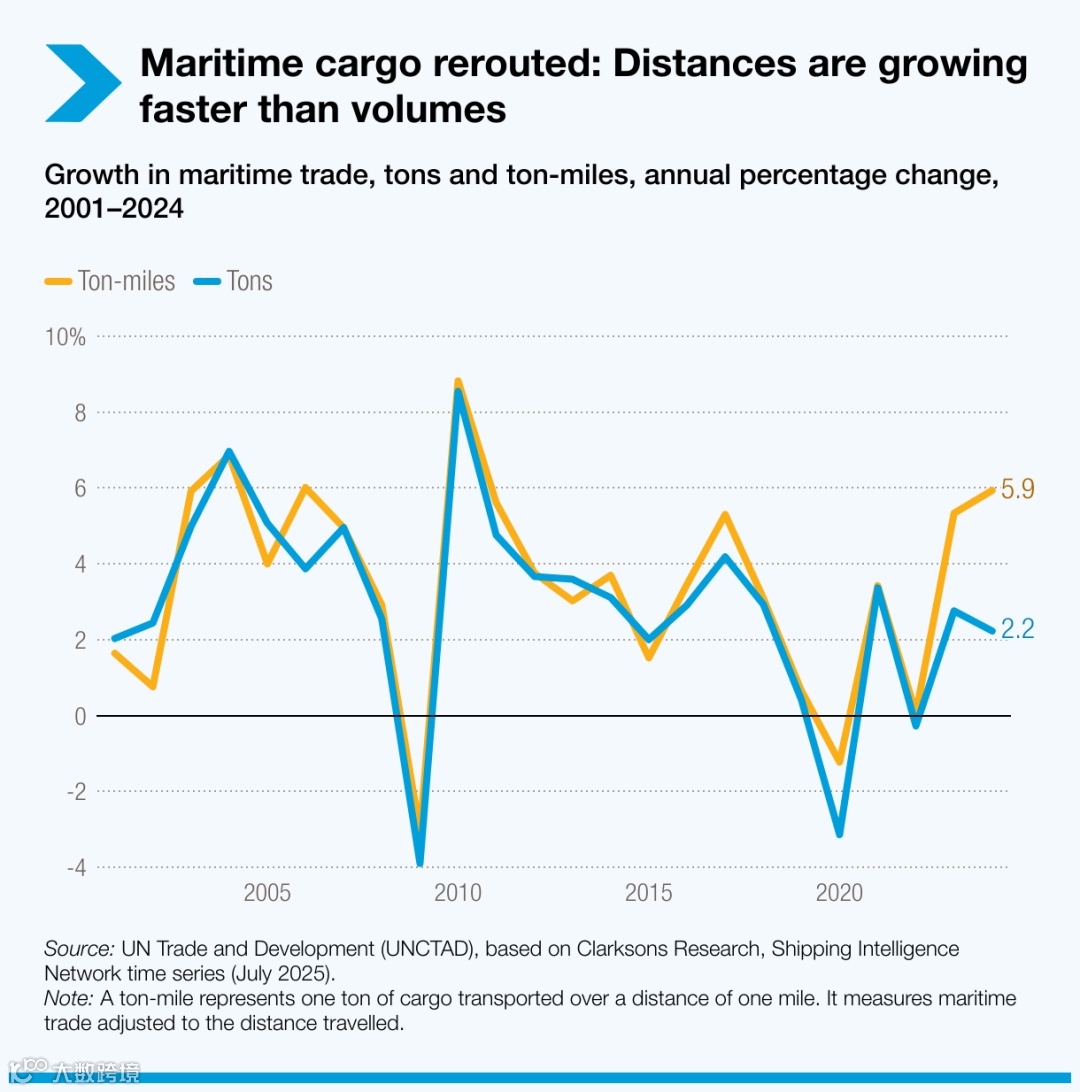
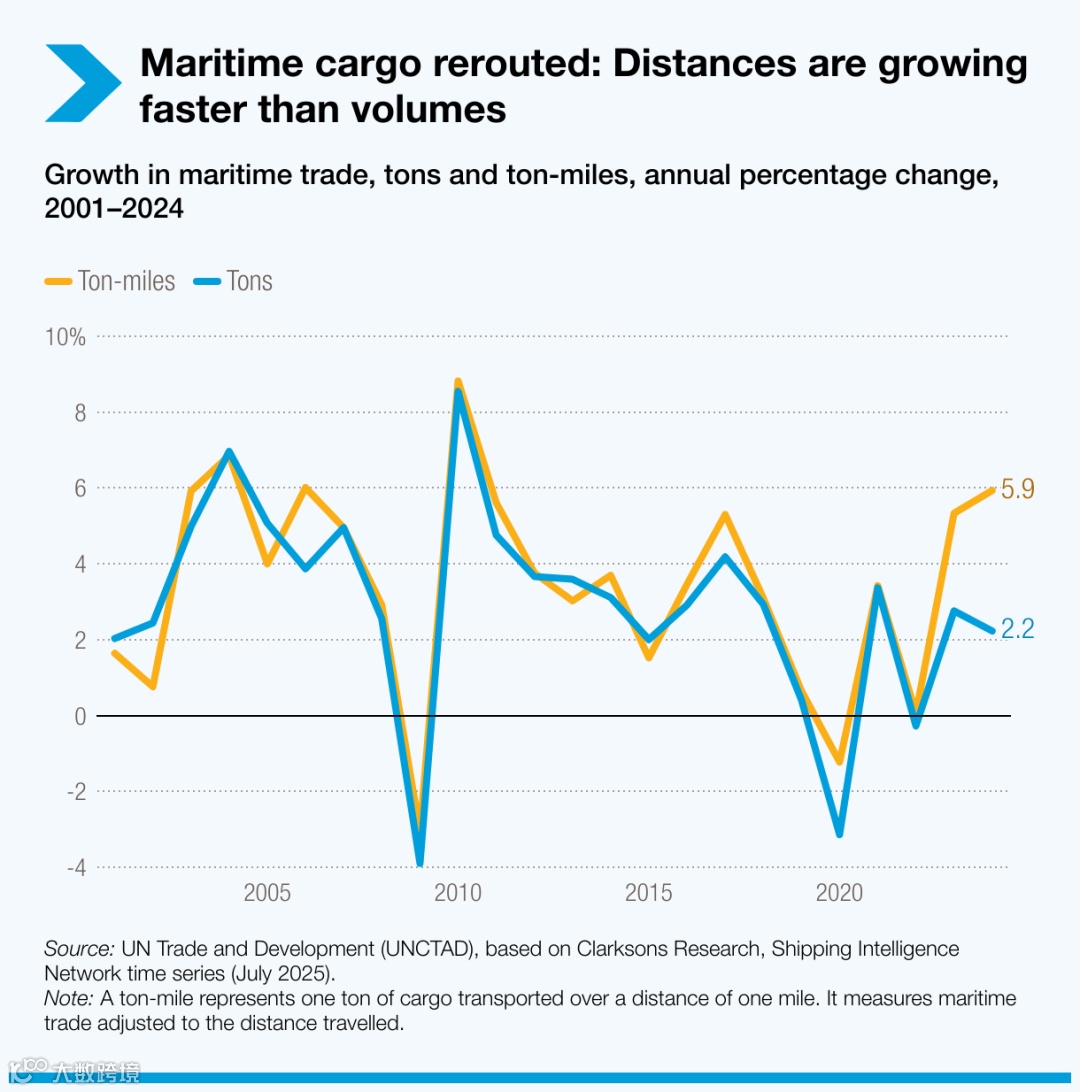
Vessel rerouting has pushed up distances, causing ton-miles to jump 5.9% in 2024, nearly three times the growth in volume.
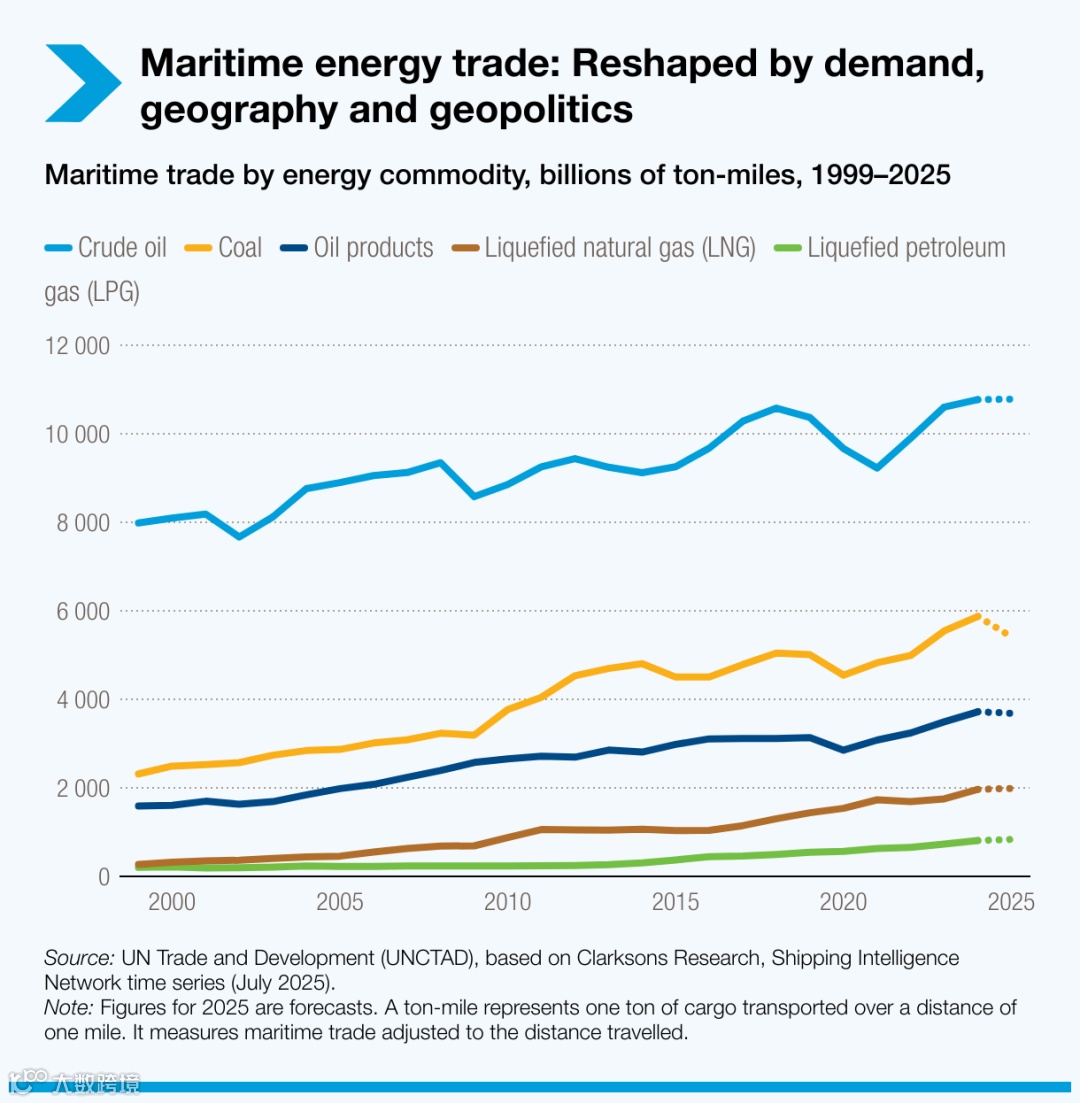
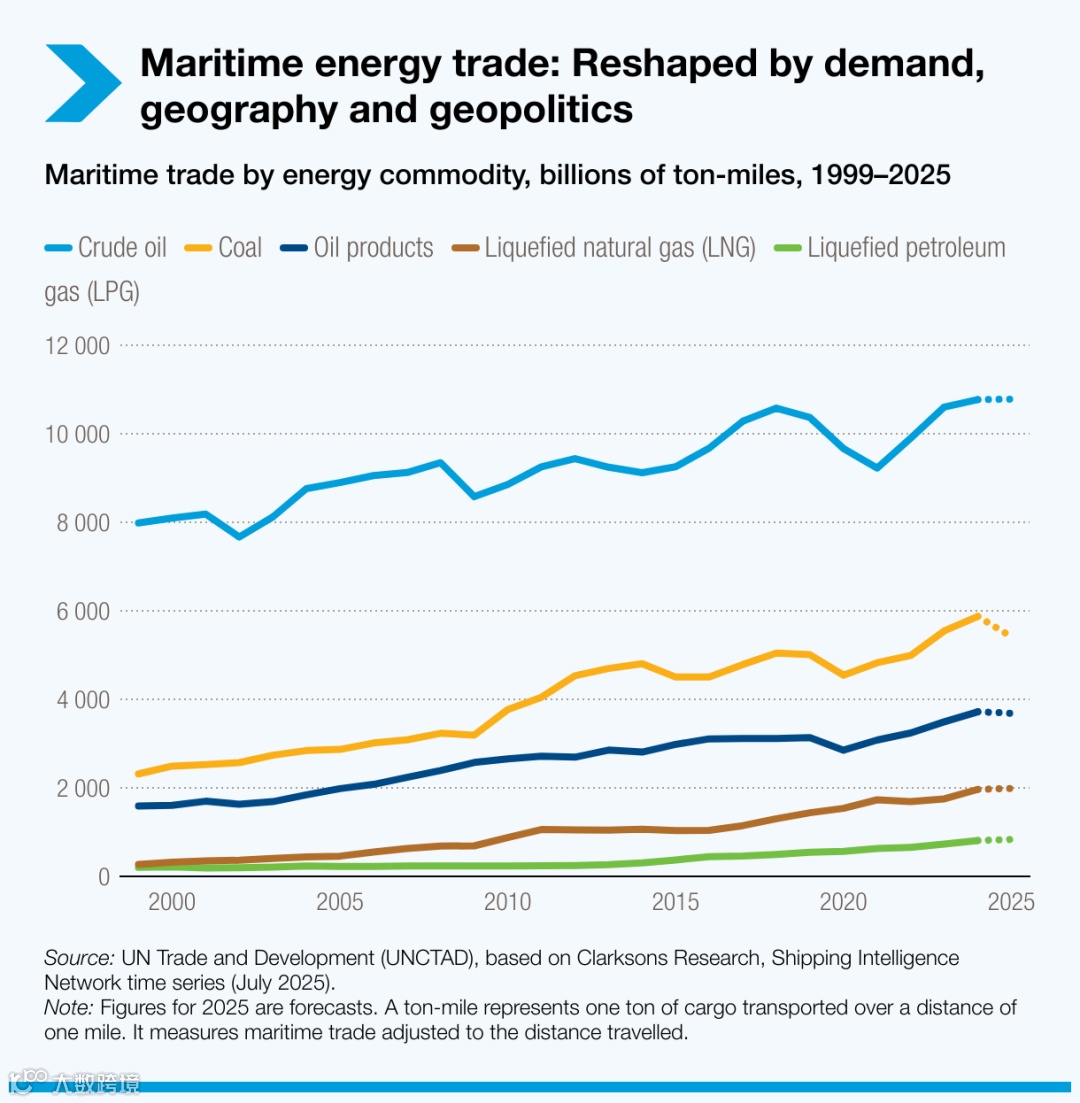
Maritime energy trade patterns are also shifting. Coal rose despite a longer-term decline, oil stayed flat but took longer routes and gas increased. Demand, geopolitics and diversification strategies are reshaping energy flows, shipping distances and the geography of energy trade.
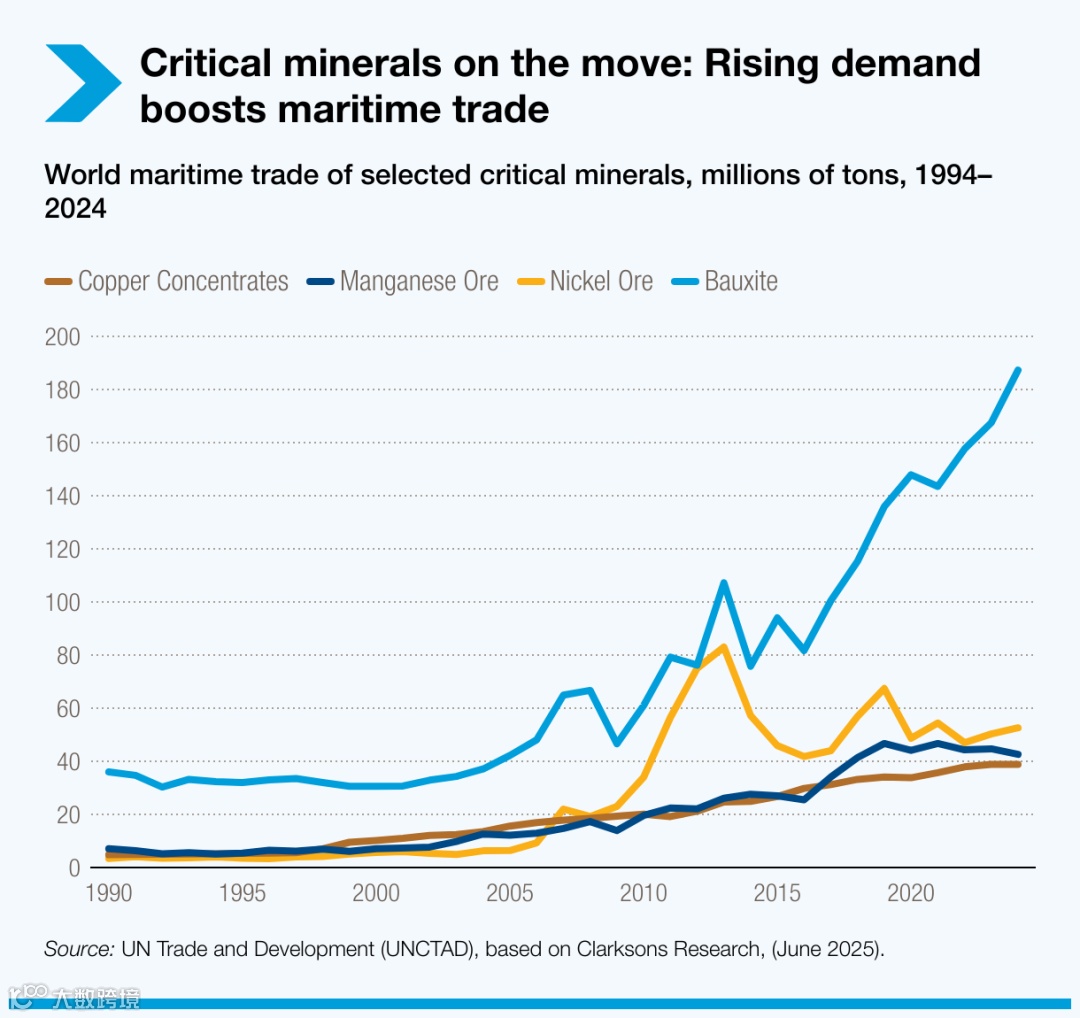
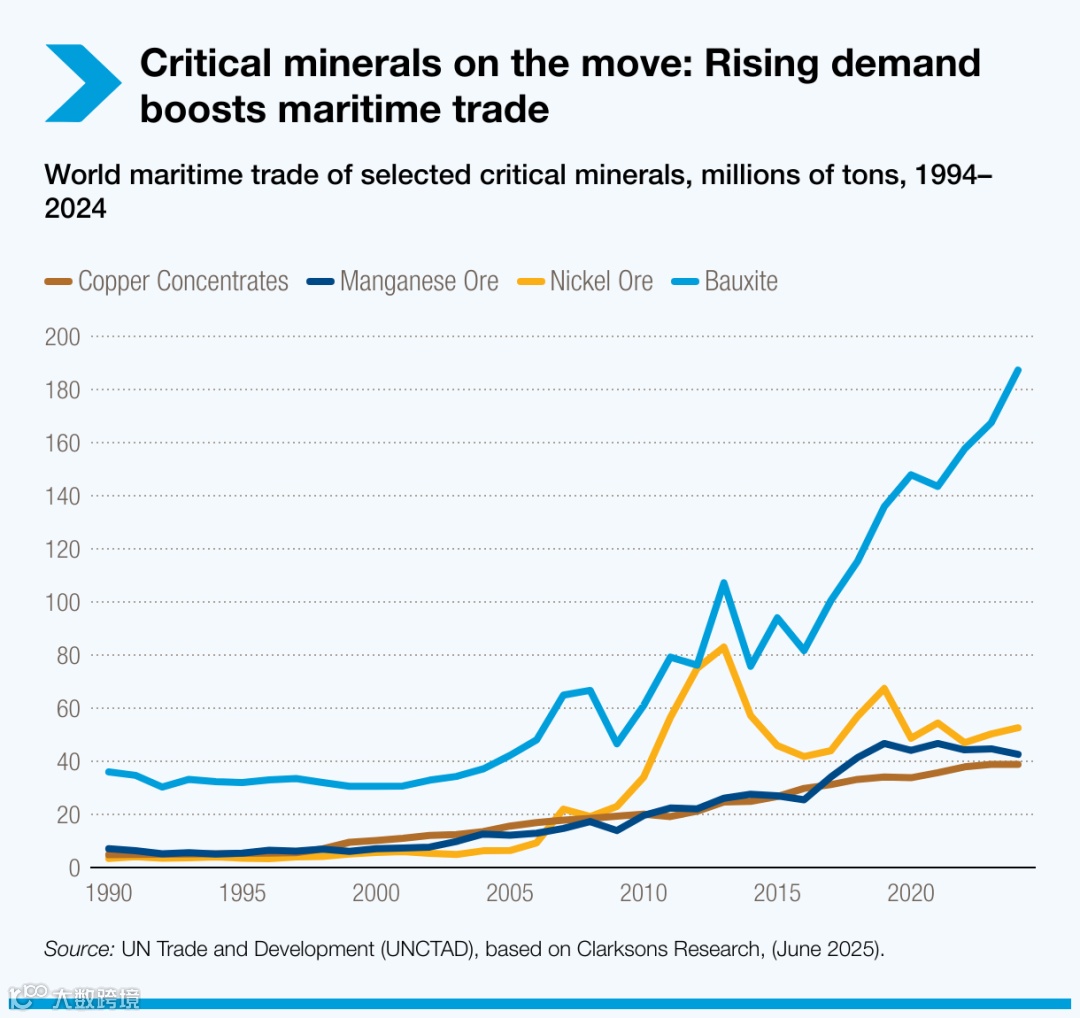
Critical minerals trade is expanding, creating opportunities but also risks. These developments are reshaping maritime trade and putting new demands on transport and logistics.
Will the fleet of the future be ready for decarbonized shipping?
World shipping fleet and service
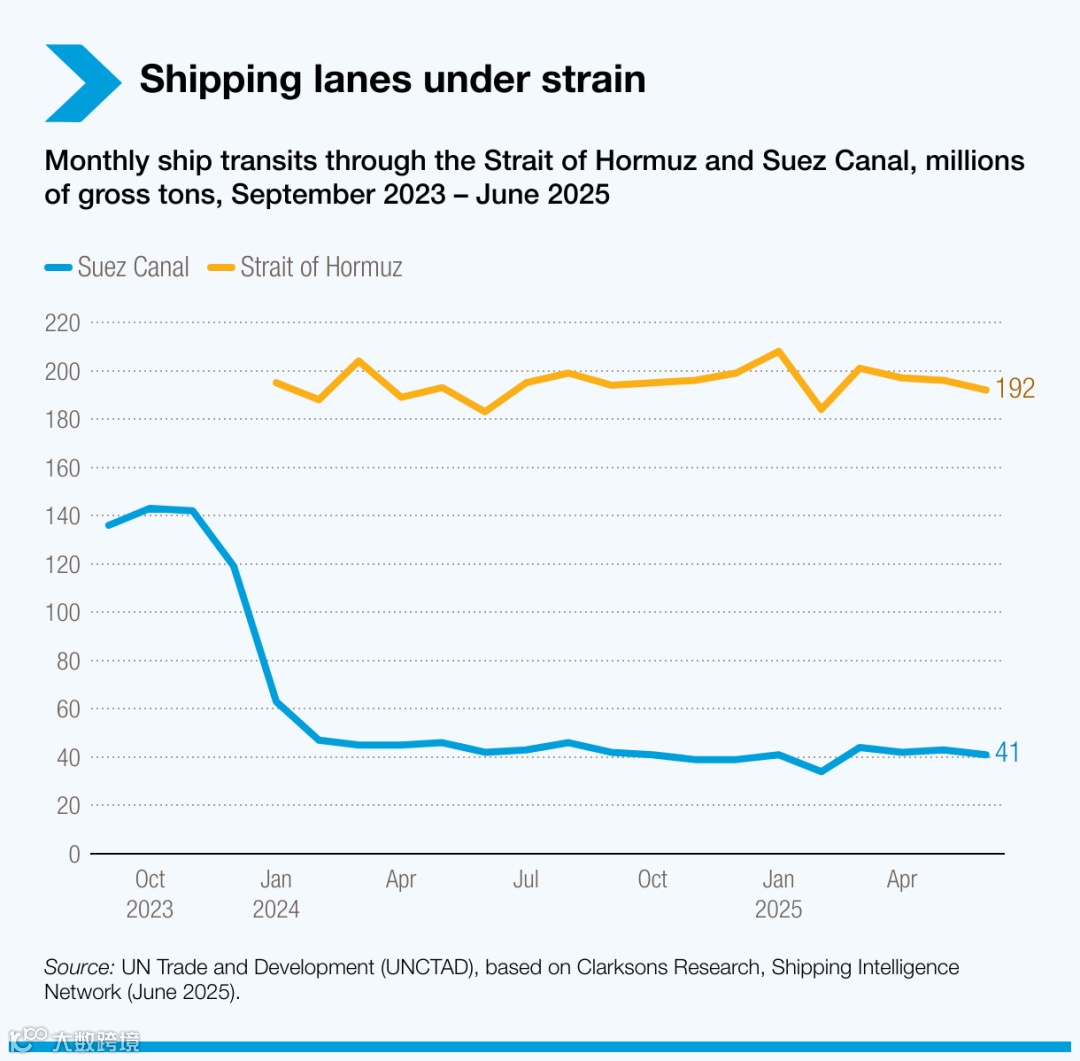
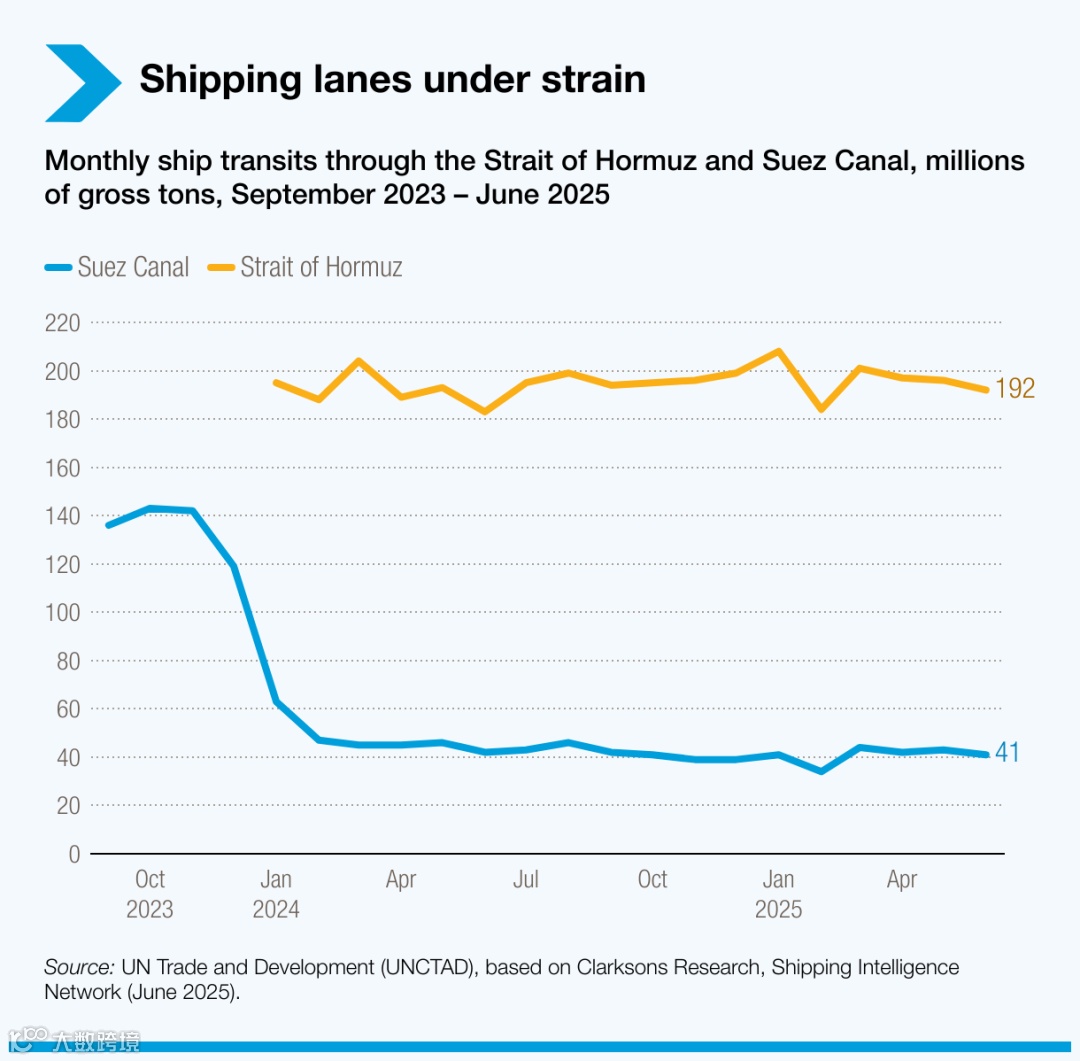
By May 2025, tonnage through the Suez Canal was still 70% below 2023 levels. The Strait of Hormuz, through which 11% of global trade and a third of seaborne oil trade flow, also faces disruption risks. Rerouting onto longer routes increased carbon emissions from shipping in 2024.
New trade tariffs in the United States and elsewhere have added complexity. For developing economies, shifting routes could generate transshipment opportunities for some ports, but could also increase shipping costs.
By January 2025, the world fleet counted 112,500 vessels with 2.44 billion dead weight tons. Greece, China and Japan control over 40% of capacity, while nearly 50% of capacity is registered in just three flag states – Liberia, Panama and the Marshall Islands.
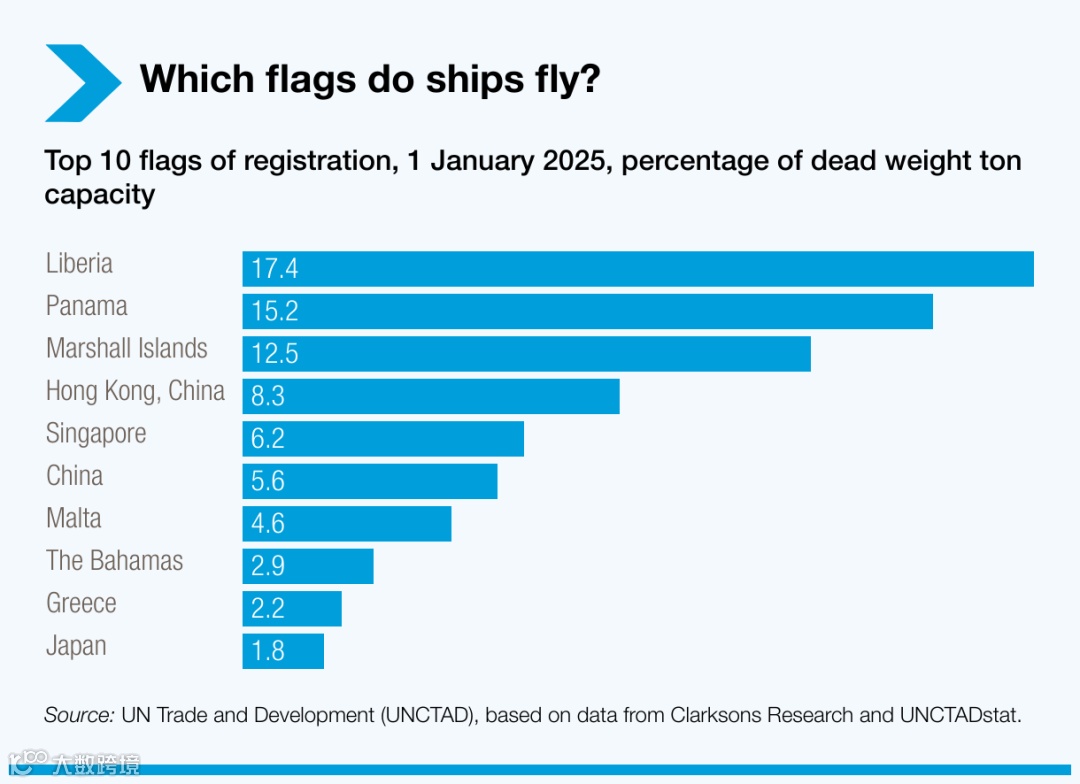
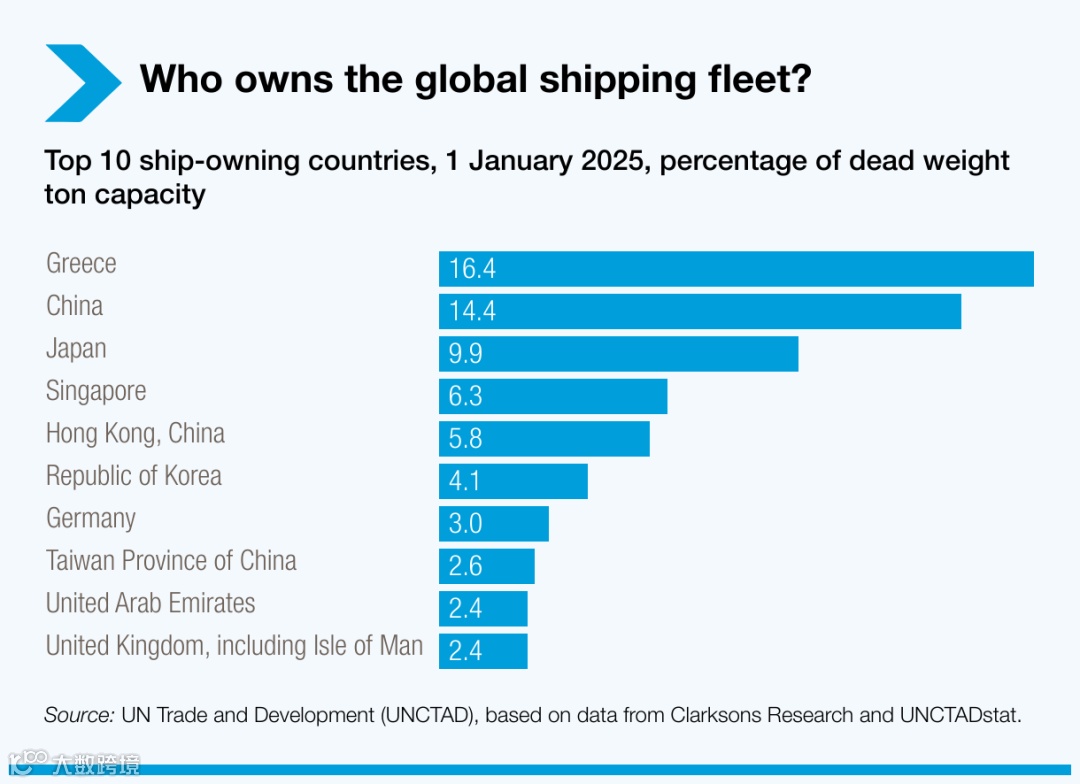
Fleet renewal, safe ship recycling, global rules on greenhouse gas emissions control and skilled labour are key for a timely and just transition to low-carbon shipping.
How are shipping costs reacting to disruption and regulatory compliance?
Freight rates and maritime transport costs
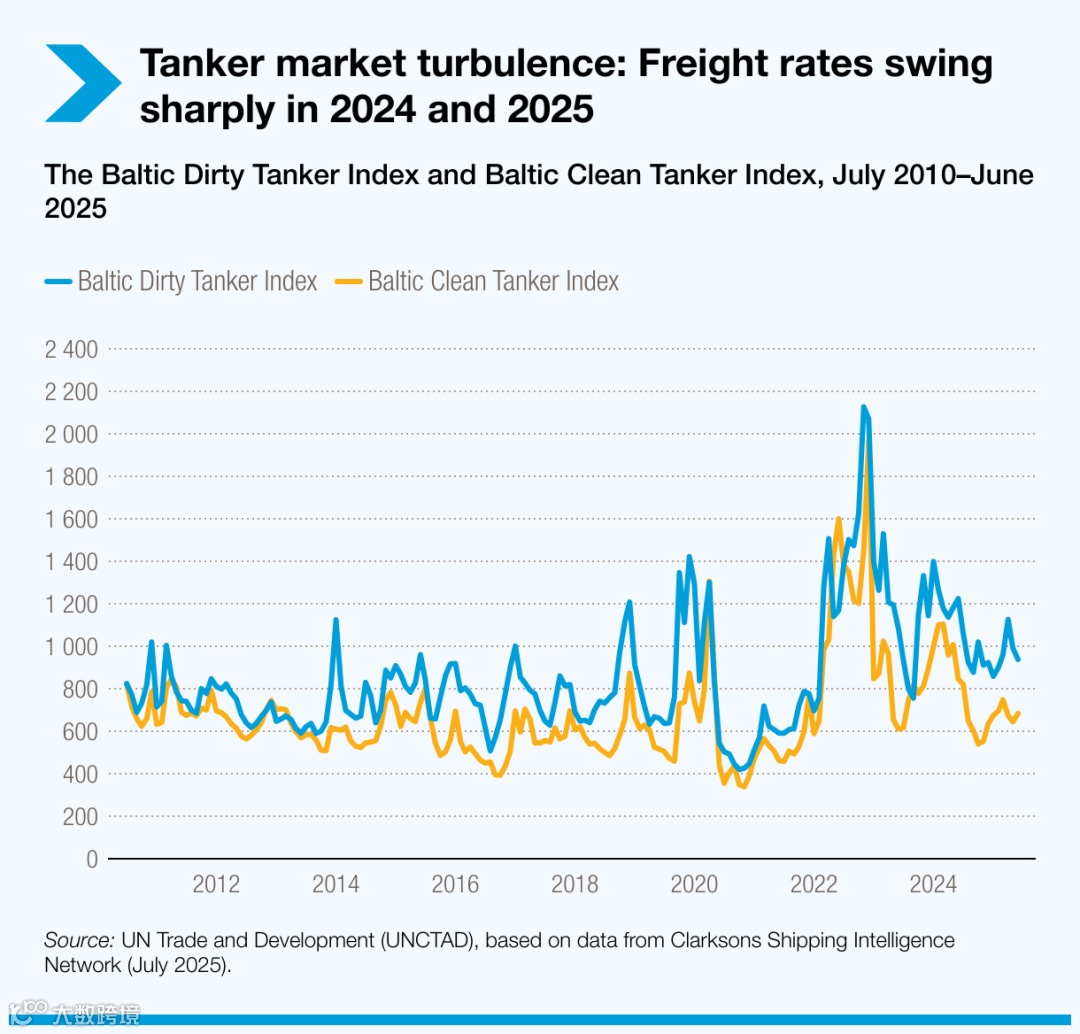
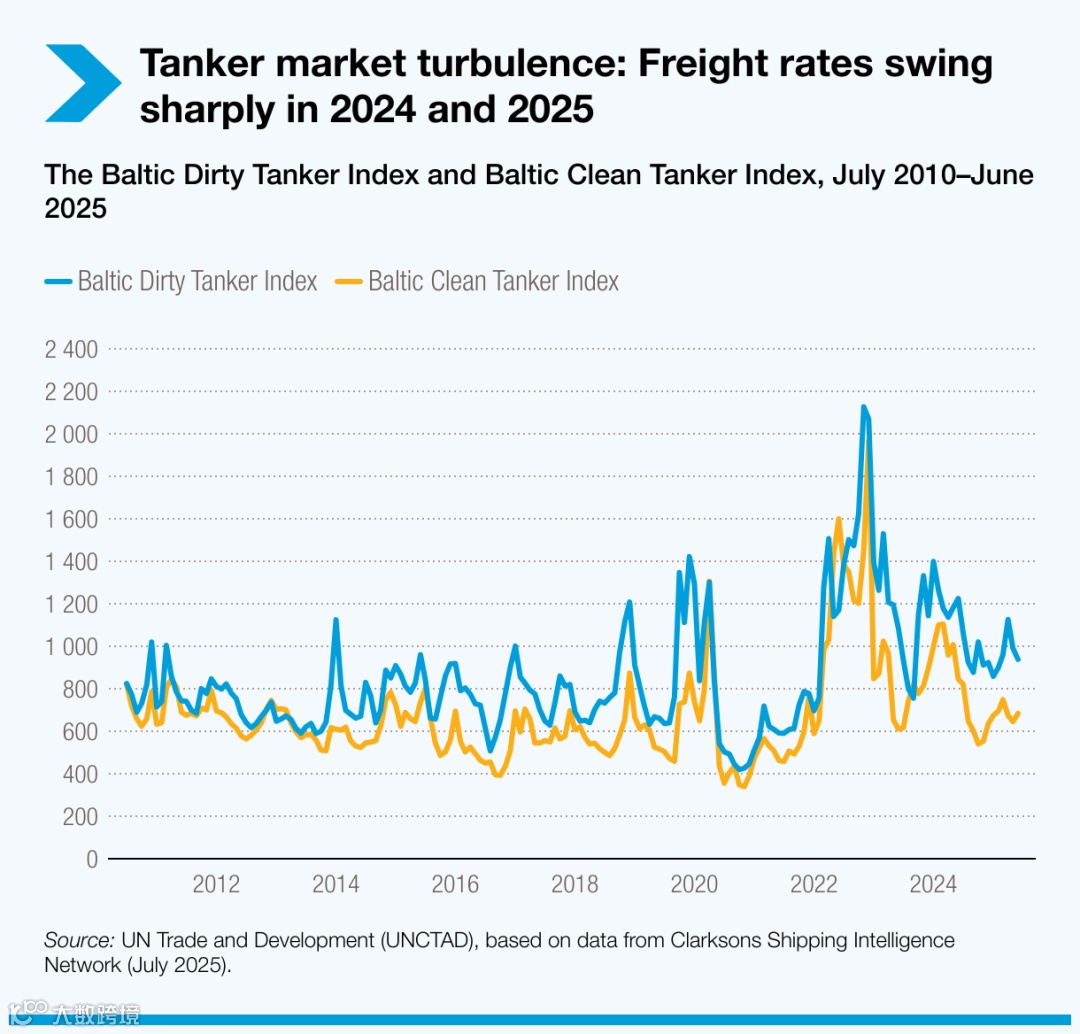
Freight rate volatility has become the new normal. Container, bulk and tanker freight rates have remained elevated and volatile in 2024 and 2025, swinging sharply amid geopolitical tensions, trade policy shifts and supply–demand imbalances. This instability is driving up global trade costs.
Rerouting ships has lengthened voyages, cut effective capacity and raised operating costs. Container shipping was hit hard with spot and charter rates nearing COVID-19 peaks by mid-2024 before easing, but still far above pre-crisis levels. Volatility has continued in 2025, amid new tariffs and the risk of disruptions in the Strait of Hormuz.
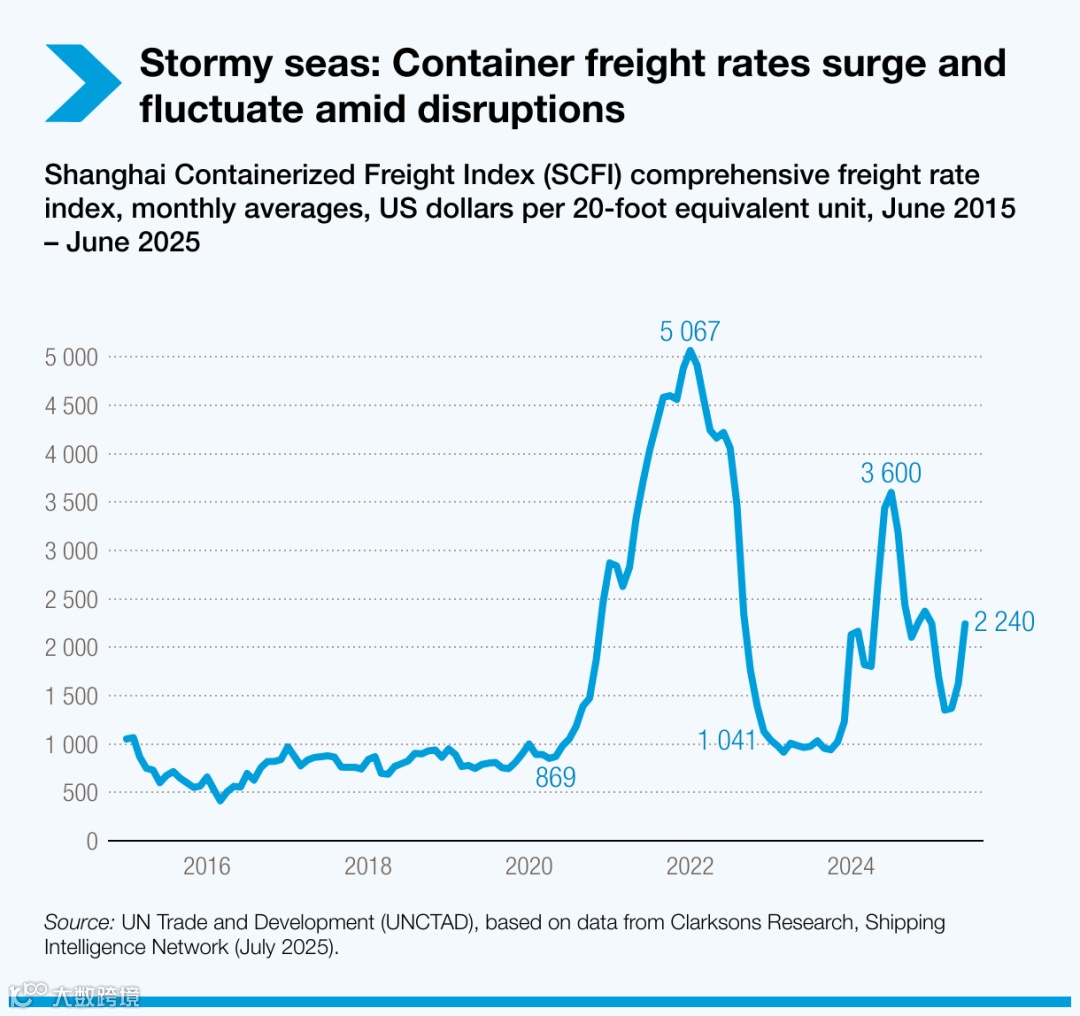
Dry bulk freight rates surged in 2024 on the back of strong coal, grain and fertilizer demand, Red Sea rerouting and limited fleet growth, before softening in 2025. Tanker markets, reflecting their sensitivity to geopolitical factors, were marked by volatility, with rates spiking in June 2025.
Environmental compliance expenditures add another layer to shipping costs. European Union emissions pricing is starting to affect transport costs, fleet choices and competitiveness across ship segments.
How do port performance and digital trade facilitation tools intersect?
Port performance and maritime trade facilitation
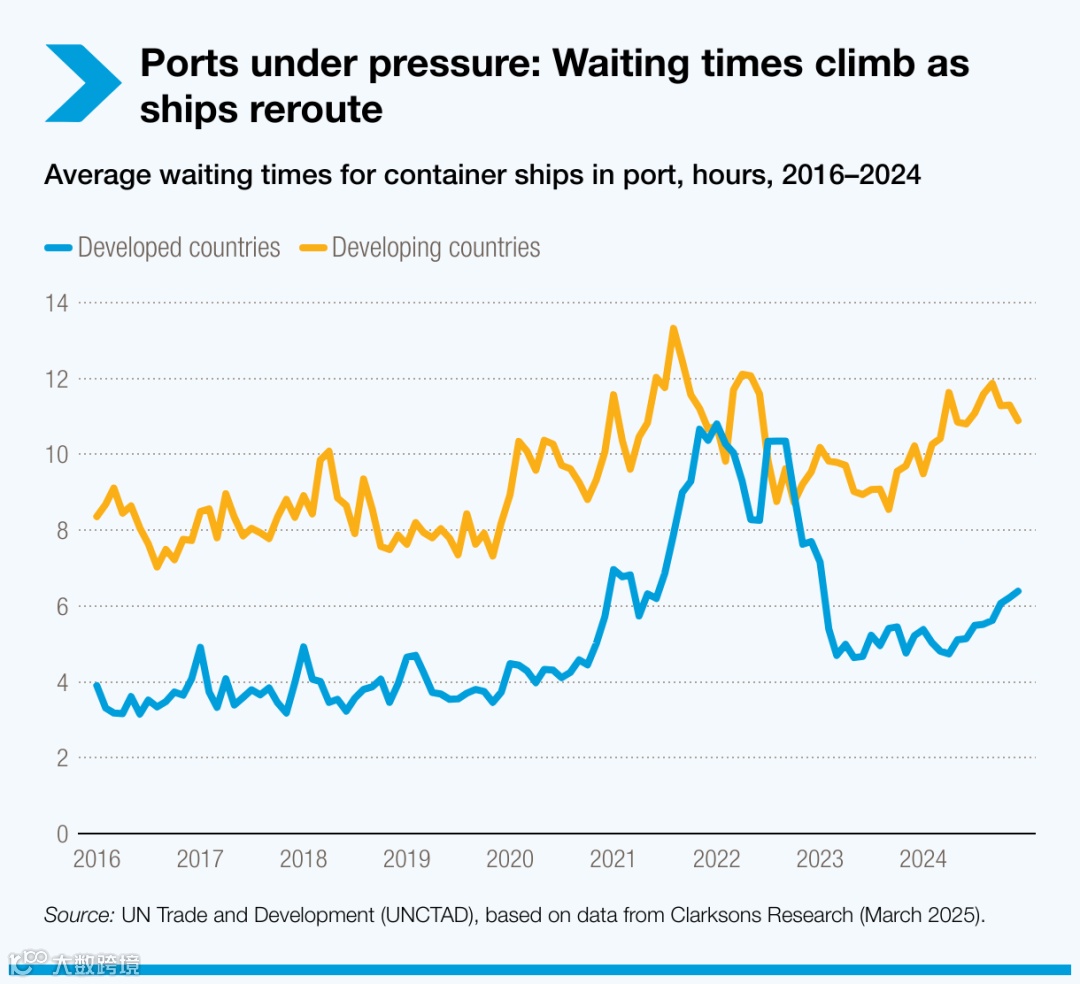
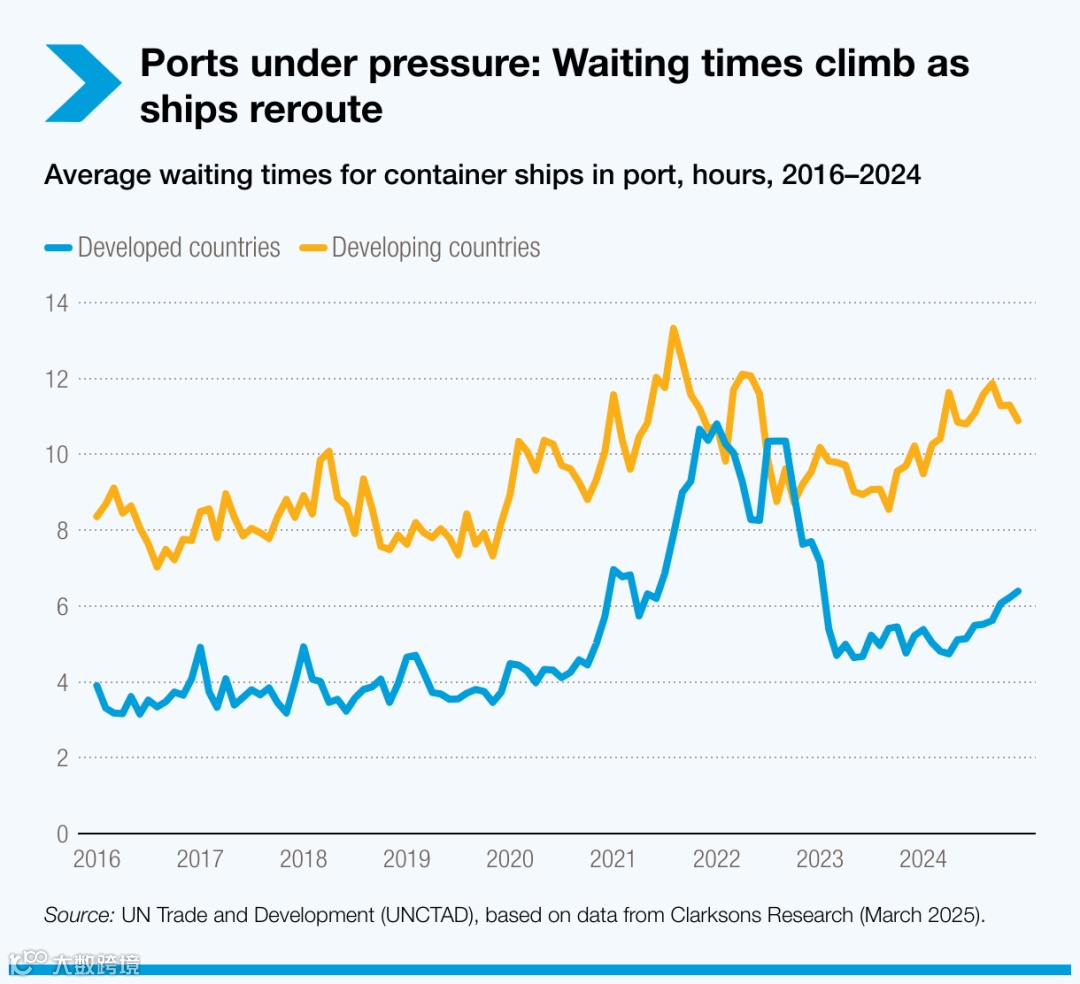
Ports are under increased strain as ship rerouting and port call reshuffling disrupt schedules. Between December 2023 and March 2024, average port waiting times climbed 23% to 6.4 hours in developed economies and 7% to 10.9 hours in developing ones.
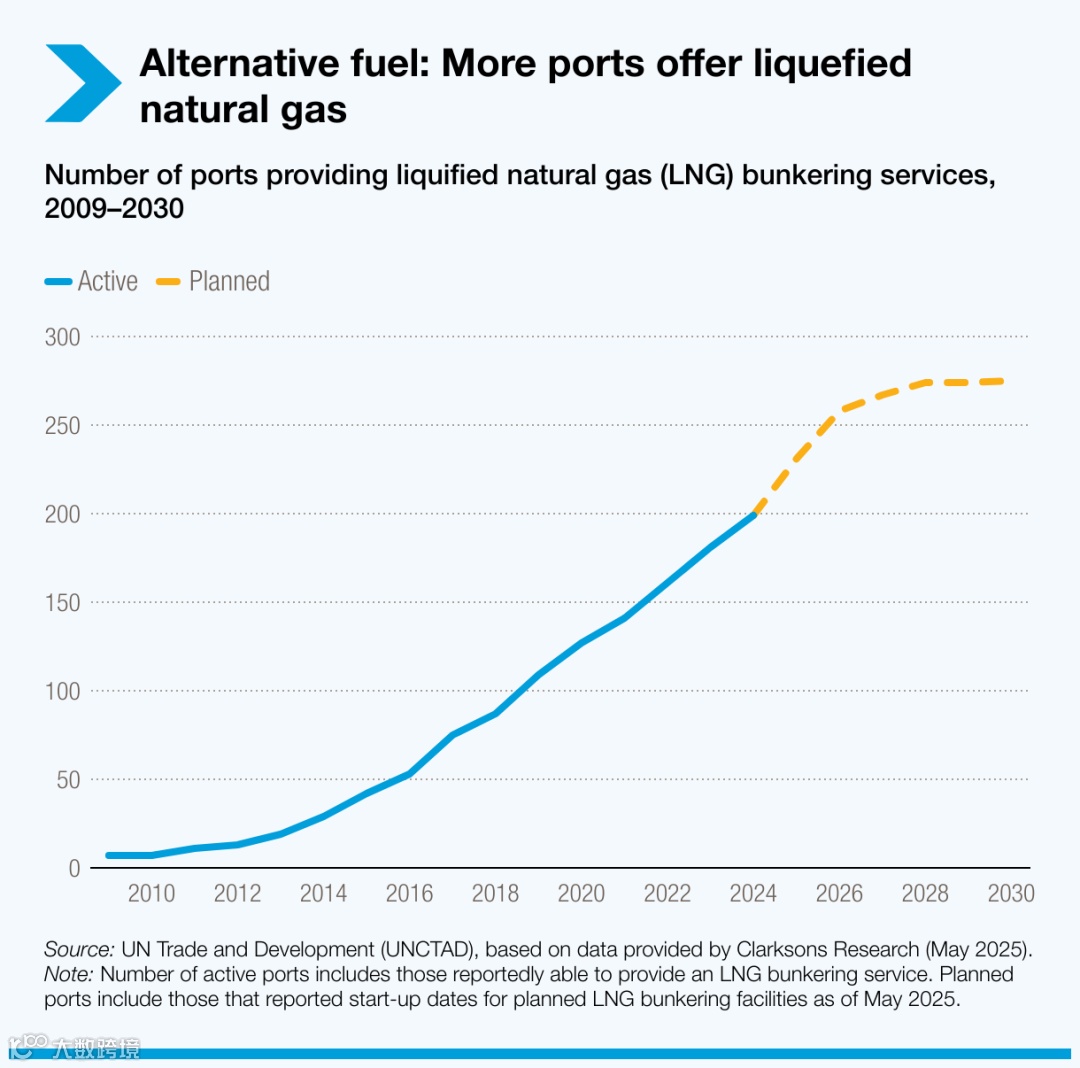
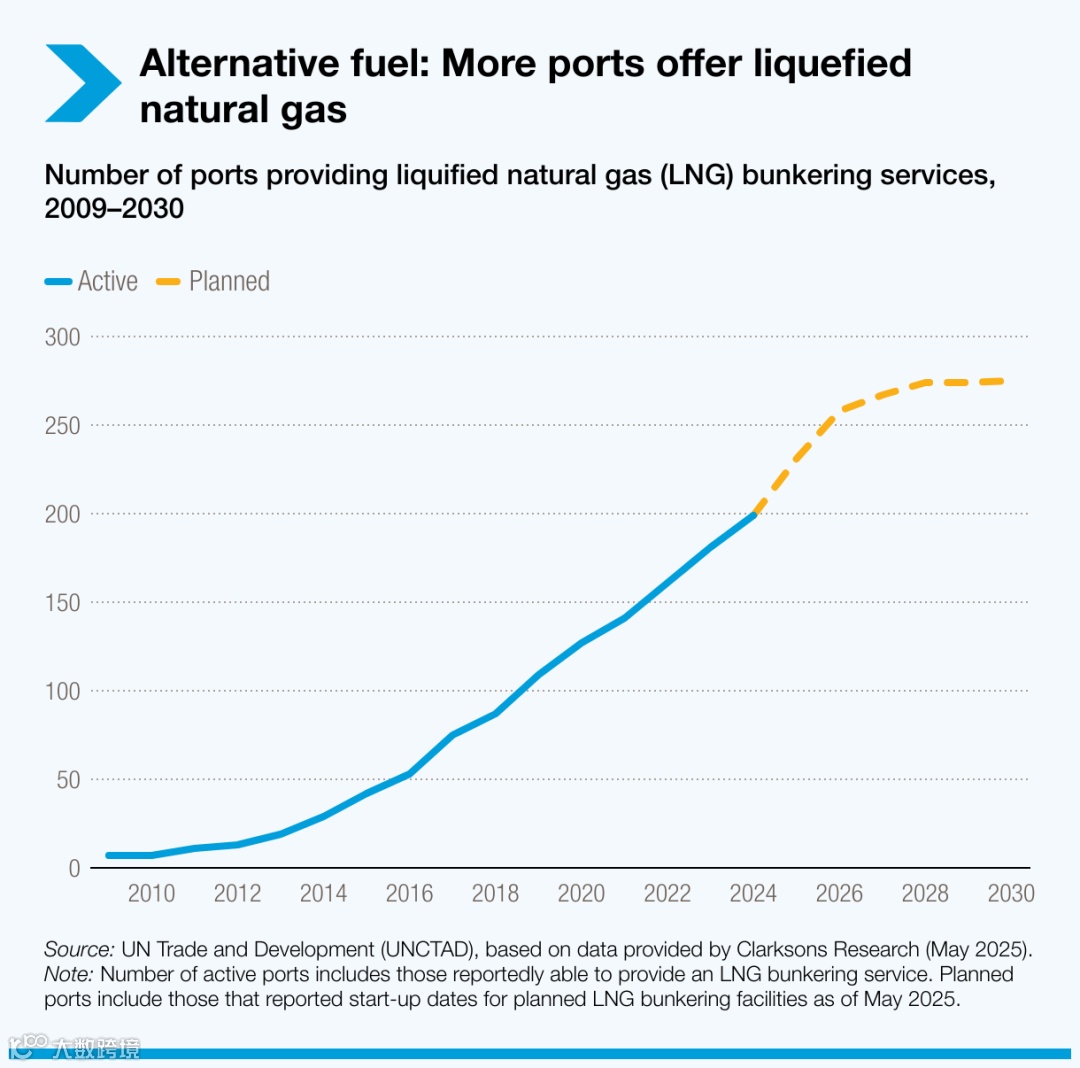
Improving port performance is increasingly urgent, as is adapting port infrastructure and services to the impacts of climate change and upgrading them for the energy transition. By 2024, about 200 ports were offering LNG bunkering services and more on the way.
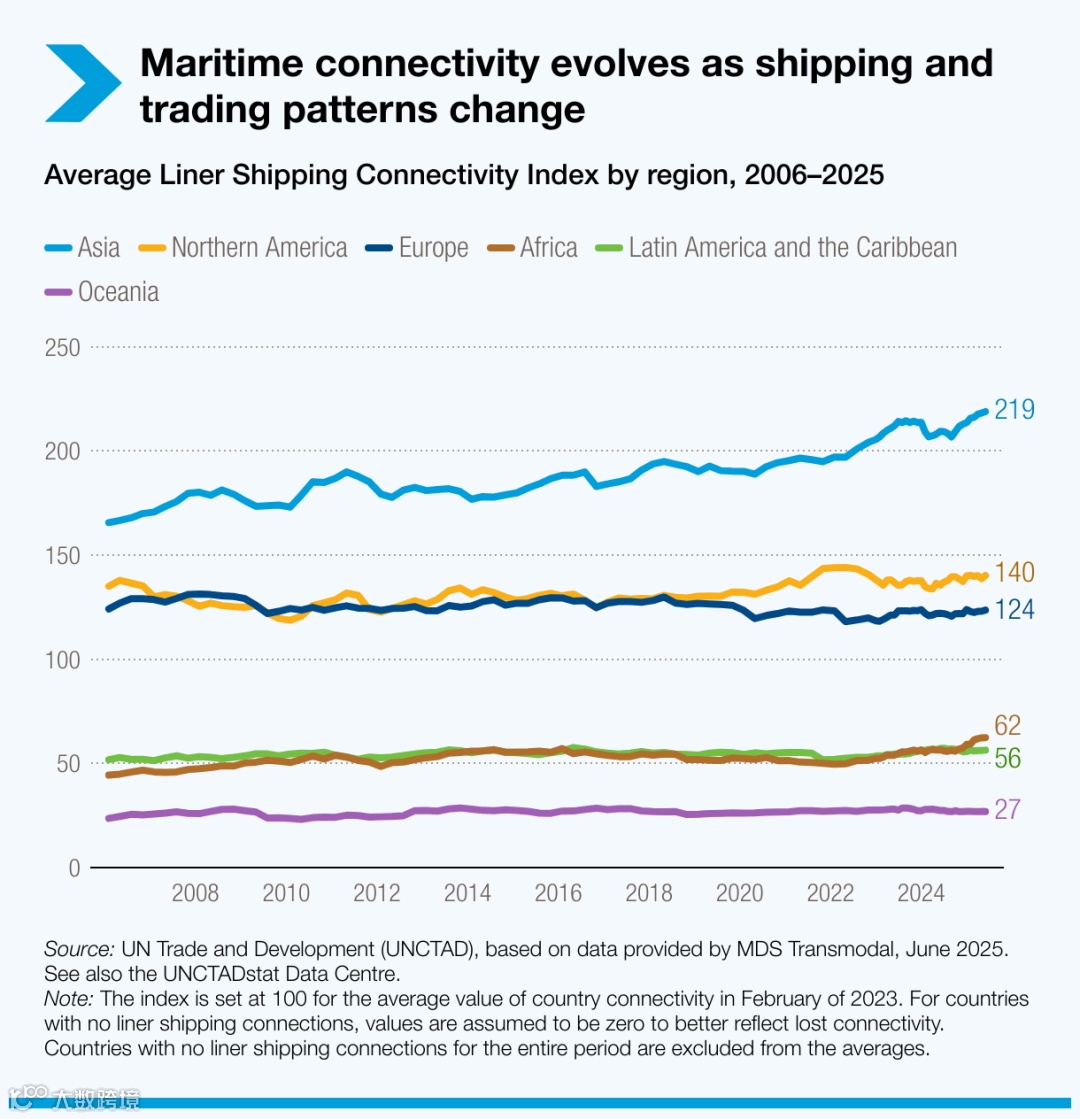
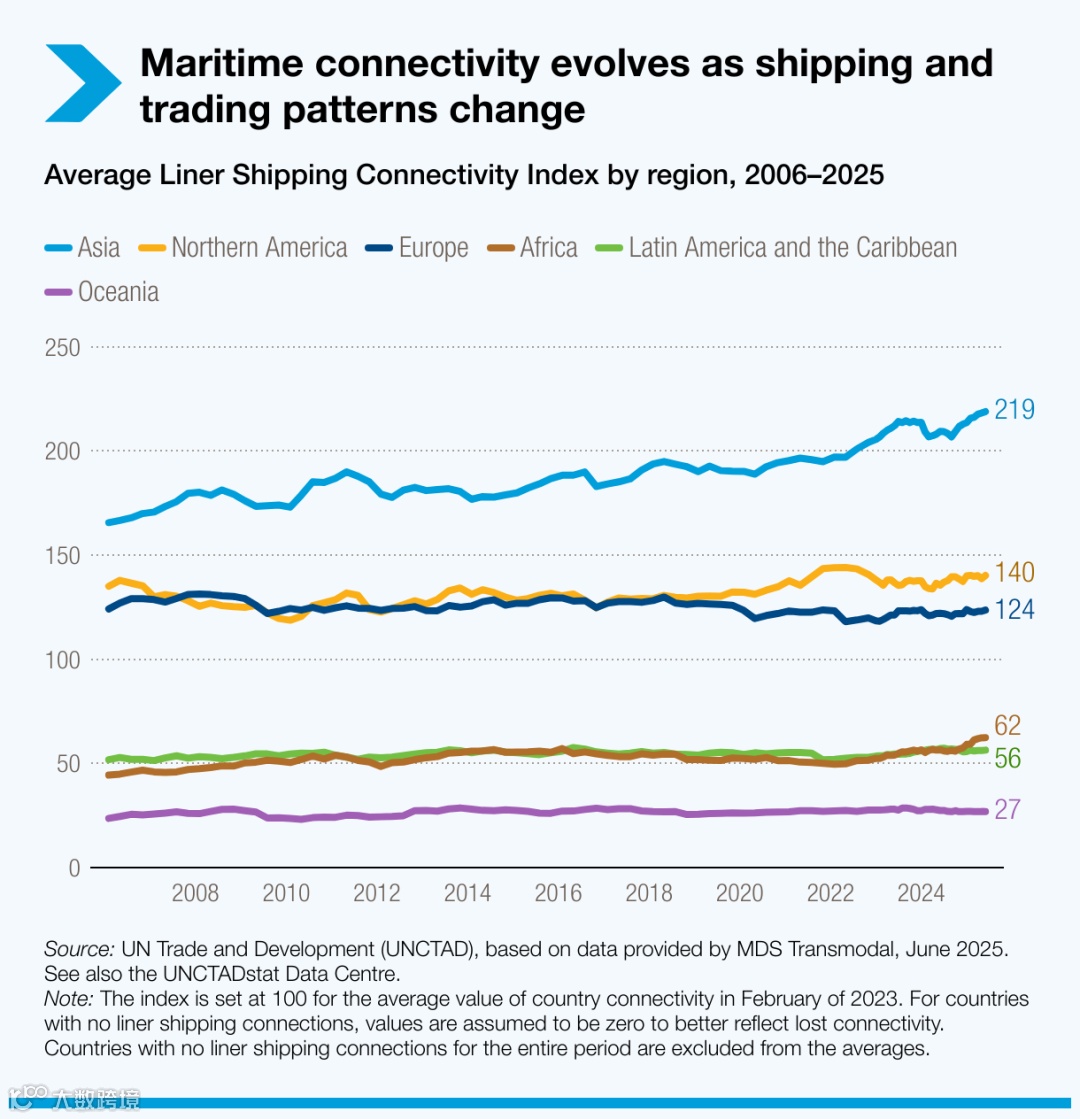
Countries’ maritime connectivity patterns are also shifting. UNCTAD’s Liner Shipping Connectivity Index shows that while Asia retained its lead, Africa posted a 10% improvement between June 2024 and June 2025.
Ports are not just infrastructure and services – they’re powered by people. Yet diversity remains limited. Technology could open doors if matched with inclusive training.
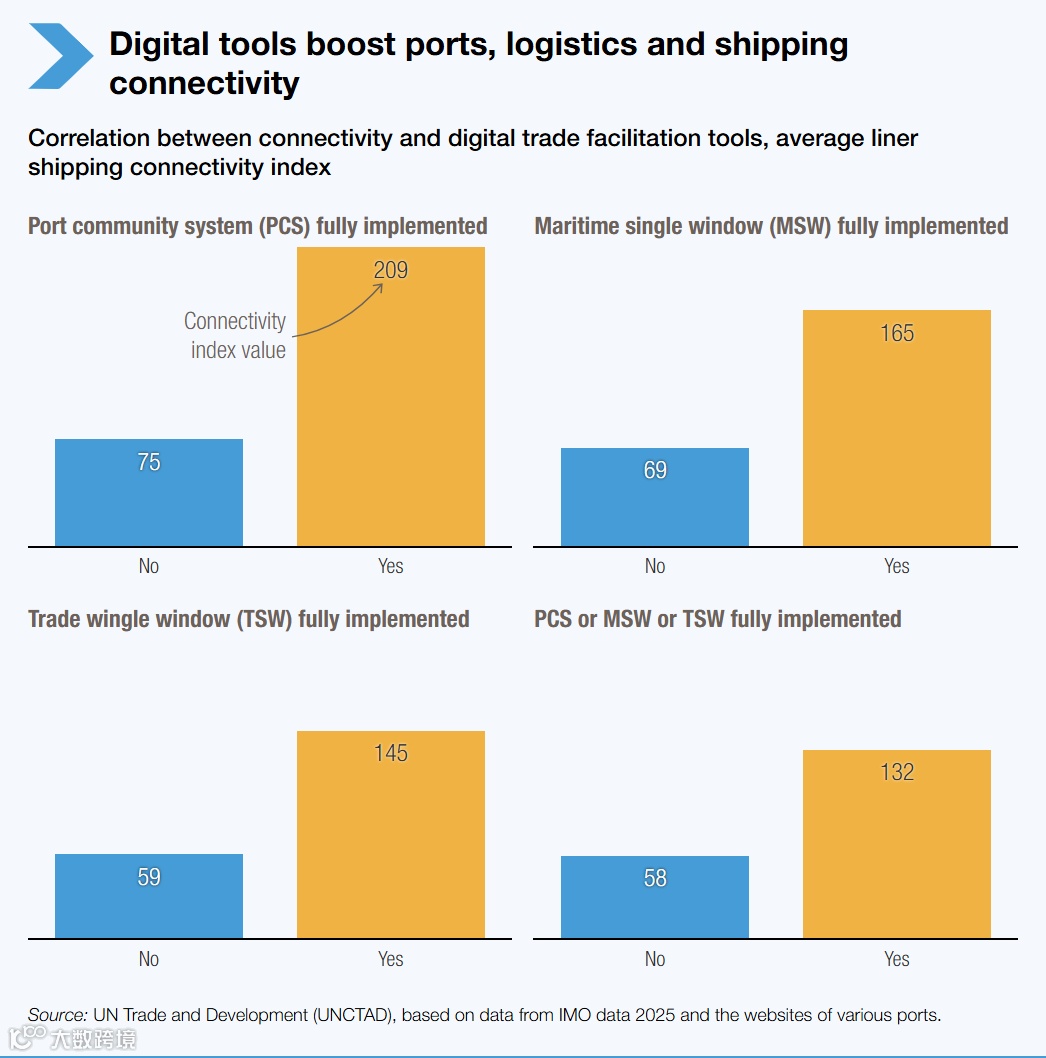
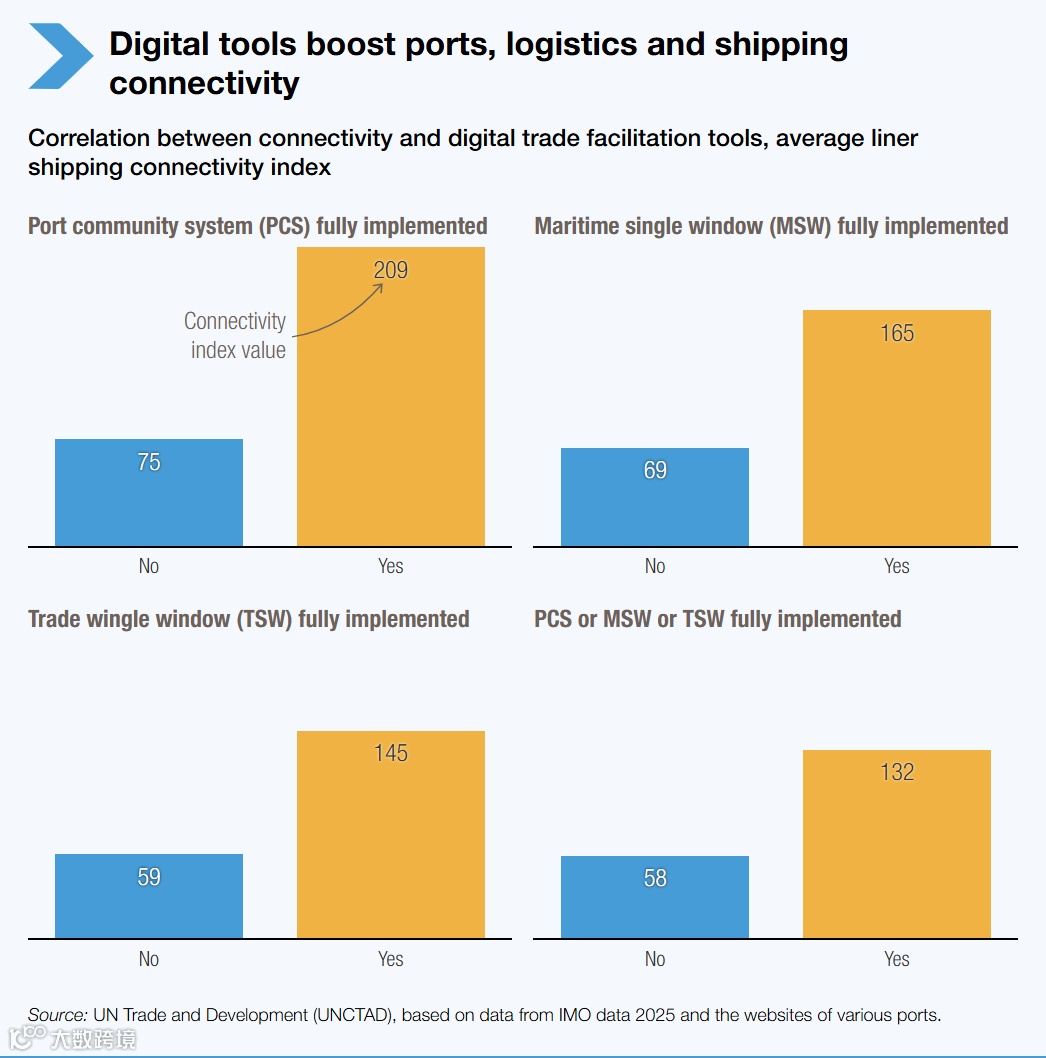
Digital trade facilitation tools boost performance in ports and other links in the transport chain. Trade single windows, maritime single windows and port community platforms help reduce inefficiencies and costs. Countries with such tools show stronger shipping connectivity and logistics performance.
Are international legal frameworks keeping pace with new challenges and opportunities?
Legal issues and regulatory developments
Global shipping is moving closer to global climate rules. In October, the IMO will consider the formal adoption of its Net-Zero Framework. This would set the course toward net-zero by 2050 by introducing a global fuel standard and carbon pricing mechanism for international shipping.
Revenues generated by the framework, if adopted, could help fund a just transition, including in small island developing states and least developed countries. But with significant investment needed to renew fleets, scale up alternative fuels and upgrade ports, mobilizing private finance will also be crucial.
Alternative fuels can cut emissions, but their use and carriage raise new safety and environmental risks that require attention. Adequate safety protocols and appropriate global rules on liability and compensation are needed. The IMO is beginning to review whether existing international liability regimes are adequate. This process provides vulnerable developing countries an opportunity to make their voices heard.
The world’s 1.9 million seafarers – most from developing countries – remain under strain. While recent amendments to the Maritime Labour Convention are encouraging, seafarer rights need more consistent implementation and enforcement, involving concerted action from flag states, port states and industry.
The Hong Kong Convention on ship recycling entered into force in June 2025, setting new global standards on safety and environmental sustainability. Its widespread ratification will be key to maximizing its impact.
The IMO is drafting a code for the safe, secure and environmentally sound operation of autonomous ships, to be finalized in 2026. It is also developing guidance or best practices on ship registration. All countries and industry stakeholders should engage in this important work.
What will it take to chart the right course?
10 actions for a sustainable and resilient maritime transport
Maritime transport stands at a pivotal juncture. It must transition to a sustainable, resilient and digitally enabled future while navigating an increasingly unpredictable operational landscape.
Priority actions for maritime transport stakeholders and governments, supported by UNCTAD, other international organizations and development partners, include the following:
Leverage maritime transport and logistics for equitable integration and transformation.
Plan and prepare for disruptions and uncertainty.
Promote fleet modernization and sustainable maritime business practices.
Protect and empower the maritime workforce and promote inclusiveness and upskilling.
Implement regulatory measures to reduce greenhouse gas emissions from international shipping, accelerate decarbonization and facilitate a just and fair energy transition.
Prepare for the safe handling, use and carriage of alternative fuels.
Leverage digital solutions and strengthen the regulatory framework to address cyber-risks.
Monitor port performance and leverage trade facilitation measures and tools.
Enhance capacity-building and support developing countries.
Strengthen and promote targeted collaboration on regulatory issues to address new challenges and foster sustainable and resilient maritime transport.
----------------------------------
About the Review of Maritime Transport
UNCTAD’s Review of Maritime Transport is the oldest annual flagship report of UNCTAD (1971) analyzing global maritime trade, fleet development, freight markets, ports, and legal and regulatory issues. The 2025 edition covers data and trends through mid-2025 and offers policy recommendations for governments, industry and international organizations.
----------------------------------
About UN Trade and Development
UN Trade and Development (UNCTAD) is dedicated to promoting inclusive and sustainable development through trade and investment. With a diverse membership, it empowers countries to harness trade for prosperity.
***
2025年海运回顾:在风浪中坚守航向
国际海运贸易
世界船队与航运服务
运费与海运成本
港口性能与海运贸易便利化
法律问题与监管动态
前行之路
海运与贸易正面临严峻挑战。曾经数日即可通过红海的船舶,如今需绕行好望角数周。运费高企且波动剧烈。港口中断正变得长期化。供应链的可靠性与韧性正面临考验。
更长的航线增加了延误、成本和排放,发展中国家受到干扰和不确定性的冲击尤为严重。
深刻的转型也在重塑该行业。技术、环境和地缘经济的转变正以前所未有的速度汇聚,这要求我们重新思考海运的运作方式。替代燃料船舶目前已占新订单船舶吨位的一半以上,但现役船队中仍有超过90%使用传统燃料。自动化和数字化虽能提高效率,但也加剧了网络风险。
海运业曾经历过风浪。但从未有如此多的转型如此迅速地同时发生。该行业将适应变化。问题在于,这种适应将是有序管理还是混乱无序,是包容共享还是制造分裂,是可持续的抑或仅仅是勉力维持。
《2025年海运回顾》提供了一个必要的行动和政策制定框架,以便在这个动荡的世界中保持贸易流通。
“未来的转型——向零碳、数字系统、新贸易路线的转型——必须是公正的转型。它们必须赋能于人,而非排斥;必须增强韧性,而非加深脆弱性。”雷贝卡·格林斯潘,联合国贸易和发展会议(UNCTAD)秘书长。
海运和贸易模式如何变化?
国际海运贸易
全球海运贸易面临压力。在2024年实现2.2%的温和增长后,海运贸易增速预计将在2025年放缓至0.5%,随后在2026-2030年间年均增长2%。
船舶改道增加了航行距离,导致吨英里数在2024年跃升5.9%,几乎是货运量增长率的三倍。
海运能源贸易格局也在发生变化。尽管长期呈下降趋势,煤炭贸易量有所增长;石油贸易量持平但航线更长;天然气贸易量增加。需求、地缘政治和多元化战略正在重塑能源流向、航运距离和能源贸易的地理格局。
关键矿物贸易正在扩大,这既带来机遇也伴随风险。这些发展正在重塑海运贸易,并对运输和物流提出新的要求。
未来的船队能否为航运脱碳做好准备?
世界船队与航运服务
截至2025年5月,通过苏伊士运河的吨位仍比2023年水平低70%。霍尔木兹海峡——全球贸易的11%和海运石油贸易的三分之一经由该海峡——也面临中断风险。改道更长的航线增加了2024年航运的碳排放。
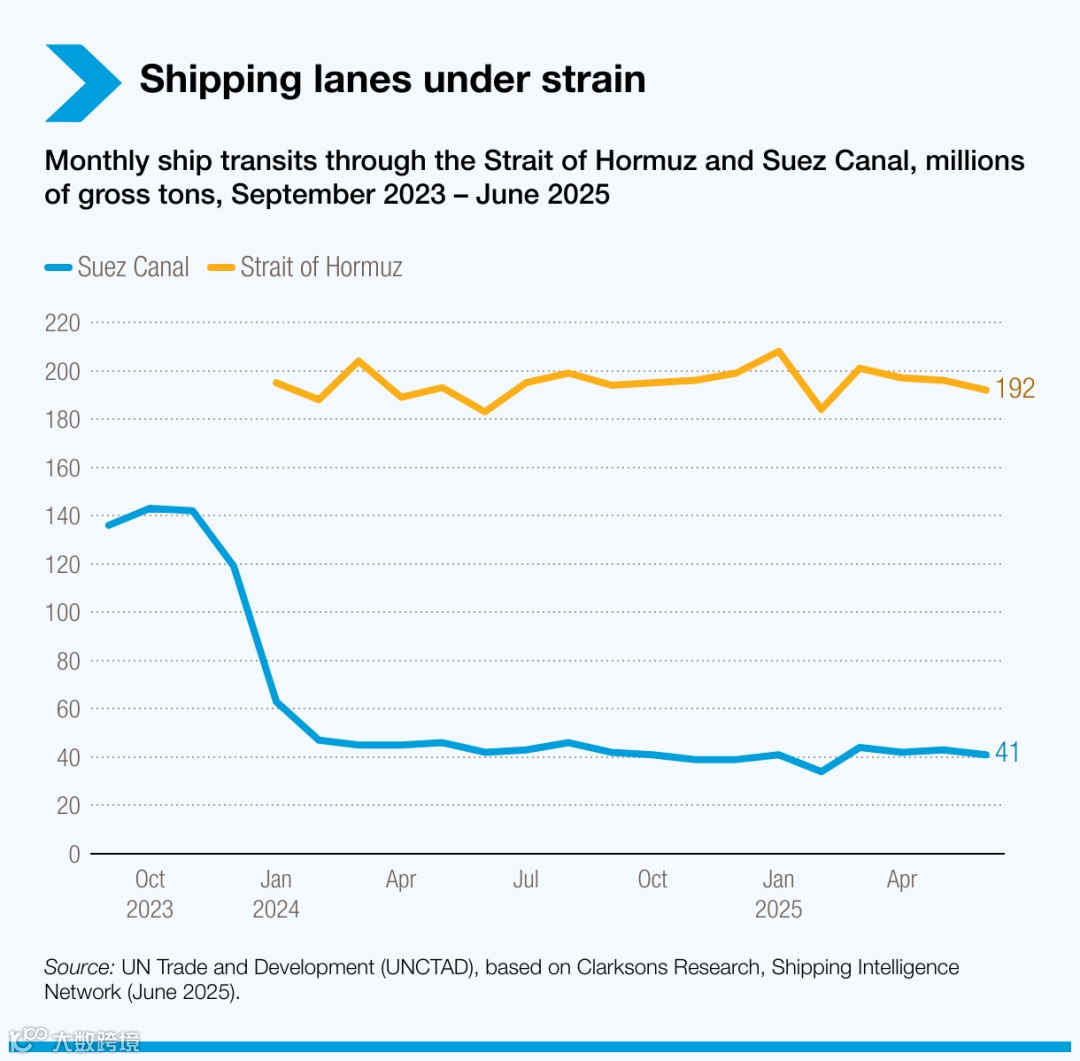
美国及其他地区的新贸易关税增加了复杂性。对发展中经济体而言,航线改变可能为一些港口带来转运机会,但也可能增加航运成本。
截至2025年1月,全球船队拥有112,500艘船舶,总计24.4亿载重吨。希腊、中国和日本控制了超过40%的运力,而近50%的运力仅注册在三个船旗国——利比里亚、巴拿马和马绍尔群岛。
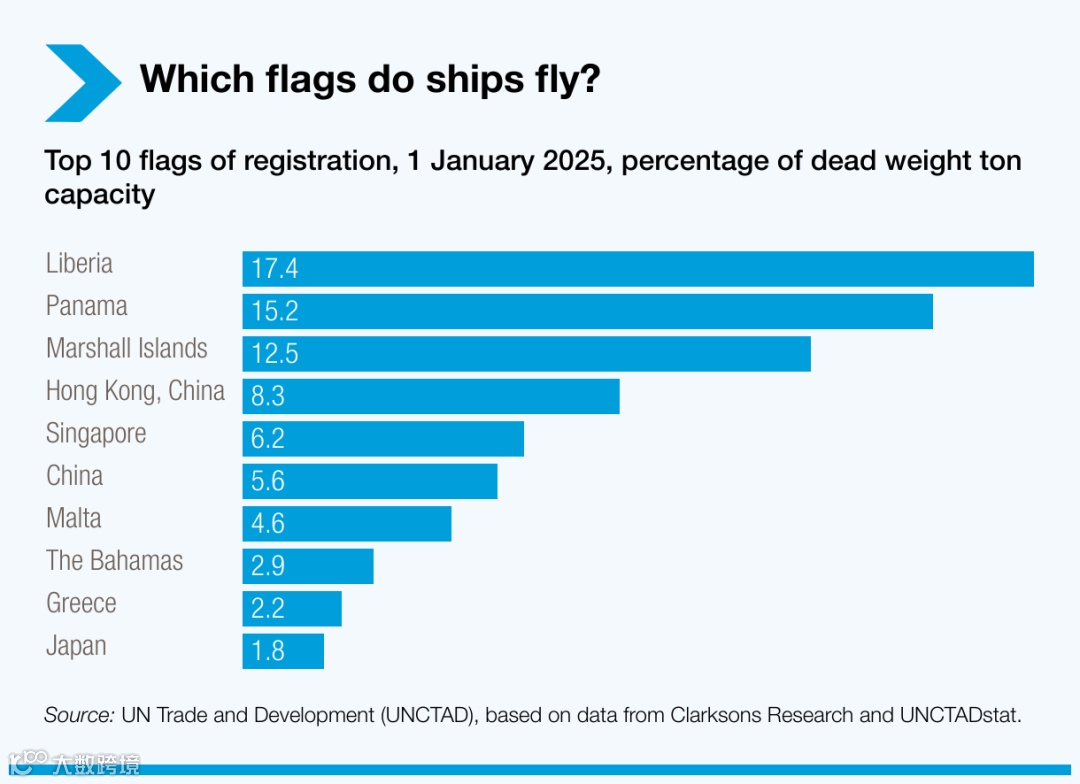
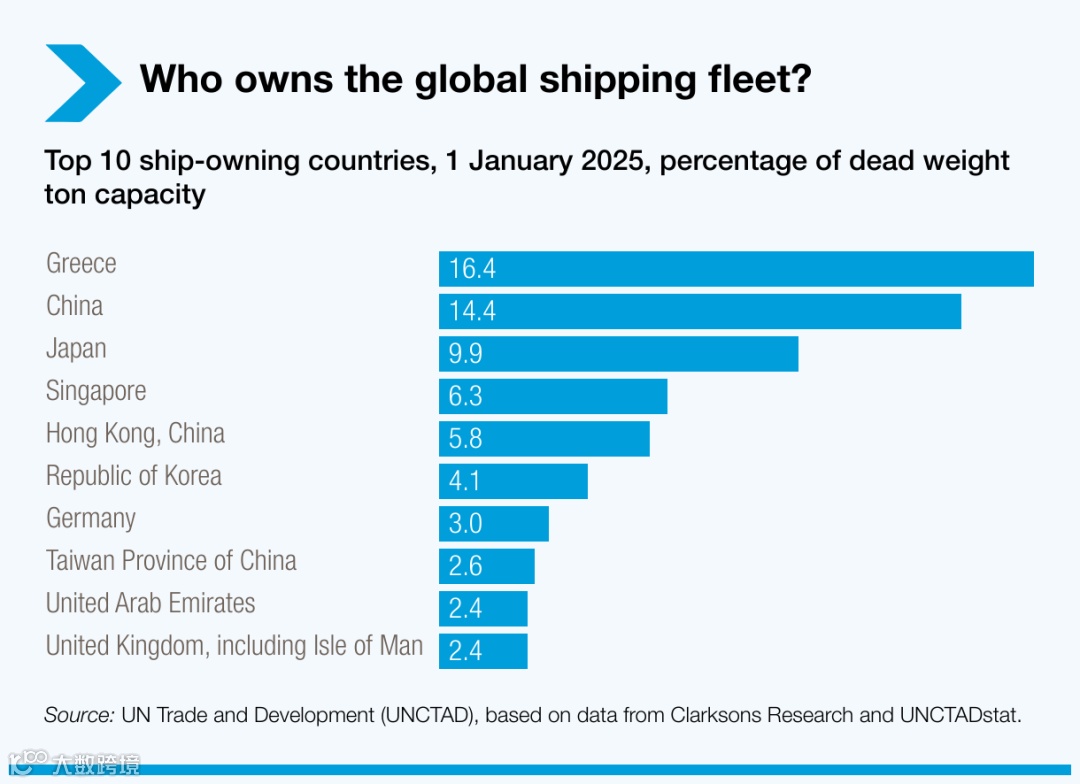
船队更新、安全的船舶回收、温室气体排放控制的全球规则以及熟练劳动力,对于及时、公正地向低碳航运转型至关重要。
运输成本如何应对中断和合规要求?
运费与海运成本
运费波动已成为新常态。集装箱、干散货和油轮运费在2024年和2025年保持高位且波动剧烈,在地缘政治紧张、贸易政策转变和供需失衡中大幅震荡。这种不稳定推高了全球贸易成本。
船舶改道延长了航程,削减了有效运力,并增加了运营成本。集装箱航运受到重创,现货和期租费率在2024年中接近新冠疫情峰值,随后有所缓解,但仍远高于危机前水平。随着新关税出台和霍尔木兹海峡中断风险,波动在2025年持续。
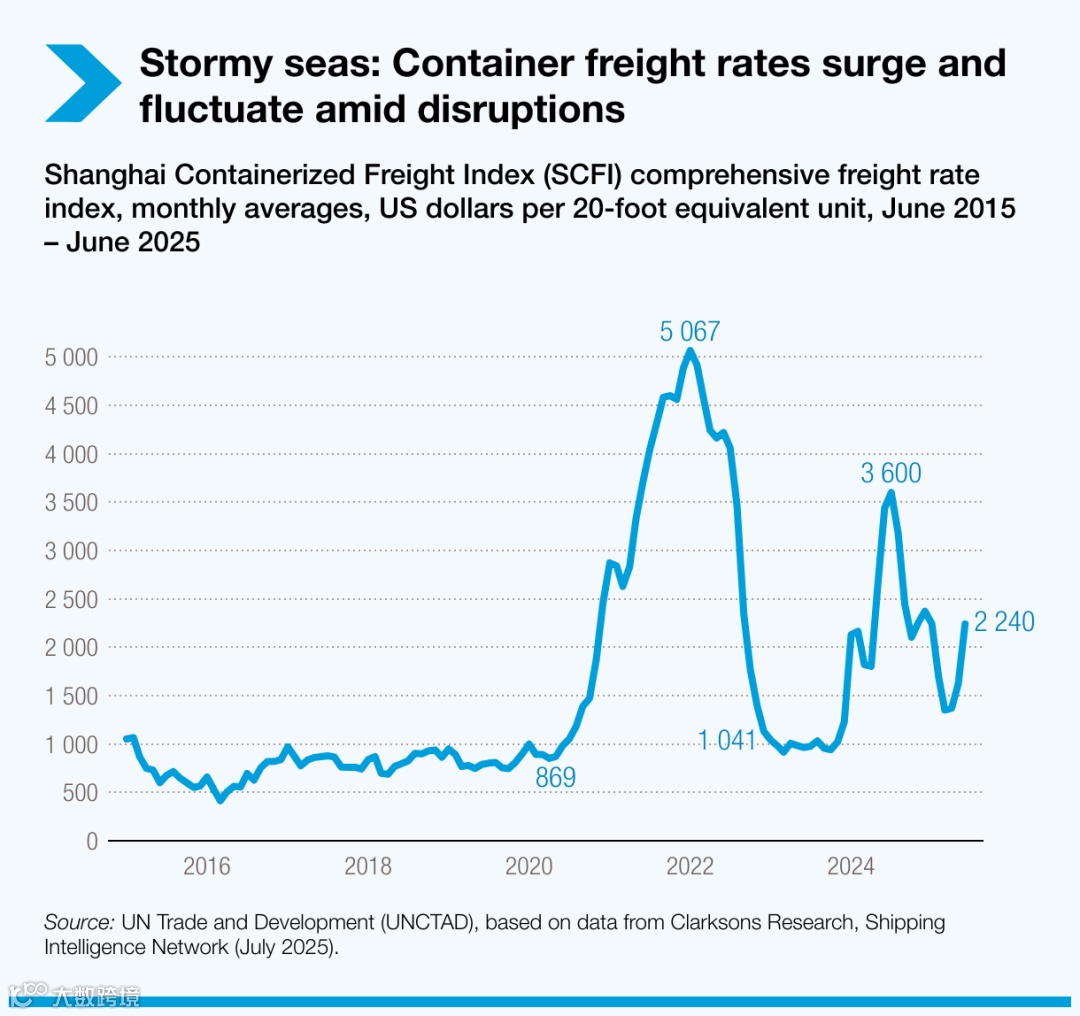
干散货运费在2024年因煤炭、谷物和化肥需求强劲、红海改道以及船队增长有限而飙升,随后在2025年走软。油轮市场则体现了其对地缘政治因素的敏感性,波动剧烈,费率在2025年6月达到峰值。
环境合规支出增加了航运成本的另一层。欧盟的排放定价开始影响运输成本、船队选择和各船型的竞争力。
港口性能和数字贸易便利化工具如何交叉?
港口性能与海运贸易便利化
随着船舶改道和挂靠港顺序重组打乱船期,港口的压力日益增大。在2023年12月至2024年3月期间,发达经济体的平均港口等待时间增加了23%,达到6.4小时;发展中国家的平均等待时间增加了7%,达到10.9小时。
提高港口性能日益紧迫,使港口基础设施和服务适应气候变化的影响,并为能源转型进行升级也同样重要。到2024年,约有200个港口提供LNG加注服务,且数量还在增加。
2025.各国的海运连通性模式也在发生变化。UNCTAD的班轮运输连通性指数显示,尽管亚洲保持领先地位,但非洲在2024年6月至2025年6月期间提升了10%。
港口不仅仅是基础设施和服务——它们由人驱动。然而,多样性仍然有限。如果配以包容性的培训,技术可以打开机遇之门。
数字贸易便利化工具提升了港口和运输链其他环节的性能。贸易单一窗口、海事单一窗口和港口社区系统有助于减少低效率和成本。拥有此类工具的国家表现出更强的航运连通性和物流性能。
国际法律框架是否跟上了新的挑战和机遇?
法律问题与监管动态
全球航运正朝着全球气候规则迈进。今年10月,国际海事组织(IMO)将审议正式通过其"净零框架"。该框架将通过为国际航运引入全球燃料标准和碳定价机制,设定2050年实现净零的路线。
如果该框架获得通过,其产生的收入可用于资助公正转型,包括支持小岛屿发展中国家和最不发达国家。但考虑到更新船队、扩大替代燃料规模和升级港口需要大量投资,调动私人融资也至关重要。
替代燃料可以减少排放,但其使用和运输带来了新的安全与环境风险,需要引起关注。需要制定充分的安全规程和适当的关于责任与赔偿的全球规则。IMO已开始审查现有的国际责任制度是否充分。这一进程为脆弱的发展中国家提供了发声的机会。
全球190万海员——大部分来自发展中国家——仍承受压力。虽然近期对《海事劳工公约》的修订令人鼓舞,但海员权利需要更一致地落实和执行,这需要船旗国、港口国和行业采取协同行动。
《香港国际安全与无害环境拆船公约》于2025年6月生效,为安全和环境可持续性设定了新的全球标准。其广泛批准对于最大化其影响至关重要。
IMO正在起草一部关于自动船舶安全、保安和环保操作的规则,预计于2026年定稿。同时也在制定关于船舶登记的指南或最佳实践。所有国家和行业利益相关方都应参与这项重要工作。
如何制定正确的路线?
可持续和韧性海运的十项行动10
海运业正处于一个关键转折点。它必须向可持续、韧性和数字化的未来转型,同时驾驭日益不可预测的运营环境。
在UNCTAD、其他国际组织和发展伙伴支持下,海运利益相关方和各国政府的优先行动包括:
利用海运和物流促进公平的一体化与转型。
规划和准备应对干扰与不确定性。
促进船队现代化和可持续的海运商业实践。
保护并赋能海运劳动力,促进包容性和技能提升。
实施监管措施以减少国际航运的温室气体排放,加速脱碳,促进公正公平的能源转型。
为安全处理、使用和运输替代燃料做好准备。
利用数字解决方案并加强监管框架以应对网络风险。
监测港口性能并利用贸易便利化措施和工具。
加强能力建设并支持发展中国家。
加强和促进针对监管问题的定向协作,以应对新挑战,培育可持续和韧性的海运。
关于《海运回顾》
联合国贸发会议的《海运回顾》是该机构历史最悠久的年度旗舰报告(始于1971年),分析全球海上贸易、船队发展、货运市场、港口以及法律和监管问题。2025年版涵盖了截至2025年中的数据和趋势,并为政府、行业和国际组织提供了政策建议。
关于联合国贸易和发展会议
联合国贸易和发展会议(UNCTAD)致力于通过贸易和投资促进包容性和可持续发展。凭借其多元化的成员,它帮助各国利用贸易实现繁荣。
***

本公众号所载内容为原创或来源于研究机构报告、官方网站动态新闻等整理、翻译与转载,转载内容版权归原作者所有,如涉及作品内容、版权或其他问题,请与本公众号联系。转载内容不代表本公众号的观点。本公众号拥有对此声明的最终解释权。 |
***凡事多躬行,莫做纸上兵***