📌 阅读原文,请点击文末“阅读原文”
【导读】
AI is Unlikely to Kill These 22 Maritime Jobs – It May Make Them Wildly More Valuable by 2030
November 28, 2025
In every serious scenario for “AI in shipping,” the same conclusion keeps coming back: the tech changes how people work, but it doesn’t remove the need for human judgment in high-risk, high-value parts of the chain.
The roles below are already being reshaped by AI, digital twins and decarbonisation rules and that combination is pushing top-end pay and demand up, not down. Salary ranges are ballpark high-side figures for experienced professionals on premium tonnage or in major hubs; actual packages vary by flag, rotation, tax, and vessel type.
 2-minute summary: 22 maritime jobs AI makes more valuable
Quick view of where each role sits, how AI helps, and rough high-side pay.
▼These 22 careers cluster around five themes: ship command and complex operations, engineering and OT, decarbonisation and finance, ports and terminals, and risk, safety and training. Across all of them, AI takes over routine monitoring and paperwork but leaves humans holding the licence, liability and negotiation. The table below lets you scan where each role lives, how AI boosts it, and an approximate high-side pay band for experienced people on strong tonnage or in major hubs.
|
|
|
|
|
|
|---|---|---|---|---|
|
|
|
|
|
|
|
|
|
|
|
|
|
|
|
|
|
|
|
|
|
|
|
|
|
|
|
|
|
|
|
|
|
|
|
|
|
|
|
|
|
|
|
|
|
|
|
|
|
|
|
|
|
|
|
|
|
|
|
|
|
|
|
|
|
|
|
|
|
|
|
|
|
|
|
|
|
|
|
|
|
|
|
|
|
|
|
|
|
|
|
|
|
|
|
|
|
|
|
|
|
|
|
|
|
|
|
|
|
|
|
|
|
|
|
|
|
|
|
|
|
|
|
|
|
|
|
|
|
|
|
|
*Pay bands are rough high-side estimates for experienced people on premium tonnage or in major hubs. Actual compensation will vary by region, employer, tax situation, rotation pattern and market cycle.
①
Master / Captain on Complex Tonnage (Tankers, LNG, Large Containers)
 Safety-critical · Human in command
Overall command of the vessel, cargo, crew and commercial performance. AI supports routing, collision avoidance and documentation, but liability and final decisions still sit with the master – especially on high-value, high-risk trades.
High-side pay (experienced)
~US$180k–US$220k+ annualised on blue-water tankers/LNG and major liner routes, with some contracts effectively higher when day-rates and rotations are factored in.
2030 outlook
Strong. More bridge automation increases the need for masters who can manage AI tools, take over instantly when systems misbehave, and carry legal responsibility in casualty or pollution cases.
Who hires
Major liner operators, tanker and LNG owners, offshore shuttle tanker fleets, national oil companies, and high-end tonnage managers.
②
Chief Officer / Cargo & Safety Management Lead
 Cargo risk · CII & safety
Turns voyage plans into workable cargo and stability plans, runs the safety culture on board, and increasingly manages emissions and CII performance in daily operations. AI can optimise stowage and trim, but someone still has to sign for cargo, stability and deck-side risk.
High-side pay (experienced)
~US$150k–US$190k annualised equivalent on LNG and high-risk tankers; 13k–16k USD/month on top gas tonnage is not unusual.
2030 outlook
Strong. Cargo complexity (wind, heavy-lift, batteries, chemicals) and emissions ratings make experienced chiefs who understand both safety and carbon economics more valuable, not less.
Who hires
LNG and LPG owners, oil/chem tanker fleets, heavy-lift/project carriers, container lines handling hazardous or temperature-controlled cargo.
③
Chief Engineer – Engines, Data & Digital Twins
 Fuel · Uptime · Complexity
Owns propulsion, fuel efficiency and machinery availability. AI-driven condition monitoring and digital twins flag issues earlier, but they still need a chief to interpret alarms, approve interventions and keep the ship trading.
High-side pay (experienced)
~US$170k–US$250k+ annualised on premium deep-sea tonnage, with some reported packages higher on specialised ships.
2030 outlook
Strong. Alternative fuels (LNG, methanol, ammonia), hybrid systems and more complex automation push mechanical and electrical complexity up – increasing demand for senior engineers who blend hands-on skills with data literacy.
Who hires
LNG and gas fleets, large container lines, offshore units, Ro-Ro and cruise operators transitioning to new fuels and complex hotel loads.
④
Electro-Technical Officer (ETO) / OT Systems Specialist
 Critical systems · Cyber & power
Keeps the digital nervous system of the ship alive – power electronics, networks, sensors, automation and cyber-resilience. As more AI is layered onto onboard systems, the ETO is the person who makes sure the data and hardware actually work.
High-side pay (experienced)
~US$140k–US$190k annualised on LNG, cruise and complex offshore units, with upper ranges on gas ships often 8k–13.5k USD/month.
2030 outlook
Very strong. Every extra sensor, camera, satellite link and AI module increases dependence on robust OT. ETOs with cyber-security and networking skills are especially in demand.
Who hires
LNG and LPG carriers, cruise ships, large container ships, offshore construction vessels, DP vessels and digitally-heavy ferries.
⑤
Dynamic Positioning (DP) Operator – Offshore, Wind & Subsea
 Precision · High day-rates
Keeps vessels locked on position for drilling, cable-laying, heavy-lift and offshore wind. AI can support thruster control and risk prediction, but a certified DPO still has to interpret the situation, authorise actions and handle failures.
High-side pay (experienced)
~US$160k–US$220k/year equivalent for senior DPO/SDPO roles, with reported averages around US$160k and top earners near US$300k.
2030 outlook
Strong. Offshore wind growth, subsea cables and complex construction campaigns keep DP demand high. Automation will tighten tolerances and reduce error, but will not remove the need for a human DPO on the console.
Who hires
Offshore drillers, OSV owners, cable-lay and construction vessel operators, offshore wind contractors and subsea specialists.
⑥
Alternative Fuels Operations Officer (LNG, Methanol, Ammonia)
 New fuels · High hazard
Specialises in bunkering, fuel quality, boil-off, safety envelopes and emissions rules for LNG, methanol and ammonia. AI can help monitor risks and optimise consumption, but physical operations and incident response stay firmly human.
High-side pay (experienced)
~US$120k–US$190k annualised for officers on gas carriers and alternative-fuelled newbuilds, with chief officers on LNG sometimes exceeding 15–16k USD/month.
2030 outlook
Very strong. Decarbonisation roadmaps show tens of thousands of seafarers requiring upskilling in new fuels by 2030, and AI tooling makes fuel specialists more productive instead of replacing competence.
Who hires
LNG/LPG and future ammonia carriers, methanol-fuelled container and Ro-Ro fleets, bunkering companies and fuel-focused operators in green corridors.
⑦
Remote Operations Centre (ROC) Watchstander / Remote Vessel Operator
 MASS · Human in the loop
As higher levels of automation and MASS trials roll out, many watchkeeping tasks move into shore-based control rooms. ROC operators oversee multiple vessels, monitor AI systems, and step in when something looks wrong or a manual decision is needed.
High-side pay (experienced)
~US$100k–US$140k/year for senior remote operations controllers in specialised centres; typical ranges today around US$70k–US$110k.
2030 outlook
Strong. Most realistic MASS roadmaps add ROC jobs faster than they remove onboard billets, particularly for complex coastal, offshore and high-risk trades.
Who hires
Large operators piloting autonomous/remote vessels, offshore service companies, ferry operators, and tech platforms offering “remote bridge” services.
⑧
Fleet Performance Manager / Fuel Efficiency Lead
 Emissions · Cost & CII
Sits at the intersection of technical, commercial and data. Uses AI and analytics to tune speed, trim, routing, hull condition and engine settings across an entire fleet – and then translate that into cash and CII scores.
High-side pay (experienced)
~US$140k–US$190k/year in major hubs, with reported averages for similar fleet manager roles around US$75k–US$135k before bonus.
2030 outlook
Very strong. EU ETS, CII and FuelEU Maritime push fleet-wide optimisation to board level. AI increases leverage, but owners still want humans who can choose trade-offs, challenge models and explain savings to charterers.
Who hires
Blue-chip liner companies, major tanker owners, bulk fleets with performance programmes, and software vendors offering managed optimisation services.
⑨
Voyage Optimisation Analyst / Weather Routing Specialist
 Weather · TCE & ETA
Works behind AI-driven routing tools and port-call platforms, blending forecasts, congestion data, charter-party terms and bunker prices into practical route choices. The AI proposes options; the analyst decides what is acceptable for safety, TCE and emissions.
High-side pay (experienced)
~US$110k–US$160k/year in large trading hubs, based on similar marine operations and analytics roles in liner companies and weather-routing providers.
2030 outlook
Strong. Voyage optimisation is a prime AI use-case, but counter-party risk, weather uncertainty and emissions clauses mean humans still own the final call on “sensible risk” vs. “paper optimisation”.
Who hires
Weather-routing companies, voyage optimisation SaaS vendors, large tramp owners and chartering desks, and liner network planning teams.
⑩
Port Captain / Marine Superintendent
 Incidents · Vetting & people
Sits at the junction of ship, port and office. Handles vetting, incident investigations, mooring and terminal issues, local regulations and the messy human parts that AI platforms cannot cleanly solve.
High-side pay (experienced)
~US$140k–US$200k/year in major ports and for senior superintendent roles, with typical ranges today around US$90k–US$140k.
2030 outlook
Strong. As port-call optimisation tools and AI ETAs spread, companies still need humans who can negotiate with terminals, pilots and local authorities – and take ownership when things go wrong.
Who hires
Shipowners and managers, oil majors, terminal operators, vetting-heavy charterers and P&I clubs needing embedded marine expertise.
⑪
Predictive Maintenance Planner / Reliability Engineer (Shore-Based)
 Data-driven uptime · Drydock strategy
Turns sensor data, AI alerts and class requirements into practical maintenance plans. Instead of fixed-interval overhauls, this role uses condition monitoring and digital twins to time drydocks, arrange riding squads and keep ships trading with minimal surprises.
High-side pay (experienced)
Often ~US$110k–US$160k+ in major hubs for senior planners and reliability leads, with higher total compensation where bonus and ship performance incentives are tied to uptime.
2030 outlook
Strong. More sensors and more AI means more maintenance decisions to prioritise and justify. Owners need people who can challenge false positives, schedule work windows and explain the cost case to finance teams.
Who hires
Large shipmanagers, offshore fleets, cruise operators, engine makers, OEMs with remote monitoring centres, and class-linked digital service arms.
⑫
Maritime Decarbonisation Strategist / Sustainability Officer
 Fleet transition · Carbon roadmaps
Designs the company’s path through CII, EU ETS, FuelEU Maritime and future IMO rules. Combines technical options (retrofits, new fuels, newbuilds) with commercial strategy, finance and customer pressure to build a realistic decarbonisation plan.
High-side pay (experienced)
Senior decarb leaders in big groups can reach ~US$130k–US$200k+ total compensation, especially where the role reports into the C-suite or global sustainability teams.
2030 outlook
Very strong. Rules are tightening and customers increasingly demand firm transition plans. AI helps with scenario modelling, but people still decide what risks to take and which pathways fit the company’s capital and risk appetite.
Who hires
Blue-chip shipowners, liner groups, energy majors, commodity houses with owned tonnage, major logistics providers and maritime technology alliances.
⑬
EU ETS & Carbon Compliance Manager (ETS, CII, FuelEU Maritime)
 Allowances · MRV · Contracts
Owns emissions reporting, allowance planning and cost allocation across fleets and charter-parties. Uses AI dashboards and MRV data, but remains accountable for data quality, audits and who ultimately pays for carbon on each voyage or trade.
High-side pay (experienced)
In larger owners and operators, total compensation can sit roughly in the ~US$110k–US$170k band for senior carbon compliance and ETS managers, with upside where trading exposure is significant.
2030 outlook
Strong. As more regions add shipping to carbon pricing schemes, data and contracts get more complex. AI streamlines number crunching, but regulators and auditors still expect a named human responsible for the figures.
Who hires
European-focused shipowners and managers, commodity traders, liner groups, emissions trading desks, and specialist maritime compliance consultancies.
⑭
Green Finance / Sustainability-Linked Shipping Finance Specialist
 Capex · Covenants · ESG KPIs
Structures loans, leases and bonds where pricing is linked to emissions and efficiency. Uses climate and performance models, but must understand ships, regulations and credit to set realistic KPIs that both banks and owners can live with over a 5–10 year horizon.
High-side pay (experienced)
Senior specialists in major finance centres can reach ~US$150k–US$250k+ including bonus, depending on deal volume and responsibility for origination and structuring.
2030 outlook
Very strong. Regulators, lenders and charterers are all pushing for greener fleets. AI helps with portfolio analytics, but deal-making, negotiation and risk appetite remain stubbornly human.
Who hires
Shipping banks, leasing houses, export credit agencies, PE funds, and large owners with in-house finance and treasury teams.
⑮
Safety Management System Architect / AI-Aware Compliance Manager
 ISM · Procedures · Human factors
Designs and maintains the Safety Management System and procedures that crews actually follow. Uses AI tools to draft, search and analyse incidents, but stays responsible for keeping the SMS realistic, compliant and aligned with how ships really operate.
High-side pay (experienced)
Senior HSEQ and compliance managers in global fleets can reach roughly ~US$110k–US$170k+ depending on fleet size and regulatory exposure.
2030 outlook
Strong. Regulators are cautious about AI in safety-critical systems. That increases the need for human gatekeepers who understand both automation and the limits of what can be safely delegated to software.
Who hires
Shipowners and managers, offshore operators, passenger and ferry companies, class-linked advisory units and P&I clubs providing safety support.
⑯
Port Call Optimisation Coordinator / Port Community System Lead
 Berth windows · Just-in-time arrivals
Uses port-call and PCS platforms to get ships, terminals, pilots, tugs, trucks and customs working from the same data. AI predicts congestion and delays, but this role negotiates the reality: who moves when, and how to cut idle time without upsetting local stakeholders.
High-side pay (experienced)
Roughly ~US$100k–US$160k+ in larger ports and hub roles, with upside where the job is tied to measurable savings and schedule reliability metrics.
2030 outlook
Strong. Port-call optimisation is one of the most active areas for AI and digitalisation, but still depends on humans who can align incentives across a fragmented port ecosystem.
Who hires
Major port authorities, terminal operators, liner companies with port-call teams, and tech vendors offering port-call and PCS platforms.
⑰
Terminal Automation & Yard Optimisation Manager
 Cranes · Yard plans · Gate flows
Oversees algorithms and operating rules for automated cranes, yard blocks and truck gates. AI helps forecast flows and suggest plans, but humans still design rules, manage labour agreements and handle disruptions like storms, strikes or vessel bunching.
High-side pay (experienced)
Senior automation and yard optimisation managers can earn roughly ~US$120k–US$200k+ depending on terminal size, union environment and 24/7 coverage responsibility.
2030 outlook
Strong. More terminals are automating, but fully “hands-off” yards remain rare. Experience in both operations and algorithms is a scarce combo that AI systems actually rely on.
Who hires
Global terminal operators, large regional ports, specialist automation vendors and consulting firms focused on port and yard performance.
⑱
Maritime Cybersecurity / OT Security Officer (Ship & Port)
 Networks · OT · Incident response
Protects shipboard and port operational technology from ransomware, spoofing and other cyber risks. AI can help detect anomalies, but someone still has to design architecture, run drills, talk to class and insurers, and manage real incidents at 03:00 UTC.
High-side pay (experienced)
Skilled OT security leads can see compensation in the ~US$130k–US$200k+ range, particularly when combining maritime operational experience with recognised cyber certifications.
2030 outlook
Very strong. Every extra sensor, AI module and remote connection increases the attack surface. Regulators and insurers are paying closer attention to cyber risk, not less.
Who hires
Shipowners and managers, ports and terminals, navies and coastguards, classification societies, cyber consultancies and insurers with cyber programmes.
⑲
P&I Loss Prevention Specialist / Marine Risk Engineer
 Claims trends · Onboard training
Uses casualty data, near-miss reports and site visits to reduce claims. AI can surface patterns, but this role turns them into practical guidance, seminars and checklists that crews and shore staff will actually follow under pressure.
High-side pay (experienced)
Senior loss prevention and marine risk engineers can see packages in the ~US$130k–US$200k+ range, particularly in major P&I clubs and broking houses.
2030 outlook
Strong. Rising hull, cargo and liability costs keep loss prevention firmly on the agenda. AI enriches the risk picture but does not replace the need for experienced mariners to translate it into behaviour change.
Who hires
P&I clubs, marine insurers, brokers, classification societies and large owners with in-house loss prevention teams.
⑳
Sanctions, Trade & KYC Screening Analyst (Maritime Focus)
 Ownership webs · Dark activity
Reviews counterparties, vessels and trades for sanctions and financial crime risk. AI helps with screening and vessel behaviour analytics, but contentious cases still need human judgment on beneficial ownership, flags of convenience and deceptive patterns.
High-side pay (experienced)
Senior maritime sanctions and KYC specialists can see compensation in the ~US$100k–US$170k+ band, particularly in large banks, trading houses and energy majors.
2030 outlook
Strong. Sanctions regimes and enforcement activity remain volatile. AI reduces manual screening but pushes more complex edge cases to experienced analysts who can defend their decisions to regulators.
Who hires
Banks, commodity traders, oil and gas majors, shipping groups with high sanctions exposure, and specialised maritime intelligence providers.
㉑
Maritime Simulator Instructor / Digital Twin Training Specialist
 Skills · Scenarios · Human factors
Designs and runs bridge, engine-room and port simulations that mirror AI-rich, highly automated environments. Helps crews and shore staff learn how to work with decision-support tools, understand new failure modes and maintain situational awareness when automation is doing more of the routine work.
High-side pay (experienced)
Experienced simulator instructors and training centre leads can see ~US$90k–US$150k+ in busy hubs, with upside when managing large facilities or global training programmes.
2030 outlook
Strong. Decarbonisation, MASS and new fuels all require large-scale upskilling. Simulator-heavy training is the only realistic way to rehearse complex, rare, high-stakes scenarios safely.
Who hires
Maritime academies, shipping companies with in-house simulators, navies and coastguards, pilotage organisations, training vendors and port authorities.
㉒
Maritime AI Enablement Lead / Data Product Manager
 Translating ships · Data · AI
Acts as the “glue” between seafarers, charterers, port captains, engineers and data/AI teams. Chooses which real problems to attack with AI, defines data products, and makes sure tools are usable, trusted and actually change behaviour across fleets and offices.
High-side pay (experienced)
In large groups, senior AI enablement and data product roles with deep maritime background can reach ~US$150k–US$230k+ including bonus, reflecting their leverage across multiple business units.
2030 outlook
Very strong. Many AI projects fail not for technical reasons but because they miss real operational context. Companies are learning they need domain-heavy product owners who can speak both “bridge” and “backend”.
Who hires
Large shipowners and operators, maritime SaaS and optimisation vendors, port and terminal tech teams, and logistics platforms investing heavily in AI.
AI isn’t a bulldozer flattening maritime careers; it’s more like a force multiplier sitting on top of the people who already carry risk, hold licences and understand how ships, ports and cargoes work in the real world. The common theme across these 22 roles is that AI takes away some of the grunt work and adds a layer of data and complexity, but leaves humans fully responsible for judgment, liability and negotiation.
For shipowners, managers and port leaders, the play is likely: protect and grow these roles, don’t hollow them out. Invest in upskilling seafarers and shore staff into the data and AI layer, pair strong domain people with technologists, and treat “human + AI” as a new standard watchkeeping team, not a short-term cost-cutting trick.
***
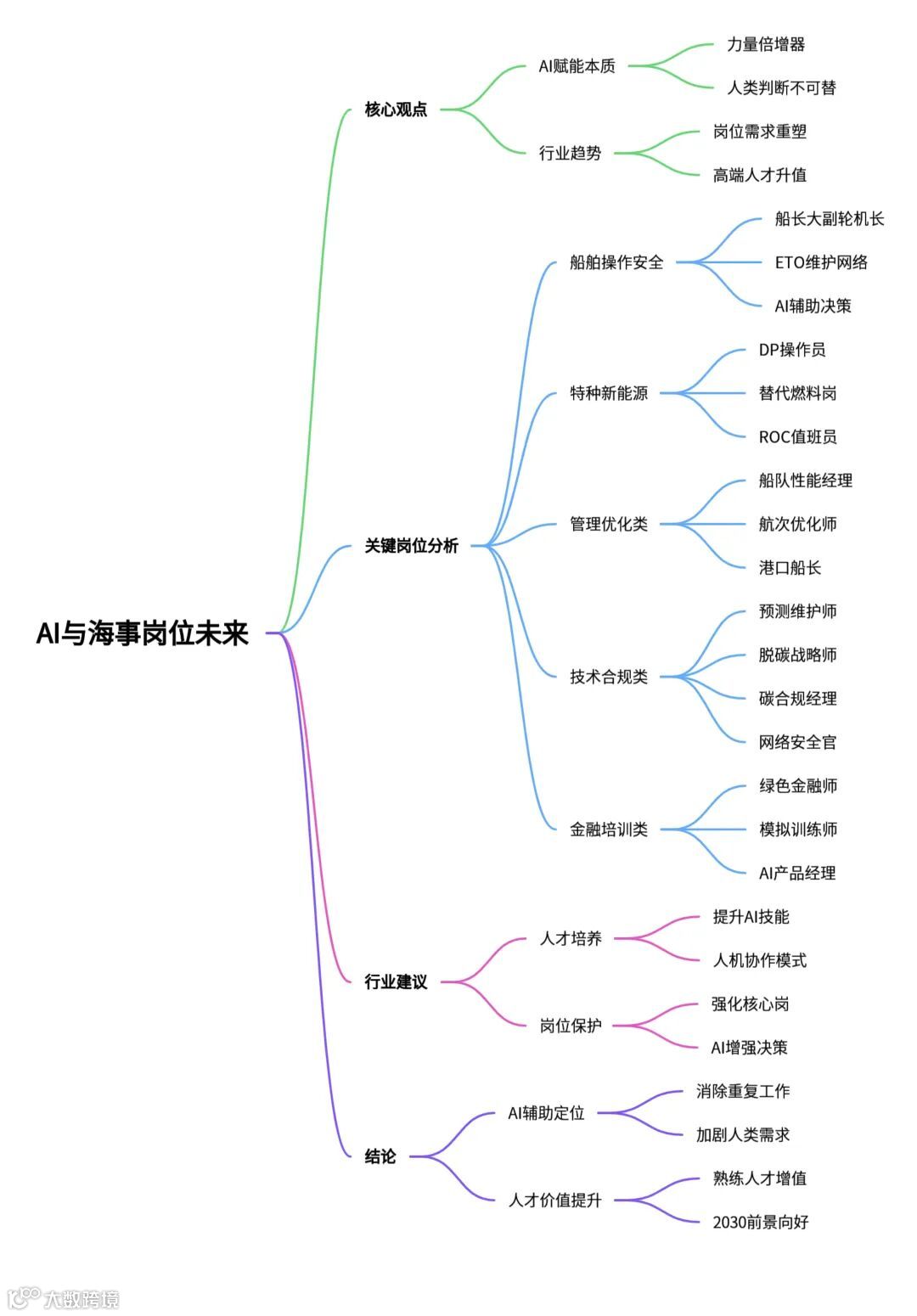
【总结】这篇题为《AI不太可能淘汰这22个海事岗位——到2030年它可能让它们变得更有价值》的文章详细分析了人工智能在海事行业中对关键岗位的影响。文章核心观点:
AI不是替代,而是赋能:AI不会大规模取代海事岗位,而是作为“力量倍增器”提升人类决策效率。在高风险、高价值的环节,人类判断、法律责任和谈判能力仍不可替代。
趋势:AI、数字孪生和脱碳法规正在重塑岗位需求,反而推高了高端人才的薪资和需求。
AI在海事行业的作用是辅助而非取代,它消除了部分重复性工作,但加剧了对人类判断、责任承担和复杂场景处理能力的需求。到2030年,熟练掌握AI工具的专业人才价值将显著提升。
***
本公众号所载内容为原创或来源于研究机构报告、官方网站动态新闻等整理、翻译与转载,转载内容版权归原作者所有,如涉及作品内容、版权或其他问题,请与本公众号联系。转载内容不代表本公众号的观点。本公众号拥有对此声明的最终解释权。 |
***凡事多躬行,莫做纸上兵***