

In the digital era, data is the lifeblood of every organization—powering operations, decision-making, and innovation. But when data flows slow, lag, or break, business operations lose visibility and agility. This challenge becomes even greater in SAP HANA environments, where real-time data synchronization with Kafka message queues can be both technically complex and performance-sensitive.
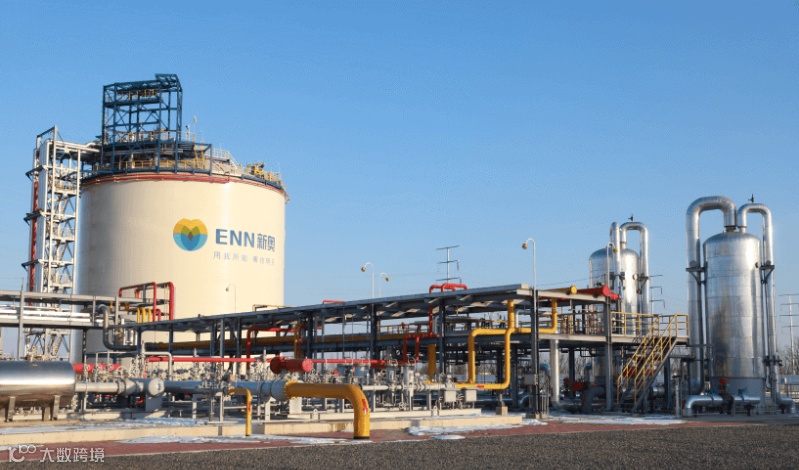
One leading gas and energy enterprise sought to enhance operational efficiency and decision-making through digital transformation. However, as the company’s business expanded, it faced increasing demands for real-time synchronization of large-scale production data between its SAP HANA database and Kafka.
To achieve this, the enterprise needed a high-performance, stable, and low-impact synchronization solution—one that could deliver real-time insights while minimizing the load on production systems.
Two Attempts, One Persistent Challenge
The company tried two different approaches before finding success—but neither fully met its requirements.
Attempt 1: SAP Data Intelligence Cloud + Kafka
The first approach used SAP’s Data Intelligence Cloud in combination with Kafka. While theoretically feasible, the real-world results fell short:
Significant impact on production performance: The solution relied on trigger-based mechanisms, which introduced latency and high overhead under large data volumes.
Complex configuration and maintenance: The tool required deep technical expertise for setup and daily management, making long-term maintenance costly and cumbersome.
Attempt 2: SAP Native Tools → MySQL/Oracle → Third-Party Kafka Connector
In the second attempt, the company synchronized data from SAP to MySQL or Oracle using native tools, then pushed it to Kafka via a third-party connector. However, this setup still faced key problems:
Unnecessary middleware: The multi-hop architecture added layers of complexity and maintenance cost.
Latency and consistency issues: Each additional layer introduced synchronization delays and risked data inconsistency—falling short of real-time reliability standards.
i2Stream: One Solution That Changed Everything
After the two failed trials, the enterprise turned to Information2’s i2Stream, which finally provided the optimal solution. By directly analyzing SAP HANA database logs to capture changes, i2Stream—officially supported by SAP HANA—achieved real-time, low-latency synchronization between SAP and Kafka.
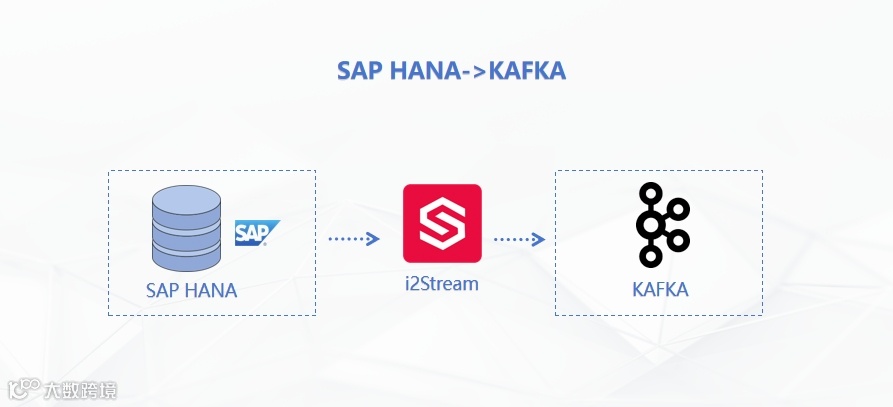
i2Stream continuously parses HANA transaction logs to capture incremental data changes and uses streaming data processing technology to ensure high-performance synchronization across heterogeneous environments. It supports both DML and DDL synchronization, ensuring data completeness, consistency, and structural alignment across platforms—even under high concurrency scenarios.
Project Highlights
1. Minimal Impact on Production
Unlike traditional trigger-based approaches, i2Stream extracts incremental data directly from HANA logs. This method dramatically reduces production system load, allowing synchronization to run smoothly without disrupting daily operations.
2. Efficient Real-Time Synchronization
Leveraging SAP HANA’s Operational Data Provisioning (ODP) technology, i2Stream uses ODP_RESET, ODP_OPEN, and ODP_FETCH interfaces to achieve precise incremental synchronization. Compared to conventional tools, i2Stream delivers faster, more accurate synchronization with Kafka—meeting stringent real-time business requirements.
3. Flexible Customization and Integration
Information2 also provided customized configurations to match the customer’s business needs. From synchronization frequency to data format adjustments, i2Stream was tailored for optimal stability and reliability in production.
Ultimately, i2Stream achieved seamless incremental synchronization from SAP HANA to Kafka, using JCO-driven ODQMON integration combined with ODP technology. The deployment proved simple, efficient, and stable—minimizing production impact while ensuring accurate, real-time data delivery.
Every detail in data synchronization affects the speed and precision of enterprise decision-making. With i2Stream, the energy company gained the ability to process and analyze real-time data without delays—boosting both operational efficiency and competitiveness.
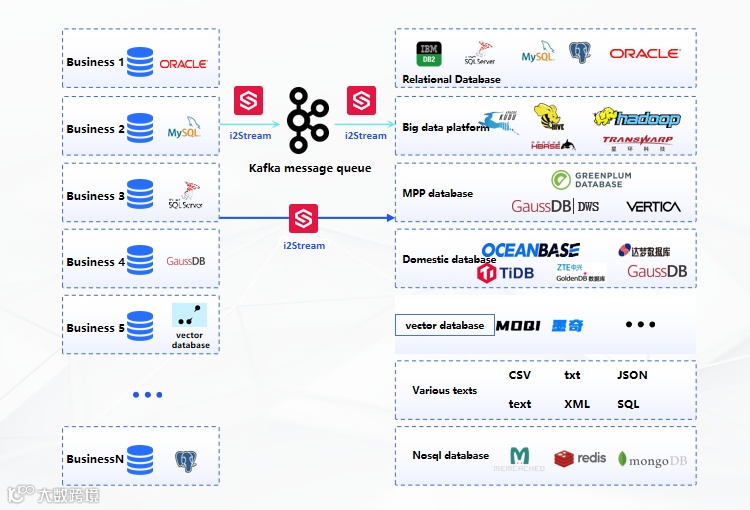
Today, i2Stream supports more than a dozen mainstream databases, including Oracle, MySQL, SQL Server, PostgreSQL, DB2, Kudu, Hive, and HBase, offering enterprises a unified, high-performance platform for continuous, real-time data synchronization.

Contact Us and Free Trial:
support.global@info2soft.com