📌 阅读原文,请点击文末“阅读原文”
【问问ima】生成播客: Annual_progress_r... https://ima.qq.com/share/#/ai-chat/XteFIhTCZ
China, India, and Brazil move on green shipping corridors as industry awaits climate regulations
27 November 2025
Annual progress report on green shipping corridors finds 25 new zero-emission trade routes launched in 2025, bringing total to 84 worldwide.
China, India, and Brazil look to capture major opportunities in zero-emission shipping amidst regulatory uncertainty.
Report warns against ‘wait and see’ attitude following delay to the International Maritime Organization’s (IMO) Net-Zero Framework.
Report calls for action at the national level to drive progress, create first-mover advantage, and position for early access to future IMO incentives.
27 November 2025, Copenhagen – The movement to create green shipping corridors – trade routes designed to demonstrate and scale novel zero-emission fuels, vessels, and technologies – has expanded in numbers and geographic scope, according to a new progress report published today by the Getting to Zero Coalition and the Global Maritime Forum.
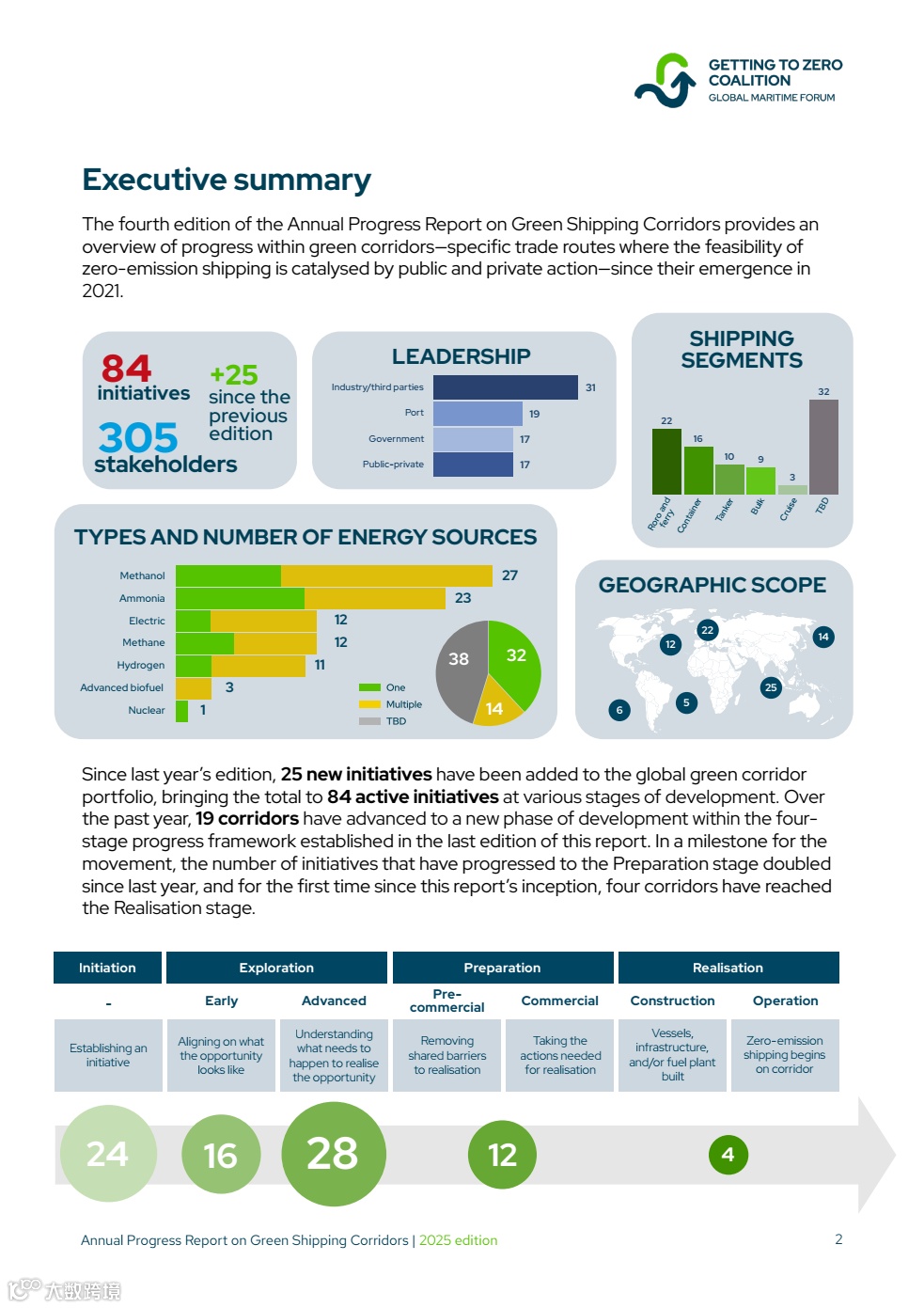
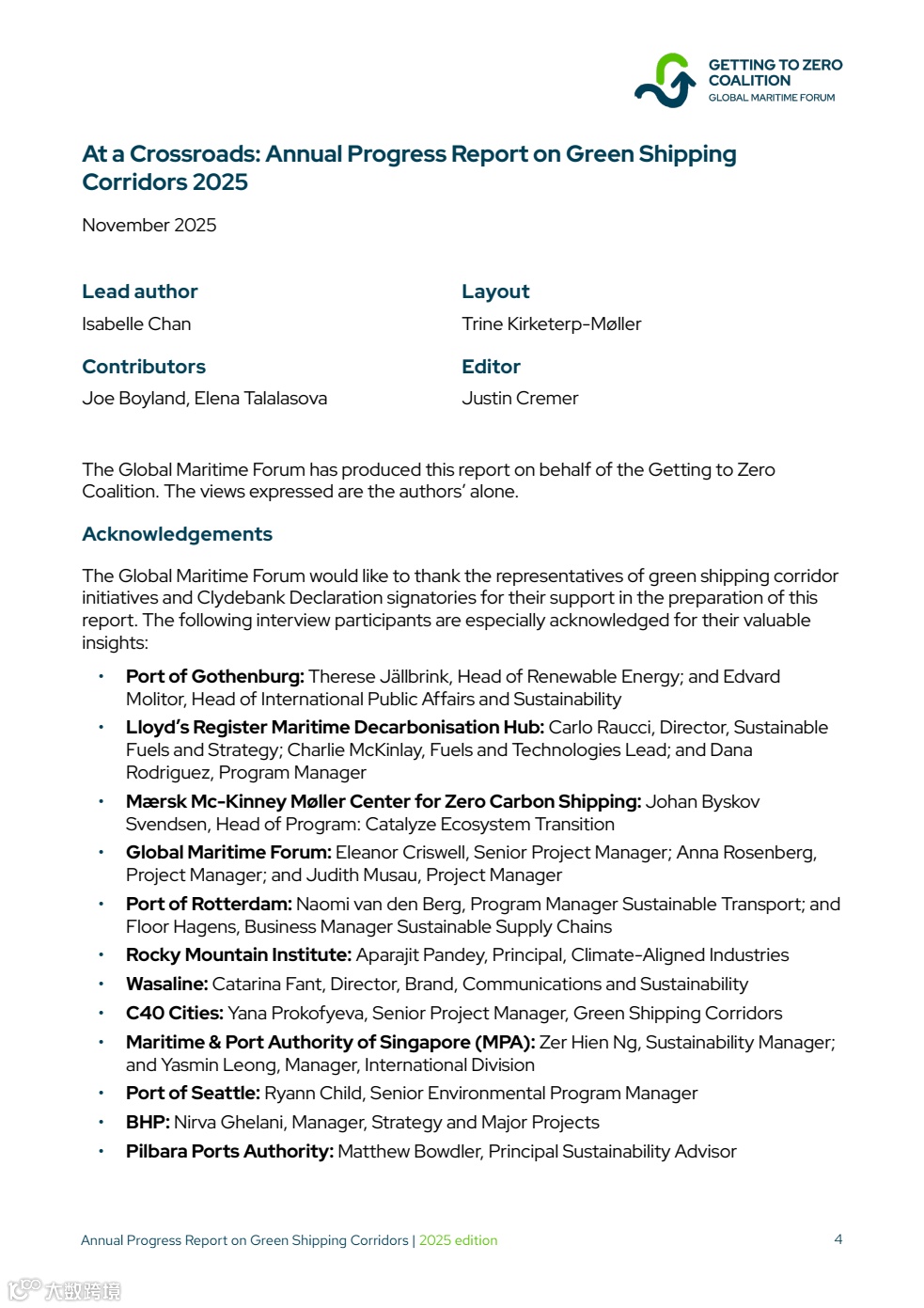
This year’s edition, At a Crossroads: Annual Progress Report on Green Shipping Corridors 2025, identifies 25 new green corridor initiatives, expanding the global total to 84 active initiatives. Initiatives have been launched in major developing economies like China, India, Brazil, Chile, Ghana, and Kenya, reflecting the significant economic opportunities that can be seized through the development of zero-emission marine fuels and bunkering capabilities in these regions.
The news comes only a month after discussions to adopt the International Maritime Organization’s (IMO) landmark Net-Zero Framework, designed to establish a path for shipping to reach net-zero emissions by 2050, were delayed for at least one year.
“The move of major countries like China, India, and Brazil into green corridors is hugely promising, as these are markets that will determine whether zero-emission shipping scales fast enough to meet global climate goals,” Jesse Fahnestock, director of decarbonisation at the Global Maritime Forum, said. “But even more importantly, we’re seeing recognition from these countries that green corridors are more than just environmental projects – they are strategic economic infrastructure. Countries that move early stand to gain competitive industrial and geopolitical advantages across energy, trade, and technology.”
For the first time since the report’s inception in 2022, four green shipping corridors have now reached the ‘realisation stage’, an important milestone at which the construction and/or operation of vessels, infrastructure, and/or fuel plants takes place. However, the report cautions that many of the 84 initiatives remain stalled by a 'feasibility wall' created by the cost gap between conventional and zero-emission fuels – a challenge that the Net-Zero Framework, delayed until at least next October, could help overcome.
Despite this delay, the report warns that industry and governments should not surrender the next year to a 'wait and see' approach. Instead, corridors should make use of emerging policies and programmes from national governments, such as the EU’s Global Gateway initiative, H2Global, and Australia’s Hydrogen Headstart programme – something that would unlock progress ahead of a global framework and put participants among the frontrunners to benefit from future IMO incentives.
“We have at least 12 months before the IMO’s Net-Zero Framework is adopted,” Fahnestock said. “That time can either be spent waiting, or used to build projects that create strategic economic advantages, generate learnings that can influence the IMO’s reward mechanism, and put participants first in line for future global rewards. Those who act now will be best positioned to benefit when regulation catches up.”
To best expand and progress green corridors, the report recommends the industry:
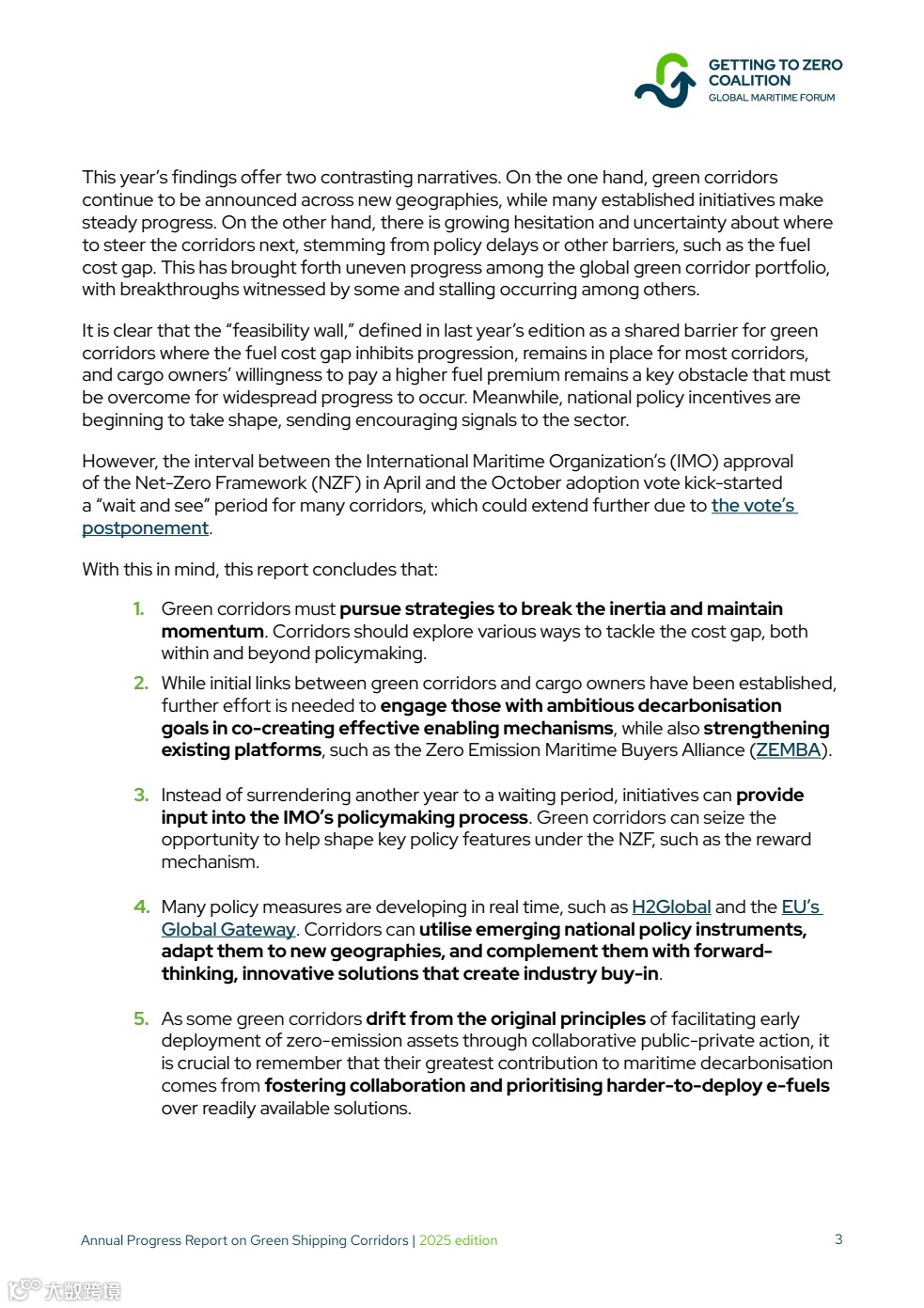
Pursue strategies to break inertia and maintain momentum, closing the cost gap and ensuring corridors are advanced enough to qualify for first mover rewards once they’re available.
Capitalise on the opportunity to shape IMO policy, like the reward mechanism, and be well-positioned to benefit from eventual regulation.
Better engage those with ambitious decarbonisation goals that can help scale solutions, particularly cargo owners who may be more willing to pay a premium for cleaner fuels.
Utilise emerging national policy and adapt it for new geographies to accelerate change and encourage industry buy-in.
Stay true to original principles, remembering that green corridors’ greatest contribution to maritime decarbonisation comes from fostering collaboration and prioritising harder-to-deploy e-fuels over more readily available solutions.
About the Getting to Zero Coalition
The Getting to Zero Coalition is a powerful alliance of more than 200 organisations (including over 180 private companies) within the maritime, energy, infrastructure, and finance sectors. The Coalition is committed to getting commercially viable zero-emission vessels powered by zero-emission fuels into operation by 2030. Hitting this milestone is essential if we are to achieve maritime shipping’s moon-shot ambition of full decarbonisation by 2050.
About the Global Maritime Forum
The Global Maritime Forum is an international not-for-profit organisation committed to shaping the future of global seaborne trade. It works by bringing together visionary leaders and experts who, through collaboration and collective action, strive to increase sustainable long-term economic development and human well-being.
Established in 2017, the Global Maritime Forum is funded through a combination of grants and partner contributions. It operates independently of any outside influence and does not support individual technologies or companies. Most of its roughly 45-person staff is based in the organisation's headquarters in Copenhagen, Denmark.
***
行业静候气候法规之际,中国、印度和巴西推进绿色航运走廊建设
2025年11月27日
绿色航运走廊年度进展报告发现,2025年新启动了25条零排放贸易航线,使全球总数达到84条。
在监管不确定性的背景下,中国、印度和巴西寻求抓住零排放航运领域的重大机遇。
报告警告,在国际海事组织(IMO)净零框架延迟出台后,行业应避免持"观望"态度。
报告呼吁各国政府层面采取行动以推动进展,创造先发优势,并为尽早获得未来IMO激励措施做好准备。
2025年11月27日,哥本哈根 – 根据"零排放联盟"和全球海事论坛今日发布的一份最新进展报告,旨在示范和推广新型零排放燃料、船舶和技术的绿色航运走廊建设行动,在数量和地理范围上均有所扩大。
今年的报告《处于十字路口:2025年绿色航运走廊年度进展报告》确认了25个新的绿色走廊倡议,将全球活跃倡议总数扩大至84个。中国、印度、巴西、智利、加纳和肯尼亚等主要发展中经济体也已启动相关倡议,这反映出通过在这些地区发展零排放船用燃料和加注能力,可以抓住重大的经济机遇。
这一消息发布之际,距旨在为航运业到2050年实现净零排放设定路径的国际海事组织具有里程碑意义的"净零框架"谈判被推迟至少一年,仅过去一个月。
全球海事论坛脱碳总监杰西·法恩斯特克表示:"中国、印度和巴西等主要国家进军绿色走廊领域的前景非常广阔,因为这些市场的表现将决定零排放航运能否快速规模化以达到全球气候目标。但更重要的是,我们看到这些国家认识到,绿色走廊不仅仅是环境项目——它们是战略性的经济基础设施。及早行动的国家有望在能源、贸易和技术领域获得竞争的工业优势和地缘政治优势。"
自该报告于2022年首次发布以来,首次有四个绿色航运走廊进入了'实现阶段',这是一个重要的里程碑,意味着船舶、基础设施和/或燃料工厂的建造和/或运营已实际开展。然而,报告警告称,在84个倡议中,许多仍因传统燃料与零排放燃料之间的成本差距所形成的'可行性壁垒'而停滞不前——这一挑战本可由净零框架(现已推迟至至少明年十月)来帮助克服。
尽管存在这一延迟,报告警告行业和政府不应在未来一年采取"观望"态度。相反,各走廊应利用各国政府新出台的政策和计划,例如欧盟的"全球门户"倡议、德国的"H2Global"计划和澳大利亚的"氢能领跑者计划"——这将能在全球框架出台之前解锁进展,并使参与者跻身于能够率先受益于未来IMO激励措施的先驱行列。
"我们至少还有12个月的时间,IMO的净零框架才会被采纳,"法恩斯特克说。"这段时间,要么在等待中度过,要么用于建设项目,以创造战略经济优势,积累能够影响IMO奖励机制的经验教训,并使参与者在未来全球奖励中处于领先地位。那些现在就采取行动的人,将在法规跟进时处于最佳受益位置。"
为最好地扩展和推进绿色走廊,报告建议行业:
1.采取策略打破惯性、保持势头,缩小成本差距,并确保走廊建设足够先进,以便在先行者奖励可用时能够符合资格。
2.抓住机遇影响IMO政策(如奖励机制),并为最终从法规中受益做好定位。
3.更好地吸纳那些拥有雄心勃勃脱碳目标并能帮助规模化解决方案的参与者,特别是那些可能更愿意为清洁燃料支付溢价的货主。
4.利用新兴的国家政策并将其适应新的地域,以加速变革并鼓励行业认同。
5.坚守最初原则,牢记绿色走廊对海运脱碳的最大贡献在于促进合作,并优先部署较难部署的电子燃料,而非更易获得的解决方案。
关于零排放联盟
零排放联盟是由海事、能源、基础设施和金融领域超过200个组织(包括超过180家私营公司)组成的强大联盟。该联盟致力于到2030年让由零排放燃料驱动的、具有商业可行性的零排放船舶投入运营。实现这一里程碑对于达成海运业到2050年完全脱碳的宏伟目标至关重要。
关于全球海事论坛
全球海事论坛是一个致力于塑造全球海运贸易未来的国际非营利组织。其工作方式是汇聚有远见的领导者和专家,通过协作和集体行动,努力促进可持续的长期经济发展和人类福祉。
全球海事论坛成立于2017年,资金来源于赠款和合作伙伴捐款。它独立运作,不受任何外部影响,不支持特定的技术或公司。其约45名员工大部分位于丹麦哥本哈根的总部。
***
本公众号所载内容为原创或来源于研究机构报告、官方网站动态新闻等整理、翻译与转载,转载内容版权归原作者所有,如涉及作品内容、版权或其他问题,请与本公众号联系。转载内容不代表本公众号的观点。本公众号拥有对此声明的最终解释权。 |
***凡事多躬行,莫做纸上兵***