
Grieser, W., LeSage, J.P., & Zekhnini, M. (2022). Industry Networks and the Geography of Firm Behavior.Management Science.
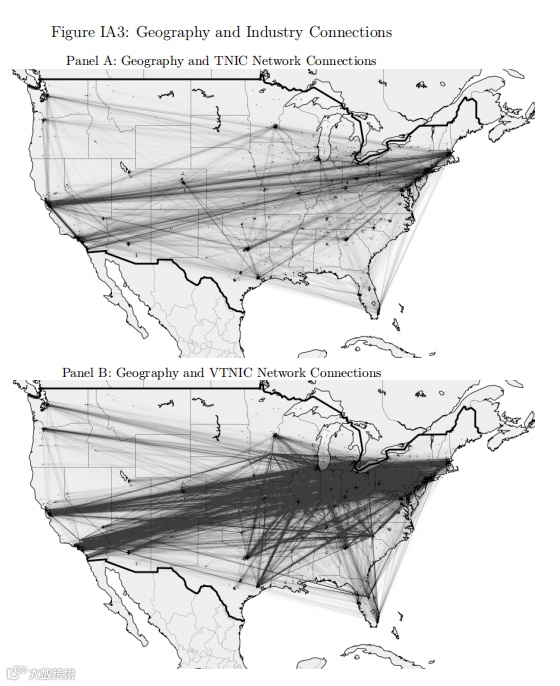
Using a network approach that circumvents well-known challenges in estimat-ing peer effects, we show that interactions with a firm's geographic neighbors play a signif-icant causal role in corporate investment behavior and a modest role in financial policies and firm performance. Moreover, these geography network effects are almost entirely driven by propagation effects through product market and supply chain networks. We cor-roborate our findings in a quasi-experimental framework that allows for spillovers in treat-ment effects. Our findings help rationalize industrial clusters (e.g., Silicon Valley), as they illustrate that agglomeration economies are substantial and operate predominantly within industry boundaries.
McNerney J, Savoie C, Caravelli F, et al. How production networks amplify economic growth[J]. Proceedings of the National Academy of Sciences, 2022, 119(1).
Technological improvement is the most important cause of long-term economic growth. In standard growth models, technology is treated in the aggregate, but an economy can also be viewed as a network in which producers buy goods, convert them to new goods, and sell the production to households or other producers. We develop predictions for how this network amplifies the effects of technological improvements as they propagate along chains of production, showing that longer production chains for an industry bias it toward faster price reduction and that longer production chains for a country bias it toward faster growth. These predic-tions are in good agreement with data from the World Input Output Database and improve with the passage of time. The results show that production chains play a major role in shaping the long-term evolution of prices, output growth, and structural change.
Setzler, B., & Tintelnot, F. (2021). The Effects of Foreign Multinationals on Workers and Firms in the United States.The Quarterly Journal of Economics
Governments go to great lengths to attract foreign multinationals because they are thought to raise the wages paid to their employees (direct effects) and to improve outcomes at local domestic firms (indirect effects). We construct the first U.S. employer-employee data set with foreign ownership information from tax records to measure these direct and indirect effects. We find the average direct effect of a foreign multinational firm on its U.S. workers is a 7% increase in wages. This premium is larger for higher-skilled workers and for the employees of firms from high GDP per capita countries. We find evidence that it is membership in a multinational production network—instead of foreignness—that generates the foreign-firm premium. We leverage the past spatial clustering of foreign-owned firms by country of ownership to identify the indirect effects. An expansion in the foreign-multinational share of commuting-zone employment substantially increases the employment, value added, and—for higher-earning workers—wages at local domestic-owned firms. Per job created by a foreign multinational, our estimates suggest annual gains of US$13,400 to the aggregate wages of local incumbents, two-thirds of which are from indirect effects. Our estimates suggest that—via mega-deals for subsidies from local governments—foreign multinationals are able to extract a sizable fraction of the local surplus they generate
Jola-Sanchez, A. F., & Serpa, J. C. (2021). Inventory in Times of War. Management Science.
Using data from 38,916 businesses in war-torn Colombia and from 5,138 attacks by the two rebel groups, FARC and ELN, we study how firms manage inventory during civilwar. We obtain exogenous variation in the conflict intensity via a differencein-differences model, which hinges on the peace process between Colombia's government and FARC. Relying on this identification strategy, we hypothesize and show that war causes two effects on firm-level inventories. First, it leads firms to replace physical assets (inventory) with fungible assets (cash), causing them to operate with an oversecured financial buffer, but a fragile operational buffer. Second, this inventory reduction occurs mostly in unprocessed inventories (finished-goods inventories are insensitive to violence), meaning that, although war-torn businesses are equipped to fulfill planned orders, they become inflexible at handling uncertain future demand. We then show that themagnitude of these effects is highly contingent on the firm's position in the supply chain, its proximity to distributionmarkets, and the type of attacks it is subject to. We then propose policies to address war-related risk in supply chains.
Boehm C E, Flaaen A,Pandalai Nayar N. Input linkages and the transmission of shocks: Firm-level evidence from the 2011 Tōhoku earthquake[J]. Review of Economics and Statistics, 2019, 101(1): 60-75.
Abstract Using novel firm-level microdata and leveraging a natural experiment, this paper provides causal evidence for the role of trade and multinational firms in the cross-country transmission of shocks. The scope for trade linkages to generate cross-country spillovers depends on the elasticity of substitution with respect to domestic inputs. Using the 2011 Tōhoku earthquake as an exogenous shock, we structurally estimate production elasticities at the firm level and find greater complementarities in input usage than previously thought. For Japanese affiliates in the United States, output falls roughly one-for-one with declines in imports, consistent with a relationship between imported and domestic inputs that is close to Leontief
Hsu P H, Lee H H, Peng S C, et al. Natural disasters, technology diversity, and operating performance [J]. Review of Economics and Statistics, 2018, 100(4): 619-630.
Abstract In this paper, we empirically measure the impact of natural disasters on firm-level operating performance and examine if such impact can be mitigated by technology diversification. Using major natural disasters specified by Barrot and Sauvagnat (2015) and factory location data from the toxic release inventory (TRI) database, we first find that firms with factories located in states affected by natural disasters are much less profitable. Second, we find that firms with diversified technologies are significantly less subject to the impact of natural disasters, suggesting that technology diversity enhances firms’ sustainability.
Acemoglu D, Akcigit U, Kerr W.Networks and the macroeconomy: An empirical exploration[J]. Nber macroeconomicsannual, 2016, 30(1): 273-335.
The propagation of macroeconomic shocks through input-output and geographic networks can be a powerful driver of macroeconomic fluctuations. We first exposit that in the presence of Cobb-Douglas production functions and consumer preferences, there is a specific pattern of economic transmission whereby demand-side shocks propagate upstream (to input-supplying industries) and supply-side shocks propagate downstream (to customer industries) and that there is a tight relationship between the direct impact of a shock and the magnitudes of the downstream and the upstream indirect effects. We then investigate the short-run propagation of four different types of industry-level shocks: two demand-side ones (the exogenous component of the variation in industry imports from China and changes in federal spending) and two supply-side ones (TFP shocks and variation in knowledge/ideas coming from foreign patenting). In each case, we find substantial propagation of these shocks through the input-output network, with a pattern broadly consistent with theory. Quantitatively, the network-based propagation is larger than the direct effects of the shocks. We also show quantitatively large effects from the geographic network, capturing the fact that the local propagation of a shock to an industry will fall more heavily on other industries that tend to collocate with it across local markets. Our results suggest that the transmission of various different types of shocks through economic networks and industry interlinkages could have first-order implications for the macroeconomy.