
9 月 4-5 日,金砖国家领导人峰会(BRICS Summit)将在我国厦门举办,这是继 G20 杭州峰会之后在我国举办的又一次重要的国际会议,是今年我国最重要的主场外交之一。
在峰会即将召开之际,让我们一起来看看专家们对金砖国家发展的思考吧。
We are currently in a time of critical global economic recovery. We need to consider the future of globalization, especially in light of the emergence of various anti-globalization and de-globalization ideas, as well as the increasing political uncertainties intensified by Britain’s retreat from EU, the Donald Trump administration and European elections. Here comes the question: Where will globalization go and how can we guarantee the recovery of the world economy?
目前,世界经济正处在复苏的关键时期,全球化正处在十字路口。各种反全球化、逆全球化的思潮涌动,随着英国脱欧、特朗普新政,尤其是欧洲大选年, 各种不确定性与日俱增,全球化到底何去何从,世界经济复苏的时间点在哪里? 这些都需要我们理性的分析和拭目以待。
The global economic landscape has also undergone radical changes partially resulting from the biggest economic crisis in the 21st century and the ensuing European debt crisis. Consequently, the economic landscape is transferring from one fueled by old growth drivers, as represented by G7 and developed countries, to that driven by new engines of growth—emerging economies and developing countries led by BRICS countries. Passing the economic development baton to developing countries has allowed them to become major engines for world economic growth. Accordingly, since the financial crisis in 2008, the contribution of developing countries to the world economy has exceeded 70 percent.
世界经济格局也因为百年不遇的金融危机和随后的欧债危机发生了根本改变,原来以七国集团及发达国家在全球占主导的经济格局转变为以金砖国家为领头羊的新兴经济体为主体,世界经济格局从发达国家转向了发展中国家,发展中国家接过了经济发展的接力棒,成为拉动经济增长的重要引擎。尤其是金融危机以来,发展中国家对世界经济增长的贡献率超过了 70%。
In the past decade of development, BRICS countries have playeda greater role in shaping the world’s economic landscape. Since BRICS countries maintain robust development momentum, show strong development potential, and contribute substantially to the world economy, many countries expect to transition from participants to leaders of global economic governance. As predicted by Jim O’Neill, who coined the acronym BRIC, BRIC will become the world’s top six economies together with the United States (US) and Japan.
金砖国家经过十年磨一剑的发展,在世界经济格局的转变中逐渐挑起重担。 由于金砖国家的发展势头好、发展潜力大,对世界经济增长贡献多,各国对金砖国家的期待也从对全球经济治理的参与者逐渐向引领者转变。正如金砖之父吉姆·奥尼尔所预测的,金砖国家将与美日一起成为全球前六大经济体。
At a moment when globalization is being questioned, BRICS countries should commit to the responsibility of boosting globalization by maintaining their own stable economic progress. Such progress will dispel notions that BRICS economies are fading. By leading emerging economies and developing countries toward continuing globalization, BRICS countries will help bring the world economy back on a healthy, stable and rapid development track which will benefit people around the world.
在全球化发生迷离思潮的时候,金砖国家要勇担推进全球化的重任,不仅要做好国内的事情,消除外界对金砖国家褪色论的质疑,而且还要带领新兴经济体、发展中国家,继续推进全球化,继续引领世界经济在正确的轨道上,健康稳定地快速前进,为全球人民带来福祉。
❶ To shoulder the responsibility of leading globalization. Nowadays as isolationism, populism, terrorism and trade protectionism are gaining ground, not only is globalization at a critical turning point, but the world economy is also in recovery. Facing the rise and fall of competition between developed and developing countries in the world economy, globalization needs to be driven by developing countries, as represented by BRICS countries.
一是金砖国家引领全球化责无旁贷。在孤立主义、民粹主义、恐怖主义、贸易保护主义抬头的今天,全球化正处于十字路口,世界经济处于复苏关键期。发达国家与发展中国家在全球经济中此消彼长,全球化需要以金砖国家为代表的发 展中国家作为引擎。
❷ To become engines for new globalization. IMF data shows that over the past 10 years, BRICS’ contribution to world economic growth has exceeded 50 percent; per a Goldman Sachs report, BRICS’ GDP will outperform G6 (the United States, Britain, France, Germany, Japan and Italy) by 2050.
二是金砖国家正成为新全球化的发动机。IMF数据显示,金砖国家在过去十年内对世界经济增长的贡献率超过50%。
❸ To reinforce structural adjustment and implement innovation-driven growth strategies. BRICS countries should accelerate their structural reform as well as innovate in economic growth patterns. These economic growth patterns should focus on innovation, new industrial revolution, digital economy and structural reform.
三是要加强结构调整、实施创新增长战略。金砖国家应促进结构性改革和创新经济增长方式,在创新、新工业革命、数字经济、结构性改革等要素上应实现重点突破。
❹ To deepen reform and step up financial cooperation to lead globalization. BRICS countries need to strengthen their financial cooperation to address current speculation about the decline of BRICS economies. Members with strong complementary economic structures need to bring their resources and advantages into full play while reinforcing their own structural reform, in order to consolidate financial cooperation and innovative mechanism construction and to push forward globalization.
四是要深化改革、加强金融合作引领全球化。当前金砖褪色论等甚嚣尘上,金砖国家面临内外挑战,加强金砖国家的金融合作刻不容缓。经济互补性强的金砖国家在加强自身结构性改革的同时,亟待发挥各国禀赋优势,加强金融合作及 创新机制建设,推进全球化。
❺ To further boost economic and trade cooperation by taking advantage of the Belt and Road Initiative. BRICS countries should follow and lead the Belt and Road Initiative by focusing on infrastructure construction. This will allow for better interconnectivity and thus strengthen their economic and trade exchanges. Through signing free trade agreements (FTA) and building free-trade zones (FTZ), BRICS countries will promote common economic development by sharing development results with countries along the Belt and Road, which will ultimately lead to further globalization.
五是要搭乘“一带一路”快车促进经贸合作。金砖国家应搭乘并引领“一带一路”快车,着力于基础设施互联互通建设,加强各国之间的经贸往来。结合自 贸协定的签署和自由贸易区的建设,推动经济的共同发展,与沿线各国共享经济发展成果,引领全球化。
❻ To intensify construction of platforms for economic and financial cooperation. BRICS countries should intensify their efforts to establish the New Development Bank and make contingent reserve arrangements, as well as cement financial cooperation with other bilateral and multilateral platforms such as the Asian Infrastructure Investment Bank (AIIB) and the Silk Road Fund. This will elevate the voices of emerging economies and developing countries in the world economy.
六是要加强经济、金融合作大平台建设。金砖国家应加强金砖银行、应急储备安排建设,并加强与其他双边和多边平台如亚投行、丝路基金等的金融合作,增强新兴经济体和发展中国家在世界经济上的话语权。
❼ To launch first the “Bond Connect” and then the “BRICS Connect.” BRICS countries should pursue interconnectivity of their capital markets by developing their own investment and financing mechanisms. They should also gradually build financial cooperation platforms like the “Bond Connect” and the “BRICS Connect.”
七是先打造“债券通”再打造“金砖通”。金砖国家应推动资本市场的互联互通建设,成立金砖国家的投融资机制,逐步打造“债券通”“金砖通”等金融合作平台。
❽ To strengthen monetary cooperation and improve the international monetary system. In order to change the US dollar-dominant international monetary system, BRICS countries should enhance monetary interconnection along the development path, first by monetary clearing and settlement, then by regionalization and internationalization.
八是加强货币合作以完善国际货币体系。金砖国家应推动货币互联互通,实现金砖国家货币由清结算到实现区域化、国际化的发展路径,改变美元霸权的国际货币体系。
❾ To build up cooperation in financial regulation to guard against financial risks. To withstand risks in the international market, BRICS countries should work more closely in coordinating macroeconomic policies, collaborating in financial regulation, improving related regulatory systems and stepping up enforcement.
九是加强金融监管合作来防范金融风险。金砖国家应加强宏观政策协调,强化金融监管合作,完善相关监管制度并提高执行力度,共同抵御国际市场的不确定性风险。
❿ To highlight greenness, inclusiveness, fairness and innovation in financial cooperation. The BRICS countries which best represent the economic benefits of developing countries should vigorously launch changes to the global economic governance system, drive globalization and foster growth of the world economy in a green, inclusive and creative manner.
十是金融合作要以绿色、普惠、平等及创新为根本。金砖国家集中代表了发展中国家的经济利益,应着力推动全球经济治理体系改革,引领全球化,推动世界经济以绿色、普惠、创新增长。

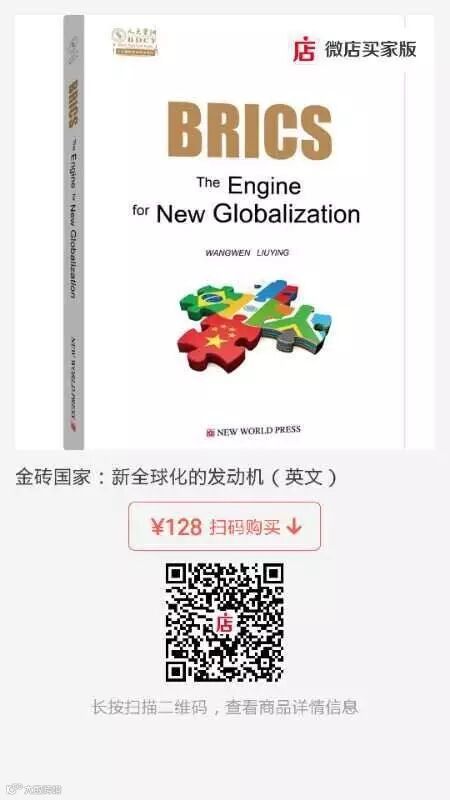
以上内容来自于人大重阳金融研究院的研究成果——《金砖国家:新全球化的发动机》(新世界出版社,2017年8月版)。

双语君(微信ID:Chinadaily_Mobile)发现这本书内容丰富,特为大家谋来福利!
我们将送出《金砖国家:新全球化的发动机》(BRICS: The Engine for New Globalization)中文和英文版各三本。
留言点赞数前3名的读者将获得英文版,第4至6名的读者将获得中文版。
点赞截止:9月2日中午12点
PS:最多只能有100条留言入选,所以大家要抓紧行动哦。
有兴趣购买的同学可长按下面二维码进入购买页面。↓↓↓