


As of today, the recently adopted ‘China Risk Oriented Solvency System’, also known as “C-ROSS”, is the only regime by which a Mainland insurer’s capital adequacy is regulated. Following the implementation of China’s 13th Five-Year plan in 2016, the China Insurance Regulatory Commission (CIRC), as the industry’s sole regulator, published an outline of the plan, including several goals relating to the reformation, innovation and regulation of the insurance industry. This draws interesting comparisons with the overseas capital adequacy regimes of other major jurisdictions, notably with Solvency II in the EU. Both these reforms mark a fundamental shift towards a risk-based, market-oriented approach to estimating capital requirements, being geared as they are towards individual insurance entities, rather than the previous "one-model-fits-all" approach. This is expected to lead to greater market efficiency in managing risk, and enhance consumer protection. For China, it marks a renewed focus on both volume and value for the domestic insurance sector, implicitly recognizing that better risk management includes all drivers of product profitability, including product terms and conditions, guarantees, pricing and underwriting[1]. As a result, the transition towards fully implementing, supervising and enforcing the C-ROSS regime is already having far reaching repercussions.
By appropriating the most useful features of existing global regimes, C-ROSS has formulated a risk-based supervision regime that is on par with global standards, yet remains tailored to the specifics of the Chinese insurance market. In common with Solvency II in the EU, three key pillars underpin these rules, which can be summarized as: 1) Quantitative - laying down how much capital the insurers must hold; 2) Qualitative - internal governance and formal supervision; and 3) Disclosure requirements - so that the market may more accurately assess and price insurers, and supervise unregulated risks[2] . The structure is as follows:
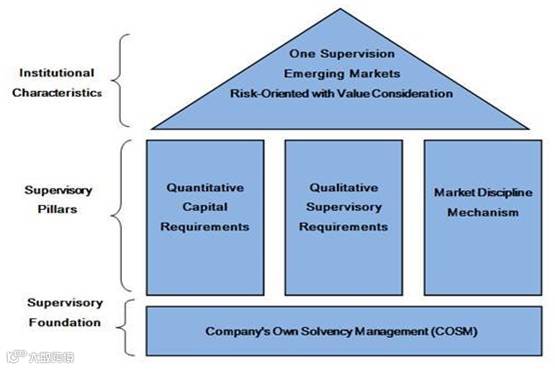
The effects of full implementation are manifold. Merger and acquisition activity is set to benefit from the increased emphasis on diversification, and a number of acquisitions to this end have already been consolidated or are underway. Smaller insurers may be encouraged to merge and work together to offer a wider portfolio of products and services to consumers, and their service channels, at the same time as sharing the compliance burden regarding modeling and reporting requirements, and in lowering their overall capital requirements. And increased disclosure requirements may make for a more open and transparent market, whereby the market plays a greater role in capital allocation.
The reallocation of risk to individual insurers has seen similar knock-on effects in the more mature insurance markets of the EU, where an increase in de-risking activity looks set to continue. Insurers looking to hedge longevity risk in respect of pension scheme deficits and annuity books has, intentionally or not, resulted a spate of reinsurance activity. In China, the private pension and annuity market is less comprehensive overall, yet has still been embraced by its domestic life insurers with CIRC’s support. However, in China, the application of risk charges under C-ROSS is significantly higher for international reinsurance companies than their domestic counterparts. The EU has a single market at its core, and the Solvency II rules are designed to harmonize the industry throughout its member states; C-ROSS on the other hand, is designed to operate according to the unique features of its own single market – China; giving rise to its own divergent outcomes.
This can be further explained by the different stage of growth of the Chinese insurance market compared with its global counterparts in the EU, US and Japan. To put this growth into perspective, in 2016, premium volume stood at more than 3.1 trillion Yuan, with an annual 5-year growth rate of 16.8 per cent. Levels of insurance penetration (3.59% of GDP) and insurance density (USD 271.77 per capita) at the end of 2015, are projected to reach 5%, and RMB 3,500 per capita by 2020[3] .It is important then, that this projected expansion should not be unduly shackled by restrictions on sustainable growth, as is a stated goal under the C-ROSS rules.
Market monitoring, consumer protection mechanisms and reputational risks also take on greater primacy in the Chinese market, both in order to address a lingering culture of mis-selling, lax client practices, fraud and overall customer satisfaction levels, and to carry out a reputational risk assessment as part of the pillar II “qualitative” assessment. CIRC’s mandate to develop and oversee this assessment and other consumer protection mechanisms is indicative of its status as a single regulator, again emphasizing that the rules are tailored to China’s own unique system and development path. Under the fractured nature of European supervision, such elements may fall out with the Solvency II regulations and into the rules of other supervisory bodies, for instance, the Treating Customer’s Fairly regime.
C-ROSS is also simpler in its risk management and governance procedures and techniques[4] , including the quantitative measures used to determine capital adequacy under Pillar I. C-ROSS adheres to fixed formulas based on easily measurable parameters – ratio factors for reserves and sum at risk for life insurers, for instance; whereas under Solvency II, more complex calculation methods are adopted, and insurers have the option to provide their own internally developed models to meet the relevant standards[5] . Such measures are impractical to a Chinese insurance industry that is shorter in auditing resources and solvency trained risk management personnel.
The Solvency Aligned Risk Management Requirements and Assessment (SARMRA) is another key Pillar I variant where simplification is inherent. Under SARMRA, CIRC alone are required to provide the assessment and annual score. This score can then be used to determine the level of any applicable capital add-ons or reductions, providing insurers with a defined and certain process for determining this variance. In comparison, the Own Risk and Solvency Assessment (OSRA) under Solvency II allows for insurers to carry out their own risk assessment, and the capital add-ons are discretionary. The overall effect of SARMRA is to provide Chinese insurers with a defined process for determining capital variances, without the responsibility of carrying out their own assessments[6] .
In all, C-ROSS and Solvency II both represent fully integrated regulatory and managerial systems that are not only designed to identify and prevent risk, but more fundamentally, to stimulate the industry’s own risk management ability through a reward and penalty mechanism[7] , driving market efficiency. Themes of deregulation, financial innovation, strict supervision, corporate governance, competition and sustainability run through each of them. However, C-ROSS is marked in ways that reflect the Chinese characteristics of its market and its current maturity level, while its implementation is still ongoing[8]. To meet the insurance needs of a growing nation the size of China is a complex task, but C-ROSS will better equip the industry to do so.
[1]http://www.mckinsey.com/gsa/industries/financial-services/our-insights/the-life-journey-china
[2]https://www.ft.com/content/51bc0c08-aa38-11e5-9700-2b669a5aeb83
http://www.casact.org/community/affiliates/areca/1116/Zhao.pdf
[3]Several Opinions of the State Council on Accelerating the Development of the Modern Insurance Service Industry
[4]www.clydeco.net/.../Solvency%20II%20&%20Chinese%20Solvency%20Regulation__July2011.pdf
[5]“Where, for instance, the standard formula for calculating risk based capital requirements (the Solvency Capital Requirement) under Article 114 of the Solvency II Directive is calibrated to seek to ensure that insurers hold enough capital to cover a 1 in 200 event i.e. with a 99.5% confidence level, for the next 12 months” https://eiopa.europa.eu/regulation-supervision/insurance/solvency-ii
[6]http://www.milliman.com/insight/2015/Analysis-of-Chinas-new-C-ROSS-solvency-capital-regime/
[7]http://www.casact.org/community/affiliates/areca/1116/Zhao.pdf
[8]Under Solvency II, firms had to implement the rules by 1 January 2016

AnJie Law firm is a Chambers & Partners Tier 1 ranked firm in the Insurance sector in China, and is widely recognized amongst peers and clients for its outstanding legal capabilities in this area, including compliance and M&A. It is fully integrated and supported by its relationships in multiple jurisdictions, including the EU and US. The AnJie Law Firm website can be accessed at www.anjielaw.com.
For further information on this article or on any aspect of Chinese insurance law, please contact Hao Zhan at AnJie Law Firm by telephone (+86 10 8567 5988) or email (zhanhao@anjielaw.com), or Sharif Hendry (sharifhendry@anjielaw.com).

文章仅代表作者观点,不视为安杰律师事务所正式法律意见或建议。如需转载或引用请注明出处。如有任何问题欢迎与本所联系