


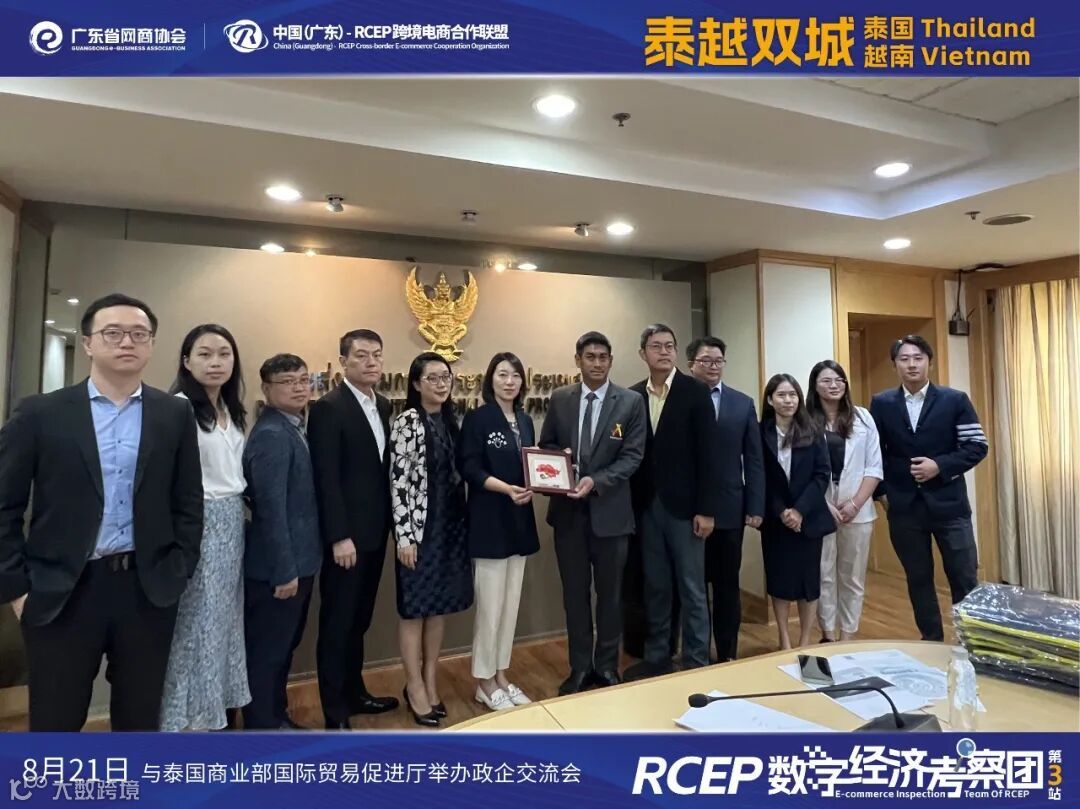
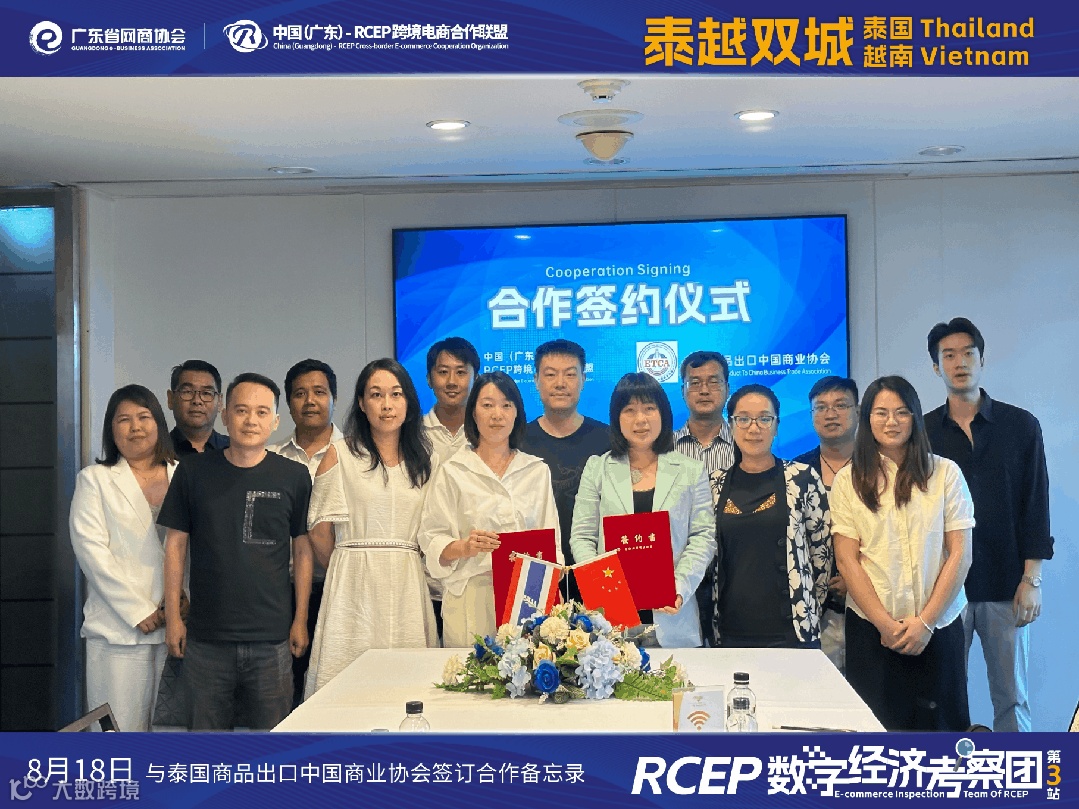
8月18日-24日 ,协会与RCEP联盟携手会员单位组成RCEP数字经济考察团出访了泰国、越南相关企业,并分别与泰国商品出口中国商协会、泰国创新发展合作协会、越南中国商会广东企业联合会签订合作备忘录,增强双边合作;与泰国商业部国际贸易促进厅展开政企交流会,更好地促进广东企业开拓东南亚市场和品牌出海发展。
From August 18th to 24th, the Association, in conjunction with the RCEP Alliance, formed the RCEP Digital Economy Inspection Team and visited related enterprises in Thailand and Vietnam. They signed memorandums of understanding with the Thai Goods Export to China Business Association, Thailand Innovation Development Cooperation Association, and China Chamber of Commerce in Vietnam Guangdong Enterprises Association to strengthen bilateral cooperation. They also had a government-enterprise exchange meeting with the International Trade Promotion Office of the Thai Ministry of Commerce to better promote Guangdong enterprises to develop the Southeast Asian market and brand overseas.


签署合作备忘录合照
PHOTO

市场概况

消费习惯 Consumption Habits
//偏好线下 Preference for offline
//先享后付 Pay later
//依赖进口 Dependence on import
泰国的消费者大多偏好线下购物体验,通过线上品牌宣传,吸引消费者进入线下购物,因此泰国消费者更倾向于进入购物中心、商超消费。产品品牌与定位也影响消费者的选择:欧美品牌被视为高端,日韩品牌被视为中高端,中国品牌定位中部,而泰国本土品牌则不被本地消费者青睐。
尽管泰国的“Promptpay”(由泰国央行牵头创立的支付平台)二维码支付方式使用率正在稳步增长,截至 2021 年 7 月,泰国已有 6220 万用户注册了代理,与该国发行的借记卡数量相当,但大多数泰国消费者的支付习惯仍然是使用现金。这是因为泰国的贫富差距较大,很多普通居民很难存下积蓄,因此提前消费、分期付款或借款并不被视为“丑事”。
Most Thai consumers prefer the offline shopping experience. They are attracted to physical stores through online brand promotion. Hence, Thai consumers prefer to go to shopping centers and supermarkets for their purchases. The product brand and positioning also affect consumer choices: Western brands are seen as high-end, Japanese and Korean brands as mid-to-high-end, Chinese brands as mid-range, and Thai local brands are not favored by local consumers.
Although the use of "Promptpay" (a payment platform initiated by the Bank of Thailand) QR code payment method is steadily increasing, as of July 2021, there are 62.2 million users registered as agents in Thailand, equivalent to the number of debit cards issued in the country, but most Thai consumers still prefer to use cash. This is because there is a significant wealth gap in Thailand, and many ordinary residents find it difficult to save money, so advance consumption, installment payments, or borrowing are not considered "shameful."


相比之下,越南消费者更依赖海外进口产品,尤其是中国产品。他们主要在线下购物,而且大多使用现金,信用卡使用率较低。ZALOpay是越南本土的支付软件,但失业率高、贫富差距大,且国内制造业不发达,使得物美价廉的进口产品成为越南消费者的首选。
In contrast, Vietnamese consumers are more dependent on imported products, especially those from China. They mainly shop offline and mostly use cash; the credit card usage rate is relatively low. ZALOpay is a local payment application in Vietnam, but the high unemployment rate, a significant wealth gap, and underdeveloped domestic manufacturing make cost-effective imported products the first choice for Vietnamese consumers.
小结:尽管疫情导致线上支付平台使用率有所提升,但泰越两国消费体系仍然以现金为主,信用卡使用率低。支付平台尚无一家能够独大,因此电商平台开始主推COD货到付款、先享后付BNPL等模式。
Summary: Although the pandemic has led to an increase in the usage of online payment platforms, the consumer systems in both Thailand and Vietnam still primarily use cash,
热销品类 Hot Sell
<美妆个护、3C产品、小家电和时尚服装>
<Cosmetic, 3C product, fashion>
最受欢迎 Most Popular

·
美妆
Cosmetic
·
家电
Home Appliance

在泰国,TIKTOK上的热销品类主要是美妆个护、3C产品、小家电和时尚服装。THISSHOP电商平台的首席运营官吴仲昭表示,泰国年轻人对3C产品和时尚品类的追求很高,均客单价也较高。
In Thailand, the best-selling categories on TIKTOK are beauty and personal care, 3C products, small household appliances, and fashion apparel. Wu Zhongzhao, the Chief Operating Officer of THISSHOP e-commerce platform, said that Thai youth have a high demand for 3C products and fashion categories, and the average order value is also high.
越南则是一个高度依赖进口的国家,价格不低的时尚品、3C产品、快消品和美妆个护等重要品类的价格大多由进口国定价。欧美产品价格最高,其次是日韩和中国产品。越南消费者更喜欢物美价廉的中国产品,但据考察团线下调研时发现,中国产品价格在越南比在国内更加昂贵。
Vietnam, on the other hand, is a country highly dependent on imports. The prices of essential categories such as fashion items, 3C products, fast-moving consumer goods, and beauty and personal care products are mostly set by the importing countries. Western products are the most expensive, followed by Japanese, Korean, and Chinese products. Vietnamese consumers prefer cost-effective Chinese products, but according to the research conducted by the inspection team, the prices of Chinese products in Vietnam are even higher than in China.
小结:虽然泰国越南的电商市场品类相似,但泰国有自己的品牌打造体系,更倾向于线下消费,越南的电商发展潜力则更大。两国消费者对本土品牌信心不足,因此电商市场仍然具有巨大的发展空间。
Summary: Although the e-commerce market categories in Thailand and Vietnam are similar, Thailand has its own brand-building system and prefers offline consumption, whereas the e-commerce development potential in Vietnam is greater. Consumers in both countries lack confidence in local brands, so the e-commerce market still has enormous
社媒发展 Social Media Development
Facebook用户最多 Most Users: Facebook
TikTok发展迅猛 Rapidest Growth: Tiktok

在泰国,社交媒体的使用情况十分广泛,有5000万人使用Facebook,4280万人使用YouTube,3580万人使用TikTok,3570万人使用Messenger,以及1850万人使用Instagram。这意味着社交媒体的使用率高达72.8%,并且这一数字还在稳步增长。据美杜莎传媒介绍,尽管Facebook有自己的营销模式,并且在泰国一直占据主流,但TikTok的增长速度更快。例如,Facebook需要长达3年的时间来培养达人,而在TikTok上,这个过程只需要3-6个月。自从TikTok进入泰国以来,大量的年轻用户转向了这个平台,使得其增长势头仍在持续。
In Thailand, the use of social media is widespread, with 50 million people using Facebook, 42.8 million using YouTube, 35.8 million using TikTok, 35.7 million using Messenger, and 18.5 million using Instagram. This means that the usage rate of social media is as high as 72.8%, and this number is still steadily increasing. According to Medusa Media, although Facebook has its own marketing model and has always been mainstream in Thailand, TikTok is growing faster. For example, it takes as long as 3 years for Facebook to cultivate influencers, while on TikTok, this process only takes 3-6 months. Since TikTok entered Thailand, a large number of young users have switched to this platform, and its growth momentum is still continuing.
在越南,虽然也有本土的社交媒体软件“Zalo”(类似于微信,拥有支付、朋友圈、小程序等功能),但Facebook仍然是最受欢迎的社交媒体平台,拥有7709万用户(总人口大约9000万)。其次是TikTok,拥有5000万用户,增长迅速,而Instagram有1142万用户。越南用户对公共和私人社交软件的区分较明显:TikTok和Facebook更多用于“公域”社交,而Zalo和Instagram更多用于“私域”社交。
值得注意的是,TikTok已经超过Lazada,成为越南第二大电商平台。时尚品类占整个TikTokShop的GMV(总销售额)的一半,其次是3C产业。3C产业的上升空间巨大,例如,OPPO在TikTokShop越南上仅用半年时间就实现了惊人的GMV增长1871%。
In Vietnam, although there is also a local social media software "Zalo" (similar to WeChat, with payment, circle of friends, and mini programs functions), Facebook is still the most popular social media platform, with 77.09 million users (total population about 90 million). Next is TikTok, with 50 million users, growing rapidly, and Instagram with 11.42 million users. Vietnamese users have a clear distinction between public and private social software: TikTok and Facebook are more used for "public domain" socializing, while Zalo and Instagram are more used for "private domain" socializing.
It is worth noting that TikTok has surpassed Lazada and become the second largest e-commerce platform in Vietnam. Fashion categories account for half of the total GMV (Gross Merchandise Volume) of TikTokShop, followed by the 3C industry. The 3C industry has huge room for growth. For example, OPPO achieved an astonishing GMV growth of 1871% on TikTokShop Vietnam in just half a year.
小结:虽然泰国和越南都有自己的本土社交媒体软件,但Facebook、TikTok和Instagram仍然是最主要的平台。用户对“公域”社交软件(如Facebook、TikTok)和“私域”社交软件(如Instagram、Zalo)的区分比较明显。
Summary: Although both Thailand and Vietnam have their own local social media software, Facebook, TikTok, and Instagram are still the main platforms. Users have a clear distinction between "public domain" social software (such as Facebook, TikTok) and "private domain" social software (such as Instagram, Zalo).
进入泰越市场难点 Entering Thailand and Vietnam Market Challenges
在泰国,进入市场的难点主要包括以下几个方面:
In Thailand, the main challenges to enter the market include:
01供应链有限 Limited Supply Chain
由于泰国的本土供应链相对有限,制造品类主要依赖于中国、日本和韩国的进口。这使得对跨境供应链和本土海外仓的依赖性非常高。据新侨集团董事长分享,泰国的仓储和人力成本并不比中国低,大约是30元/平方米,工资是2500-3000元人民币。如果需要中国的管理人员,还需要配合一定数量的本土员工。尽管如此,泰国的仓储行业竞争还算比较平和,没有出现恶意竞争。
Due to a relatively limited local supply chain in Thailand, the manufacturing categories mainly depend on imports from China, Japan, and Korea. This makes the dependence on cross-border supply chains and local overseas warehouses very high. According to the chairman of Xin Qiao Group, the warehousing and labor costs in Thailand are not lower than those in China, about 30 yuan/square meter, and the wages are 2500-3000 yuan. If Chinese management personnel are needed, a certain number of local employees must be matched. Despite this, the competition in Thailand's warehousing industry is relatively mild, with no malicious competition.
02 物流配送 Logistics and Distribution
在物流配送方面,陆运卡车和空运是主要的运输手段,通常需要3-7天。但是,由于泰国的公路基础设施尚不发达,可能会导致更长的时间。从本土仓库到消费者手中通常需要3天左右。这意味着一些易碎的、保质期短的产品销售可能会面临一定的困难。对于退货、换货的残次品也难以实现二次销售,从而导致一定的损失。
In terms of logistics and distribution, land trucks and air transport are the main means of transportation, usually requiring 3-7 days. However, due to the underdeveloped road infrastructure in Thailand, it may take longer. It usually takes about 3 days from the local warehouse to the consumer. This means that the sale of some fragile, short shelf-life products may face certain difficulties. For returned or exchanged defective products, it is also difficult to achieve secondary sales, leading to certain losses.
03 品牌营销 Brand Marketing
在品牌营销方面,泰国有一套完整的体系,类似于欧美的线上品牌宣传和线下优惠推广,以引导消费者到线下。通常,一些产品无法在线上购买。这也意味着如果中国品牌想进入泰国,需要考虑在泰国本土线下落地。
In terms of brand marketing, Thailand has a complete system, similar to online brand promotion and offline discounts in the West, to guide consumers offline. Usually, some products cannot be purchased online. This also means that if Chinese brands want to enter Thailand, they need to consider landing offline in Thailand.


而在越南,进入市场的难点也包括供应链有限、物流配送、政府规定和基础设施:
In Vietnam, the challenges to enter the market also include limited supply chain, logistics and distribution, government regulations, and infrastructure:
01 供应链有限 Limited Supply Chain
越南的本土供应链同样有限。越南的特点是,大部分在越南生产的外资产品(主要是科技产品)都是销往国外的,而国内的消费品则依赖于进口。
The local supply chain in Vietnam is also limited. A characteristic of Vietnam is that most foreign-funded products produced in Vietnam (mainly tech products) are sold abroad, while domestic consumer goods rely on imports.
02 政府规定 Government Regulations
由于越南政府不承认中国新版护照,需要通过各种公证公司进行一系列合规操作才能在越南创办企业。
Since the Vietnamese government does not recognize the new version of the Chinese passport, a series of compliant operations must be carried out through various notary companies to establish a company in Vietnam.
03 基础设施 Infrastructure
越南的公路基础设施非常不发达,高速公路非常稀缺。因此,如果想在越南落地,最好在胡志明市和河内附近拥有自己的海外仓,以减少物流配送时间。
The road infrastructure in Vietnam is very underdeveloped, and highways are very scarce. Therefore, if you want to land in Vietnam, it is best to have your own overseas warehouse near Ho Chi Minh City and Hanoi to reduce logistics and distribution time.
小结:泰国和越南的供应链有限、物流配送困难、创办本土公司以及对外国品牌的特定市场营销需求,是进入这两个市场的主要难点。
Summary: Limited supply chain, logistics and distribution difficulties, establishment of local companies, and specific market marketing requirements for foreign brands are the main challenges to enter these two markets.
总 结
Summary
泰国和越南的电商市场具有巨大的发展潜力,这对于中国的优质品牌商,制造商,服务商以及电商生态系统中的其他参与者来说是一个非常重要的机会。广东省网商协会通过这次实地考察,亲自体验了泰国和越南的本地环境和商业氛围。旨通过这次考察所得的信息,为那些计划拓展业务到东南亚市场或者已经在东南亚市场运营的会员单位提供实时的帮助和资源连接。
The e-commerce markets in Thailand and Vietnam have tremendous development potential, which is a very important opportunity for Chinese high-quality brand merchants, manufacturers, service providers, and other participants in the e-commerce ecosystem. The Guangdong E-commerce Association, through this field inspection, personally experienced the local environment and business atmosphere in Thailand and Vietnam. The purpose of this investigation is to provide real-time assistance and resource connections for member units planning to expand their business to the Southeast Asian market or already operating in the Southeast Asian market based on the information obtained.

更多企业资讯和对接需求可以联系协会,
也希望有需求、有兴趣的小伙伴
可以参与到下一次游学考察团,
十月印尼等你参与哦✈️✈️~
For more corporate information and docking needs, you can contact the association.
We also hope that friends with needs and interests can participate in the next study tour inspection team.
Indonesia is waiting for your participation in October ✈✈~


RCEP能够为区域内新经济的发展提供推动力。不仅能够享受减免和规定的关税、获得贸易投资提供便利、促进生产链和供应链的相互连接、促进国际间的数字经济发展,还能为中小型企业和地方企业提供机会,促进其更加深入市场。
希望对接相关需求的企业联系联盟.



END

