



撰写:Filte首席执行官Giles Goodwin
来源:华尔街日报
日期:2016年3月18日
翻译:凯辉基金
我们认为数字广告业以独特的前瞻性和永远走在时代前沿的优越性逐渐地瓦解着传统广告行业。过去,我们或许只将“数字化”作为考量广告的因素之一,但如今,一切的一切都是数字化。
然而,很多时候,我们看到数字广告都未能成功地与消费者连接,最终导致其与消费者渐行渐远。
原因很简单:未能充分考虑到用户的体验,按照数字化的说法,就是UX(User Experience)。
最好的一个例子来阐释用户体验的重要性莫过于优步公司。原本一家普通的叫车公司,用数字科技优化用户体验,在七年之间逐步的将自己的品牌享誉全球,甚至让公司的名字成功地成为了一个动词。现在我们可以“优步”去吃饭,下班了“优步”回家,甚至在搭乘跨国航班去到另一个国度后依旧能动动手指轻松“优步”地到达目的地。同样,亚马逊和Zappos(注:Zappos是一家美国鞋类销售的B2C网站)的成功也离不开优化用户体验的发展策略。用户从网上购物的浏览挑选开始,到支付,再到退货,一切过程从简。用户粘度自然逐年提升。
谷歌公司更是用户体验的开拓者之一,最简洁的搜索框为用户进行精简搜索。当前,谷歌的最主要的收入来源也是其针对用户搜索习惯而设计的付费搜索产品,比如AdWord,一款针对用户体验而设计数字化广告的平台。值得一提的是,谷歌早期的广告产品的理念即是为用户提供最好的体验,而正是这一理念奠定了谷歌如今全球范围内的业务增长。
但是,我并不能说这对价值600多亿美元的数字广告业一定行得通。数字广告有时平庸乏味,并不起作用。就本质上来说,数字广告很糟糕。就好像政治评论家们在福克斯新闻上指责唐纳德特朗普的得票率上升,并且在共和党内起内讧,我将广告拦截器(某种程度上也是可视性和欺诈性广告)的崛起不仅归咎于纯粹的贪婪和“糟糕的演员”,还归咎于良好的用户体验在行业内的整体匮乏。这导致我们错失了良机。
但这种概括也并非完全准确。多年来,数字产业在记录消费水平上锐意进取,对我们来说这是很大的机会。有些人会继续关注“广告拦截、可视性和欺诈性广告”这个问题的表象,但明智的营销者会用更具发展性的视角,将数字广告活动的效果设定为终极目标,而用户体验无疑是一个正确的出发点。
每天,大量的机会涌入数字广告业,从业者面临着如何抉择,如何设定理念和策略的挑战。如果我们向优步和其他成功的企业学习,将用户体验视为关键部分与出发点,那么用户不止不会轻易离去,反而会对品牌更加忠诚。由此可见,互联网给消费者带来了前所未有的选择。而当人们面对如此繁杂的选择时,极好的用户体验是推动增长的重要因素。
在2015年中,我有幸在一家大型创新媒体公司与一些产品经理分享了对广告产品、产业和机遇的意见和想法。会议结束时,其中一个产品经理说,她之前从未思考和探讨过关于发展广告业的用户体验。对于从业者来说,这确实是一个令人耳目一新的话题。而我也从那次会议之后开始研究数字广告行业中的用户体验。
2016年数字广告行业无疑会面临一些重大的挑战,但令我高兴的是越来越多的人开始谈论用户体验 -- 这将是解决很多问题的核心,也将是开启行业迅猛增长的关键。作为广告业的从业者,我们需要反思如何避免让数字广告对用户来说像税收一样痛苦又无法避免,再想想优步,亚马逊和谷歌是如何巧妙地解决用户体验问题并实现最大收益。只要我们现在行动起来,加入这些优化数字广告领军者的浪潮,机会还在,一切都不算晚。
原文链接:http://www.wsj.com/articles/why-digital-advertising-is-the-last-one-to-the-party-1458315544

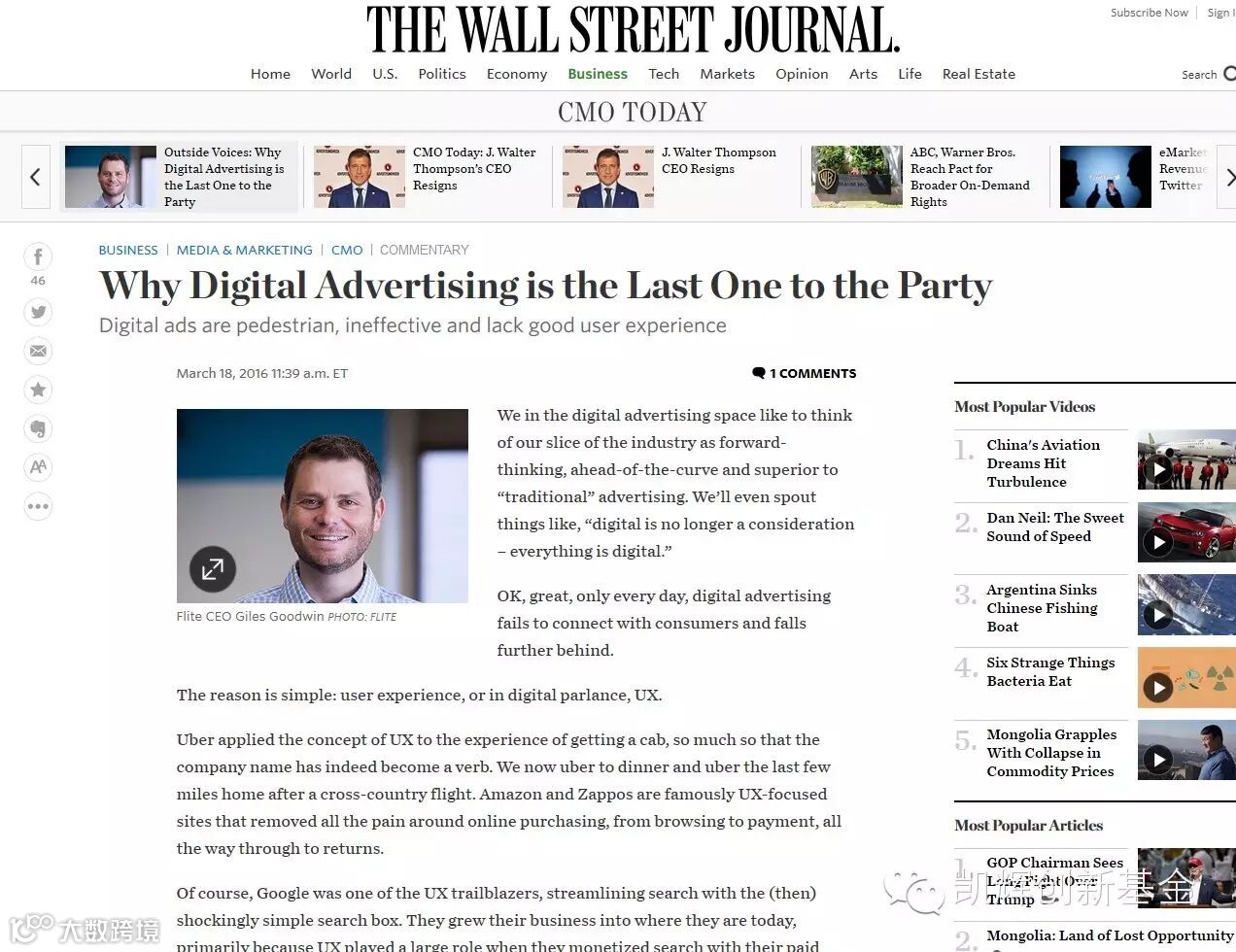
Written by: Giles Goodwin, CEO of Filte
Resource: Wall Street Journal
Date: March 18, 2016
We in the digital advertising space like to think of our slice of the industry as forward-thinking, ahead-of-the-curve and superior to “traditional” advertising. We’ll even spout things like, “digital is no longer a consideration – everything is digital.”
OK, great, only every day, digital advertising fails to connect with consumers and falls further behind.
The reason is simple: user experience, or in digital parlance, UX.
Uber applied the concept of UX to the experience of getting a cab, so much so that the company name has indeed become a verb. We now uber to dinner and uber the last few miles home after a cross-country flight. Amazon and Zappos are famously UX-focused sites that removed all the pain around online purchasing, from browsing to payment, all the way through to returns.
Of course, Google was one of the UX trailblazers, streamlining search with the (then) shockingly simple search box. They grew their business into where they are today, primarily because UX played a large role when they monetized search with their paid search product. Google’s early ad products were great experiences for users and its continued focus on ad experience has fueled most of their growth to date.
However, I cannot say the same for the $60 billion-plus digital advertising industry. Ads are pedestrian and ineffective. Essentially, digital ads suck. In the same way political pundits blame the rise of Donald Trump on Fox News and infighting within the GOP, I blame the rise of ad blockers (and viewability and ad fraud to some extent) not just on pure greed and “bad actors,” but on the industry’s overall lack of good UX. Period. We missed the boat.
Well, that’s not 100% accurate. While the digital industry forges ahead to record spending levels and will for many years to come, we do have a chance to right the ship. Some will continue to focus on the symptoms of the problem – ad blocking, viewability and fraud – but smart marketers will see the bigger picture, that the efficacy of digital ad campaigns must be the goal and UX is certainly a good place to start.
All of us who work in digital advertising have a massive opportunity. If we learn from Uber and other industries that have embraced UX as a critical component, we’ll ensure that the consumer isn’t left out of the equation and doesn’t simply walk away. The lesson is clear: the Internet gives consumers unprecedented choice. Great user experience is paramount to drive growth when people have choice on what products and services they adopt.
Midway through 2015, I sat down with a few product managers at a large and innovative media company. We shared thoughts on the industry and opportunities for developing better ad products. At the end of the meeting, one of the product managers said that she’d never before had a conversation about the UX of an ad and how it was refreshing to do so. That conversation stuck with me since then.
We in digital advertising certainly face a number of significant challenges in 2016, but I’m excited to hear more people begin to talk about user experience. It will be central to solving many of those issues, as well as key to unlocking runaway growth. As an industry we need to reframe the view that digital ads have to feel like a tax or necessary pain for users. Consider instead that the prize will be huge for those who get it right. Just look at what solving for UX has done for Uber, Amazon, and Google. For the moment, we still have a bit of time to get to the party before it’s too late.
Giles Goodwin is chief executive officer for Flite, a creative management platform.
The original link: http://www.wsj.com/articles/why-digital-advertising-is-the-last-one-to-the-party-1458315544