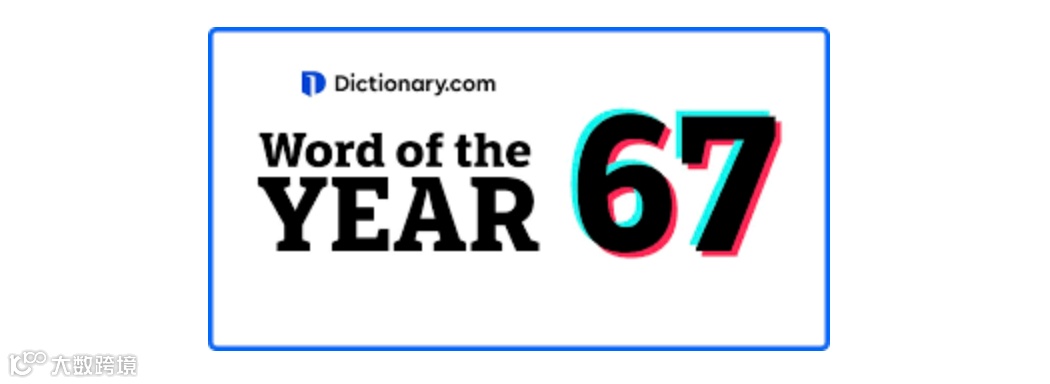
Dictionary.com在10月28日公布了2025年的年度词汇。不过,他们选择了一个奇怪的词,不对,是两个数字:67。它们读作“六、七”,而不是“六十七”。
这个词来源于Skrilla的歌曲《Doot Doot (6 7)》,其歌词中多次重复这两个数字。
这个词的意思大概就是“还行,凑合,及格线”,“六分七分的样子吧”,类似这种语义。前阵子Sam Altman玩梗还用了这个词,让网速不够快的群众摸不着头脑,以为新模型真就是这么草率被公布了。

Dictionary.com的组委会说,他们自己也还在努力弄明白这个词到底是什么意思,但它的确展现了一个新词,如何随着年轻人的爱用、多用而迅速风靡全球。
(图源:视觉中国)
According to Dictionary.com, 6-7 “is a viral, ambiguous slang term” that is “largely nonsensical.” The website suggests that “some argue it means 'so-so,' or 'maybe this, maybe that,' especially when paired with a hand gesture where both palms face up and move alternately up and down.”
Dictionary网站表示,“67”是一个爆红的、含义模糊的俚语,大体上没有明确意义。有些人认为它表示“就那样吧”或“也许是这样,也许是那样”,配上双手掌心朝上、交替上下晃动的动作,意思更明显。Others use 6-7 “as a way to respond to questions or as a result of seeing the numbers '67' in consecutive order in the wild, such as on a math problem or within a phone number," the website said.
该网站指出,还有人使用"6-7"来回答问题,或是因为在现实生活中,比如在数学题或电话号码中连续看到数字"67"。
Searches for 6-7 rose in a “dramatic” fashion in the summer of 2025, increasing more than sixfold since June, according to Dictionary.com's announcement. At this point, “the surge shows no signs of stopping.”
据Dictionary.com公布的数据显示,2025年夏季"6-7"的搜索量呈现"爆发式"增长,自6月以来增幅超六倍。目前"这一飙升趋势仍未见消退迹象"。
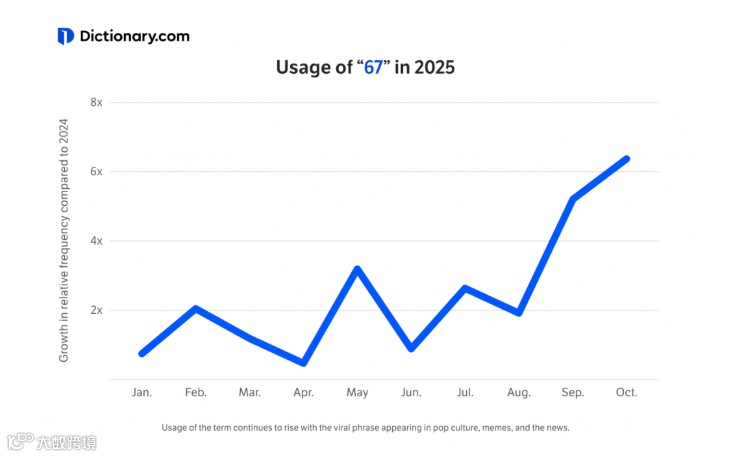
(图源:Dictionary.com)
“It's meaningless, ubiquitous, and nonsensical. In other words, it has all the hallmarks of brainrot,” they said. Still, they added, “it remains meaningful to the people who use it because of the connection it fosters."
该网站指出,这个词既无意义、又泛滥,还荒诞离谱,可以说是典型的脑腐式词汇。但该网站也强调,对用它的人来说,它依然有意义,因为它建立了人与人之间的联系。
“The Word of the Year isn't just about popular usage; it reveals the stories we tell about ourselves and how we've changed over the year.”
该网站称:"年度词汇不只是流行使用;它揭示了阐述发生在我们身上的事件,以及我们在过去一年里发生的改变。"
以下是Dictionary网站2025年其它候选词汇:
Traditionally, agentic has been used in psychology and sociology to describe human agency, or the capacity to act independently, make choices, and shape one’s environment. In 2025, however, agentic has taken on a new dimension. As AI continues to advance, the word has evolved to describe technologies that can perform tasks autonomously and make independent decisions — so-called agentic AI. This emerging sense of agentic captures the blurring boundary between human and machine initiative, reflecting society’s growing fascination and concern about the idea of technology possessing a kind of self-directed capability once thought uniquely human.
The term aura farming saw a sharp rise in usage in 2025, peaking in June after months of steady growth. Combining aura (in the modern sense of charisma, style, or personal energy) with farming (meaning “cultivation” or “deliberate effort”), the term refers to the practice of intentionally developing one’s presence or vibe. The term crystallized around the viral “boat kid” meme, which showed a young man dancing at the prow of a racing boat in Indonesia. His confident moves, endlessly remixed and celebrated online, became the emblem of the broader phenomenon of curating one’s image and energy for public admiration.
Broligarchy (a blend of bro and oligarchy) has become one of 2025’s defining political neologisms. First gaining traction in 2024, the word saw several spikes in usage this year, notably around Donald Trump’s January inauguration, which was attended by a coterie of high-profile tech and business leaders often associated with the “bro” archetype. Playful yet pointed, broligarchy captures the public frustration felt in some circles with the concentration of power among a small, culturally homogenous elite. The word exemplifies how language evolves to make sense of power structures, offering both satire and social critique in a single, memorable coinage.
The term clanker has surged in popularity since mid-2025, emerging as a viral, often mocking label for artificial intelligence. Once a niche sci-fi term used to describe literal robots, clanker has been repurposed for the digital age. Today, it’s commonly used to deride AI systems, chatbots, and other nonhuman technologies, and its rise mirrors growing unease over the role of AI in society. At once humorous and hostile, clanker encapsulates a moment of cultural reckoning as fascination with intelligent machines collides with deep-seated fear and resentment toward them.
The 🧨 dynamite emoji, traditionally representing dynamite, a firecracker, or TNT, took on an unexpected new meaning in 2025. Once used to convey excitement, impact, explosive energy, or literal firecrackers, it began to see a playful reinterpretation following the engagement of singer Taylor Swift and professional footballer Travis Kelce. Across social media, the emoji was rebranded as shorthand for the couple themselves — “T ‘n’ T,” or “T & T” — symbolizing a relationship that fans saw as both powerful and endearing. The rise of the 🧨dynamite emoji in this context highlights how digital symbols evolve alongside cultural moments. What was once simply an icon of literal or metaphorical combustion has become a cute, fandom-driven emblem of celebrity romance.
The term Gen Z stare surged in popularity in mid-2025, capturing both a generational quirk and a cultural flashpoint. The term refers to a blank or expressionless look often attributed to members of Generation Z, particularly in workplace or retail settings. While some commentators have tried to analyze the Gen Z stare as a deeper psychological response to post-pandemic social upheaval, most people use the term playfully as part of an ongoing, lighthearted tug-of-war between generations.
The kiss cam, long a staple of sports arenas and concert venues, found new cultural life in the summer of 2025 after a viral moment that captured global attention. On July 16, two executives from the data company Astronomer were shown together on the kiss cam at a Coldplay concert. Their visibly awkward reaction — ducking, hiding their faces, and refusing to play along — quickly turned into one of the year’s most talked-about viral clips. Memes soon followed, replacing the couple with other humorous or ironic pairings, solidifying kiss cam as shorthand for public exposure and digital schadenfreude.
Overtourism refers to the overwhelming influx of visitors to popular destinations, leading to environmental strain, cultural disruption, and local frustration. First gaining traction in the late 2010s, the word has seen fresh spikes in usage as global travel returned to full force after the Covid-19 pandemic. News stories this year amplified the discussion: Venice’s new tourist tax, Japan’s restrictions on access to Mount Fuji, and viral clips of visitors behaving badly all brought overtourism to the forefront of public debate.
The word tariff has reemerged as a focal point of political and economic discussion in 2025, marking a resurgence for a powerful mechanism that has shaped global commerce for centuries. While its prominence waned in the postwar era, tariff has resurfaced in public discourse amid renewed trade tensions. This year saw notable spikes in usage, particularly around April’s “Liberation Day” discussions and other presidential orders. In 2025, tariff has taken on new political weight, reflecting how economic instruments once confined to policy circles are now wielded as tools of diplomacy and national strategy.
The term tradwife, short for “traditional wife,” has seen renewed attention in 2025. Originally tied to conservative subcultures that idealize a dutiful, domestic model of femininity, tradwife has since broadened into a label for an aesthetic as much as an ideology. While some embrace the tradwife identity as a personal choice, others critique it as reinforcing outdated gender roles. The term’s evolution shows how language around traditional values continues to adapt and spark debate in modern digital culture.
来源 | 译世界综编自Dictionary网站、翻吧等,转载请注明来源!