


报告标题

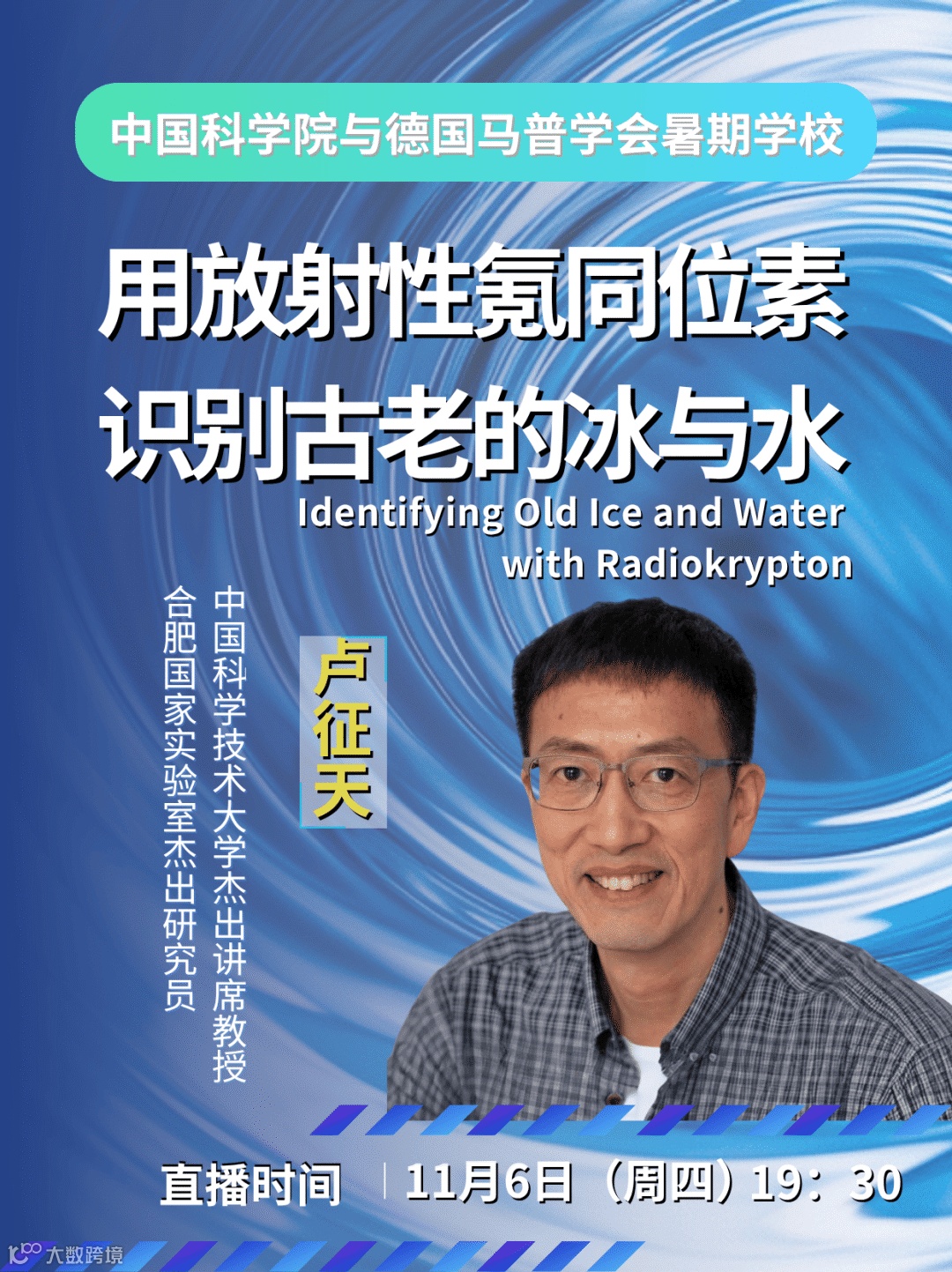
用放射性氪同位素识别古老的冰与水
Identifying Old Ice and Water with Radiokrypton
报告人

卢征天
中国科学技术大学 合肥国家实验室
报告时间

2025年11月6日(周四) 19:30
报告形式

线上直播
报告摘要

惰性气体同位素氪-81的半衰期长达23万年,是测定十万至百万年尺度地下水与冰芯年龄的理想示踪剂。然而,其在环境样品中的同位素丰度极低(仅约10-13,即十万亿分之一),自上世纪中叶起便成为同位素检测领域的标志性挑战。我们提出并发展了原子阱痕量分析方法(Atom Trap Trace Analysis)。该方法具备单原子灵敏探测能力,成功攻克了这一困扰学界六十年的难题,使得氪-81测年在地球科学领域的大范围应用成为可能。近年来,我们提取并分析了来自全球各地(包括七大洲)的样品,并与国内外地球与环境科学家合作,为研究地下水循环提供关键的时间信息,并在青藏高原、南极洲和格陵兰探寻古老的冰样以重建古气候历史。
The long-lived noble-gas isotope 81Kr is the ideal tracer for old water and ice with ages of 0.1-1 million years, a range beyond the reach of 14C. 81Kr-dating, a concept pursued over the past six decades, is now available to the earth science community at large. This is made possible by the development of the Atom Trap Trace Analysis (ATTA) method, in which individual atoms of the desired isotope are captured and detected. ATTA possesses superior selectivity, and is thus far used to analyze the environmental radioactive isotopes 85Kr, 39Ar, 41Ca, and 81Kr. These isotopes have extremely low isotopic abundances in the range of 10-17 to 10-11, and cover a wide range of ages and applications. In collaboration with earth scientists, we are dating groundwater and mapping its flow in major aquifers around the world, and dating old ice from the deep ice cores of Antarctica, Greenland, and the Tibetan Plateau. For an update on this worldwide effort, please google "ATTA Primer".
报告人简介

卢征天,现任中国科学技术大学杰出讲席教授、物理学院严济慈讲席教授、少年班学院院长,合肥国家实验室杰出研究员。
他1987年本科毕业于中国科大;1994年获得加州大学伯克利分校物理博士学位;1994-1997年在JILA研究所任博士后;1997-2015年在阿贡国家实验室物理部工作,历任助理研究员、研究员、资深研究员并在芝加哥大学物理系担任兼职教授。他2000年获得美国青年科学家总统奖;2009年获得美国物理学会Francis M. Pipkin奖;2015年全职加入中国科学技术大学。他在2011-2013年期间担任美国国家核科学顾问委员会委员;2015-2016年担任美国物理学会精密测量专业委员会主任;2015-2024年担任德国核物理马普所顾问委员会委员;2023年起担任上海交大物理与天文学科战略规划委员会委员;2023年起担任合肥微尺度交叉科学国家研究中心学术委员会委员。
激光痕量探测与精密测量实验室:http://atta.ustc.edu.cn
Zheng-Tian Lu is University Distinguished Professor, Yan Jici Professor of Physics and the Dean of the School of the Gifted Young, the University of Science and Technology of China (USTC). He received a B.Sc. from USTC in 1987 and a Ph.D. from UC Berkeley in 1994. Prior to rejoining USTC in 2015, he was a Senior Scientist at Argonne National Laboratory and a Professor (part-time) at The University of Chicago. Throughout his career, Lu has been developing techniques of laser manipulation and laser spectroscopy of atoms, and applying these techniques to ultrasensitive trace analysis, studying nuclear structure, and testing fundamental symmetries. He received a U.S. Presidential Early Career Award in 2000, was elected a Fellow of the American Physical Society in 2006, and received the Society’s Francis M. Pipkin Award in 2009. He served as a member of the U.S. Nuclear Science Advisory Committee in 2011-2013, and as Chair of the Topical Group of Precision Measurement and Fundamental Constants of the American Physical Society in 2015-2016. He serves on the advisory boards of the Max Planck Institute for Nuclear Physics, the School of Physics and Astronomy of Shanghai Jiao Tong University, and Hefei National Research Center for Physical Sciences at the Microscale.