


For most people, language learning is deeply fulfilling, fun, and a bit challenging. It takes time, discipline, and a well of motivation that you’ll need to refill. That’s why knowing the language difficulty ranking in relation to your native tongue can be useful.
Most widely-spoken languages by category
With over 7,000 languages spoken across the globe, it’s difficult to rank them all. The below language difficulty charts capture languages spoken by the majority of the world’s population.
The Foreign Service Institute includes time estimates alongside difficulty rankings, but it’s important to note that everyone’s language goals are different. The time estimates here reflect how long it would take the average person to reach a Level 3 proficiency level, which is pretty fluent by most standards.
If your goals align more with a Level 1 or 2 proficiency, you may be able to learn a language even faster.
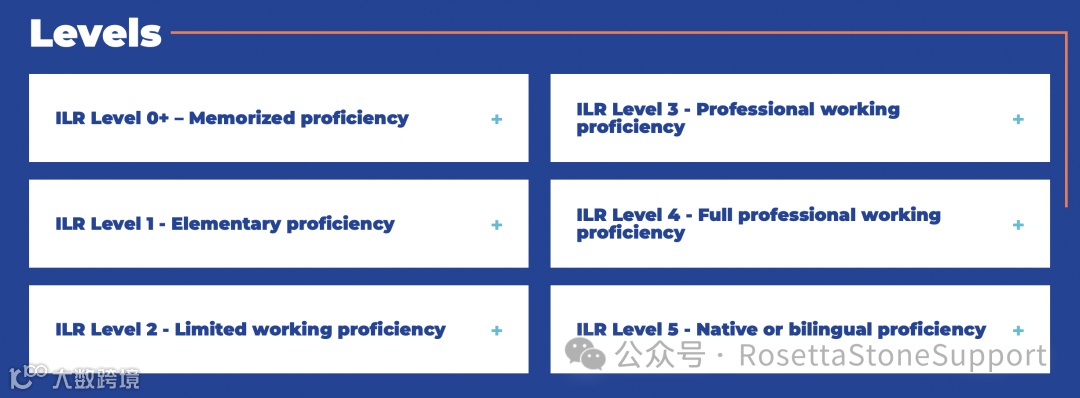
source:https://www.icls.edu/government-language-training/ilr-proficiency-levels
Category I languages
It takes approximately 24-30 weeks (600-750 hours of practice) to reach professional working proficiency in these languages. They are very closely related to English, so many of the same grammar rules and similar vocabulary apply.
Danish
Dutch
French
Italian
Norwegian
Portuguese
Romanian
Spanish (Latin America or Spain)
Swedish
Category II languages
It takes approximately 36 weeks (900 hours of practice) to obtain professional working proficiency in these five languages. Though German is in the same family as English, its nuanced pronunciation gives it a higher difficulty level than other Germanic languages.
German
Haitian Creole
Indonesian
Malay
Swahili
Category III languages
Approximately 44 weeks (1,100 hours of practice) is what you need to reach professional working proficiency in these languages. You’ll notice that many languages in the below language difficulty chart do not use the Latin alphabet.
| Albanian | Lithuanian |
| Amharic | Macedonian |
| Armenian | Mongolian |
| Azerbaijani | Nepali |
| Bengali | Polish |
| Bulgarian | Russian |
| Burmese | Serbo-Croatian |
| Czech | Sinhala |
| Dari | Slovak |
| Estonian | Slovenian |
| Farsi | Somali |
| Finnish | Tagalog |
| Georgian | Tajiki |
| Greek | Tamil |
| Hebrew | Telugu |
| Hindi | Thai |
| Hungarian | Tibetan |
| Icelandic | Turkish |
| Kazakh | Turkmen |
| Khmer | Ukrainian |
| Kurdish | Urdu |
| Kyrgyz | Uzbek |
| Lao | Vietnamese |
| Latvian |
Category IV languages
You’ll need approximately 88 weeks (2,200 hours of practice) to reach professional working proficiency in the below languages. These hardest languages to learn are ranked as such because they’re deeply nuanced, with complex grammar and pronunciation rules. Don’t let their place on this list deter you from diving right in, though—we’ve built courses to help you learn quickly and effectively!
Arabic
Chinese (Cantonese)
Chinese (Mandarin)
Japanese
Korean
Using language difficulty ranking for language learning
There’s no set timeline for how long it takes to learn a language, but language difficulty rankings serve as guides on your journey.
Learning a language is a marathon, not a sprint. It’s the last thing an eager language learner wants to hear, but it’s also incredibly valuable information. Knowing this makes it easier to stay motivated and disciplined and keep your eye on the prize—your personal language goals—at all times.
No matter the difficulty level of your new language, Rosetta Stone makes learning easy, effective, and fun with our Dynamic Immersion method. You can work at your own pace, or generate a custom plan based on your goals to meet the timeline you have in mind. Ready to supercharge your learning? Try Rosetta Stone’s Live Tutoring for a truly interactive experience!