
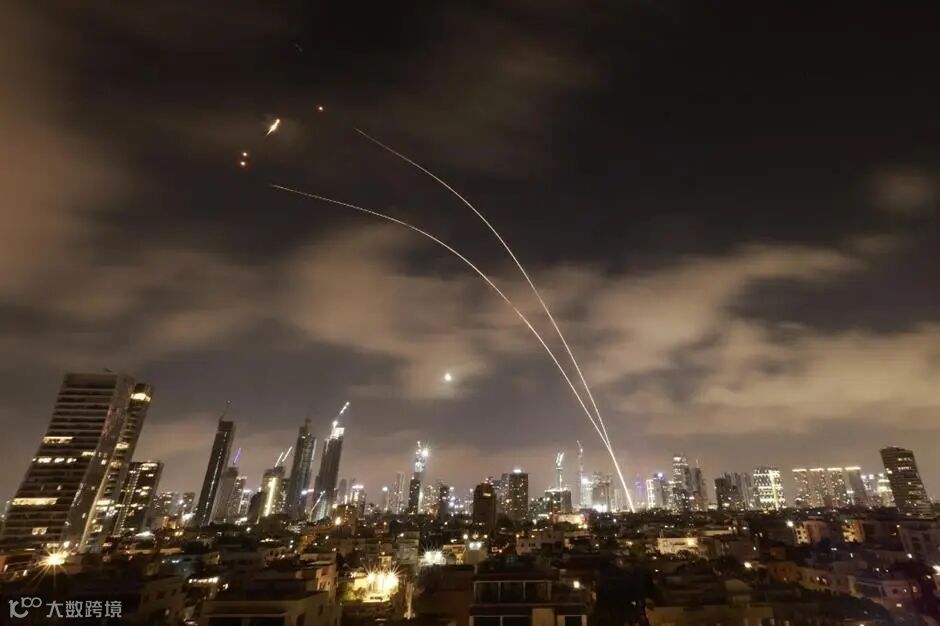
Israeli air defence systems are activated to intercept Iranian missiles over the Israeli city of Tel Aviv early on June 18, 2025.
Iran claimed early Wednesday to have fired hypersonic missiles at Israel in the latest round of overnight strikes between the archfoes, hours after Donald Trump demanded the Islamic republic's "unconditional surrender."
The US president insists Washington has played no part in ally Israel's bombing campaign, but also warned Iran his patience is wearing thin as the conflict enters a sixth day.
Israeli warplanes targeted the Iranian capital before dawn Wednesday after the military issued a warning on social media for civilians in an area known as District 18 to evacuate.
Iranian state media reported explosions ricocheting in the Piroozi, Sabalan and Sayyad areas of Tehran.
In retaliation, Iran told residents of Tel Aviv to prepare for an attack, with the Islamic Revolutionary Guard Corps claiming its hypersonic Fattah-1 missiles were "repeatedly shaking the shelters" in the commercial hub.
"The 11th wave of the proud Operation Honest Promise 3 using Fattah-1 missiles" was carried out, the Guards said in a statement broadcast on state television.
Hypersonic missiles travel at more than five times the speed of sound and can manoeuvre mid-flight, making them harder to track and intercept.
Iran also sent a "swarm of drones" toward Israel, where the army said it intercepted two over the Dead Sea area.
World powers have scrambled for an offramp, hoping to prevent the conflict from spiralling into a region-engulfing war.
In separate phone calls with his Iranian counterpart and US envoy Steve Witkoff on Tuesday night, Egyptian Foreign Minister Badr Abdelatty urged a diplomatic solution.
Trump fueled speculation about American intervention when he made a hasty exit from the G7 summit in Canada, where the leaders of the club of wealthy democracies jointly called for a ceasefire.
Back in Washington on Tuesday, Trump demanded the Islamic republic's "unconditional surrender."
He also boasted that the United States could easily assassinate Iran's supreme leader.
"We know exactly where the so-called 'Supreme Leader' is hiding. He is an easy target, but is safe there — We are not going to take him out (kill!), at least not for now," Trump wrote on his Truth Social platform.
He met with his National Security Council to discuss the conflict, ending after an hour and 20 minutes with no immediate public statement.
While he has repeatedly vowed to avoid wading into the "forever wars" of the Middle East, Trump ordered the USS Nimitz aircraft carrier to the region along with a number of US military aircraft.
US officials stressed he has not yet made a decision about any intervention.
Evacuations
Despite international alarm, neither side has backed off from the long-range blitz that began Friday, when Israel launched an unprecedented bombing campaign targeting Iranian nuclear and military facilities.
Israel claims its attacks have killed senior Iranian commander Ali Shadmani as well as his predecessor, Gholam Ali Rashid.
Residential areas in both countries have suffered deadly strikes since the fighting broke out, and foreign governments have scrambled to evacuate their citizens.
More than 700 foreigners living in Iran have crossed into neighboring Azerbaijan and Armenia since Israel launched its campaign, according to government figures.
The United States said it was closing its embassy in Jerusalem until Friday amid the growing conflict, but there was no announcement about helping Americans leave the "crisis area."
French President Emmanuel Macron said Trump had a critical role to play in restarting diplomacy with Iran, where attempts at regime change would bring "chaos."
China accused Trump of "pouring oil" on the conflict, while Turkish President Recep Tayyip Erdogan accused Israeli leader Benjamin Netanyahu of being "the biggest threat to the security of the region."
Source: AFP