

CONTACT: Zeng Ming, email: cncarolzeng@163.com
Abstract: Based on the Belt and Road Initiative (BRI) as a quasi-natural experiment, this paper uses panel data from 124 countries between 2006 and 2019 to build a difference-in-differences (DID) model to investigate the BRI employment effect on participating countries and mechanisms. We observed that the BRI had significantly increased employment rates in participating countries, and that this result remained robust after using the instrumental variable (IV) to mitigate endogeneity and perform a robustness test. There are differences in the BRI’s employment effect depending on the income level, labor conditions, and the digital economy’s development level of BRI countries: compared with low-income countries and lower-middle-income countries, the BRI has a more significantly positive effect on the employment rates of upper-middle-income and high-income countries; the BRI’s employment effect is stronger in countries with higher labor market efficiencies and better labor relations; In countries with higher levels of digital economy, the BRI has a relatively greater positive effect on employment. The BRI has increased employment rates in participating countries on both the supply and demand sides by building infrastructure, interconnecting industries and resources, and improving human capital through the exchange of human resources. Further analysis suggests that the BRI’s employment effect promotes the sophistication of participating countries’ employment structures, hence improving employment quality, and that participating countries’ employment levels may continue to improve in the medium and long run.
Keywords: Keywords: BRI , employment effect, infrastructure, investment

1. Introduction
The Belt and Road Initiative (BRI) is a “Chinese solution” for the country to actively participate in global openness and sharing, and promote the common prosperity of the global economy (Lu et al., 2021). Since its announcement in 2013, the BRI has received broad attention and an enthusiastic response from participating countries. The BRI has exerted an important effect on the economic development and industrial upgrade of participating countries during its implementation (Jia and Lei, 2019). However, BRI countries face significant obstacles in reaching the goal of sufficient and equal employment as global economic growth slows. As an innovative paradigm for regional economic integration, the BRI has significantly enhanced economic development and improved livelihoods in participating developing countries by exchanging capital, technology, and talent, thereby injecting vitality into their labor markets (Du et al., 2019). According to employment data from the World Bank’s open database, the average employment rate in BRI countries remained below the global average employment rate between 2006 and 2019, but climbed by 1.93 percentage points from 54.29% in 2006 to 56.22% in 2019, outpacing the global average employment rate growth of 0.58 percentage points from 57.84% to 58.42% over the same period. Furthermore, the average employment rate in BRI countries rose by 0.24 percentage points in the seven years prior to the BRI’s implementation (2006-2012) and 1.66 percentage points in the seven years following its implementation (2013-2019). This comparison demonstrates that BRI countries’ employment levels have improved significantly since the BRI’s introduction.
Without a doubt, the BRI provides a path of cooperation for mutually beneficial results through common development, serving as an international public good highly praised in many countries. However, some media outlets and analysts see the BRI as a Chinese version of the Marshall Plan (Shen and Chan, 2018), criticizing it as a means for China to engage in “economic exploitation” of participating countries (Sun, 2015). Some questioned the BRI’s role in exporting China’s excess industrial capacity, which would increase the risk of de-industrialization in low-income and resource-rich countries while pushing out local labor-intensive employment (Zhai, 2018). The World Bank’s employment rate data shows a significant jump in employment rates in BRI countries following the BRI’s implementation. However, they cannot forcefully deny the aforementioned doubts because the potential employment effect of other factors for BRI countries cannot be ruled out. Therefore, it is vital to provide science-based responses to the following questions: (i) Did the BRI boost the employment levels of participating countries? (ii) If the BRI has a job-creating effect, is there any heterogeneity in that effect due to the diverse socio-economic conditions of the BRI countries? (iii) If the BRI has increased employment levels in participating countries, what is the transmission mechanism? (iv) How could China contribute more to the development of the BRI in order to increase job creation in BRI countries? Clarifying the above issues will help reveal the achievements of the BRI from the perspective of employment, repudiating the criticisms or cynical interpretations of the BRI based on empirical results.
With the BRI’s announcement as a policy event, we used the difference-in-differences (DID) method to discuss the BRI’s employment effect on participating countries. Given the BRI’s complex framework, this paper aims to clarify the heterogeneous factors that contribute to the BRI’s employment effect on participating countries, as well as to discuss the specific conduits of such effect from the perspectives of infrastructure-driven development, trade and investment promotion, industrial interconnection and resource complementarity, and human capital improvement. Employment quality, an essential component of sustainable development, is rarely addressed in the existing research on the BRI’s employment effect on participating countries. Following a discussion of the BRI’s employment effect, this paper investigates the inter-sectoral distribution of the employment structure as well as the dynamic trends of the employment effect in order to conduct a thorough analysis of the BRI’s effects on the level and quality of employment in participating countries.
2. Literature Review
2.1 Research on the BRI’s Policy Effects
As the BRI’s implementation progresses, scholars have focused more on its policy effect. Overall, existing research centers on the BRI’s economic effect for China, especially in terms of cross-border trade (Sun et al., 2017; Mao et al., 2019), outbound investment (Jin and Shen, 2019; Lyu et al., 2019; Du and Zhang, 2018), corporate upgrade and innovation (Wang and Lu, 2019), industrial structure transformation and upgrade (Fang and Zhao, 2021), employment rate and quality improvement (Liu and Yan, 2022; Liao et al., 2021), and economic growth (Guo, 2019). These studies have basically confirmed the BRI’s positive economic effects on China.
The BRI seeks to promote common development for mutual benefit and win-win results. In accordance with this mission, some scholars have started to pay attention to whether the BRI could result in substantive policy dividends on participating countries and assessed the BRI’s effects on socioeconomic development and livelihoods in terms of economic development, income distribution, poverty reduction, and sustainable development. In terms of economic income, research indicated that the BRI have helped participating countries improve their economic performance (Ma, 2022) and close income gaps (Bi et al., 2021). Niu et al. (2020) further statedthat within the BRI framework, China’s outbound foreign direct investment (OFDI) would not only raise per capita income in BRI countries, but improve internal income distribution and structure. In terms of poverty governance, Wang et al. (2020) concluded that the BRI has a pan-regional poverty reduction effect. Further research indicates that China’s investment and aid in BRI countries may help to alleviate poverty in host countries (Peng, 2020; Zhang, 2018a). In terms of sustainable development, Lyu and Li (2021) observed that the BRI had a significantly positive effect on the human development index (HDI) of participating countries. Liu (2022) noted that the BRI could assist participating countries to achieve sustainable development and increase their livelihoods. Some research have also discussed sustainable economic development in specific areas of cooperation. For example, Qi and Xu (2018) discovered that the BRI had generated green technological progress and propelled green transition in BRI countries through the channel of trade openness.
2.2 BRI’s Employment Effect on Participating Countries
Based on cross-national panel data from 2004 to 2016, Lyu et al. (2018) uncovered that the BRI had increased job growth in BRI countries. Li et al. (2022) used China’s renewable energy investment in Pakistan as a case study and discovered that China had generated 8,905 jobs in Pakistan through renewable energy investment under the BRI. Some research found a positive employment effect. For example, China’s ODI has raised employment levels in host countries (Zhang, 2018b) and the proportion of female employment in participating countries (Han and Xu, 2020).
The BRI’s employment effect is heterogeneous due to the impact of many factors such as economic growth, institutional environment, labor conditions, and individual employee characteristics. A small number of studies have focused on the heterogeneity of the initiative’s employment effects. For example, Lall and Lebrand (2020) examined the heterogenous effects of transportation infrastructure investment from the perspective of labor mobility and discovered that, unlike Kyrgyzstan and Uzbekistan, transportation infrastructure investment under the BRI had exacerbated inequalities in labor market access in Kazakhstan. Bird et al. (2020) argued that the heterogeneity in employment rate changes stems from differences in the initial employment shares of industries. Lyu et al. (2018) evaluated the heterogeneity of the BRI’s employment effect based on demographic factors such as gender and education level, and discovered that the BRI was conducive to increasing women’s employment in participating countries.
In general, the majority of existing research has examined the BRI’s effect on employment levels in participating countries through case studies, with inadequate attention to the BRI’s direct employment effect and conduit of transmission. Furthermore, the existing research literature has paid insufficient attention to the heterogeneity. Therefore, this paper aims to: First, establish a theoretical framework for the BRI’s employment effect on participating countries by utilizing the BRI’s cooperation framework and supply-demand factors that influence employment. The theoretical framework will be empirically tested to determine the BRI’s employment effect and the potential mechanism of transmission. Second, the heterogeneity of the employment effect will be examined in relation to the income level, labor conditions, and digital economy development of participating countries. Third, the analytical framework will incorporate employment quality to reflect the BRI’s substantive employment effect on participating countries.
3. Theoretical Analysis and Research Hypothesis
Under the BRI’s cooperation framework, China has engaged in all-round and extensive cooperation with participating countries, facilitating the orderly and free flow of economic factors, efficient resource allocation, and in-depth market integration, thus hastening the pace of regional integration. Countries have participated in various forms of cooperation for regional integration as part of the globalization process, and there are also research findings regarding the employment effects of regional integration. Fertig (2003), for example, asserted that joining the European Union would lower member states’ unemployment rates and boost employment in the service sector. Mashayekhi et al. (2012) discovered that trade liberalization in the South Africa Development Community (SADC) could create more jobs and transform member states’ employment structures; Park et al. (2021) found that Regional Comprehensive Economic Partnership(RCEP) accession could effectively create more jobs in Asia-Pacific countries.
Based on the employment supply and demand factors, the BRI can generate direct and indirect employment effects on participating countries. Specifically, the direct employment effect is mainly manifested as follows: As Chinese companies accelerate their “going global” pace with the opportunity of the BRI, they establish factories and industrial development zones in BRI countries, thereby creating numerous local jobs and expanding the demand for the local workforce. The indirect employment demand effect refers to the enhanced cooperation between China and BRI participating countries in the fields such as finance, investment, and trade, promoting the cross-border flow of capital, technology, and human resources, and thus stimulating the economic growth and development of relevant industries in participating countries. Moreover, the economic growth effect of BRI has also brought about technological progress to participating countries, prompting the development of new products and business lines, which further expands labor demand. Hence, we put forward the following research hypothesis:
H1: The BRI is conducive to raising the employment level of participating countries
Infrastructure construction has always been a priority area for the BRI, which seeks to foster “infrastructure connectivity”. China has adhered to the basic framework of “six corridors, six channels, serving multiple countries and ports” to strengthen its collaboration with BRI countries for the development of roads, civil aviation, postal services, and ports. The improvement of “four-in-one” connection via land, sea, air, and transportation networks has uplifted infrastructure development in BRI countries. Furthermore, China has implemented a large number of aid projects and overseas project contracts, such as water supply, electric power, agriculture, and water conservancy, among other public-interest infrastructure projects that have been a major source of local jobs in host countries (Githaiga et al., 2019). China has also prioritized the development of digital infrastructure, driving the exchanges and collaboration with BRI countries in other fields. This has a dual impact on both supply and demand sides of employment (Zhang et al., 2010). From a demand perspective, higher infrastructure investment may increase corporate output capacity through productivity growth and expand labor demand; from a supply perspective, infrastructure is viewed as a leading capital that will attract factors of production such as capital and labor to agglomerate (Wu and Shen, 2013), improve labor supply, and create more jobs. Improving infrastructure helps host countries boost productivity (Yeoh and Stansel, 2013), and higher productivity spurs job growth(Duggal et al., 1999). The development of digital infrastructure has also reduced the cost of searching, enhancing the efficiency of labor market matching and improving the employment environment. Based on the aforementioned analysis, we propose the following research hypothesis:
H2: The BRI promotes jobs growth in participating countries via the impetus of infrastructure development
The BRI prioritizes investment and trade. In forms of factory construction, industrial parks, projects or business needs, outbound foreign direct investment (OFDI) directly drives employment growth in related industries through demand effects. Furthermore, OFDI indirectly raises employment levels by enhanced economic growth in participating countries. Meanwhile, OFDI is often accompanied by an influx of technology, managerial expertise, and professional knowledge. When Chinese-funded enterprises go global, they bring advanced production technologies and managerial practices with them. This transfer of technology and knowledge helps host countries improve their labor competence and skills level, as well as expand the supply of highly skilled workforce to meet the demand of high-tech industries. The agglomeration effect of businesses and human resources will help to attract additional factors of production that contribute to local economic development as well as employment. Two-way and multi-way trade under the BRI will assist participating countries in expanding market scale and investment sectors, resulting in the creation of even more jobs. New modes of the digital economy, such as cross-border e-commerce, have accelerated trade development toward network-based development, digitalization, and increased convenience, exerting a significant effect on the transition and development of small and medium-sized enterprises (SMEs) in participating countries. These SMEs are the foundation of job growth. For countries with insufficient resource endowment, the BRI has significantly improved interconnectivity and reduced the cost and time of transportation for imported raw materials and intermediate inputs. This has helped to improve domestic enterprises’ factor input structure and promote job growth by sharpening their comparative advantages. Therefore, we propose the following research hypothesis:
H3: The BRI boosts the level of employment in participating countries via the driving force of trade and investment
Industrial sectors are a source of job creation, and a reasonable industrial structure promotes job growth and increases employment elasticity(Lu and Ou, 2011). The BRI encourages complementarity and the exchange of resources, technologies, and markets throughout supply chains, promoting upstream and downstream industrial chain coordination as well as industrial transition and upgrading in various countries. Based on the data of China’s direct investments in BRI countries, Jia and Lei (2019) found that China’s OFDI had generally accelerated industrial upgrading in host countries. Wang and Zhong (2021) discovered, using the propensity scoring match (PSM) and DID approaches, that the BRI might increase the sophistication of industrial structure in participating countries. According to the structuralist theory, the essence of an upgrade of industrial structure is the transformation of allocation of production factors among different industries (He and Li, 2020), which is conducive to increasing productivity and capacity expansion in relevant industrial sectors, thus driving labor demand. Furthermore, the improvement of industrial structure has a substantial diffusion effect, resulting in the formation of new industries with a high degree of correlation. Emerging industries require a large workforce in the early stages of their development, thus increasing job demand (Guo and Sun, 2022). Thus, we suggest the following hypothesis:
H4: The BRI is conducive to improving the level of employment in participating countries via the industrial interconnection and resource complementarity mechanisms
Human capital not only influences employment from the supply side but also affects a country’s sustainable economic growth (Lai et al., 2005). Cooperation and the exchange of human resourcesare essential components of people-to-people ties. Apart from the official procedures for talent exchange and cooperation, labor cooperation and investments made by Chinese-funded companies in participating countries are significant factors that facilitate talent exchanges. Ge et al. (2020) claimed that the BRI had greatly improved people’s mobility in participating countries, especially when it came to the flow of highly skilled talent, educated, high social capital and professional individuals with a wealth of managerial expertise. Agglomeration economics holds that the concentration and exchange of human resources will foster human capital accumulation and accelerate knowledge spillover in the region (Wang et al., 2020). This will enhance the human capital structure and increase the availability of highly skilled and competent workforce. In reality, talent exchanges and collaboration are increasingly being conducted on a regular basis by private actors on their own initiative. Such collaboration has ranged from high-level talent exchanges, labor cooperation, student exchanges, and the establishment of Confucius Institutes to cooperative programs in vocational technical education and training. Based on the study on Kenya, Musyimi et al. (2018) found that the BRI’s technical and vocational education and training programs had helped raise local labor skills and improve the employment rate in Kenya. Therefore, we put forth the following hypothesis:
H5: The BRI promotes the level of employment in participating countries by raising human capital through the exchanges of human resources
4. Research Design
4.1 Model Specification
Taking the BRI as a quasi-natural experiment, this section develops a DID model to examine the BRI’s employment effect on participating countries. Our first step, based on the questions being discussed, is to create two dummy variables. (i) Dummy variable for the treatment group (BRI). If a sample is a BRI country, the value is 1, indicating the treatment group; otherwise, the value is 0, indicating the control group. (ii) Dummy variable for policy time (Post). Based on the year of the BRI’s announcement, we designate 2013 as the year of policy shock, assigning the value of 1 to 2013 and following years and 0 to all previous years. Thus, the following baseline regression model is set:

In equation (1), i and t signify the dimensions of country and time, respectively, and Employment it represents the employment rate of people aged above 15 in country i in year t. DIDit is the interaction term for the BRI , expressed as DIDit=BRIi×Postt. Coefficient α1 denotes the BRI’s employment effect on participating countries, and is a key parameter in this paper. Controlit defines a set of control variables that influence the level of employment according to country and time. μi is the fixed effect of country, σt is the fixed effect of year, and εit is the stochastic disturbance term.
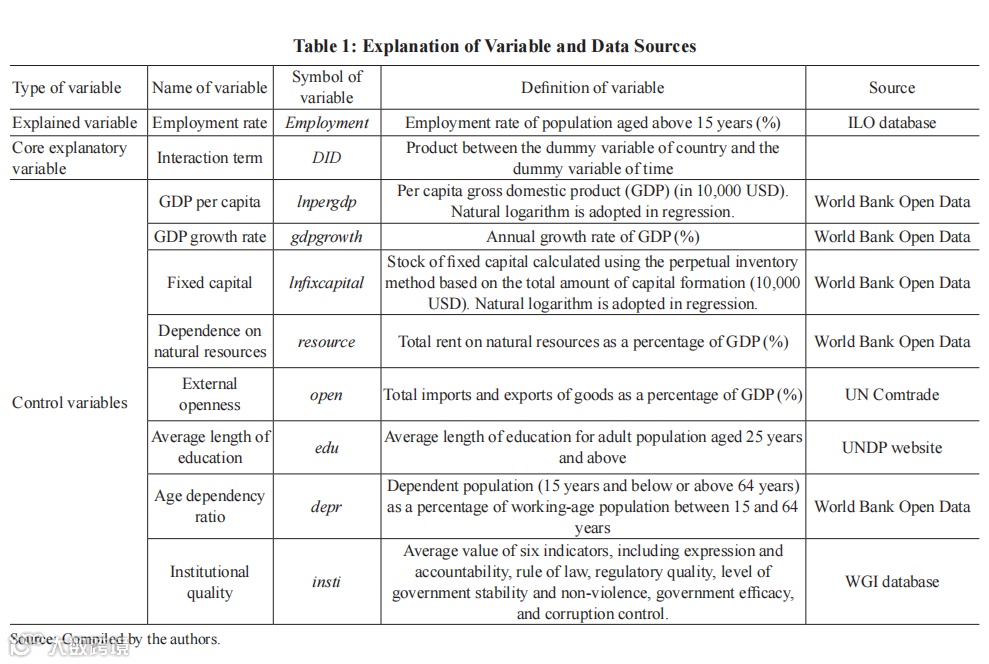
In this paper, our selection of the treatment group is not entirely stochastic. As a result, there could be differences between the treatment group and non-BRI countries in terms of the level of economic development, the endowment of natural resources, and the level of human capital. Some differences already existed before the occurrence of policy shock, and such differences also serve as key variables for the level of employment. Referencing Dai and Song (2021) and Jia and Lei (2019), we have controlled for the per capita gross domestic product (GDP) (lnpergdp), GDP growth rate (gdpgrowth), fixed capital (lnfixcapital), dependence on natural resources (resource), the level of economic openness (open), the average length of education (edu), dependency ratio (depr), and institutional quality (insti). The selection of control variables is primarily based on the following considerations: (i) the level of economic growth theoretically shares a consistent trend of change with the level of employment, and a country’s level of economic growth is a direct determinant of the employment rate; (ii) a country’s fixed capital represents the level of its capital factor supply, and has a substitutive effect with the labor factor; (iii) the level of dependence on natural resources is a key variable affecting a country’s economic growth efficiency and industrial structure, and also exerts a major impact on the employment level and human capital accumulation (Xu and Shao, 2006); (iv) a country’s exports of goods and services will create more jobs not only in the corresponding sectors of the economy, but also in other sectors or industries under the spillover effect; (v) the average length of education and dependency ratio reflect the quality and demographic structure of a country, serving as direct determinants of employment; (vi) institutional quality is another determinant of a country’s employment. Table 1 presents the specific measurement methods and sources of data for the variables:
4.2 Descriptive Statistics of Samples
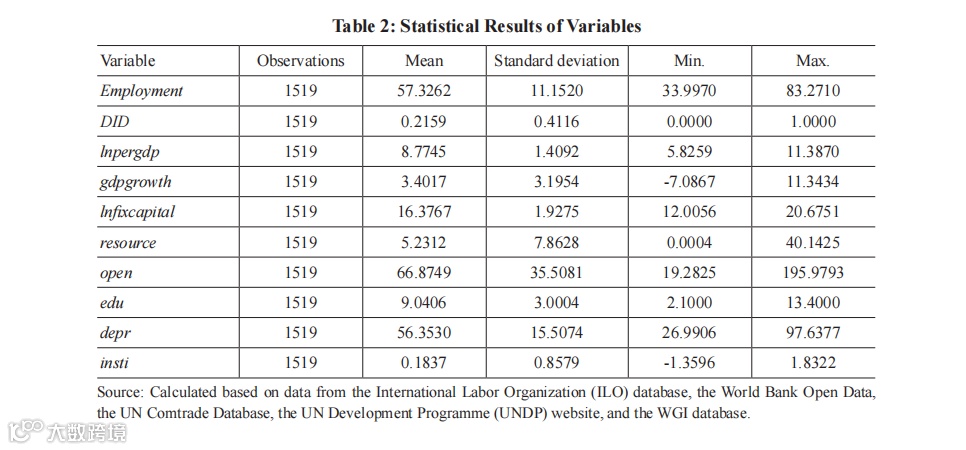
This study defines the temporal dimension of research samples taken between 2006 and 2019. To reduce outlier interference, we winsorized all continuous variables at 1%.After removing missing values from the key variables, we obtained 1,519 sample observations, which included relevant information for 124 countries and regions, 50 of which are BRI countries and 74 of which are non-BRI. Table 2 shows descriptive statistics for variables. Table 2 shows that the standard deviation of employment rates for sample countries is 11.15, indicating relatively wide employment gaps.
5. Empirical Results and Analysis
5.1 Baseline Regression Results
The regression results for the baseline model are reported in Table 3. Column (1) of Table 3shows the estimated results without the control variables. Column (2) controls all of the control variables in equation (1). As shown in columns (1) and (2) of Table 3, the coefficient of DID is significantly positive at 1%, showing that the BRI has a positive effect on the level of employment in participating countries, hence supporting hypothesis H1. As shown in column (2) of Table 3, the regression coefficient is 1.10 after including all control variables, indicating no significant change from column (1), and the goodness of fit has increased, implying that the control variable selection is appropriate. The coefficient of DID shows that, with other control factors held constant, the change in the average employment rate of those over the age of 15 was 1.10 percentage points higher than the control group following the BRI’s announcement.

5.2 Test of Model Effectiveness
5.2.1 Parallel trend test
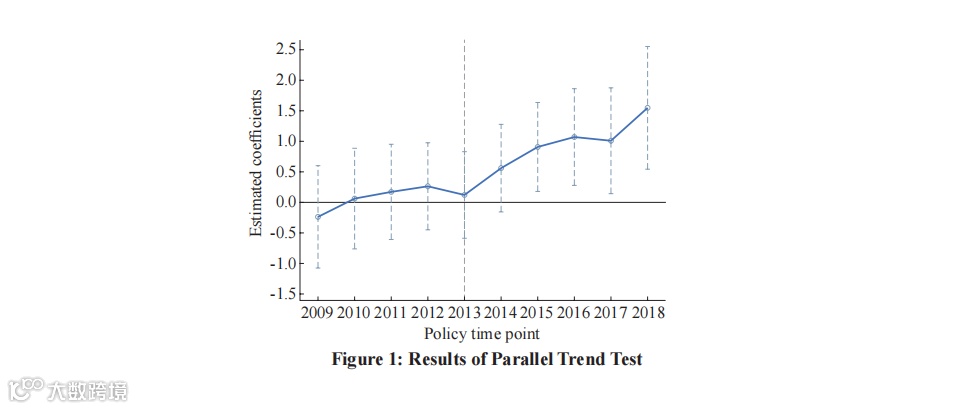
The DID method assumes that the treatment and control groups shared the same trend prior to the BRI’s introduction, i.e., changes in employment rates due to other factors before and after 2013 should be consistent between BRI and non-BRI countries. Referring to Cao and Chen (2022), we incorporated a dummy variable of year before and after the policy year for a parallel trend test, and the specific model is indicated in equation (2).

In equation (2), dummy variable Postkit represents k years before and after BRI countries joined the BRI (k=5) (including the year when the BRI was proposed), and the dummy variable for non-BRI countries is 0. Coefficient αk reflects differences in the results for the treatment group and control group before and after the BRI’s announcement. As can be learned from Figure 1, the regression coefficients for all the years preceding 2013 are all insignificant, indicating the absence of significant differences in the trend of change between the treatment group and control group before the BRI’s announcement. This suggests that our estimated results have passed the parallel trend test. Further, there was a significant increase in the average employment rate of the treatment group after 2013 as compared with the control group, and such increase steadily intensified over time.
5.2.2 Placebo test
Although the parallel trend test result has proven the robustness of baseline regression, this result may still be influenced by omitted variables. Referencing Lyu et al. (2019) and Lu et al. (2021), we created a dummy treatment group for a placebo test. After excluding the missing values, we retained samples of 124 countries and regions, including 50 BRI countries. We randomly selected 50 countries from the 124 countries and regions to form a “pseudo-treatment group” BRIipesudo, and created a pseudo-differential term to enter the baseline model regression BRIipesudo×Postt. To enhance the placebo test effect, we repeated this process for 500 times. Result of the placebo test indicates that the estimated coefficients for the treatment groups randomly selected for 500 times are distributed around 0, and the p-values of most estimated coefficients are greater than 0.1. Compared with the estimated coefficients obtained from randomly selecting the control groups for 500 times, the actual estimated coefficient is apparently an outlier. This implies that other omitted variables have a relatively small impact on the BRI’s employment effect on participating countries.
5.3 Robustness Test
5.3.1 Impact of other policies during the same period
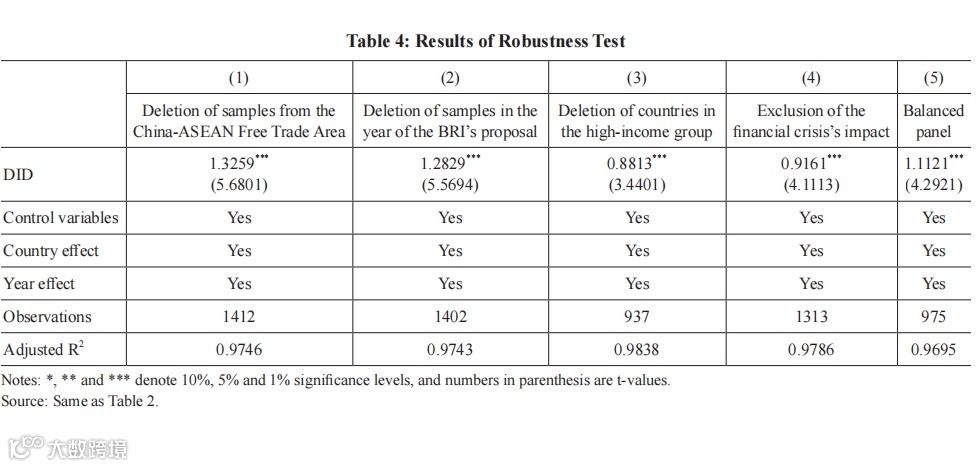
The BRI is a new model of international regional economic cooperation (Lu et al., 2021). During the sample observation period, various international or regional cooperation policies may cause disparities in employment levels among countries. China established the China-ASEAN Free Trade Area in 2010 to promote economic and trade cooperation in East Asia, as one of the world’s three regional economic cooperation blocs. In terms of coverage, the China-ASEAN Free Trade Area and the BRI share some similarities. To prevent such policy interference, country samples from the China-ASEAN Free Trade Area must be excluded. According to the analytical results in column (1) of Table 4, the coefficient of DID remains significantly positive at the 1% level after eliminating the potential employment effect of the China-ASEAN Free-Trade Area, implying that the original results are robust.
5.3.2 Deletion of sample observations in the year of the BRI’s announcement
Countries joined the BRI at different points in time after its initial announcement in September 2013. Furthermore, there could be a lag for the BRI to have an employment effect, which may not materialize in the first year of 2013, causing the estimated results to be biased. The preceding parallel trend test also indicates that in the current phase of the BRI’s announcement in 2013, the treatment and control groups followed a consistent development trend with no significant differences. To improve the robustness of the estimated results, we eliminated all observations of sample countries and regions in 2013 and tested the baseline regression model. As column (2) of Table 4 shows, the coefficient of the DID term remains significantly positive at 1%, supporting the original results.
5.3.3 Country samples of the high-income group
Rapid economic expansion will result in job growth. For one thing, technological advancement will raise corporate labor demand through the effect of output growth; on the other hand, new technologies can be utilized to develop new products or sectors, creating new jobs (Yao and Xia, 2005). According to this concept, countries with higher economic growth rates and per capita incomes have higher employment rates. The majority of BRI countries are developing countries. To prevent the interference of this factor, we conducted a regression analysis after removing samples from high-income countries and regions using the World Bank’s country income classification standards for 2020-2021, divided by income levels. As can be seen in column (3) of Table 4, the coefficient of DID remains significantly positive at 1% after omitting high-income nation data, implying that the original results remain robust.
5.3.4 Employment shock of the global financial crisis
The sample coverage period runs from 2006 to 2019, and the 2008 global financial crisis is also expected to have an impact on the employment rate. To strengthen the robustness of the results, we performed another regression analysis after eliminating the samples from 2008 and before. The results in column (4) of Table 4 show that, even after accounting for the influence of the global financial crisis, the DID coefficient remains significant at 1%.
5.3.5 Use of balanced panel
Certain statistics for the employment rate and key control variables in BRI and non-BRI countries are absent as a result of stochastic or non-stochastic factors. We eliminated missing items from the baseline regression, resulting in an unbalanced panel. In this part, a balanced panel is used to perform a robustness test. The results in column (5) of Table 4 show that after using the balanced panel, the coefficient of DID remains significant at 1%, indicating that the calculated results are robust.
5.4 Treatment of Endogeneity Problem
To address the potential endogeneity problem, we used the panel instrumental variable (IV) method, referring to Wang and Lu (2019). To give a consistent estimate of real parameters, an effective instrumental variable must meet both relevance and exogeneity criteria. Referring to Cao and Li (2021), we developed an instrumental variable (IVlanguage) based on the similarities of official languages between China and other countries, with raw data sourced from the Center for Prospective Studies and International Information (CEPII) database. Language is a key aspect of culture, and a shorter cultural distance reduces transaction cost and friction (Ji, 2018). Theoretically, the closer a country’s official language is to China’s, the smaller the cultural difference between the two countries (Xu and Li, 2015), and the greater the country’s recognition and adoption of the BRI. This correlation meets the requirements for an instrumental variable. Furthermore, a country’s official language is determined by its historical and cultural heritage, as well as the needs of its political institutions, and is not directly tied to its employment level, thus meeting the exogeneity condition. As a result, this instrumental variable is justifiable because it solely influences the degree of employment through the BRI.
Notably, the endogeneity variable BRI country (BRI) is incorporated into the model as an interaction term (BRI×Post). As such, the appropriate instrumental variable for this interaction term is IVlanguage×Post. Hence, the first-stage regression model for the instrumental variable should take the form of equation (3):

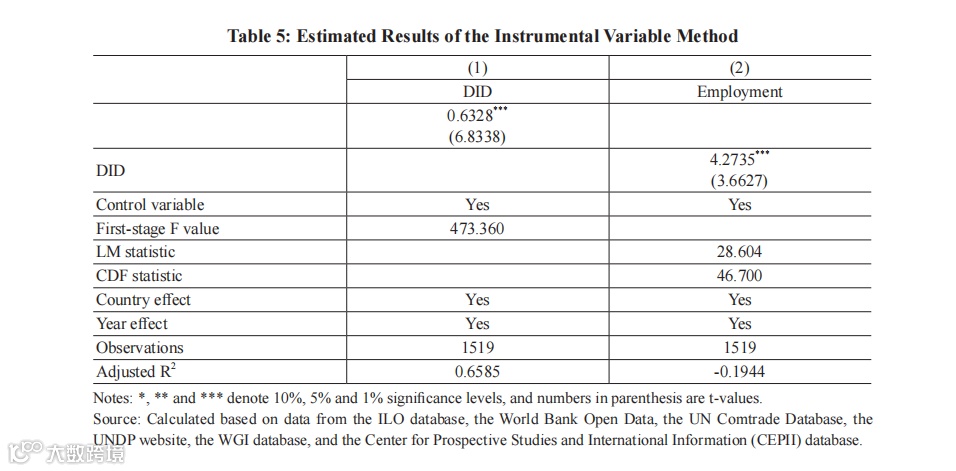
In equation (3), IVlanguage is the instrumental variable of “similarity of official languages between China and other countries”. If a country has a similar official language with China’s, the value is 1; otherwise, it is 0. Other definitions are the same with equation (1). The two-stage regression results of the instrumental variable are shown in Table 5. As can be learned from column (1) of Table 5, the coefficient of instrumental variable IVlanguage×Post in the first-stage regression is positively significant at 1%, which satisfies correlation. Meanwhile, the F-value of the first-stage regression is 473.360, which is greater than the critical value of 10; and LM statistic after the second-stage regression is 28.604, which has passed the under-identification test. CDF statistic is 46.70, which is greater than Stock and Yogo’s (2005) critical value of 16.38 at the 10% level. This suggests that the instrumental variable is not weak. According to the results of the second-stage regression, the coefficient of DID remains positively significant. This reveals that after addressing the endogeneity problem, the BRI still has led to an increase in the level of employment in participating countries.
6. Heterogeneity Analysis
6.1Assessment of Income Differences by Country
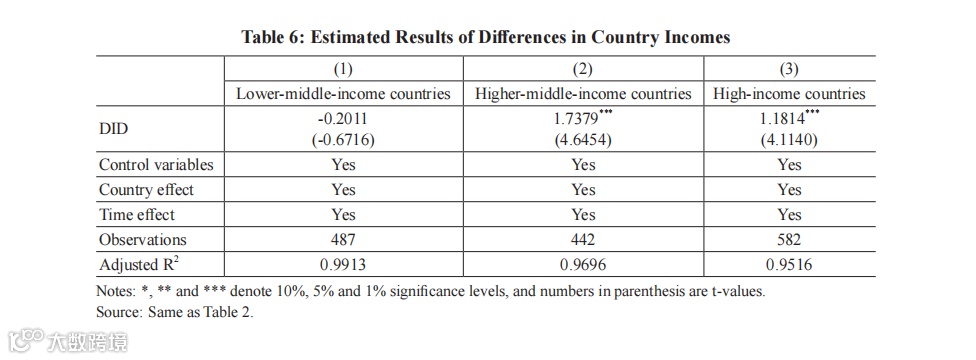
According to Okun’s Law, economic growth can boost employment in industrialized countries with developed market economies. Therefore, in those countries, the BRI will generate a more efficient employment promotion effect with increasing returns. According to the Petty-Clark Theorem, the level of economic development is strongly correlated with the cross-sectoral migration of labor. Countries with higher per capita incomes will see a stronger agglomeration of workforce in the industrial and service sectors. Employment levels in countries undergoing industrialization and market-oriented reforms are influenced by the combined effects of economic transition and evolving industrial structure through economic growth (Liu et al., 2015). We conducted a regression study of the World Bank’s country income categories (2020-2021) to assess the effect of employment on development levels. Due to the modest number of low-income countries, we put low-income samples in the lower-middle-income group for evaluation. Table 6 shows the regression results divided by country income.
Table 6 shows that the BRI’s employment effect is negative for lower-middle-income countries but significantly positive for upper-middle- and high-income countries. This suggests that the BRI’semployment effect varies between countries with different income levels, and is more significant for upper-middle-income and high-income countries.
6.2 Differences in Labor Conditions
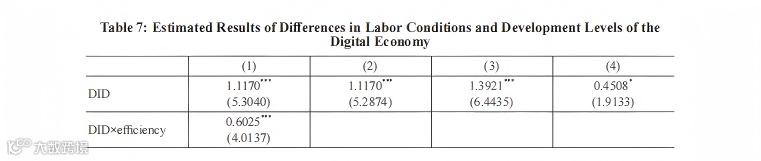
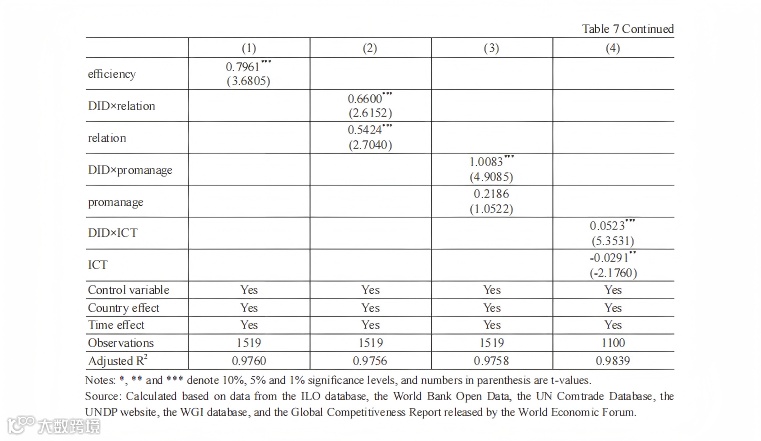
The BRI’s employment effect is also subject to the labor conditions of participating countries. Labor conditions exist in formal and informal forms, affecting the host countries’ labor supply and demand. Labor conditions are also a key factor for host countries to attract foreign capital, which is impacted by information asymmetry and institutional frictions (Xu and Liu, 2019). Based on the World Economic Forum’s (WEF) Global Competitiveness Report over the years, we assessed the heterogeneity of labor conditions in three dimensions: labor market efficiency (efficiency), labor relations (relations), and reliance on professional management (promanage). According to the Global Competitiveness Report, countries’ labor market efficiency, labor relations, and reliance on professional management are graded on a scale of 1 to 7, with 1 being the worst and 7 the best. Furthermore, we included interaction terms between DID and the three laborcondition variables listed above in the model to evaluate the differentiated effects of labor conditions on the BRI’s employment effect, with results presented in Table 7, columns (1)-(3).
The estimated coefficients for the interaction terms indicate that in countries where the labor market is more efficient, labor relations are more stable, and the dependence on professional management is higher, the BRI has a stronger effect on promoting employment. The reasoning is that in the host countries with better labor conditions, it is easier for Chinese-funded enterprises to recruit qualified employees and maintain a more stable relationship with their employees, thereby reducing labor risks and improving the efficiency and effectiveness of professional management. When Chinese-funded companies enjoy a boost in labor productivity, it generates positive feedback that motivates them to expand their investment and create even more jobs, hence enhancing the job creation effect.
6.3 Development Disparities of the Digital Economy
The BRI’s ten-year implementation coincided with the rapid development of the global digital economy. Theoretically, in countries with a relatively high level of digital economic development, the cost of information search in the labor market is lower, and the labor force faces less information asymmetry in the job market. In comparison, countries with lower digital economy development levels face more labor market information asymmetry and information frictions, reducing the effectiveness of labor market supply-demand matching. To assess the hetereogeneity of the digital economy’s development level, we measured the adoption of information and communications technology (ICT) in sample countries. The data comes from the Global Competitiveness Report. According to the report, ICT adoption is classified into seven grades on a scale of 1 to 7, with 1 being worst and 7 representing the best. Furthermore, we included the interaction term between DID and ICT in the model, and the regression results are shown in Column 4 of Table 7. The estimated coefficient of interaction term indicates that the BRI’s employment effect varies according to the level of digital economy development in participating countries. The BRI’s employment promotion effect is stronger in more digitally developed participating countries.
7. Mechanism Test
The previous section demonstrated via empirical testing that the BRI has greatly increased employment rates in participating countries. Then what mechanisms does the BRI use to improve the employment level of BRI participating countries? In this section, we will examine the infrastructure-driven mechanism, the trade and investment-driven mechanism, the industrial interconnection and resource complementarity mechanism, and the human capital improvement mechanism based on talent exchange proposed in the research hypothesis.
7.1 Infrastructure-Driven Mechanism
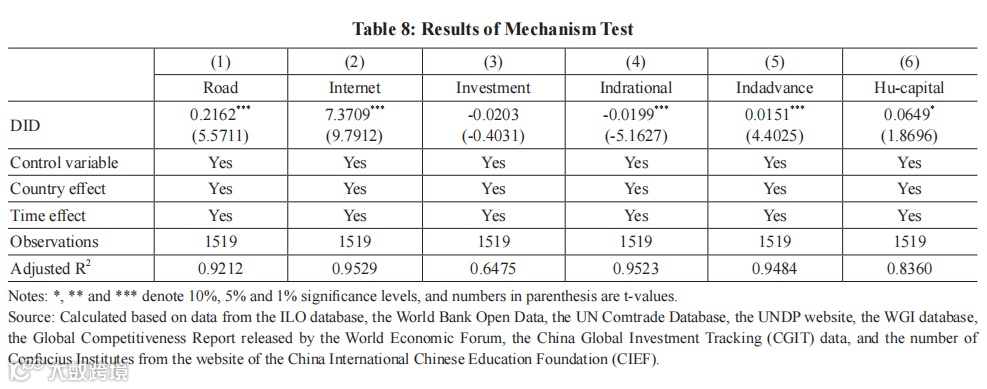
The BRI will generate an employment promotion effect by improving the infrastructure in participating countries, according to our theoretical analysis. We therefore estimated the effects of traditional infrastructure and digital infrastructure, respectively. In particular, the Global Competitiveness Report data is used to establish road quality (Road) as a proxy variable for traditional infrastructure. Column (1) of Table 8 displays regression results that employ Road as the proxy variable. This variable is also categorized into seven grades, with 1 representing the worst and 7 the best, in accordance with the previous discussion. Digital infrastructure is given priority in BRI infrastructure cooperation. The quality of digital infrastructure development and the coverage of digital infrastructure are both reflected in the actual connections of users, which is known as internet penetration. Consequently, we employ Internet penetration (Internet) as a proxy variable for digital infrastructure. The regression results for the Internet as the proxy variable are presented in column (2) of Table 8. The coefficient of DID is significant at 1%, as evidenced by columns (1) and (2) of Table 8, suggesting that the BRI is advantageous for the development of both traditional and digital infrastructure in BRI countries. According to the aforementioned theoretical analysis, the BRI has increased employment levels in participating countries through the infrastructure-driven mechanism.
7.2 Trade and Investment-Driven Mechanism
In this section, we utilize the number of Chinese overseas investment and construction projects (Investment) as a proxy variable. Such data are collected from the China Global Investment Tracking (CGIT) Data” compiled by the American Enterprise Institute (AEI). Given the right-skewed distribution of investment project members, we calculated the logarithm of raw data and added it by 1 before inserting it into the model. The regression results are displayed in column 3 of Table 8. As seen in column (3), the coefficient of the key explanatory variable DID is negative but not significant. One possible explanation is that foreign investment and trade are influenced by host countries’ institutional environments, levels of industrial growth, and labor market efficiency. Furthermore, there may be a lag in the employment effect of investment and trade, or there may be a non-linear effect, i.e., a “threshold” beyond which a significant employment effect might be generated. Some research on the relationship between OFDI and employment in host countries reveals that if a host country has a more labor-intensive industrial structure, capital and technology-intensive industries from foreign countries will temporarily crowd out domestic employment (Bufe, 1993). To rule out industrial crowding-out and excess capacity migration, we shall put the industrial interconnection and resource complementarity mechanisms to the test.
7.3 Industrial Docking and Resource Complementarity Mechanisms
Industrial interconnection and resource complementarity manifest themselves in two ways: first, both sides’ comparative advantages are fully utilized to realize resource, technology, and market complementarity and promote the reasonable development of industrial structure in BRI countries. Second, investment and trade serve to foster the industrial transition and sophistication of countries’ industrial structures.According to Gan et al. (2011), we used the Theil index (Indrational) to determine the appropriate level of industrial structure based on the distribution of output value and workforce across various industrial sectors. The more the Theil index of samples deviates from 0, that is, the bigger the absolute value of the index, the more irrational the industrial structure of a sample country. Regarding the sophistication of industrial structure (Indadvance), we use the vector angle cosine approach from Fu (2010).
As seen in column (4) of Table 8, the coefficient of DID is negative, implying that the BRI has improved the industrial structure of participating countries, resulting in a shift toward a more reasonable industrial development structure. As shown in column (5) of Table 8, the coefficient of DID is positive and significant at the 1% level, indicating that the BRI has helped to improve the sophistication of industrial structures in participating countries. This conclusion implies that the BRI has increased employment rates in participating countries, as indicated by the foregoing theoretical analysis. This conclusion also indicates the economic complementarity of cross-border industrial capacity cooperation under the BRI’s implementation. In other words, the BRI has helped participating countries’ industrial structures become more sophisticated and improved through industrial interconnection and resource complementarity based on the principles of “mutual consultation, joint development, and shared benefits,” facilitating workforce employment.
7.4 Human Capital Improvement Mechanism Based on Human Resources Exchange
Lastly, we examine whether the employment levels of participating countries have improved as a result of the BRI using the human capital improvement mechanism of human resources exchange. With raw data from the China International Chinese Education Foundation (CIEF) website, we use the number of Confucius Institutes in each sample country (Hu-capital) as a proxy variable to evaluate this mechanism. We added 1to the number of Confucius Institutes to obtain the logarithm of the distribution, which is also biased to the right. The results presented in column (6) of Table 8 indicate that the coefficient of DID is significant at 10%. This suggests that through the exchange of human resources, cooperation in education, and other initiatives, the BRI has improved the standard of human capital in participating countries. On one hand, human capital reflects an improvement of workforce skills and labor supply, increasing the chance of employment; on the other hand, human capital indirectly promotes economic growth in BRI countries through the knowledge spillover effect, creating more jobs and further raising the level of employment in participating countries.
8. Further Analyses
8.1 Structural Analysis of the BRI’s Employment Effect
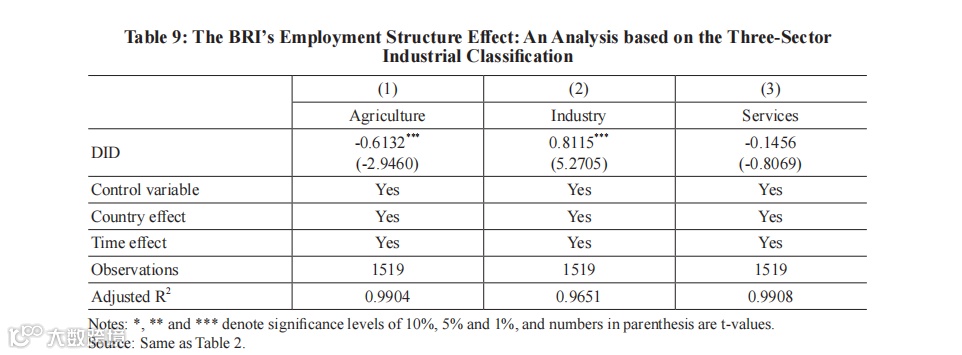
Is the BRI helping to improve the employment structures of participating countries? From an employment inclusion standpoint, Lyu et al. (2018) discovered that the BRI helped to increase women’s employment rates in participating countries. The sectoral structure of employment represents the distribution of labor factors across economic sectors and industries, and the level of its equilibrium is strongly related to employment quality. Following the categories of primary, secondary, and tertiary industries, this section addresses the disparities in the BRI’s employment effect on participating countries. The regression results are presented in Table 9. As seen in columns (1) and (2) of Table 9, the BRI has an insignificantly negative employment effect in the agricultural sector, but a positive job-creation effect for the industrial sectors of participating countries. On the one side, the BRI has resulted in more frequent bilateral economic and trade contacts. Aid and investment under the BRI framework would allow for the free movement of factors such as technology, capital, and human resources on a larger scale, resulting in spillover effects that drive industrial development in participating countries (Wang and Zhong, 2021). With industrial expansion and an increasing percentage of industrial output value, it is natural for the agricultural sector to account for a diminishing share of value added and manpower. Meanwhile, industrial development creates non-farm jobs, causing a shift in the workforce from agricultural to industrial sectors. In this regard, the BRI has helped participating countries improve the sophistication of their employment structures, hence increasing employment quality. As shown in column (3) of Table 9, the BRI has a negative effect on the service sector during the sample period, but the coefficient is insignificant. One probable explanation is that the majority of BRI countries are developing economies that are still in the process of industrial transition, with only moderate service sector development. In contrast, service sector exchanges and cooperation were initially centered on the development of service infrastructure and human resources. While there was a lag between investment and return on those factors, it also required some time for the employment structure to improve.
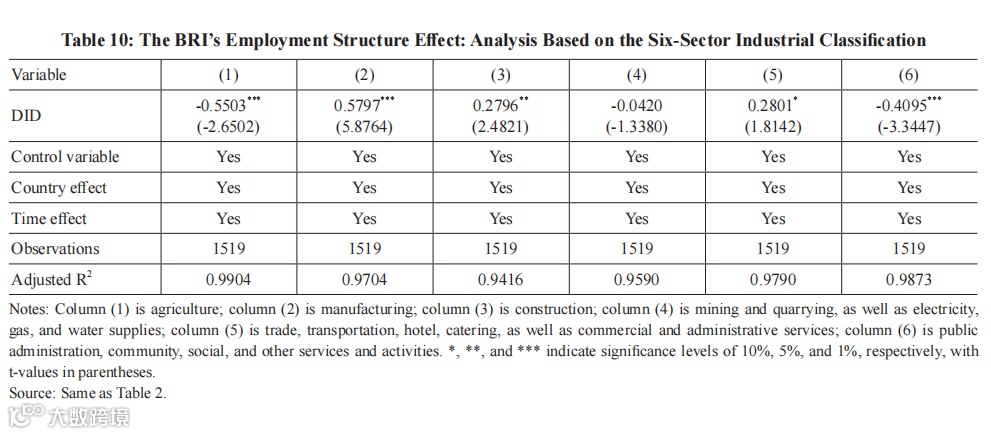
In this section, we look at how the BRI affects the structure of employment sectors in participating countries, using the ILO’s industrial structure classification of six sectors and data from the ILO database. The regression results are presented in Table 10. Sector-wise, the BRI continues to have a negative employment effect on the agricultural sector for the same reasons mentioned above. Given that the BRI aims to promote interconnectivity, it has a significantly positive employment effect for the manufacturing and construction sectors, which are part of the secondary sector under the three-sector classification system(Jin, 2016). The BRI has exerted a positive effect on host countries’ manufacturing and construction sectors through infrastructure interconnectivity, trade facilitation, and financial intermediation, resulting in a higher level of employment in those sectors. This finding is consistent with the conclusion of Bird et al. (2020), who discovered that the BRI’s employment effect was predominantly created in the manufacturing sector, which has the highest initial share of employment in many BRI countries. The mining and quarrying sector shows a high level of resource-led development(Buckley, 2008). In comparison to the BRI’s job creation effect, a host country’s natural endowment has a greater impact on the mining and quarrying sector. The DID coefficient is significant at 10% for the trade, transportation, hotel, catering, and commercial and administrative services sectors, indicating that the BRI has improved employment in those sectors.
According to the above analysis, the employment distribution data for the three-sector and six-sector industrial classifications both indicate that the BRI has improved the sectoral structure of employment in countries along the route, therefore improving employment quality.
8.2 Dynamic Analysis of the BRI’s Employment Effect
The aforementioned study leads us to speculate that the variety and complexity of the transmission channels could cause a lag in the employment effect of the BRI. For example, infrastructure and cross-border trade projects have significantly different transmission channels, as well as transmission times. The overarching question is whether the BRI’s employment effect is sustainable? In the face of a slowing global economy, answering this question is critical for restoring confidence and harnessing the BRI’s benefits to increase employment levels and quality through a new paradigm of sustainable international cooperation.
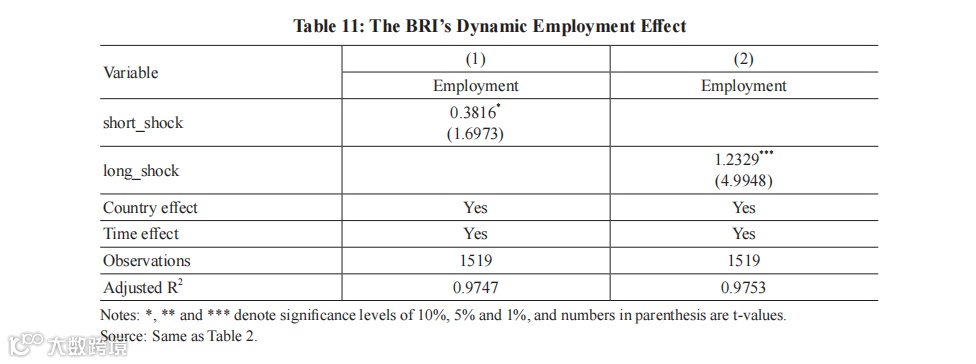
To test the dynamic nature of the BRI’s employment effect, we identified short-term shocks (short_shock) in the first two years after the BRI’s announcement, and mid- and long-term shocks (long_shock) in the third to sixth years after the BRI’s announcement, with regression results shown in columns (1) and (2) of Table 11. The results of Table 11 show that the BRI has created a significant positive effect on employment levels since its inception, but the mid- and long-term effects of BRI participation are more significant.
9. Conclusions and Policy Implications
Based on panel data from 50 BRI countries and 74 non-BRI countries collected between 2006 and 2019, we developed a DID model to investigate the BRI’s employment effect on participating countries, as well as a heterogeneity analysis and transmission mechanism test. Our research findings indicate that: (i) the BRI has greatly raised employment levels in participating nations, and this conclusion remains true after passing the endogeneity test and a number of robustness tests. (ii) According to our heterogeneity research, the BRI’s employment effect varies significantly across countries with varied income levels, labor conditions, and higher degrees of digital economy development. In particular, the employment promotion effect is most significant in countries with higher labor market efficiencies, better labor relations, greater dependence on professional management, and higher development levels of the digital economy, as well as in upper-middle and high-income. (iii) According to the mechanism test, the BRI has raised employment levels in participating countries through infrastructure construction, industrial interconnection, and resource complementarity, as well as human capital improvement as a result of human resource exchange. The investment and trade-driven mechanism is insignificant, presumably due to the presence of a nonlinear effect. (iv) Based on our examination of employment levels in various industrial sectors, we believe that the BRI has also improved the employment structure of participating countries, resulting in a more sophisticated employment structure and higher employment quality. (v) The BRI’s employment effect is also dynamic, with the potential to increase employment in participating countries over the medium and long term. Based on the preceding conclusions, we have developed the following policy recommendations:
First, the BRI has greatly improved employment conditions in participating countries, and this effect is dynamic and will continue to increase over time. As a result, efforts should be made to promote high-quality joint development under the BRI, as well as to establish a multilateral network of more extensive and deeper collaboration at a higher level through the development of the “ five connectivities,” namely policy, infrastructure, trade, financial, and people-to-people connectivities. It is proposed to establish sustainable development cooperation mechanisms to deepen long-term partnerships between China and BRI participating countries, to capitalize on the BRI’s positive effect on employment levels and quality, and to contribute to the timely achievement of the United Nations Sustainable Development Goals and the promotion of sufficient and equal employment in BRI participating countries.
Second, it is suggested that cooperation with lower-middle-income countries be broadened and intensified in order for them to benefit from development dividends. Chinese-funded businesses should be encouraged and supported to hire local workers and create more jobs in the host countries. Advocacy programs should be implemented to guarantee that Chinese-funded companies rigorously adhere to local and international labor standards and fully meet their social responsibilities. Meanwhile, BRI countries should work together more closely in the digital economy, particularly in the areas of cross-border e-commerce and other innovative business models, in order to take advantage of the opportunities presented by the joint development of the “Digital Silk Road” and distribute their resources and industries in a way that generates more employment opportunities through the adoption of new economic paradigms and business models.
Third, it is suggested that infrastructure interconnectivity be increased while also promoting the infrastructure’s job-creating effect. The introduction of new infrastructure construction elements into current infrastructure projects should be prioritized in order to assist the transition and improvement of traditional infrastructure while also accelerating the creation of digital infrastructure. BRI countries should be encouraged to invest in China within the current cooperation framework in order to develop mutually beneficial two-way trade and investment. Investment and trade structures will move from labor and resource-intensive to capital and technology-intensive. Trade digitalization should be accelerated in order to take advantage of the Digital Silk Road’s cost-saving benefits, particularly e-commerce, and improve trade connectivity. The industrial development characteristics of China and other BRI participating countries should be precisely identified in order to select areas for industrial cooperation in a targeted manner to smooth the market circulations of production factors and products, as well as improve the traditional industries of BRI countries to support their industrial upgrade. Furthermore, efforts should be made to assist BRI countries with human resource development and human capital improvement through infrastructure construction, investment and trade, human resource exchange, and educational cooperation at various levels, as well as informal cooperation with private actors.participating countries.
China Economist (Chinese Title: 《中国经济学人》) is an academic journal supervised by the Chinese Academy of Social Sciences (CASS) and sponsored by the Institute of Industrial Economics, CASS. Launched in March 2006, China Economist is a bilingual (Chinese and English) publication with a global distribution. It is dedicated to disseminating cutting-edge research in economics and management from China to the world, providing a platform for international scholars to exchange ideas, and representing the fundamental interests of the Chinese people through its scholarly contributions. The journal aims to enhance understanding of China among foreign audiences, thereby increasing the country’s international influence and discursive power.China Economist has been indexed by prominent databases such as EconLit, EBSCO, ProQuest, and SCOPUS. It has also been selected for the AMI Chinese Humanities and Social Sciences Journals by the Chinese Academy of Social Sciences, being recognized as a journal that represents the highest level of English-language publications in the humanities and social sciences in China.