
点击“司法鉴定科学研究院” 关注我们


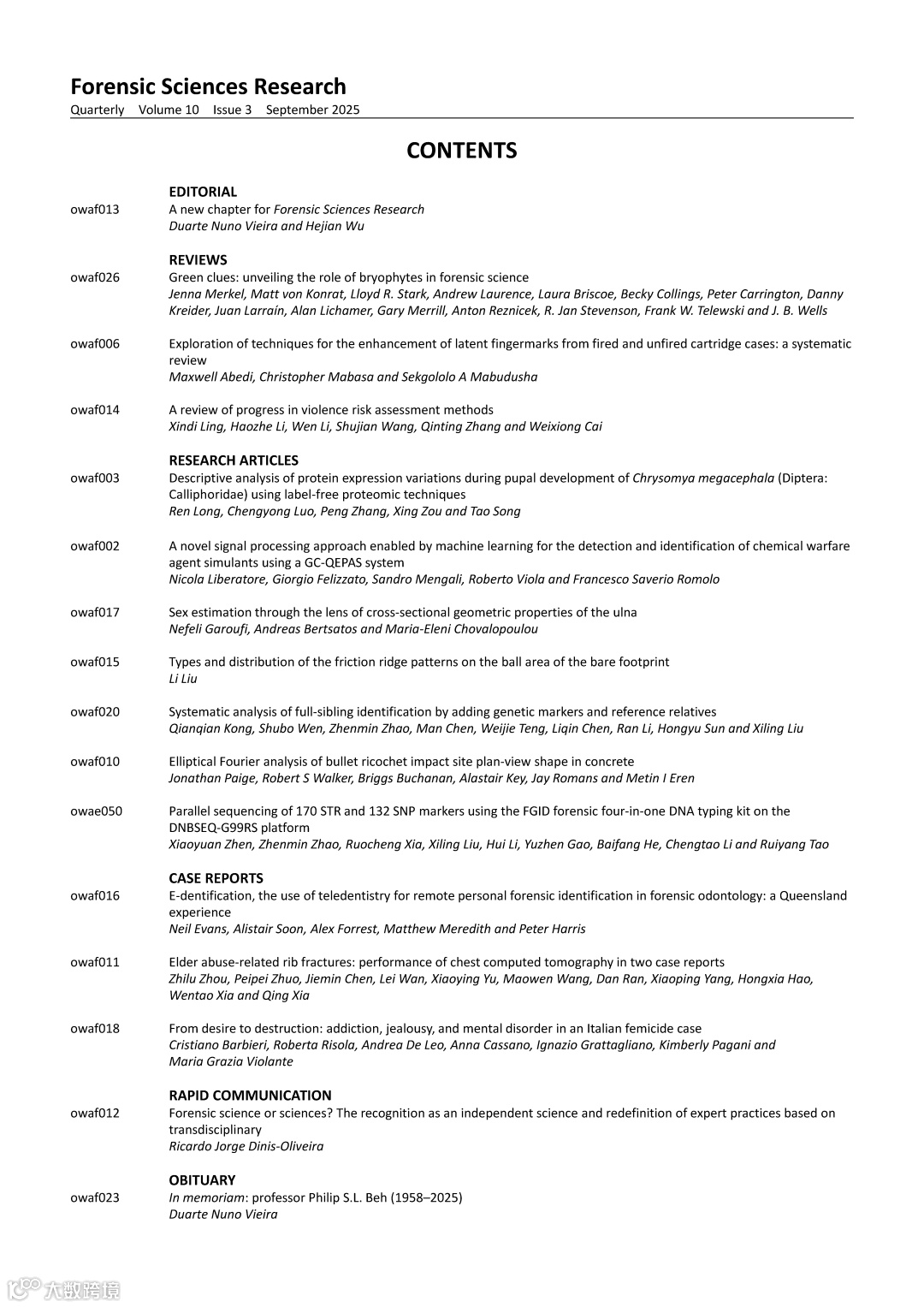
REVIEWS
Green clues: unveiling the role of bryophytes in forensic science
Jenna Merkel, Matt von Konrat, Lloyd R. Stark, Andrew Laurence, Laura Briscoe, Becky Collings, Peter Carrington, Danny Kreider, Juan Larraín, Alan Lichamer, Gary Merrill, Anton Reznicek, R. Jan Stevenson, Frank W. Telewski, J. B. Wells
Abstract: Forensic botany is the use of plant material as evidence to aid in forensic investigations. Bryology is the study of bryophytes, which consist of mosses, liverworts, and hornworts. Botanical evidence as a whole, and more specifically potential bryophyte evidence, is an underused potential tool that can provide crucial information in criminal investigations. This paper (i) outlines a review of all bryophyte applications to forensic science, to the best of our knowledge, (ii) demonstrates the potential of using this type of evidence, (iii) presents details into each case, and (iv) highlights the various uses of bryophytes as forensic evidence. From our review, all cases have seemingly been limited to mosses. The overarching goal is for this review to be a resource that encourages law enforcement to search for plant fragments and microscopic bryophytes.
Key points
• Bryophytes are an underutilized potential tool within forensic science.
• Bryophytes are ubiquitous as well as have a number of unique features and can be found in almost every environment around the world.
• Many reported and published case reports exemplify the numerous applications for bryophytes and other botanical evidence within forensic science.

Exploration of techniques for the enhancement of latent fingermarks from fired and unfired cartridge cases: a systematic review
Maxwell Abedi, Christopher Mabasa, Sekgololo A Mabudusha
Abstract:The ability to develop latent fingermarks from fired and unfired cartridge cases can be crucial in resolving crime cases and advancing forensic investigations. Currently, there is a lack of consensus on the ideal technique to employ for the enhancement of latent fingermarks from fired and unfired cartridge cases. This review therefore aims to explore techniques and methods employed to develop latent fingermarks from fired and unfired cartridge cases. A systematic search of peer-reviewed original articles was performed from four main electronic databases: ScienceDirect, Scopus, Google Scholar, and PubMed. According to data from our review, the most well-established method for developing latent fingermarks from fired and unfired cartridge cases remains the sequential application of cyanoacrylate fuming, followed by gun bluing, and the application of a fluorescent dye called basic yellow 40. This review also discusses the current scope of research, highlights the limitations, and provides practical recommendations for future perspectives.
Key points
• Fingermark evidence on fired and unfired cartridge cases cannot be undervalued.
• The enhancement of latent fingermarks from fired cartridge cases is possible although challenging.
• Enhancement of latent fingermarks from fired cartridge case is possible with cyanoacrylate fuming followed by gun bluing and basic yellow 40.
• Recover Latent Fingerprint Technology, palladium deposition, and cold patination fluid are promising fingermark enhancement techniques.

A review of progress in violence risk assessment methods
Xindi Ling, Haozhe Li, Wen Li, Shujian Wang, Qinting Zhang, Weixiong Cai
Abstract:Violence often occurs among patients with mental disorders. The risk of violence is assessed under the demand of psychiatric clinical treatment or forensic assessment. Corresponding therapeutic intervention strategies could be developed according to the outcome of the assessment. Currently, violence risk assessment methods are mainly divided into actuarial assessment and structured professional judgement. Scientific and objective assessment results support judicial decisions and risk management. However, all the assessment methods have certain shortcomings, and there is still room for improvement. This paper reviews several tools of violence risk assessment and their research progress, focusing on the main content of each tool and its applicability. The review aimed to provide a reference for the selection and application of violence risk assessment tools and optimization of violence risk assessment methods in the future.
Key points
• The violence risk assessment methods are widely used in psychiatric clinical treatment or forensic assessment, but all the methods have certain shortcomings.
• The review discussed main contents and research progress of several violence risk assessment tools in order to explore applicability of each tool.
• The review aimed to provide a reference for the selection and application of violence risk assessment tools and optimization of violence risk assessment methods in the future.

RESEARCH ARTICLES
Descriptive analysis of protein expression variations during pupal development of Chrysomya megacephala (Diptera: Calliphoridae) using label-free proteomic techniques
Ren Long, Chengyong Luo, Peng Zhang, Xing Zou, Tao Song
Abstract: Age estimation is a critical aspect of forensic entomology, especially in the examination of pupae. The use of proteins as a means for age identification shows great promise. In this study, proteomic techniques were employed to investigate differentially expressed proteins (DEPs) during the intrapuparial stage of Chrysomya megacephala. Specimens were sampled at four distinct time points: 0 h (Group A), 24 h (Group B), 48 h (Group C), and 72 h (Group D). Our analysis uncovered 56 DEPs between Groups B and A, 116 DEPs between Groups C and A, and a total of 152 DEPs between Groups D and A. These DEPs were categorized into nine clusters based on their expression patterns. Cluster 1 exhibited an increasing trend in protein expression, while Cluster 4 displayed the opposite pattern. Clusters 2, 6, and 9 showed an initial rise followed by a decline, whereas Cluster 3 demonstrated the reverse trend. Cluster 8 indicated an initial rise, a subsequent drop, and another rise, while Cluster 7 showed an initial decrease, followed by an increase and a minor decrease. Notably, the C-type lectin domain-containing (CTLD) protein and Failed axon connections (Fax) protein consistently displayed an upward trend. These two DEPs were selected for validation using the parallel reaction monitoring technique–targeted proteomics, confirming the trends observed in the initial analysis. In summary, this study highlights the potential of using proteins as reliable biomarkers for estimating pupal age.

A novel signal processing approach enabled by machine learning for the detection and identification of chemical warfare agent simulants using a GC-QEPAS system
Nicola Liberatore, Giorgio Felizzato, Sandro Mengali, Roberto Viola, Francesco Saverio Romolo
Abstract:The detection and identification of chemical warfare agents (CWAs) present challenges in emergency response scenarios and for safety and security applications. This study presents the development and validation of an innovative analytical method using a gas chromatography (GC) and quartz-enhanced photoacoustic spectroscopy (QEPAS) sensor for the detection of stimulants for six CWAs. Following the guidelines of the European Network of Forensic Science Institute (ENFSI) and the Commission Implementing Regulation (EU) 2021/808, the analytical method was validated. The validation results demonstrated the robustness and reliability of both the GC and QEPAS modules. Moreover, with regard to the toxicological threshold levels, this study highlights the efficacy of a prototype of a portable device for real security and safety applications. Furthermore, a machine learning (ML) approach was developed to automate the detection and identification of CWAs’ stimulants. The workflow involved two interconnected stages: detection based on chromatographic retention times (RTs), and identification using infrared (IR) spectra through the one-class support vector machines classifier. The classifier was activated only after obtaining a positive detection based on RTs. The results highlight the ML model’s effectiveness in CWA detection and identification, combining RT analysis and IR spectrum classification, achieving 97% accuracy at a 95.5% confidence interval and 99% accuracy at a 99.7% confidence interval; this result demonstrates the model’s utility for real-world security and safety applications for CWAs.

Sex estimation through the lens of cross-sectional geometric properties of the ulna
Nefeli Garoufi, Andreas Bertsatos, Maria-Eleni Chovalopoulou
Abstract: Sex estimation is an essential part of anthropological analysis in both forensic and archaeological studies, as it is vital for the construction of biological profiles from skeletal remains. The last years have seen a steady increase in the development of alternative methodologies for sex estimation, which do not depend on strictly traditional osteometric measurements. The present study focuses on the evaluation of the sex diagnostic capacity of the diaphyseal cross-sectional geometric (CSG) properties of the ulna on 215 individuals (120 males, 95 females) from a contemporary Greek population sample, utilizing support vector machine supervised learning algorithms for the classification analysis. The correlation of age-at-death on the utilized CSG variables and the effect of bilateral asymmetry in the presence of sexual dimorphism were evaluated as well. The highest cross-validated accuracy reached was 98.15%, exceeding the accuracy achieved by standard ostemeotric measurements of the ulna, highlighting the importance of evaluating and, subsequently, incorporating alternative measurements in sex estimation practices. The optimal classification model is freely available as a standalone R function, in order to facilitate the utilization of the CSG properties in forensic context.

Types and distribution of the friction ridge patterns on the ball area of the bare footprint
Li Liu
Abstract:The comparison of footprints to establish positive identification of individuals is an accepted practice. Due to the poor clarity and limited quantity of friction ridge skin detail in the bare footprint at crime scenes, it can prove challenging and problematic to locate the part of the foot that made the print. The aim of the present study is to analyse the types and its distributions of patterns in the ball area of the footprint. The samples comprise 1 460 adults. Results show that loops, whorls, and arches have been found in the ball area of the footprint. In the inner zone, loops are 65.51% of all the patterns, in which vertical loop-down is the most common pattern. In the mid zone, 54.04% of the samples only have vertical loop-down as the single pattern, and 7.71% show multiple patterns, with particularly nine types of multiple patterns found. In the outer zone, patterns are very rare. Only 5.45% of the samples have horizontal loop-outer, and 0.27% of the samples are vertical loop-down. Different patterns in the ball area of the foot show different frequencies of appearance. The shapes of patterns are different in each area of the foot. The examination of the patterns in the bare footprint could be a possibility of locating a certain position of the origin foot.

Systematic analysis of full-sibling identification by adding genetic markers and reference relatives
Qianqian Kong, Shubo Wen, Zhenmin Zhao, Man Chen, Weijie Teng, Liqin Chen, Ran Li, Hongyu Sun, Xiling Liu
Abstract: Full-sibling (FS) identification is a crucial aspect of kinship analysis. However, current FS identification methods need to be more accurate and effective for routine FS identification. In this study, the optimal cut-off values for FS identification by incorporating both the identical by state (IBS) and likelihood ratio (LR) methods under four different levels of error rates were assessed. The corresponding sensitivity, specificity, accuracy, and effectiveness were calculated for different numbers of short tandem repeats (STRs), ranging from 19 to 55. The identified cut-off values were validated using authentic pedigrees from the Han population in East China. It was determined that the cut-off values derived from the IBS method and LR method with an error rate below 0.01% were dependable and practical. The study also explored the impact of half-sibling relationships and the inclusion of reference relatives in FS identification. Currently, an updated technical specification for FS identification in China was released, serving as a valuable resource for FS testing in forensic applications.

Elliptical Fourier analysis of bullet ricochet impact site plan-view shape in concrete
Jonathan Paige, Robert S Walker, Briggs Buchanan, Alastair Key, Jay Romans, Metin I Eren
Abstract: Bullet ricochets often leave impact sites that can be useful for shooting incident reconstruction. Here, we assess the proposal that these sites can potentially provide information about the design and composition of the projectile and possibly the corresponding firearm. We produced impact sites in concrete from five bullet types fired at two distances, for a total of 10 experimental conditions. Then, using elliptical Fourier analysis, we assessed the 297 bullet ricochet impact sites’ plan-view outline shapes. Of the different bullet types, the 45 calibre Hollow Points exhibited the greatest variability in ricochet impact site shape, and the greatest potential for diagnosis. Overall, statistical assessment of robust sample sizes of ricochet impact sites suggests that there is too much overlap between different bullets' ricochet sites’ plan-view form for confident identification of bullet design and composition, much less identification of the firearm from which it originated. We conclude with an extended discussion about future experiments involving bullet ricochet impact sites, including the employment of “paradigmatic classification”, which can both organise the testing of experimental variables as well as illustrate the tremendous amount of experimental work that still needs to be conducted before researchers or firearm examiners draw firm conclusions.
Key points
• Bullet ricochet impact sites often occur in shooting incidents.
• We analysed bullet richochet impact site shapes in concrete using elliptical Fourier analysis.
• Results suggest different bullet types’ ricochet impact shape morphospaces overlap with each other.
• This overlap obscures conclusions about the design and composition of the projectile and possibly the responsible firearm.

Parallel sequencing of 170 STR and 132 SNP markers using the FGID forensic four-in-one DNA typing kit on the DNBSEQ-G99RS platform
Xiaoyuan Zhen, Zhenmin Zhao, Ruocheng Xia, Xiling Liu, Hui Li, Yuzhen Gao, Baifang He, Chengtao Li, Ruiyang Tao
Abstract: Massive parallel sequencing (MPS) has rapidly emerged as a promising technique for forensic DNA typing due to its capacity to simultaneously detect numerous genetic markers and samples in a single reaction, allowing the direct acquisition of sequence information. In this current investigation, the FGID forensic four-in-one DNA typing kit was employed on the DNBSEQ-G99RS high-throughput sequencing platform to simultaneously analyse two types of forensic genetic markers—short tandem repeat (STR) and single nucleotide polymorphism (SNP). A total of 306 DNA markers, comprising Amelogenin, 66 autosomal STR (A-STR) loci, 29 X chromosomal STR (X-STR) loci, 75 Y chromosomal STR (Y-STR) loci, and 135 SNP (132 A-SNP and 3 Y-SNP) loci, were genotyped for 100 unrelated individual samples (50 males and 50 females). As a result, sequence-based STR typing identified 940 alleles on A-STRs, 378 alleles on X-STRs, and 519 alleles on Y-STRs. In comparison with length-based alleles, the number of unique alleles based on sequence increased by 58.18%. Additionally, 97 new sequence variations were observed at 29 STR loci, and MPS sequence information was obtained for the first time at 42 STR loci. Furthermore, when utilizing sequence-based data, forensic parameters exhibited a notable increase in combined power of discrimination (CPD) and combined power of exclusion for A-STR, a slight increase in CPD and combined mean exclusion chance for X-STR, and a marginal increase in discrimination capacity for Y-STR. Moreover, information data for 132 A-SNPs were acquired. As anticipated, our findings highlight the advantages of MPS in forensic genetic applications while contributing novel genetic data for Asian populations in forensic practice.

CASE REPORTS
E-dentification, the use of teledentistry for remote personal forensic identification in forensic odontology: a Queensland experience
Neil Evans, Alistair Soon, Alex Forrest, Matthew Meredith, Peter Harris
Abstract: Dental comparison is recognized by the International Criminal Police Organization as one of three primary forensic identification techniques that can provide conclusive findings. Queensland is a large Australian state with a centralized forensic odontology service located at Queensland Health’s Coronial and Public Health Sciences (CPHS) in Brisbane, which sits in the state’s South-Eastern corner. Almost half of the Queensland population is located outside of Brisbane, and the distance to regional centres can be very large. Transporting forensic dental personnel and their equipment to these regional centres to undertake identification and examination procedures can be both expensive and time-consuming, depriving CPHS of service for the period of absence. The acquisition of post-mortem computed tomography (PMCT) data locally in regional centres with remote access electronically from CPHS in Brisbane has the potential to alleviate these issues in many cases. Forensic radiographers at CPHS work with forensic odontologists to produce multi-planar reformat images from PMCT data, which simulate common dental radiographs such as orthopantomogram, bitewing, and periapical views. Additional images, such as three-dimensional (3D) reconstructions of the teeth and jaws, can also be produced and viewed from various angles. These multi-planar reformat and 3D images can be compared with antemortem (AM) radiographic images and dental records of a missing person sourced from public or private dental surgeries, public hospitals, or private radiology practices. Comparisons can be made not only with AM traditional dental radiographs but also with images and reconstructions produced from AM dental cone-beam computed tomography or medical computed tomography data. The authors term this remote dental identification “e-dentification”. While e-dentification offers numerous advantages, there are several limitations to its use, including access to the necessary equipment, the consistent acquisition of high-resolution PMCT data, and artefacts, including those due to metal restorations, that may be present in computed tomography images. We present four cases to illustrate and discuss e-dentification.

Elder abuse-related rib fractures: performance of chest computed tomography in two case reports
Zhilu Zhou, Peipei Zhuo, Jiemin Chen, Lei Wan, Xiaoying Yu, Maowen Wang, Dan Ran, Xiaoping Yang, Hongxia Hao, Wentao Xia, Qing Xia
Abstract: Trauma in victims of abuse often exists in various ways, and the characters usually manifest as non-fatal injuries, repetitive occurrence, and the injured parts are relatively hidden. Forensic experts are optimally positioned to raise suspicion for abuse when comprehensively considering a forensic investigation, reviewing imaging, and other multiple factors of geriatric injury victims. However, few experts received formal or informal training in abuse identification. In this article, we discussed two cases of suspected victims of abuse with rib fractures and attempted to determine the location, timing, and directionality of these injuries to raise the index of suspicion for abuse. We present two cases to characterize the radiographic changes of rib fractures in various stages of healing and radiographic findings in elder abuse events. To improve the accuracy of the imaging diagnosis, we collected a series of computed tomography images of rib fractures and compared all computed tomography images of these two victims with these images. We found that the victims presented with repeated rib fractures and with different stages of healing. We strongly suspect these were abuse cases due to the radiographic findings and clinical recordings demonstrated by these cases. We aim to raise awareness of abuse in radiology and forensic medicine to help these victims and reduce such incidents.

From desire to destruction: addiction, jealousy, and mental disorder in an Italian femicide case
Cristiano Barbieri, Roberta Risola, Andrea De Leo, Anna Cassano, Ignazio Grattagliano, Kimberly Pagani, Maria Grazia Violante
Abstract: This contribution aims to analyse an Italian femicide case that progressed through three levels of trial up to the Supreme Court of Cassation and required an expert opinion. This analysis will address specific forensic psychiatry issues inherent to this field, i.e., the interaction between addiction, jealousy, and mental disorder in a femicide case, which necessitates a comprehensive understanding of both criminology and legal medicine. On one hand, the nosographic setup of the so-called dual diagnosis (in the case examined, there was alcohol addiction and a borderline personality disorder), together with conditions inherent to a personality disorder (in this specific case, at least a borderline state or actually marginal manifest disease) that integrated an infirmity with legal relevance. Both conditions were inserted in a relational context of dysfunctional and collusive characters in which the victim’s personality caused her, at a victimological level, to become an active partner co-responsible for the criminal act.
Key points
· Forensic psychiatric analysis in a case of femicide.
· Nosographic difficulty in making dual diagnosis.
· Assessment of the perpetrator’s mental capacity and of diminished responsibility.
· Personal predisposition of the victim as an active partner in the crime.

RAPID COMMUNICATIONS
Forensic science or sciences? The recognition as an independent science and redefinition of expert practices based on transdisciplinary
Ricardo Jorge Dinis-Oliveira
Abstract: Forensic science explores scientific knowledge to clarify legal and legal issues. Since I started in this area of knowledge in mid-2007, my priority has been to create a centre of reference and excellence that would advance forensic science, an area sometimes based on self-taught practices. Along this pathway, I always considered that we were dealing with an articulated set of “Forensic Sciences” and not with a single “Forensic Science”, but I was, at least partially, wrong! This work discusses the competencies of the different forensic subspecialties, seeking to be the starting point for reformulating forensic teaching, research, and public and private forensic activity. It also highlights the concern of offering a certain level of professionalization to forensic science. For this reflection, it was important to follow a path that had its foundations in the study of the historical roots of forensic science, namely the first Portuguese forensic case, to study the revolutionary scientific contribution triggered by the “CSI effect”, to understand in depth the competencies of each of the forensic subspecialties and bring this knowledge to specialized pre- and postgraduate training, to promote innovation through peer review of empirical forensic practices to increase the scientific evidence, the development of certification mechanisms for forensic experts and their respective code of ethics, and to open the doors for artificial intelligence to assist the courts and the opportunity that forensic science represents in the development of other areas of health sciences, life, and social behaviour. Thus, it was born, very unconsciously, a scientific project for the transdisciplinary reformulation of forensic activity, but over time, it allowed me to realize that we can have specialists trained in all its dimensions and plenitude. The pillars for the modernization of this science and, ultimately, the law, which, together with education and health, are the three main pillars of society. Not punishing innocent people, leaving criminals unharmed through scientific evidence, seeking justice, and repairing the damage is the supreme spirit of Forensic Science. Our One Forensics model is now being considered to be implemented by other countries.

OBITUARY
In memoriam: professor Philip S.L. Beh (1958–2025)
Duarte Nuno Vieira

2025年第3期
“
Forensic Sciences Research
Sponsor: Academy of Forensic Science
Website: https://academic.oup.com/fsr
Submission System: www.editorialmanager.com/tfsr
E-mail: fsr@ssfjd.cn
扫描下方二维码,悦读本刊

推荐阅读