

News
“十五五”规划
及对欧洲市场的影响
The 15th FYP
& Its Impact on the European Market
中国正在起草的第十五个五年规划(2026—2030年),将为未来五年经济与社会发展确立总体方向。该规划以实现高质量发展为核心目标,重点关注经济结构优化、创新体系完善、绿色低碳转型与国内市场潜能的进一步释放。规划强调提升产业链韧性与自主创新能力,推动制造业向高端化、智能化和可持续化发展,同时加快数字经济与实体经济的融合。
China’s 15th Five-Year Plan (2026–2030) will define the overall direction of the country’s economic and social development for the next five years. Centered on achieving high-quality growth, the plan focuses on optimizing economic structures, strengthening innovation capacity, advancing green and low-carbon transformation, and unleashing the potential of the domestic market. It highlights efforts to enhance industrial resilience and innovation-driven competitiveness, promote the upgrading of manufacturing toward high-end, intelligent, and sustainable development, and accelerate the integration of the digital and real economies.
在全球经济复苏乏力和国际竞争格局重塑的背景下,这一规划不仅旨在巩固中国长期增长的内生动力,也为全球企业创造新的合作机遇。能源转型、清洁技术、智能制造、医疗健康及消费升级等领域,将成为未来五年中外资本与企业的重要发力点。
Against the backdrop of a sluggish global recovery and shifting international dynamics, the plan aims not only to reinforce China’s internal growth momentum but also to create new opportunities for global collaboration. Areas such as energy transition, clean technology, smart manufacturing, healthcare, and consumer market upgrading are expected to become key focal points for cross-border investment and business engagement in the coming years.
值得注意的是,这一发展蓝图的实施将对全球经济格局,尤其是与中国联系紧密的欧洲市场,产生深远影响。随着中欧在绿色转型、数字化和科技创新领域的合作不断深化,欧洲企业将在这一轮规划中发现新的市场机遇与战略空间。
Notably, the implementation of this development blueprint is expected to have profound implications for the global economy — particularly for Europe, which maintains close trade and technological ties with China. As cooperation deepens in green transition, digitalization, and innovation, European businesses are likely to find new market opportunities and strategic room for partnership within the framework of the 15th Five-Year Plan.
1. 新能源与绿色转型
The New Energy & Green Transition
中国正在制定的第十五个五年规划(十五五),将为欧洲市场带来多层次的影响。该规划预计将继续强调科技创新与绿色转型,这意味着在可再生能源及数字技术等领域,欧洲企业将获得新的合作机遇与市场空间。同时,中国对高端制造与供应链韧性的重视,也可能推动中欧在工业升级与供应链协作方面的深度对接。
China's upcoming 15th Five-Year Plan will generate multi-layered impacts on the European market. The plan is expected to maintain emphasis on technological innovation and green transition, creating new cooperation opportunities and market potential for European enterprises in sectors like renewable energy and digital technology. Meanwhile, China's focus on high-end manufacturing and supply chain resilience may drive deeper industrial upgrading and supply chain collaboration between China and Europe.
在绿色产业方向上,据中国能源研究会与彭博新能源财经(BNEF)的预测,如果中国及全球市场按照《巴黎协定》目标路径发展,中国清洁能源产业的总产值到2035年可能达到 约15至18万亿元人民币(约合2–2.5万亿美元)(中国能源研究会,2023;BNEF,2024)。 对欧洲市场而言,这意义重大。
In the green industrial sector, ccording to forecasts by the China Energy Research Society and Bloomberg New Energy Finance (BNEF), if China and the global market develop along the Paris Agreement target path, the total output value of China’s clean energy industry could reach approximately RMB 15 to 18 trillion (approximately US$2 to 2.5 trillion) by 2035 (China Energy Research Society, 2023; BNEF, 2024). For the European market, this has significant meaning.
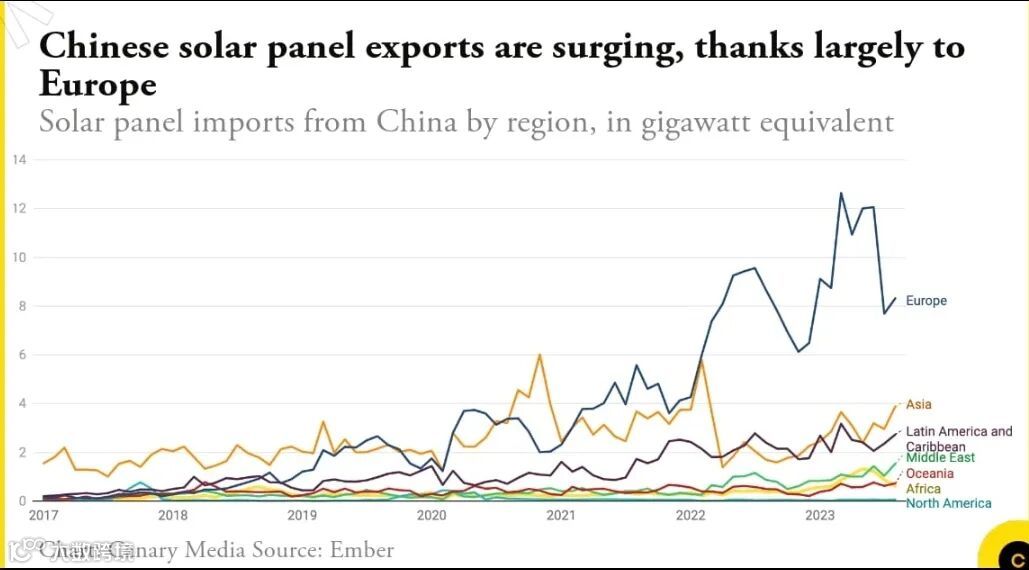
新能源与电动汽车产业将成为中欧合作与竞争并存的焦点。规划明确提出要推动新能源汽车、锂电池、光伏等“新三样”产业发展,并加快海外布局。对欧洲而言,这意味着既有合作机遇——例如中国企业在欧洲建设电池工厂、提供绿色技术解决方案——也有产业竞争的挑战,尤其是在电动汽车与储能领域。
The new energy and electric vehicle sectors are set to become focal points of both cooperation and competition between China and Europe. The plan highlights the rapid development of the so-called “new three” industries—electric vehicles, lithium batteries, and solar energy—and encourages their global expansion. For Europe, this means opportunities for collaboration, such as Chinese investment in European battery plants and renewable energy projects, but also heightened competition in clean tech and automotive markets.
随着中国加速向低碳经济转型,欧洲的环保技术企业与绿色金融服务业将迎来显著增长点。中国对风电、光伏及氢能等清洁能源的持续投入,将为欧洲相关设备制造商和技术服务商创造稳定的需求。此外,中国碳排放权交易体系的完善也可能与欧盟的碳边境调节机制形成互动,推动双方碳市场标准的逐步融合。
As China accelerates its transition to a low-carbon economy, European environmental technology firms and green financial services will encounter substantial growth opportunities. Continuous Chinese investment in clean energy sectors like wind power, photovoltaic, and hydrogen will generate stable demand for European equipment manufacturers and technical service providers. Furthermore, the refinement of China's carbon emission trading system may interact with the EU's Carbon Border Adjustment Mechanism, promoting gradual convergence of carbon market standards.
数据图:中国太阳能电池板出口激增,主要得益于欧洲
Pic: Canary Media, Ember
2. 高端制造业与核心技术
Advanced Manufacturing & Core Technologies
在中国即将实施的“十五五”规划(2026–2030)中,先进制造业和核心技术被明确列为战略重点,旨在构建以创新为驱动的现代化产业体系。这一方向不仅为中国自身的经济转型提供动力,也为欧洲企业带来了前所未有的合作机遇。
In China's forthcoming 15th Five-Year Plan (2026–2030), advanced manufacturing and core technologies are explicitly identified as strategic priorities, aiming to build an innovation-driven modern industrial system. This direction not only propels China's economic transformation but also presents unprecedented cooperation opportunities for European enterprises.
中国政府计划加大对人工智能、智能制造、机器人技术、增材制造(3D打印)等领域的投资,推动制造业从劳动密集型向技术密集型转变。这一转型不仅提升了国内产业的竞争力,也为欧洲企业提供了参与中国高端制造业升级的机会。例如,欧洲在工业自动化、精密仪器和高端制造设备方面具有优势,可通过技术合作、联合研发等方式,与中国企业共同开发新产品和新技术,拓展双方在全球市场的份额。
The Chinese government plans to increase investments in artificial intelligence, smart manufacturing, robotics, and additive manufacturing (3D printing), transitioning the manufacturing sector from labor-intensive to technology-intensive. This transformation enhances domestic industrial competitiveness and offers European companies opportunities to participate in China's high-end manufacturing upgrade. For instance, Europe has strengths in industrial automation, precision instruments, and high-end manufacturing equipment, which can be leveraged through technological cooperation and joint research and development to jointly develop new products and technologies, expanding both parties' market share in the global market.
然而,市场机遇伴随调整挑战。中国在推进技术自主的过程中,可能会加强对关键技术和核心部件的本地化生产,这对依赖技术输出的欧洲企业构成一定压力。例如,中国在关键科技领域的自主可控战略可能促使部分产业链回流,短期内或影响欧洲对中国中间产品的出口,或可能影响欧洲企业在这些领域的市场份额。
However, market opportunities coexist with adjustment challenges. In advancing technological self-reliance, China may strengthen local production of key technologies and core components, posing pressure on European companies reliant on technology exports. For example, China's strategy to achieve self-sufficiency in key technological fields may lead to partial industrial chain repatriation, potentially affecting European exports of intermediate goods to China in the short term, or potentially impacting European companies' market share in these areas.
这需要欧洲企业重新评估供应链布局与技术合作模式。双方需通过深化对话机制,平衡安全关切与开放合作。
This requires European enterprises to reassess their supply chain configurations and technical cooperation models. Both sides need to balance security concerns with open cooperation through enhanced dialogue mechanisms.
3. 服务业
Service Sector
中国“十五五”规划明确提出要加快发展服务业,特别是金融、医疗、教育、文化创意和旅游等领域,以满足日益增长的中产阶级需求。根据中国国家统计局最新数据,2024年服务业对国民经济增长的贡献率达到56.2%,凸显了其在经济中的主导与拉动作用(国家统计局,2025)。这一趋势显示出服务业在国民经济中持续巩固的主导作用。对于欧洲企业而言,这为进入中国市场提供了广阔的空间。欧洲在高端医疗、教育培训、文化创意产业等方面具有优势,可通过合资、合作或技术输出等方式参与中国市场的建设。此外,中国政府也在“十五五”规划中提出要扩大服务业对外开放,简化外资准入程序,为欧洲企业提供了更多的合作机会。
China's 15th Five-Year Plan explicitly aims to accelerate the development of services, particularly in finance, healthcare, education, cultural creativity, and tourism, to meet the growing demands of the middle class. According to the latest data from China's National Bureau of Statistics, the service industry's contribution to national economic growth reached 56.2% in 2024, highlighting its leading and driving role in the economy (National Bureau of Statistics, 2025). This trend demonstrates the continued consolidation of the service industry's dominant role in the national economy. For European enterprises, this presents vast opportunities to enter the Chinese market. Europe holds advantages in high-end healthcare, educational training, and cultural creative industries, which can be leveraged through joint ventures, collaborations, or technology exports to participate in China's market development. Moreover, the Chinese government has proposed expanding the opening-up of the service sector and simplifying foreign investment access procedures in the 15th Five-Year Plan, providing more cooperation opportunities for European enterprises.
然而,挑战也不可忽视。中国服务业的本土化程度较高,欧洲企业在进入中国市场时可能面临文化差异、市场准入壁垒和人才短缺等问题。例如,在教育培训领域,中国的教育体系和教学方式与欧洲存在差异,欧洲教育机构需要在课程设置、师资培训和教学方法等方面进行本土化调整,以适应中国市场的需求。此外,中国政府对外资企业在某些服务领域的准入仍有限制,欧洲企业在进入这些领域时可能需要克服政策壁垒。
However, challenges cannot be overlooked. The localization of China's service sector is relatively high, and European enterprises may face cultural differences, market access barriers, and talent shortages when entering the Chinese market. For instance, in the educational training sector, China's education system and teaching methods differ from those in Europe, requiring European educational institutions to localize their curriculum, teacher training, and teaching methods to meet the needs of the Chinese market. Additionally, the Chinese government still imposes restrictions on foreign investment in certain service sectors, and European enterprises may need to overcome policy barriers when entering these fields.
4. 消费潜力升级
Consumer Potential Upgrades
中国“十五五”规划强调要促进消费升级,推动绿色消费和数字消费,鼓励高品质、个性化和可持续的消费模式。根据中国国家统计局发布的数据,2024年中国社会消费品零售总额达到约48.3万亿元人民币,同比增长7.2%(国家统计局,2025)。业内预测,随着居民收入增长和消费结构升级,这一数字在2025年仍将保持稳健增长。这为欧洲消费品品牌提供了进入中国市场的良机。欧洲在奢侈品、环保产品、健康食品和高端家电等领域具有竞争力,可通过品牌授权、跨境电商和本地化生产等方式拓展中国市场。
China's 15th Five-Year Plan emphasizes promoting consumption upgrades, encouraging green and digital consumption, and advocating for high-quality, personalized, and sustainable consumption patterns. According to data released by China's National Bureau of Statistics, China's total retail sales of consumer goods reached approximately RMB 48.3 trillion in 2024, a year-on-year increase of 7.2% (National Bureau of Statistics, 2025). Industry forecasts predict that this figure will continue to grow steadily in 2025 as residents' incomes rise and their consumption structure upgrades. This provides a favorable opportunity for European consumer goods brands to enter the Chinese market. Europe has competitiveness in luxury goods, eco-friendly products, health foods, and high-end household appliances, which can be expanded into the Chinese market through brand licensing, cross-border e-commerce, and localized production.
然而,市场竞争也日益激烈。中国本土品牌在价格、渠道和产品创新方面具有优势,欧洲品牌在进入中国市场时需要充分了解当地消费者的偏好和需求,制定差异化的市场策略。此外,数字化转型和电商平台的崛起改变了消费模式,欧洲品牌需要加强线上渠道的建设和数字营销能力,以适应新的消费趋势。
However, market competition is becoming increasingly fierce. Chinese domestic brands have advantages in price, channels, and product innovation. European brands need to fully understand local consumer preferences and demands when entering the Chinese market and develop differentiated market strategies. Furthermore, the rise of digital transformation and e-commerce platforms has changed consumption patterns, and European brands need to strengthen their online channels and digital marketing capabilities to adapt to new consumption trends.
数据参考来源:
• National Bureau of Statistics of China. (2025). Statistical Communiqué on the 2024 National Economic and Social Development.
• China Energy Research Society. (2023). China Clean Energy Development Blue Book 2023.
• BloombergNEF. (2024). China’s Clean Energy Growth Outlook 2035.
• Canary Media. (2024). Europe drives record Chinese solar exports.

Learn More From Us