


Perception systems, the combination of sensors and computer vision that allow robots to interpret and interact with their surroundings, now sit at the heart of China’s technology strategy. They enable industrial automation, service robotics, autonomous vehicles, and smart infrastructure, and have become central to both economic modernization and industrial upgrading.
In 2025, China stands not only as a major adopter of robotics but also as a rapidly advancing producer of the components that enable machine perception.
This article integrates key findings from the AGP China Technology Report: Perception Systems (Sensors & Computer Vision) and expands on five strategic dimensions: the technology ecosystem, cross-border collaboration, industrial applications, market impact, and closing strategic analysis.
1. China’s Technology Ecosystem: Strengths, Gaps and Blockers
China’s perception systems ecosystem is expanding quickly, supported by a strong industrial base and active government involvement. It brings together robot developers, component suppliers, software and AI firms, and research organizations.
Strengths
Manufacturing Capabilities: Local players such as DJI, Hesai, RoboSense, and UBTech are developing LiDAR, vision systems, and humanoid robots at competitive price points.
Research and Development: Leading institutions including the Shenzhen Institute of Artificial Intelligence and Robotics for Society (AIRS) and the Chinese Academy of Sciences drive national innovation.
Policy Support: The Robot+ Action Plan and 14th Five-Year Robotics Strategy identify AI, sensors, and embedded software as key technology layers for national growth.
Gaps and Blockers
1. Semiconductor Dependencies: Advanced sensor chips and AI processors are still sourced partly from foreign suppliers.
2. Standardization: The absence of unified standards across hardware and software limits interoperability.
3. Talent Depth: China produces large numbers of engineers, but expertise in system architecture and embedded software remains uneven.
4. Investment Balance: Hardware receives strong funding, while middleware and real-time operating systems are relatively under-financed.
2. Sino-Foreign Collaboration in Perception Systems for Robotics
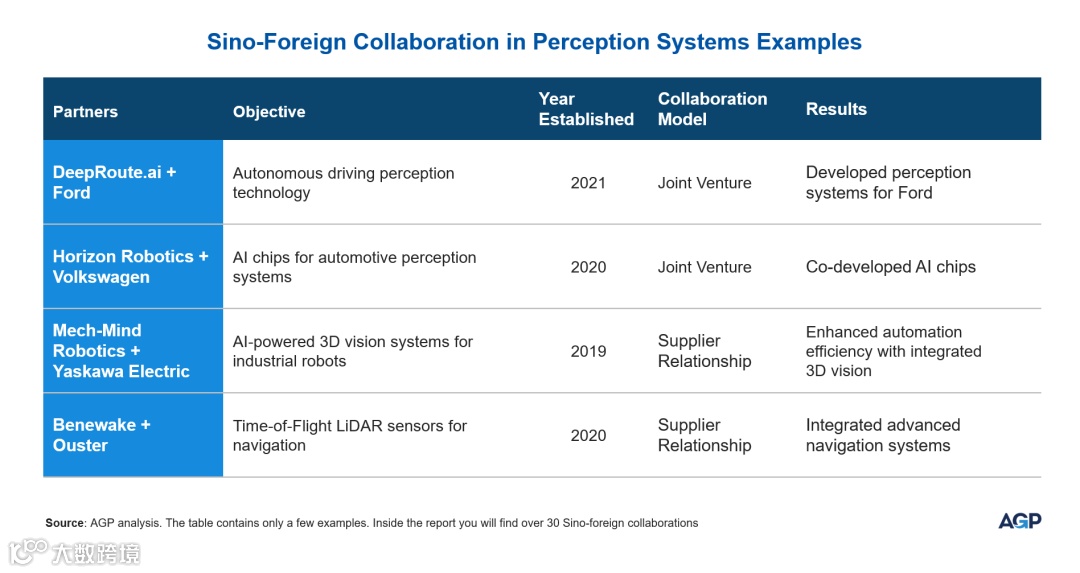
The landscape of Sino-foreign collaboration in perception systems for robotics is diverse, involving various collaborative models such as joint ventures, technology licensing, strategic investments, academic partnerships, AI stack collaborations, and supplier relationships. These collaborations have significantly contributed to advancing China's capabilities in sensor and computer vision technologies. Particularly, strategic investments and joint ventures have been instrumental in elevating China's technological prowess in perception systems, thus enhancing its global competitiveness in the robotics industry.
In the illustration below there are a few examples of Sino-foreign collaboration. Inside the report you will find the complete table, with over 30 collaborations.
3. Common Applications in China: Strategic Insight and Cluster Overview
Adoption is driven by cost efficiency, workforce pressures, and strong policy support.
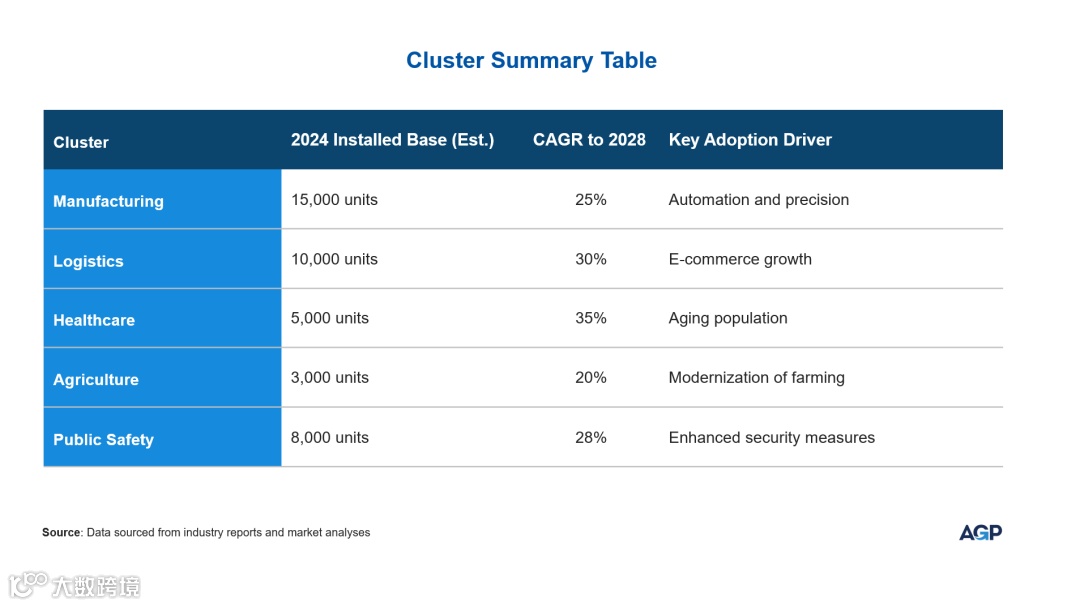
Manufacturing: Firms such as Foxconn and BYD deploy vision-guided robotic arms for assembly and inspection, improving productivity by up to 20 percent.
Logistics: Companies including Geek+ and Quicktron use autonomous mobile robots for sorting and storage management.
Healthcare: Tinavi Medical and Remebot supply surgical and telemedicine robots that support hospitals facing staffing constraints.
Agriculture: XAG and DJI Agriculture lead in drones and field robots for spraying and monitoring.
Public Safety: Hikvision and UBTech Robotics integrate AI vision in patrol and emergency response units.
4. Impact on Market Incumbents
The rise of Chinese perception systems is shifting the balance of power in robotics, automation, and autonomous systems.
Industrial Automation: Firms such as SIASUN and Mech-Mind Robotics are competing more directly with European leaders like Siemens and ABB.
Service Robotics: Dyson is known for its high-end consumer robotics, such as vacuum cleaners equipped with advanced sensors. Chinese companies like Ecovacs are introducing similar products with enhanced perception capabilities, threatening Dyson's premium market position.
Autonomous Vehicles: Domestic sensor suppliers such as Hesai and DeepRoute.ai are enabling automakers to reduce reliance on imported LiDAR and AI processors, posing a challenge to Tesla's technological lead.
5. Policy Support
Collectively, the following policies are projected to unlock significant revenue opportunities by 2028, fostering a robust ecosystem for perception systems within China's robotics industry.
National initiatives
Made in China 2025: Launched in 2015, this initiative identifies robotics as a key sector for upgrading China's manufacturing capabilities, emphasizing the need for innovation and technological advancement.
14th Five-Year Plan for Robot Industry Development: This plan aims to accelerate the expansion of robot applications, leading to the launch of the "Robot+" Application Action Plan, which envisions robots becoming a critical component of economic development, people's daily lives, and social governance.
Provincial support
Provinces such as Guangdong, Zhejiang, and Jiangsu have introduced specific funds and tax incentives to stimulate growth in robotics and AI sectors. For instance, Guangdong's plan to replace humans in factories with robots led to more than 2,000 manufacturers signing up for this initiative.
Municipal Initiatives
Cities like Shenzhen and Beijing have launched action plans to cultivate and develop intelligent robot industry clusters. In June 2022, Shenzhen announced the Action Plan for Cultivating and Developing Intelligent Robot Industry Clusters, and in June 2023, the Beijing Municipal government announced the Beijing Robot Industry Innovation and Development Action Plan (2023-2025).
6. Closing Remarks
The rapid development of perception systems, incorporating advanced sensors and computer vision, has reshaped the robotics industry landscape, establishing itself as a key technological pillar. These systems enhance a robot's ability to perceive and interpret its environment, enabling functionalities that were previously unattainable.
The technological advancements in perception systems have been profound. Innovations such as high-resolution 3D cameras and AI-driven vision processing have propelled the capabilities of robots in areas such as autonomous navigation, object recognition, and spatial awareness. These technologies empower robots to operate with greater autonomy and adaptability, critical for applications ranging from manufacturing to healthcare.
Product differentiation within the robotics industry is becoming increasingly reliant on the sophistication of perception systems. Companies are leveraging these technologies to create distinctive features that set their products apart in the competitive market. For instance, the integration of real-time 3D mapping capabilities and advanced object detection allows robots to perform complex tasks with enhanced precision and efficiency.
The ecosystem supporting perception systems is dynamic and multifaceted, involving a synergy between hardware advancements and software innovations. The development of robust and versatile sensors, coupled with sophisticated data processing algorithms, facilitates the seamless integration of perception systems into various robotic applications. These advancements are supported by strategic collaborations and partnerships, which are crucial for driving innovation and ensuring the successful deployment of these technologies.
Despite notable progress, challenges remain, such as the need for improved data integration techniques and the development of robust safety standards to ensure ethical deployment of these technologies. The industry must also address issues related to data privacy and the ethical implications of surveillance capabilities inherent in advanced perception systems.
Looking forward, the trajectory of perception systems in robotics is poised for continued transformation, with significant implications for global industries. The ongoing advancements offer substantial opportunities for enhancing efficiency and innovation across sectors, while also presenting challenges that require careful navigation by investors, policymakers, and industry leaders. The strategic importance of these technologies is underscored by their potential to redefine industry standards and drive economic growth on a global scale.
To download the full report, please visit:
https://asiagrowthpartners.com/insight/agp-china-technology-report-perception-systems-sensors-computer-vision/a85
Our full library is here:https://asiagrowthpartners.com/insights/agp
About the Author

About Asia Growth Partners
We are a management consultancy dedicated to helping clients build successful businesses in Asia.
Our mission is to help our clients grow their core businesses and capture emerging opportunities in Asia. We do this by conducting detailed research, advising strategy, and providing agile capabilities to drive forward implementation.
Asia Growth Partners is headquartered in Shanghai, with teams in China, India, Southeast Asia, and Europe.