

Special Port Fees Imposed on U.S. Vessels Pose New Challenge to Polyolefin Market
Introduction: Effective October 14, 2025, China charges special port fees on U.S. vessels. In the polyolefins market, where import and export activities are integral to China’s trade landscape, the impact of this policy is expected to vary by product. China’s PP trade with the U.S. is relatively limited, while the U.S. remains a significant supplier of PE. China’s dependency on PE imports exceeded 30% in 2024. From January to August 2025, the U.S. maintained its role as a key source of imports, supplying 14.17% of China’s total PE imports. This new policy is likely to reduce the availability of U.S.-origin polyolefins in China.
Background
On April 17, 2025, the Office of the United States Trade Representative (USTR) announced measures following Section 301 investigation into China’s maritime, logistics, and shipbuilding sectors. Starting October 14, 2025, the U.S. will impose additional port fees on Chinese-owned, operated, built, or flagged vessels. These measures seriously violate international trade principles and the China-U.S. maritime transport agreement, and caused severe disruption to maritime trade between the two countries.
In response to U.S. actions, and in accordance with China’s Regulations of the People's Republic of China on International Maritime and other relevant laws, regulations, and fundamental principles of international law, approved by the State Council, China will charge special port fees on specific U.S.-related vessels effective October 14, 2025. The maritime authority at the port of call shall be responsible for collecting the special port charges. The applicable vessels include those owned by U.S. enterprises, other organizations, or individuals; operated by U.S. enterprises, other organizations, or individuals; vessels owned or operated by enterprises or organizations where U.S. entities or individuals directly or indirectly hold 25% or more of equity (voting rights, board seats); U.S.-flagged vessels; and vessels built in the U.S. The relevant announcement details are as follows:
1. For the aforementioned vessels, special port fees will be levied per voyage, implemented in phases with specific rates as follows (fractions of one net ton are calculated as one net ton):
(1) For vessels berthing at Chinese ports from October 14, 2025: RMB 400 per net ton.
(2) For vessels berthing at Chinese ports from April 17, 2026: RMB 640 per net ton.
(3) For vessels berthing at Chinese ports from April 17, 2027: RMB 880 per net ton.
(4) For vessels berthing at Chinese ports from April 17, 2028: RMB 1,120 per net ton.
2. For vessels calling at multiple Chinese ports in a single voyage, the special fees will be charged only at the first port of call, and will not be charged again at subsequent ports of call on the same voyage. Fees will be charged for a maximum of five voyages per vessel per year.
3. The Ministry of Transport of the People’s Republic of China will formulate detailed measures to implement the decision.
China’s Polyolefin Trade with the U.S.
From 2023 to August 2025, the U.S. emerged as the leading origin of China’s PE imports, climbing from sixth place in 2022 to the top position by 2024, driven by its cost advantages and relatively stable shipping conditions. Imports from the U.S. remained among the top three sources from January to August 2025. During this period, China imported 1,272.4kt of PE from the U.S., accounting for 14.17% of China’s total import volume of PE. This included 457.3kt of HDPE (12.62% of total HDPE imports), 294.1kt of LDPE (13.89% of total LDPE imports), and 521kt of LLDPE (16.08% of total LLDPE imports).
In contrast to the high import dependence degree of PE on U.S.-origin resources, China’s PP industry has rapidly increased its self-sufficiency in recent years through robust capacity expansion and heightened R&D efforts, leading to a YoY decline in import dependence degree. Major origins of PP imports are the Middle East, Southeast Asia and Northeast Asia, with short sea shipping playing a key role. In comparison, China’s PP trade with the U.S. market remains relatively limited. From January to August 2025, PP imports from the U.S. amounted to 24.1kt, accounting for 1.11% of total PP imports, while exports to the U.S. stood at 3.3kt, taking up merely 0.16% of total PP exports. In China, PP import trade with the U.S. is constrained, and export trade is also limited, although China’s PP export market has developed strongly in recent years. China’s PP export business has gradually expanded and included long-distance trade, while the majority of these exports are directed toward filling supply gaps in South America, Africa, etc. Due to the mature technology and relatively ample supply in the U.S., the volume of PP exports to the U.S. remains minimal.
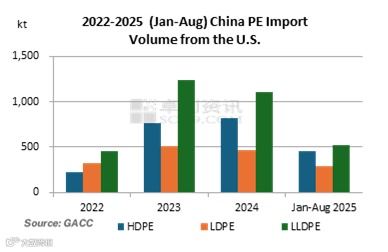
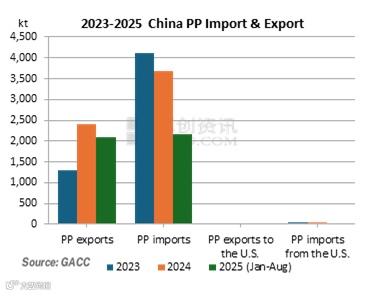
China has limited trade volume of PP with the U.S., and the variety of involved PP products is also relatively narrow. Occasionally, small quantities of products from enterprises like LyondellBasell and ExxonMobil make their way into the Chinese market. Furthermore, international suppliers currently have limited incentive to sell to the Chinese market, as China’s PP USD-denominated prices remain at a global low. In contrast, there is still more PE trade activity between China and the U.S.
In terms of PE supplies imported from the U.S., their major sources include ExxonMobil, Dow Chemical, Formosa Plastics (U.S.A.), LyondellBasell, and Chevron Phillips Chemical. In terms of product structure, these imports mainly consist of general-purpose materials such as film, injection molding and blow molding. These products have lower specificity and are highly replaceable.
With the gradual official commissioning of ExxonMobil’s Huizhou project in China, the supply structure related to ExxonMobil is expected to gradually shift toward domestic production in China. Enterprises like ExxonMobil, Dow Chemical, Formosa Plastics, LyondellBasell and Chevron Phillips Chemical are global enterprises with production and operations distributed across Europe, the Middle East and Southeast Asia. Amid ongoing uncertainties in Sino-U.S. relations, there is an expectation that supplies from Europe, the Middle East and Southeast Asia may increase. However, considering that production costs in Europe and Southeast Asia are generally higher than those in the U.S., the willingness of Chinese market participants to procure from these alternative regions will probably be reduced somewhat.
Influence of Special Harbor Dues Imposition on Polyolefin Industry
In conclusion, the imposition of special harbor dues on U.S. ships may mainly impact the shipping and shipbuilding-related industries. The polyolefin price is not notably influenced by the production cost transmission, as both propane and ethane are exempt from tariffs currently. Under the impact of the increased cost at ship enterprises, China’s domestic traders’ procurement cost may also increase. To avoid the impact of increased harbor dues, traders may choose to transfer the goods to other ships once the U.S. ships arrive in Singapore or Malaysia, and then transship them to China’s domestic ports. However, the uncertainty of the delivery will possibly increase as the shipping schedule may be prolonged. Against this backdrop, it is expected that market players in China may show weaker interest in purchasing from the U.S. in the short term. Moreover, the import volume from the U.S. is estimated to drop in Q1 2026 considering the delayed shipping schedule.
In the future, SCI will further follow up on the relevant situation of the tariff tug-of-war between China and the U.S., changes in global resource trade flow, performance of downstream demand, and changes in China’s domestic prices.
All information provided by SCI is for reference only, which shall not be reproduced without permission.
Please click "Read more" for the full article.