



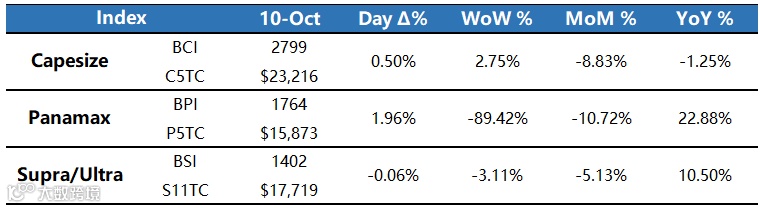
BDI Index


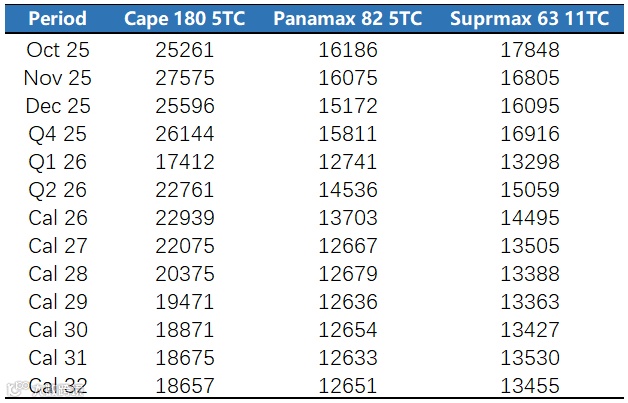
Dry FFA


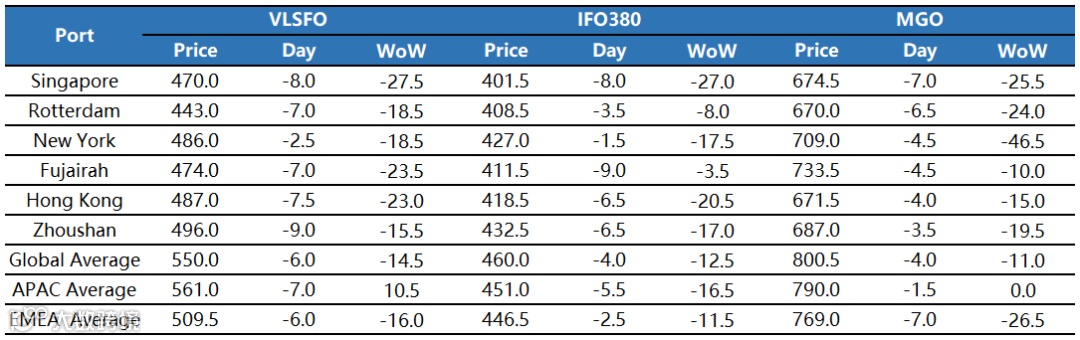
Bunker Price


Economy & Trade

Trump Announces Additional 100% Tariffs on China and Strict Export Controls
U.S. President Donald Trump announced on October 10, 2025 (Eastern Time) that, starting November 1, 2025, an extra 100% tariff will be imposed on all goods imported from China. This will be added to existing tariffs, pushing the total rate to 130% or higher.
At the same time, Trump stated that the U.S. will implement strict export controls on “all critical U.S.-made software,” banning or restricting its export to China.
This dual move is intended to retaliate against China’s recent restrictions on rare-earth mineral exports.
China Retaliates with U.S.-Linked Port Fees
On October 10, China’s Ministry of Transport released the “Announcement on the Imposition of Special Port Dues on U.S.-Related Vessels.” Effective October 14, China will levy a special tonnage-based port due on any vessel deemed U.S.-linked.
Industry observers note that China’s criteria are broader than previous U.S. measures. While few ships are U.S.-built or U.S.-flagged, the rule incorporates “ownership structure”: if U.S. persons or institutions hold ≥25% of the equity (including voting rights and board seats), the vessel must pay the fee (starting at RMB 400 per net ton and escalating annually to RMB 1,120).
According to TradeWinds’ analysis of listed owners, the majority have U.S. investor ownership above 25%. In the dry-bulk segment, companies such as SFL Corp, Norden, Star Bulk, Navios, Safe Bulkers and Diana Shipping all meet the threshold.
In a Q&A posted on the Ministry of Commerce website the same evening, officials described the measure as “self-defense” aimed at safeguarding fair competition in international shipping and shipbuilding, and urged the U.S. to correct its “wrong practices” and resolve disputes through consultation.

International Shipping

Industry Backs IMO Net-Zero Framework; U.S. Threatens Sanctions
Next week, the 176 members of the International Maritime Organization will meet in London to formally adopt the binding climate agreement reached in April. Seven global shipping-association CEOs jointly urged the MEPC special session to adopt the “Net-Zero Framework” (NZF).
The Trump administration warned it will retaliate with visa restrictions and sanctions against countries that vote for the UN body’s plan to cut maritime GHG emissions. In a joint statement on October 10, Secretary of State Marco Rubio, Energy Secretary Chris Wright and Transportation Secretary Sean Duffy announced five punitive measures—including visa bans, port fees and commercial penalties—against NZF supporters.
On October 12, the EU issued a formal statement strongly supporting IMO’s global emissions-reduction measures and called on member states to vote for the framework.
UNCTAD: Global Shipping Enters “Fragile Growth” Phase
UNCTAD’s latest report, cited by AFP, says geopolitical tensions, new tariff policies, shifting trade patterns and rerouted shipping lanes are reshaping maritime trade. Carrying over 80% of world merchandise traffic, shipping is entering a period of “weak growth, rising costs and heightened uncertainty.” After a “solid” 2.2% expansion last year, seaborne trade will stagnate at just 0.5% growth in 2025. Over the medium term (2026-2030), the average annual growth rate is expected to recover to 2%.
UNCTAD Secretary-General Rebeca Grynspan noted: “Since the Suez Canal closed in 1967, we have not seen such prolonged disruption of major trade arteries.”
Maersk: China–LatAm & China–Africa Volumes Surge
Maersk’s latest report shows steadily rising volumes from China to Latin America, led by tech, mining and metals. In the first half of 2025, China’s export share to LatAm rose from 27% to 38% year-on-year. Retail sales in LatAm are forecast to exceed US$200 billion in 2025, pushing logistics firms to invest in smart hubs, route optimization, e-trucks and smart lockers for the last mile.
China’s exports to Africa have also increased; its share of total container volumes on the continent climbed from 32% in 2019 to about 39% in 2025. Chemicals and automobiles remain the largest commodity groups from the Far East to Africa.

Commodities Market Brief

Steel
On October 8, Argentina’s government announced the temporary removal of export taxes on steel, aluminum and their derivatives, effective through December 31, 2025. The measure, published in the official gazette, applies only to countries that levy at least 45% import duties on Argentine metals; if duties fall below 45%, the tax break is automatically rescinded.
END