英格兰政府宣布大学学费将永久与通胀挂钩,但学费上涨将仅限于达到更高教学质量标准的高校,以保障学生和纳税人的利益。白皮书还提出加强监管、优化资金分配和推动高校专业化,同时引入终身学习学分制,旨在提升教育质量和技能培养,应对财政压力和人才需求挑战。
英格兰大学学费将永久与通胀挂钩
University tuition fees in England to be linked permanently to inflation
Government promises ‘higher standards’ in higher education and ‘renewed focus’ on skills in long-awaited white paper
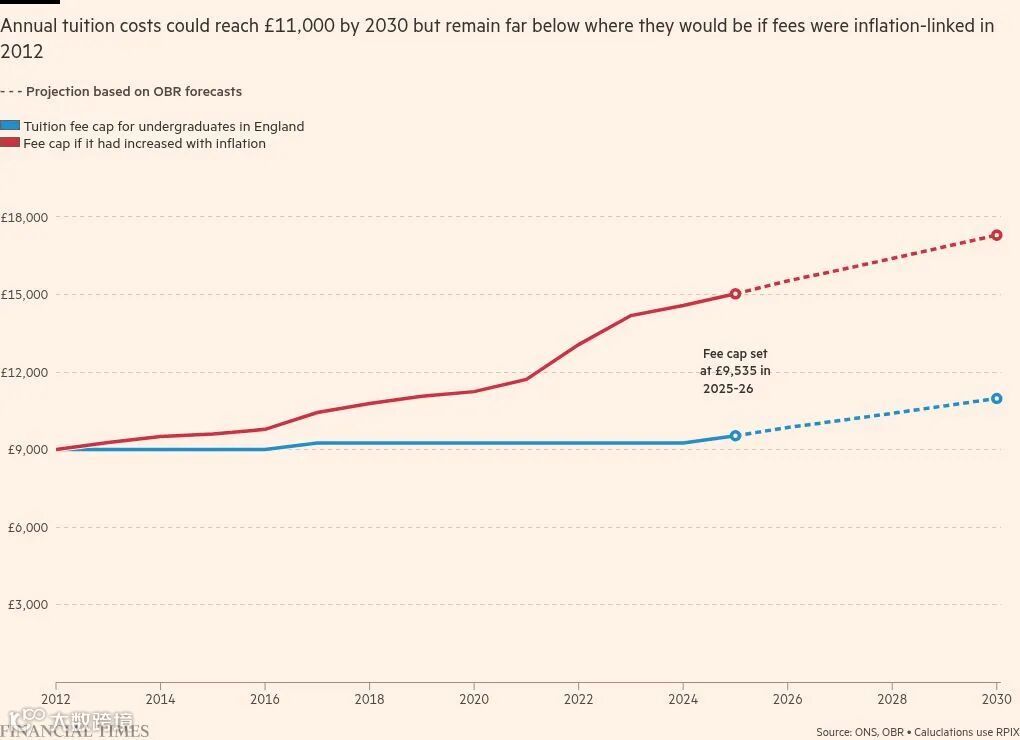
The tuition fee cap, which is set at £9,535 for the current academic year, would increase in line with forecast inflation for the next two years
Ministers will permanently link tuition fee rises to inflation in England but restrict increases to universities that meet higher quality standards, the Department for Education said on Monday.
The long-awaited government white paper on skills and post-16 education also set out plans to address the funding shortfall in research, noting that the proposed changes “may result in funding a lower volume of research”.
The proposed reforms come amid widespread cost-cutting in higher education as providers come under mounting financial pressure from a long-term funding squeeze and a clampdown on immigration that has dampened international demand.
The tuition fee cap, which is set at £9,535 for the current academic year, would increase in line with forecast inflation for the next two years, with automatic increases to be legislated “when parliamentary time allows”, the white paper said.
Bridget Phillipson announces that university tuition fees in England will rise
And to safeguard the excellence in our universities for future generations. Last November, I announced that tuition fees would increase by 285 pounds this academic year. And today I can confirm that we will increase undergraduate tuition fee caps for all higher education providers in line with forecast inflation for the next 2 academic years, and we will futureproof our maintenance loan offer by increasing maintenance loans in line with forecast inflation every academic year to provide long-term certainty over future funding. We will then legislate when parliamentary time allows to increase tuition fee caps automatically in the future linked to quality. We will not allow institutions who don't take quality seriously to make their students pay more. Charging full fees will be conditional on high quality teaching, balancing stability for universities with fairness for students and for taxpayers.
However, fee rises would become “conditional on higher education providers achieving a higher quality threshold” to protect taxpayer money, it noted.
Education secretary Bridget Phillipson told MPs that it was right that universities delivered “the world-class education students expect if they are going to charge the maximum tuition fee”.
“These reforms will ensure value for money, higher standards across our universities and colleges and a renewed focus on the skills our economy needs,” she added.
Vivienne Stern, chief executive of lobby group Universities UK, said the decision to raise fees in line with inflation would “help to halt the long-term erosion of universities’ financial sustainability” following a decade of fee freezes.
The white paper also outlined proposals to strengthen the role of the Office for Students, enabling the sector regulator to “impose recruitment limits where growth risks poor quality” and toughen its management and governance conditions of registration.
Governing bodies must ensure they have “diverse skills and capability to oversee strategy, plan prudently, understand and manage risk”, should “not sign off unachievable plans” and should “challenge whether their organisation is specialising appropriately”, the policy document added.
The OfS will also be given reinforced investigative powers to tackle abuse of the system by recruitment agents and poor quality provision by university franchises.
Universities will be encouraged to “specialise in areas of strength” through a more strategic distribution of research funding, and to explore “more consolidation and formal collaboration” to secure the sector’s financial sustainability.
Tim Bradshaw, chief executive of the Russell Group of research-intensive universities, welcomed the tuition fee announcement but urged the government to rethink the international tuition fee levy, details of which are to be set out in the Budget on November 26.
Last month the government announced it would bring back maintenance grants for disadvantaged students on priority courses. The reintroduction of grants, which were abolished by the Conservative government in 2016, will be paid for via a 6 per cent levy on international student fees.
The levy, announced as part of the immigration white paper in May, has come under criticism from universities, with sector leaders warning that the £621mn-a-year hit will lead to further redundancies.
The equivalent of more than 15,000 job cuts have already been announced in the past year, according to the University and College Union.
Acknowledging the flaws of the current post-16 education system, the paper vowed to take a “more joined-up approach across government” to deliver the industrial strategy and address the high number of young people not in education, employment or training (NEET).
The new system will provide greater flexibility through the Lifelong Learning Entitlement, a credit-based system that will unify higher and further education finance from January 2027, and the growth and skills levy that funds apprenticeships, with plans to allow employers to fund short training courses.
The proposals also included a new “stepping stone” qualification for students with lower attainment before they retake GCSE maths and English following widespread criticism of the current system that sees hundreds of thousands of teenagers resit these exams each year.



 Annie出海