


Mr. Oliver Wieck
Secretary General
ICC Germany
Wilhelmstraße 43 G,
10117 Berlin,
Germany
30 July 2025
Document 470/TA.956
Dear Mr. Wieck,
Thank you for your query regarding UCP 600. Please find below the opinion of the ICC Banking Commission Technical Advisers.
QUOTE
We received a letter of credit on 7 February 2025.
On 7 March 2025, we sent compliant documents to the issuing bank
and they were delivered to the bank on 10 March 2025.
On 31 March 2025, we demanded payment from the issuing bank, as no MT734 or payment had been received. On the same day, we surprisingly received the original documents back from the issuing bank with the following text:
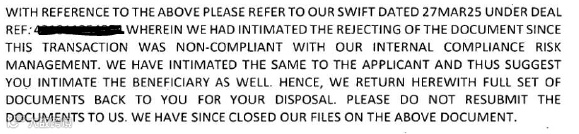
We have never received the referenced SWIFT message, not even as an MT799/999 message.
We responded as follows:
Quote
This type of return is not acceptable.
As soon as you can no longer maintain your opened LC, you must advise us immedi-ately.We have not received any information about the rejection. According to ERA 600 ART. 7 and 8, you are obliged to honour your LC from the time it is opened until it expires.
On 10 March 2025, you received the documents for the above-mentioned LC. We have not received any notification from you at this time either.
According to ERA 600/ ART 16 d you have 5 bank working days to check the docu-ments and refuse them if necessary. This has not happened either.
We did not receive any message via SWIFT from you or our common correspondent on 14 March 2025 (5th banking day). The documents are therefore considered to have been accepted.
A return after 14 days by your bank is not permitted and is bad banking practice.
As you have clearly violated the common ERA 600, we request immediate payment of the presented documents.
Unquote
In this request, we have included our correspondence, as we have not received any response from the issuing bank. Fortunately, they were able to reach a German branch/contact person and asked for assistance.
They sent us the following information by email on 4 April 2025:

On 6 April 2025, we received the following MT999 from the issuing bank:
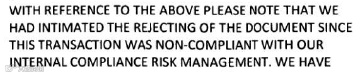
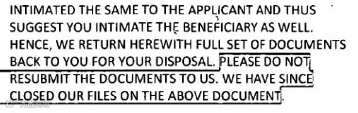
On 7 April 2025, we were informed that we should send the documents to the is-suing bank again, as they are now to be accepted. The issuing bank received the documents on 10 April 2025.
Since we had received the documents back, they are discrepant and no longer comply with the L/C terms e.g., credit expired and late presentation)
On 22 April 2025, we again sent a reminder to the issuing bank, as we had not received any payment by that date.
On 25 April 2025, we received the payment with the involvement of the German contact.
We have the following questions in this case:
1. Are internal compliance risks the same as sanctions?
Does this not have to be exactly listed in an MT message?
In our opinion, this cannot be a reason (missing information from the applicant) - see our Swift message above.
We consider internal compliance risks to be inter-company matters, which can-not lead to a refusal of documents or a release from a commitment to pay.
2. If so, does not an MT799/MT734 have to be sent within the 5 banking days (UCP600/sub-article 16 (d)) that the documents are not honoured?
If the relevant period is not respected, are documents not deemed to have been accepted (despite sanctions)?
3. If the delay of the issuing bank generates an inconsistent document presenta-tion, can they reject the documents at the time a new presentation is made? (In this case the second presentation).
ANALYSIS
On 10 March 2025, a complying presentation was delivered to the issuing bank.
On 31 March 2025, the presenter contacted the issuing bank for payment. On the same day, the original documents were received back from the issuing bank. The documents were accompanied by a statement on the covering schedule to the effect that the documents were refused as they were non-compliant with “our internal com-pliance risk management”.
Although documents were delivered to the issuing bank on 10 March 2025, no notice of refusal had been sent by the issuing bank by the close of the fifth banking day following the day of presentation, in accordance with UCP 600 article 16 prior to the presenter receiving back the documents.
The returning of documents without a formal refusal notice having been issued constitutes non-compliance with article 16, and the issuing bank is precluded under sub-article 16 (f) from claiming that the documents do not constitute a complying presentation. In any event, a mere reference to “internal compliance risk” would not constitute a valid reason to refuse the presentation. In such a case, the issuing bank is obligated to honour according to UCP 600 article 7.
Based on the information from the query, the exact nature of the “internal compliance risks” mentioned by the issuing bank is unknown, for example, if they would be equivalent to sanctions. If they were to be relevant for the purpose of the documentary credit and/or document examination, then this should be clearly stated within the documentary credit. However, it would not be considered prudent banking practice to refer to internal policies within a documentary credit. It is also a concern that the credit was even issued with knowledge by the issuing bank of such internal policies.
The issue of sanctions and internal policies has been addressed in previ-ous ICC Opinions. As an example, Opinion R906 (TA884rev) makes reference to ICC Document No.470/1238 “Guidance Paper On The Use Of Sanctions Clauses In Trade Finance-Related Instruments Subject To ICC Rules” which reads, “The implementa-tion by a bank of an internal sanctions-related policy that goes beyond what is re-quired under the laws and regulations applicable to that bank is an illustration of that discretion. It may cause a serious problem when considering the role of a confirming bank, a nominated transferring bank, a guarantor or a beneficiary. If the reference to an internal, sanctions-related policy were to allow the bank discretion to honour or re-fuse payment, one could even question if that bank has in fact assumed a legally binding obligation, a question that of course has to be determined under the applica-ble law.”
Internal compliance risks are not the same as sanctions in the context of UCP 600, and they do not automatically constitute grounds for refusing documents under an irrevocable documentary credit. Under UCP 600, particularly articles 7 and 15, the issuing bank is irrevocably bound to honour, provided a complying presenta-tion is made, regardless of any internal considerations, unless the issuing bank is legally prohibited from doing so by applicable sanction laws.
If there is a sanctions-related issue, this must typically be communicated through a formal Swift message (often an MT799 or MT734), clearly outlining the le-gal or regulatory basis on which the issuing bank is prevented from honouring its un-dertaking. It is not acceptable for a bank to simply cite “internal compliance risks” without reference to applicable legal instruments, regulatory rulings, or court orders.
Internal compliance reviews are internal policy matters and do not equate to force majeure or sanctions under UCP 600, nor do they relieve the bank of its obli-gations under the credit. Unless they are backed by enforceable law (e.g., an OFAC listing, EU Regulation, UN embargo, etc.), such matters cannot justify a failure to hon-our or an unexplained return of documents.
When a presentation is, incorrectly, returned by the issuing bank, and is subsequently re-presented, then the issuing bank must honour the presentation. This obligation to honour remains, even if the re-presentation technically breaches the original credit terms (e.g., expiry date or presentation period).
Such “second presentation” is not considered a new presentation. The
second presentation is the direct result of the issuing bank’s own procedural failure and should not reset the compliance clock or allow a new opportunity to examine documents as if they had not already been presented. In this query, the first presentation of documents was compliant and deemed accepted under UCP 600 due to the issu-ing bank’s failure to refuse them according to the requirements of article 16.
To allow the issuing bank to refuse the re-presentation due to discrepan-cies they themselves caused would effectively reward procedural malpractice and contradict the fundamental certainty that UCP 600 is intended to provide.
CONCLUSION
Questions 1 and 2: The exact nature of the “internal compliance risks” re-ferred to by the issuing bank is unknown. Nevertheless, it would not be considered prudent banking practice to refer to internal policies within a documentary credit.
When a presentation is made to the issuing bank, and it is not refused according to UCP 600 article 16, the issuing bank is precluded from claiming that the documents do not constitute a complying presentation. A mere reference to “internal compliance risk” would not constitute a valid reason to refuse the presentation. In such case, the issuing bank remains obligated to honour.
Question 3: When a presentation is, incorrectly, returned by the issuing bank, and is subsequently re-presented, then the issuing bank cannot refuse the presentation if it is returned in the same form and substance as the original presenta-tion.
文章如有侵权,请洽平台删除:
Reminder: In case of infringement, please contact the admin.to delete :