

这些政策近期出台或生效,可能影响你我生活,你都了解吗?
Private cars in 4 GD cities can access HK this month
Guangzhou, Zhuhai, Jiangmen and Zhongshan are the first batch of four cities in Guangdong Province where private passenger cars are registered can access Hong Kong via the Hong Kong-Zhuhai-Macao Bridge (HKZMB) beginning in November, according to the long-anticipated Guangdong cars heading to Hong Kong policy unveiled Friday (Oct. 31).
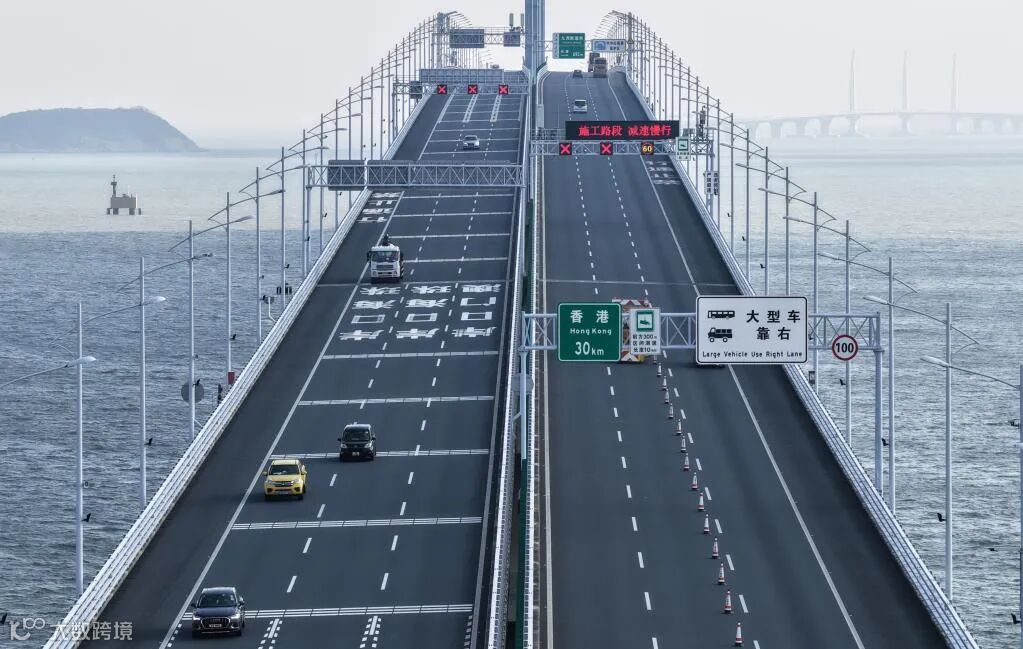
Aerial photo taken on Oct. 19 shows the traffic on the Hong Kong-Zhuhai-Macao Bridge. Xinhua
Authorities said the program will expand to other cities across Guangdong after a six-month trial period.
Both the Guangdong Measures for Management of Motor Vehicles Entering and Exiting Hong Kong via Zhuhai Road Port of the HKZMB Automated Parking Facilities, and the Guangdong Measures for Management of Motor Vehicles Entering and Exiting Hong Kong via the Zhuhai Road Port of the HKZMB will come into effect in stages this month.
Practical timelines were detailed in the announcement.
From 9 a.m. on Nov. 1, the Hong Kong Airport Authority has begun accepting bookings from Guangdong private car owners for airport parking spaces at the Hong Kong port automated parking facilities. Then, from midnight Nov. 15, approved Guangdong private car owners will be permitted to drive via the HKZMB Zhuhai Road Port into the Hong Kong port automated parking facilities.
Entry into Hong Kong’s urban area will follow a quota and lottery system for the first month of operation. Eligible Guangdong private car owners may register between 9 a.m. Nov. 1 and 12 a.m. Nov. 20 to enter a lottery for December allocations. The scheme will process 100 entries per day over 17 working days, for a total of 1,700 available slots in the initial December batch. The lottery drawing is scheduled for 10 a.m. Nov. 23, and successful applicants will be able to submit their applications beginning at 9 a.m. Dec. 9.
Approved applicants who complete the reservation process will be able to drive into Hong Kong’s urban areas via the HKZMB Zhuhai Road Port starting from midnight Dec. 23. Authorities emphasized that all crossings must comply with the relevant registration, insurance and customs procedures, and that applicants must meet the eligibility criteria set out in the published management measures.
SZ unveils plan to develop low-altitude economy
Shenzhen has put into effect a blueprint to develop the city’s low-altitude aviation infrastructure.
The plan states that more than 1,500 take-off and landing points will be built across the city by 2035, positioning Shenzhen to become a global leader in the low-altitude economy.
In the near term, Shenzhen will prioritize public service and logistics applications. Immediate priorities include resolving critical urban governance and industrial pain points such as emergency medical supplies transport and high-value goods delivery.
The plan introduces five planning strategies to guide development: regional coordination, system construction, scenario-driven deployment, facility intensification and pre-control transmission.
During preparation of the plan, the Shenzhen authority deployed digital technologies including the citywide spatio-temporal information platform to conduct systematic, three-dimensional assessments of key factors around potential facilities, including surrounding environment, airspace clearance conditions, and noise impacts, to make the siting process smarter and more precise.
The plan also commits to monitoring and evaluation of take-off and landing facility usage. Shenzhen officials say the layout will be adjusted in a timely manner as facilities come into operation, transforming a static planning map into a dynamic “live map” that responds to real-world needs and operational data.
China issues 23 measures to bolster protection for small and medium investors
The China Securities Regulatory Commission (CSRC) on Oct. 27 set out 23 concrete measures across eight areas to enhance investor proteciton and market confidence.
The CSRC places clear responsibilities on market intermediaries, requiring securities firms and other operating institutions to strengthen investor education, implement investor-suitability management, and embed investor education into routine business processes. Before selling financial products or providing services, institutions must explain business rules, clarify key contract terms and clearly warn of related risks to improve the targeting and effectiveness of investor education.
The CSRC also requires firms to take primary responsibility for handling investor complaints. Institutions must better align complaint and dispute-resolution mechanisms with internal control and compliance systems, address complaint sources, and raise overall service quality.
Investor protection agencies are given an expanded role in dispute resolution. As specialized bodies for protecting capital market investors, these organizations are encouraged to support litigation, bring shareholder representative suits and other representative legal actions to protect investor rights. The measures call for broadening practical scenarios, in which investor protection bodies assist small investors — including accepting mandates to file civil claims and participate in creditor voting during bankruptcy liquidation or reorganization of listed companies.
The CSRC asks investor protection agencies to promote exemplary cases of supportive litigation and shareholder-derivative actions, provide public explanations of typical rulings, and actively inform small investors about ongoing enforcement or litigation activities. When such agencies send inquiry letters to listed companies or initiate civil suits, they should publicly disclose appropriate information so that small investors are kept informed and can more readily exercise shareholder rights or pursue remedies.
For companies facing delisting risk, regulators will step up ongoing oversight, require clear disclosure of delisting risks to protect investors’ right to know, and enhance monitoring of abnormal trading to curb speculative manipulation. In cases of forced delisting arising from major legal violations, the CSRC urges controlling shareholders and actual controllers to take proactive compensation or other measures to offset investor losses caused by illegal acts, and calls for coordinated handling across civil, administrative and criminal proceedings to safeguard investor interests.
For voluntary delistings, the CSRC requires listed companies to provide protective measures such as cash-out options.