

![[专利速递]Bristol-Myers公开ROS1靶向药Repotrectinib合成专利](https://cdn.10100.com/user/214421bc1b384cdcb3279285542717ef.png?x-oss-process=style/180x)
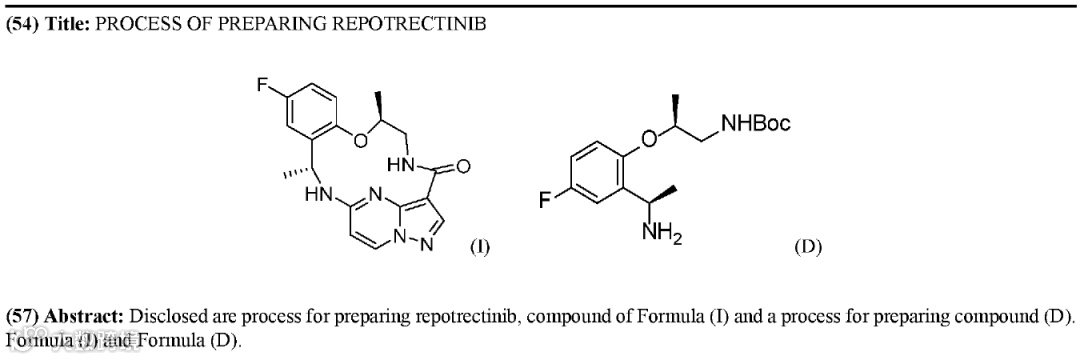
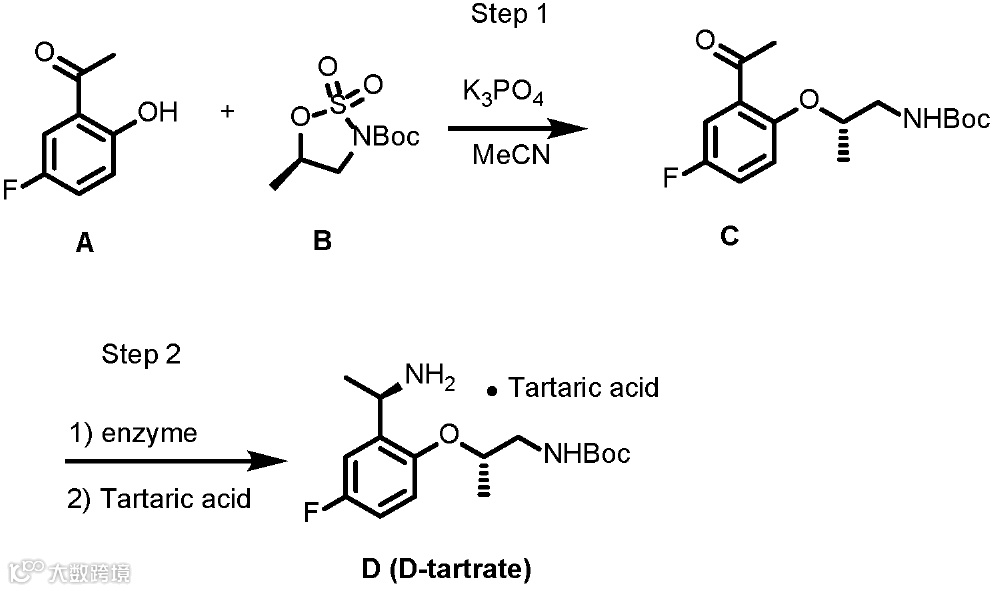
Step 1
To a solution of compound (A) (12.0 g, 50.6 mmol, 1.0 equiv) and compound (B) (8.18 g, 53.2 mmol, 1.05 equiv) in acetonitrile (60 mL) was added solid K₃PO₄ (16.2 g, 76.8 mmol, 1.5 equiv), followed by tetrapropylammonium chloride (1.14 g, 5.06 mmol, 0.10 equiv) at 20 °C under atmosphere of nitrogen. The mixture was stirred vigorously until sulfonamide was consumed as determined by HPLC analysis. Subsequently MTBE (60 mL) was added, and the resulting mixture was cooled to 0 - 5 °C. Aq. HCl solution (1.0 N, 76 mL) was slowly added at ≤20 °C. The mixture was then warmed to 20 °C, and water (120 mL) was added to dissolve the solids. The biphasic mixture was aged until the sulfonic acid intermediate was consumed as determined by HPLC analysis. The aq. phase was then removed. Heptane (96 mL) was added into the organic phase, and the resulting solution was then washed with 4% aq. NaOH solution (72 mL x2) and 5% aq. KH₂PO₄ solution (24 mL), subsequently solvent exchanged to EtOH. The batch volume was adjusted to ca. 30 mL, and was then cooled to 0 - 5 °C. Water (6.0 mL) was added over a period of 15 min, and the mixture was stirred until the seed bed was formed. Additional water (36 mL) was added over a period of 1 h, and the resulting slurry was stirred for 3 h at 0 - 5 °C prior to filtration. The filtrate was recycled to complete the transfer of the slurry in the reactor. The filter cake was washed with water (24 mL x2) and dried under vacuum at ≤35 °C, affording 14.0 g of compound (C) in 89.0% yield. ¹H NMR (500 MHz, CHLOROFORM-d) δ 7.39 (dd, J = 8.9, 3.2 Hz, 1H), 7.13 (ddd, J = 9.0, 7.4, 3.3 Hz, 1H), 6.97 (dd, J = 9.0, 4.0 Hz, 1H), 5.03 (br s, 1H), 4.63 - 4.52 (m, 1H), 3.50 - 3.40 (m, 1H), 3.38 - 3.29 (m, 1H), 2.60 (s, 3H), 1.43 (s, 9H), 1.33 (d, J = 6.1 Hz, 3H).
Step 2
0.1 M phosphate buffer pH 8.0 (70 mL, 14 vol), 6 M isopropylamine hydrochloride (65 mL, 25 eq, 13 vol), PLP (0.5 g, 10 wt%) and ATA enzyme having the enzyme SEQ ID NO 1 (as shown below) (0.5 g, 10 wt%) were charged into the reactor and dissolved by stirring. The compound (C) (5.0 g, LR) was dissolved in DMSO (40 mL, 8 vol), and the solution was added to the enzyme solution. The reaction mixture was stirred at 55°C for 24 hours. After reaction completion, celite 454 (10 g) was added to the reaction mixture, and the solution pH was adjusted to 9 - 10 by addition of aq KOH solution (5%). MTBE (100 mL, 20 vol) was added into the batch, and the resulting mixture was agitated for 0.5 h. The batch was filtered, and the reactor and filter cake were rinsed with MTBE (15 mL). The aq phase was removed from the combined filtrates, and was extracted with MTBE (50 mL, 10 vol). The combined organic phases were washed with 15% aq NaCl solution (15 mL, 3 vol) and solvent-swapped to isopropyl alcohol (IPA). The batch volume was adjusted to ~17 mL (~3.5 vol). A solution of D-tartaric acid (2.52 g, 1.05 eq) in IPA (58 mL) was added into the batch. The batch was warmed to ~80 °C until a clear solution was observed. MTBE (5 mL, 1 vol) was added, and the batch was cooled to 0 - 5 °C over a period of 15 h. The batch was stirred at 0 - 5 °C for >2 h and filtered. The reactor was rinsed with MTBE (12.5 mL, 2.5 vol), and the rinse was applied to the cake wash. The cake was dried at 50 °C under vacuum to yield compound (D) as a white solid in 87% yield (6.7g, 99.4wt%). ¹H NMR (500 MHz, DMSO-d₆) δ 7.31 (dd, J=9.4, 2.7 Hz, 1H), 7.15 - 7.11 (m, 2H), 4.63 (q, J=6.6 Hz, 1H), 4.49 (sxt, J=5.8 Hz, 1H), 3.92 (s, 2H), 3.29 - 3.12 (m, 2H), 1.43 (d, J=6.7 Hz, 3H), 1.38 (s, 9H), 1.19 (d, J=6.0 Hz, 3H).
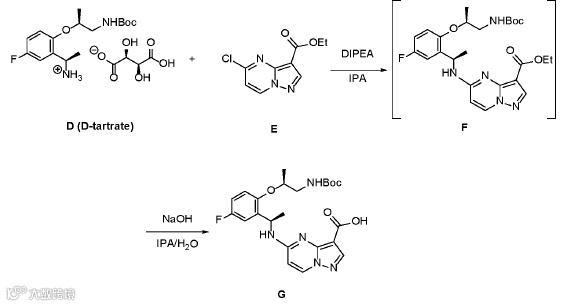
To a reactor containing compound (D) (D-tartrate) (LR; 250 g) was added isopropanol (IPA; 4.0 L/kg; 1000 mL; 786 g) [A range of 3.6-4.4 L/kg IPA can be charged]. To the resulting slurry was added 5 wt% aqueous NaOH (1.6 equiv.; 657 mL; 692 g) [A range of 2.37-2.89 L/kg 5 wt% NaOH can be charged]. The resultant solution was stirred for 30 minutes at a temperature range of 10-35 °C, over which time it became a slurry. N,N-Diisopropylethylamine (DIPEA; 2.5 equiv.; 236 mL; 175 g) was added [a range of 2.25-2.75 equiv DIPEA can be charged], followed by IPA (0.25 L/kg; 62.5 mL; 49.1 g) as a rinse. Compound (E) (1.10 equiv.; 134.2 g) [a range of 1.03-1.21 equiv E can be charged] was then added, and IPA (0.75 L/kg; 188 mL; 147 g) was again added as a rinse. The subsequent slurry was warmed to 70 °C for 12 hours (a range of 60-79 °C, with longer reaction times needed for lower temperature). The reaction was cooled to 40 °C and sampled for conversion to compound (F) as judged by UPLC. Compound (F) was then directly transformed without isolation. To the reaction was added 25 wt% aqueous NaOH (10.0 equiv.; 679 mL; 865 g) [a range of 2.43-2.97 L/kg of 25 wt% aqueous NaOHcan be charged] and the biphasic solution was then warmed to 70 °C for 12 hours (a range of 65-79 °C, with longer reaction times needed for lower temperature). After cooling to 40 °C and sampling for conversion to Compound (G) as judged by UPLC, 2-methyltetrahydrofuran (2-MeTHF; 5.0 L/kg; 1250 mL; 1070 g) [a range of 4.5-5.5 L/kg 2-MeTHF can be charged) and water (4.0 L/kg; 1000 mL; 1000 g) [a range of 3.6-4.4 L/kg water can be charged] were added, and the aqueous layer discarded. The organic phase was then iteratively washed with 20 wt% aqueous NaCl (7.0 L/kg; 1750 mL; 2010 g) [a range of 6.3-7.7 L/kg can be charged] followed by 20 wt% aqueous citric acid (3.0 L/kg; 750 mL; 814 g) [a range of 2.7-3.3 L/kg 20 wt% aqueous citric acid can be charged]. Toluene (10.0 L/kg; 2500 mL; 2180 g) [a range of 9-11 L/kg toluene can be charged] and water (1.0 L/kg; 250 mL; 250 g) [a range of 0.9-1.1 L/kg water can be charged] were then added, and the biphasic mixture was stirred for 30 minutes. After discarding the aqueous layer, the solution was distilled under reduced pressure (100-300 mBar) to a residual volume of 5.95-8.05 L/kg (end point: 1750 mL). At 50 °C (range of 45-60 °C), the solution was then seeded with 1.0 wt% (a range of 0.25 – 2.15 wt% seeds can be charged) compound (G). Following the addition of toluene (8 L/kg; 2000 mL; 1740 mL) [a range of 7.2-8.8 L/kg can be charged], cooling, and aging overnight, the slurry was filtered and washed twice with toluene (3 L/kg; 750 mL; 653 g) [a total of 2-12 L/kg toluene can be charged] to afford (G) (as a toluene solvate) (248 g, 91% potency, 9% toluene; 87% adjusted yield) as a white powder. ¹H NMR (DMSO-d₆) δ 11.50 (br s, 1H), 8.56 (d, 1H), 8.31 (d, 1H), 8.11 (s, 1H), 7.24 (m, 1H), 7.16 (m, 1H), 7.16 (toluene, m, 1H) 7.02 (toluene; m, 4H), 6.80 (m, 1H), 6.46 (d, 1H), 5.69 (m, 1H), 4.46 (m, 1H), 3.5-3.2 (m, 2H), 3.1 (m, 1H), 2.30 (toluene, s, 3H), 1.53-1.14 (m, 15H)
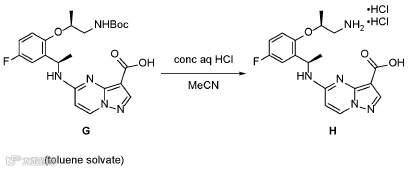
Compound (G) (10.0 g, 1 equiv, 21.1 mmol), acetonitrile (50.0 mL) [a range of 4 - 6 L/kg acetonitrile can be charged], and water (10.0 mL) [a range of 0.70 - 1.00 L/kg can be charged] were added in sequence to a 100 mL Chemglass reactor at 20 °C. The resulting mixture was cooled to 15 °C (range of 5 - 35 °C), and then aqueous hydrochloric acid (36 - 37 wt% solution, 13.0 mL, 7.40 equiv, 156 mmol) [a range of 6 - 8 equiv 33 wt% HCl can be charged] was slowly added over 30 min. When the addition of HCl aq. was complete, compound (H) (50 mg, 0.005 equiv, 108 μmol) [a range of 0.75 - 1.25 wt% seeds can be charged] was added, and the resulting mixture was warmed to 20 °C (range of 12 - 35 °C, with longer reaction times needed for lower temperature) and aged for 18 h at 20 °C. When the reaction was complete by HPLC analysis, acetonitrile (70 mL) [a range of 6 - 8 L/kg acetonitrile can be charged] was added in one portion to the product mixture. The resulting mixture was allowed to age for no less than 2 h at 20 °C. When the aging process was complete, the solids were collected by vacuum filtration and then washed with acetonitrile (50.0 mL) [a total range of 3 - 9 L/kg acetonitrile can be charged]. The collected solids were then dried under reduced pressure and at 50 °C for 18 h to afford compound (H) as a white solid (8.3 g, 17.9, 85%). ¹H NMR (400 MHz, trifluoroacetic acid - d) δ 9.27 - 8.89 (m, 1H), 8.77 - 8.32 (m, 1H), 7.86 - 6.77 (m, 7H), 5.99 - 5.54 (m, 1H), 5.30 - 5.05 (m, 1H), 3.78 (s, 2H), 2.10 - 1.79 (m, 3H), 1.66 - 1.34 (m, 3H). *some of the proton signals from N - H/OH based functional groups could not be visualized.
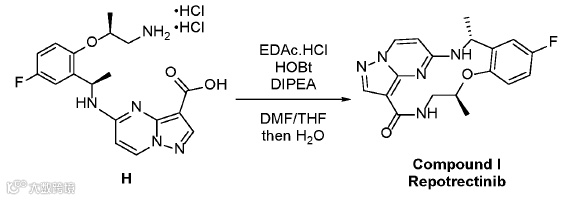
1-Ethyl-3-(3-dimethylaminopropyl)carbodiimide hydrochloride (5.16 g, 26.9 mmol, 1.25 equiv) [a range of 1.1 - 1.4 equiv 1-ethyl-3-(3-dimethylaminopropyl)carbodiimide hydrochloride can be charged] and 1-hydroxybenzotriazole (20% wet) (1.09 g, 6.5 mmol, 0.30 equiv) [a range of 0.24 - 0.36 equiv HOBt can be charged with a range of 12 - 20 wt% water content] were added to a solution of tetrahydrofuran (25 mL, 2.5 L/kg) [a range of 2 - 3 L/kg THF can be charged] plus N,N-dimethylformamide (25 mL, 2.5 L/kg) [a range of 2 - 3 L/kg DMF can be charged]. The resultant slurry was cooled to -5 °C, and N,N-diisopropylethylamine (8.5 mL, 48.4 mmol, 2.25 equiv) [a range of 2.02 - 2.48 equiv DIPEA can be charged] was added, followed by compound (H) (10.0 g, 21.5 mmol, limiting reagent). The resultant mixture was aged for 24 h at an internal temperature of 3 °C (range of -10 to 30 °C, with longer reaction times needed as lower temperature). (Optionally, 25 wt% aq NH₄OH (0.6 equiv) can be charged as a quench followed by 1 h age (not charged in this procedure.)) Next, water (60 mL, 6 L/kg) [a range 5.4 - 6.6 L/kg water can be charged] was added, and the resultant solution was heated to 35 °C (range of 27 - 42 °C). Seeds of the compound of Formula (I) (100 mg, 0.01 g/g) [a range of 0.25 - 1.75 wt% seeds can be charged] were added followed by a 2 h age. Slowly water (80 mL, 8 L/kg) [a range of 7 - 9 L/kg water can be charged] was charged additionally over the course of 2 h, followed by 2 h of additional age at 35 °C. The slurry was cooled to 20 °C over the course of 2 h, aged for 16 h more, then filtered. The filter cake was washed with 3:1 water:tetrahydrofuran (40 mL, 4 L/kg) [a range of 3.2 - 4.8 L/kg 3:1 water:tetrahydrofuran can be charged], then water (40 mL, 4 L/kg) [a range of 3.2 - 4.8 L/kg water can be charged], then water (40 mL, 4 L/kg) [a range of 3.2 - 4.8 L/kg water can be charged]. Vacuum oven drying (24 h at 65 °C and 200 mbar with a slow nitrogen purge) afforded the compound of Formula (I) (6.85 g, 89.5% yield) as a white crystalline solid. ¹H NMR (400 MHz, DMSO-d₆) 9.84 (dd, 1 H, J = 1.6, 8.0 Hz), 8.82 (d, 1 H, J = 6.8 Hz), 8.58 (d, 1 H, J = 7.6 Hz), 8.06 (s, 1 H), 7.15 (dd, 1 H, J = 3.2, 9.6 Hz), 7.05 - 6.94 (m, 2 H), 6.37 (d, 1 H, J = 7.6 Hz), 5.56 (m, 1 H), 4.50 (m, 1 H), 3.93 (ddd, 1 H, J = 6.6, 8.0, 12.3 Hz), 3.16 (ddd, 1 H, J = 2.0, 8.4, 13.6 Hz), 1.48 (d, 3 H, J = 6.0 Hz), 1.47 (d, 3 H, J = 7.2 Hz).