

PS, EPS and ABS: Prices Fluctuate at Lows amid Cost Support and Insufficient Fundamentals Improvements
Since early September, both the styrene and the downstream markets have shown a low and narrow-range fluctuation trend. The supply and demand improvement has been sluggish, transactions have remained rigid, and there is a lack of bulk procurement. In the short term, amid expectations of continued destocking, there is potential for a slight uptrend in the price of feedstock styrene, though the upside may be limited. The cost-based support for the downstream PS, EPS and ABS markets still exists. However, with insufficient improvement in end orders, downstream sectors continue to purchase on a need-to basis, while the overall supply remains loose. The market may struggle to gain upward momentum.
With cost support, PS, EPS and ABS prices remain stagnant at low levels.
Since early September, the domestic styrene market has shown a slight fluctuation trend. Continuous destocking at main ports has provided support for prices, while new capacity releases in northern China have increased supply. The price spread between Shandong and Jiangsu has gradually widened, opening arbitrage opportunities. Some low-priced Shandong goods have flowed into the East China market, dragging down port prices. As of September 11, the closing price of styrene in Jiangsu was RMB 7,130/mt, with a weekly average price of RMB 7,117/mt, up 0.86% MOM. The cost side still lacked unilateral guidance, but bottom support remained. The downstream PS, EPS and ABS markets showed a trend of narrow fluctuations at low levels, and the decline in the ABS market has also narrowed. However, buying sentiment remained insufficient, making it difficult to break the deadlock in market transactions.
Operating rates of PS, EPS and ABS industries see moderate increases.
This week, the weekly operating rates of the PS, EPS and ABS industries showed a slight upward trend. Despite shrinking profits, theoretical margins still existed, motivating PS and EPS producers to maintain operations. With some previously reduced or briefly shut-down units resuming operations and achieving stable output, the overall operating rate in the EPS industry has increased. In the PS sector, a few production lines ran at higher operating rates, pushing the industry’s overall operating rate to a medium-high level for the year. The ABS industry also saw a slight increase in its operating rate, supported by the restart of some production lines after maintenance. However, compared to the annual average, the ABS industry operating rate remained at a medium-low level for the year.
Costs edge higher, so the profits in PS, EPS and ABS industries decline.
Although new capacity in northern China has been released, with some low-priced resources flowing into East China, exerting downward pressure on the market, continuous destocking at main ports in East China has provided support. The weekly average price of styrene fluctuated with a slight increase, leading to a modest rise in the cost of PS, EPS and ABS prices. However, amid higher operating rates, spot resources have become relatively abundant. Holders were actively selling, but downstream demand in the traditional peak production season remained characterized by on-demand purchasing. The industry’s supply-demand structure has shown insufficient improvement, and market transactions have been constrained. While PS and EPS markets partially followed the upward trend of upstream prices, the increases were limited, resulting in shrinking industry profits. Due to weak buying sentiment, ABS producers have not yet raised prices in line with the feedstock market, leading to a further deterioration in industry losses.
PS, EPS and ABS Industries Profits (as of September 11)
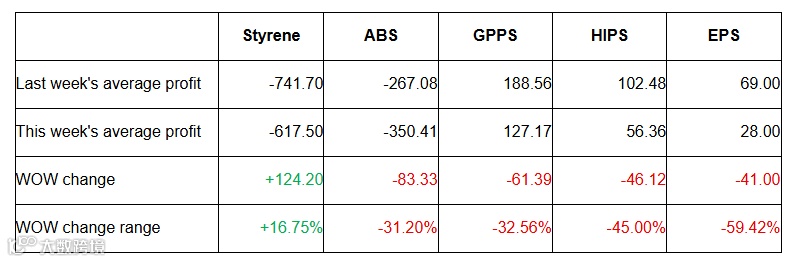
In the short term, domestic prices of PS, EPS, and ABS are expected to continue fluctuating within a narrow range at low levels. Although cost-side support persists, unilateral upward momentum remains limited. The supply-demand structure shows no significant improvement, and the market lacks transactional momentum to bolster confidence.
The supply-demand structure may see limited fluctuations in the styrene market. The styrene prices are expected to fluctuate with a slightly upward trend, but the support to the downstream market may be limited.
On the supply side, ABS sector losses are projected to deepen next week, although operating rates are anticipated to hold relatively steady. Profitability in the PS and EPS industries, while narrowed, continues to be supported by retained theoretical margins. Selected production lines may see slight fluctuations in operating rates, yet no significant change in overall output is expected. YOY comparisons show ABS supply standing at a historical high, and domestic PS supply also remains at a medium-to-high level for the period. In general, spot availability of PS, EPS, and ABS remains sufficient.
In summary, despite ongoing cost-side support, limited improvement in downstream operating rates and cautious procurement practices are curbing meaningful transaction volume. Over the short term, the PS, EPS, and ABS markets are likely to continue fluctuating narrowly near current low levels. As the National Day holiday approaches, market attention will focus on potential demand for inventory-building. A temporary moderate rise in styrene prices could prompt slight upward adjustments in PS, EPS, and ABS prices.
All information provided by SCI is for reference only, which shall not be reproduced without permission.
Please click "Read more" for the full article.