


2025年开棣(CATTI)杯全国翻译大赛是由中国外文局CATTI项目管理中心主办的高规格翻译赛事,权威性强、行业认可度高。初赛采用客观题形式,60分钟内完成50道题,全面考查语法、词汇、翻译能力和职业素养。题型分为单项选择、完形填空和阅读理解三大模块,强调语言基本功与实战应用能力。赛事禁止使用词典和工具书,对考生的综合语言能力与应试节奏掌控提出了极高要求。开棣杯初赛不是比谁“懂最多”,而是比谁“做得最快、最稳”。我们将推出“破局上岸”系列备赛资料,涵盖题型精讲、高频考点、时间管理与模拟训练,助力你系统备考、高效冲刺、成功晋级!
资料整理不易,感谢关注与推荐,期待点赞与在看
关注公众号获取更多学习资料
回复关键字CATTI杯
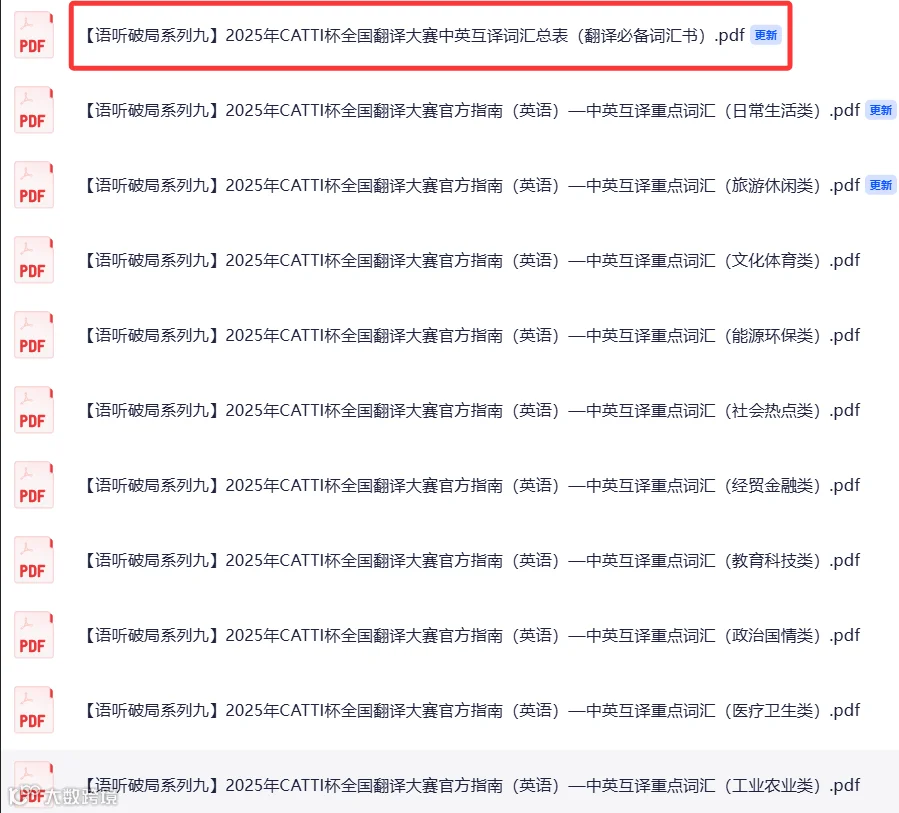
资料包文末直接查阅全部!全部PDF均免费下载!
翻译必备词汇书
2025年(CATTI)杯全国翻译大赛
(官方)
词汇中英互译重点词汇
逐词笔记
本套词汇精选了目前热门核心得中英互译的重点词汇2400左右。全部的词汇我们逐词都做了翻译解析方便大家更快的熟悉这批核心词汇。大家请文末随意获取PDF文档集。
重点来了!根据当前国际交流、政治经济、社会发展及文化传播等领域的核心议题,结合词汇的通用性、政策相关性和跨文化沟通中的高频出现概率,从这2000多词汇中精选出300个绝对翻译高频词汇。我们将围绕这批词汇做一些强化的周边练习,请注意其他文章或者文末获取文档。
遴选标准:
政策核心: 优先选择与中国国家战略、大政方针紧密相关的词汇。
时代热点: 涵盖数字经济、公共卫生、气候变化、科技创新等全球焦点领域。
文化关键: 选取代表中国文化特色和核心概念的词汇。
经济基础: 包括宏观经济、贸易、金融等基础且高频的术语。
通用高频: 在日常新闻、报告和文件中反复出现的通用词汇。

 300个绝对翻译高频词汇
(单项选择)强化题附答案
1. The concept of “______” emphasizes development that is efficient, equitable, and environmentally sustainable.
A. High-quality development
B. Trade surplus
C. Shadow banking
D. Off-campus tutoring
2. China’s “______” aims to ensure that the benefits of economic growth are shared by all citizens.
A. Fiscal policy
B. Carbon neutrality
C. Common prosperity
D. Double reduction
3. The “______” includes innovation, coordination, green development, openness, and shared growth.
A. Rural revitalization strategy
B. New development philosophy
C. Belt and Road Initiative
D. Dual circulation
4. “______” refers to a modernization path that suits China’s national conditions and differs from Western models.
A. Law-based governance in China
B. Digital China
C. Military-civilian integration
D. Chinese modernization
5. The practice of “______” ensures that the people participate in democratic processes at every stage.
A. Whole-process people's democracy
B. Social governance
C. Legal awareness education
D. Dynamic zero-COVID
6. The national strategy to boost rural economies and improve living standards in the countryside is called ______.
A. Northeast China revitalization
B. New-type urbanization
C. Rural revitalization strategy
D. Western development
7. “______” are the moral and ethical principles promoted by the state, including prosperity, democracy, and civility.
A. Revolutionary culture
B. Core socialist values
C. Cultural confidence
D. Ethical role model
8. China advocates building a “______” to promote global cooperation and shared responsibility.
A. Multilateralism
B. Win-win cooperation
C. Global governance
D. Community with a shared future for mankind
9. The “______” seeks to enhance connectivity and economic cooperation across Asia, Europe, and Africa.
A. Belt and Road Initiative
B. Shanghai Cooperation Organization
C. Forum on China-Africa Cooperation
D. Regional Comprehensive Economic Partnership
10. China’s “______” strategy focuses on expanding both domestic and international markets.
A. Supply-side structural reform
B. Dual circulation
C. Platform economy
D. Unified national market
11. Reaching “______” means a country’s CO₂ emissions stop rising and begin to decline.
A. Energy conservation
B. Green manufacturing
C. Carbon peak
D. Carbon neutrality
12. Achieving “______” requires balancing emissions with removals, often through carbon sinks or offsets.
A. Carbon peak
B. Low-carbon economy
C. Emission trading
D. Carbon neutrality
13. The “______” collectively refer to China’s goals of peaking carbon emissions before 2030 and achieving neutrality by 2060.
A. “Dual carbon” goals
B. Green finance targets
C. Ecological red lines
D. Energy intensity controls
14. The establishment of a “______” aims to eliminate local protectionism and create a level playing field nationwide.
A. Capital market
B. Business environment
C. Unified national market
D. STAR Market
15. “______” focuses on improving the quality and efficiency of supply rather than just boosting demand.
A. Trade deficit
B. Supply-side structural reform
C. Monetary policy
D. Fiscal stimulus
16. “______” was a targeted approach that successfully lifted millions out of poverty by tailoring aid to local needs.
A. Social security
B. Government-subsidized housing
C. Dynamic zero-COVID
D. Targeted poverty alleviation
17. During the pandemic, China adopted a “______” policy to quickly contain outbreaks.
A. Dynamic zero-COVID
B. Public health emergency
C. Tiered medical care
D. Regular epidemic prevention and control
18. The “______” policy aims to reduce students’ homework load and limit after-school tutoring.
A. Compulsory education
B. Well-rounded education
C. Double reduction
D. Three-child policy
19. To address demographic challenges, China introduced the “______” to encourage higher birth rates.
A. Maternity insurance
B. Three-child policy
C. Population aging
D. Elderly care service
20. “______” encompasses political, economic, military, and cyber dimensions to protect the nation’s sovereignty.
A. Social governance
B. Public order
C. Workplace safety
D. National security
21. “______” stresses harmony between humans and nature, integrating environmental protection into development.
A. Ecological civilization
B. Green development
C. Beautiful China
D. All of the above
22. Confidence in one’s own cultural heritage and values is known as ______.
A. Intangible cultural heritage
B. Media convergence
C. Cultural confidence
D. Cultural industry
23. “______” promotes collaboration between defense and civilian sectors to boost innovation.
A. Hard tech
B. Military-civilian integration
C. Industrial internet
D. Innovation-driven development
24. “______” refers to urbanization that is people-centered, green, and smart.
A. Urban renewal
B. Functional zones
C. Eastern region pioneering development
D. New-type urbanization
25. Modernizing agriculture through technology and sustainable practices is called ______.
A. Agricultural modernization
B. Rural tourism
C. Food safety
D. Land reform
26. The goal of making China a global leader in manufacturing is expressed as ______.
A. Cyber powerhouse
B. Maritime powerhouse
C. Manufacturing powerhouse
D. Quality powerhouse
27. Emphasizing excellence in products and services aligns with the vision of a ______.
A. Healthy China
B. Quality powerhouse
C. Safe China
D. Digital China
28. Building strong digital infrastructure and cybersecurity capabilities supports the goal of a ______.
A. Sci-Tech SME
B. Platform economy
C. Innovation hub
D. Network powerhouse
29. “______” aims to integrate digital technologies into all areas of society and governance.
A. Digital China
B. Cloud computing
C. Big data
D. Internet finance
30. The national strategy to improve public health and promote healthy lifestyles is ______.
A. Medical insurance
B. Family doctor system
C. Healthy China
D. Public health campaign
31. “______” envisions a country with clean air, water, and landscapes.
A. Ecological conservation
B. Beautiful China
C. Green China
D. Pure Land defense campaign
32. Ensuring social stability and public safety is central to the initiative of ______.
A. Community governance
B. Crack down on organized crime
C. Public order
D. Safe China
33. Advancing the rule of law in all aspects of governance reflects the principle of ______.
A. Law-based governance in China
B. Fight corruption
C. Judicial justice
D. Legal awareness
34. The “______” prioritizes scientific and technological advancement as the core driver of growth.
A. Independent innovation
B. R&D investment
C. Innovation-driven development strategy
D. Talent powerhouse strategy
35. Attracting and cultivating top talent to strengthen national competitiveness is the aim of the ______.
A. Young scientist program
B. Talent powerhouse strategy
C. Double World-Class Project
D. Venture capital support
36. Prioritizing job creation in policymaking reflects China’s ______.
A. SME support
B. Social security expansion
C. Market entities protection
D. Employment-first policy
37. Promoting balanced growth across regions is known as ______.
A. Coordinated regional development
B. Yangtze River Delta integration
C. Beijing-Tianjin-Hebei synergy
D. Western development
38. The “______” divides the country into zones based on ecological and economic functions.
A. National park system
B. Ecological red line
C. Functional zones
D. Territorial space planning
39. The development strategy linking Beijing, Tianjin, and Hebei is called ______.
A. Greater Bay Area
B. Beijing-Tianjin-Hebei coordinated development
C. Chengdu-Chongqing economic zone
D. Central China rise
40. Protecting the Yangtze River while fostering economic growth is the goal of ______.
A. Green manufacturing
B. Ecological civilization
C. Yellow River Basin development
D. Yangtze River Economic Belt development
41. The “______” aims to create a world-class bay area integrating Guangdong, Hong Kong, and Macao.
A. Guangdong-Hong Kong-Macao Greater Bay Area development
B. Maritime powerhouse
C. International communication
D. All-for-one tourism
42. Deepening integration among Shanghai, Jiangsu, Zhejiang, and Anhui is part of ______.
A. New-type urbanization
B. Eastern region pioneering development
C. Yangtze River Delta integration
D. Digital China
43. The initiative focusing on ecological protection and high-quality growth along China’s “mother river” is ______.
A. Blue Sky defense campaign
B. Ecological protection and high-quality development of the Yellow River Basin
C. Rocky desertification control
D. Forest coverage enhancement
44. The economic zone centered on Chengdu and Chongqing is known as the ______.
A. Northeast revitalization hub
B. Central China rise engine
C. Western development core
D. Chengdu-Chongqing economic zone
45. Reviving the industrial base in China’s northeast is called ______.
A. Northeast China revitalization
B. State-owned enterprise reform
C. Old industrial transformation
D. Urban renewal
46. The long-term strategy to develop western China’s infrastructure and economy is ______.
A. Rural revitalization
B. Poverty alleviation
C. Western development
D. Belt and Road
47. Boosting the central region’s role as a transportation and manufacturing hub reflects ______.
A. Central China rise
B. Dual circulation
C. Functional zoning
D. Eastern pioneering
48. The eastern region is expected to lead in reform and opening-up under the policy of ______.
A. Free trade ports
B. Coastal economic belt
C. Innovation pilot zones
D. Eastern region pioneering development
49. Which of the following is NOT part of China’s regional development strategies?
A. Arctic shipping route development
B. Greater Bay Area construction
C. Yangtze River Delta integration
D. Yellow River Basin protection
50. The term “______” is used to describe companies that are highly specialized and dominate niche global markets.
A. Venture capital firms
B. Platform economy
C. Hidden champions
D. Shadow banking
答案:
1.A 2.C 3.B 4.D 5.A 6.C 7.B 8.D 9.A 10.B 11.C 12.D 13.A 14.C 15.B 16.D 17.A 18.C 19.B 20.D 21.A 22.C 23.B 24.D 25.A 26.C 27.B 28.D 29.A 30.C 31.B 32.D 33.A 34.C 35.B 36.D 37.A 38.C 39.B 40.D 41.A 42.C 43.B 44.D 45.A 46.C 47.B 48.D 49.A 50.C
2025年开棣(CATTI)杯
全国翻译大赛初赛题型拆解
一、题型结构拆解
🔍 核心认知:你面对的是什么?
|
|
|
|
|
|
|---|---|---|---|---|
|
|
|
|
|
72秒/题 |
|
|
|
|
|
72秒/空 |
|
|
|
|
|
72秒/题 |
✅ 关键洞察:
每道题平均只有72秒,必须快、准、狠。 不是“慢慢做”,而是“聪明地做”。
二、每题平均耗时分配策略
⏱️ 理想时间分配表(总60分钟 = 3600秒)
|
|
|
|
|
|---|---|---|---|
|
|
|
|
|
|
|
|
|
|
|
|
|
|
|
✅ 原则:不恋战、不纠结、先易后难
📌 各题型时间细化建议
|
|
|
|
|
|
|---|---|---|---|---|
|
|
|
|
|
|
|
|
|
|
|
|
|
|
|
|
|
|
三、先做哪类题?—— 顺序优化策略
❓ 问题:是否必须按顺序做?
答案:不必!推荐顺序:单项选择 → 阅读理解 → 完形填空
✅ 推荐做题顺序及理由:
|
|
|
|
|---|---|---|
| 1 |
|
|
| 2 |
|
|
| 3 |
|
|
💡 反例警示:若先做完形填空,可能因一篇卡住而浪费10分钟,打乱整体节奏。



资料整理不易,感谢关注与推荐,期待点赞与在看
关注公众号获取更多学习资料
回复关键字CATTI杯
请点击阅读原文下载
为大家准备了文章中涉及的PDF