

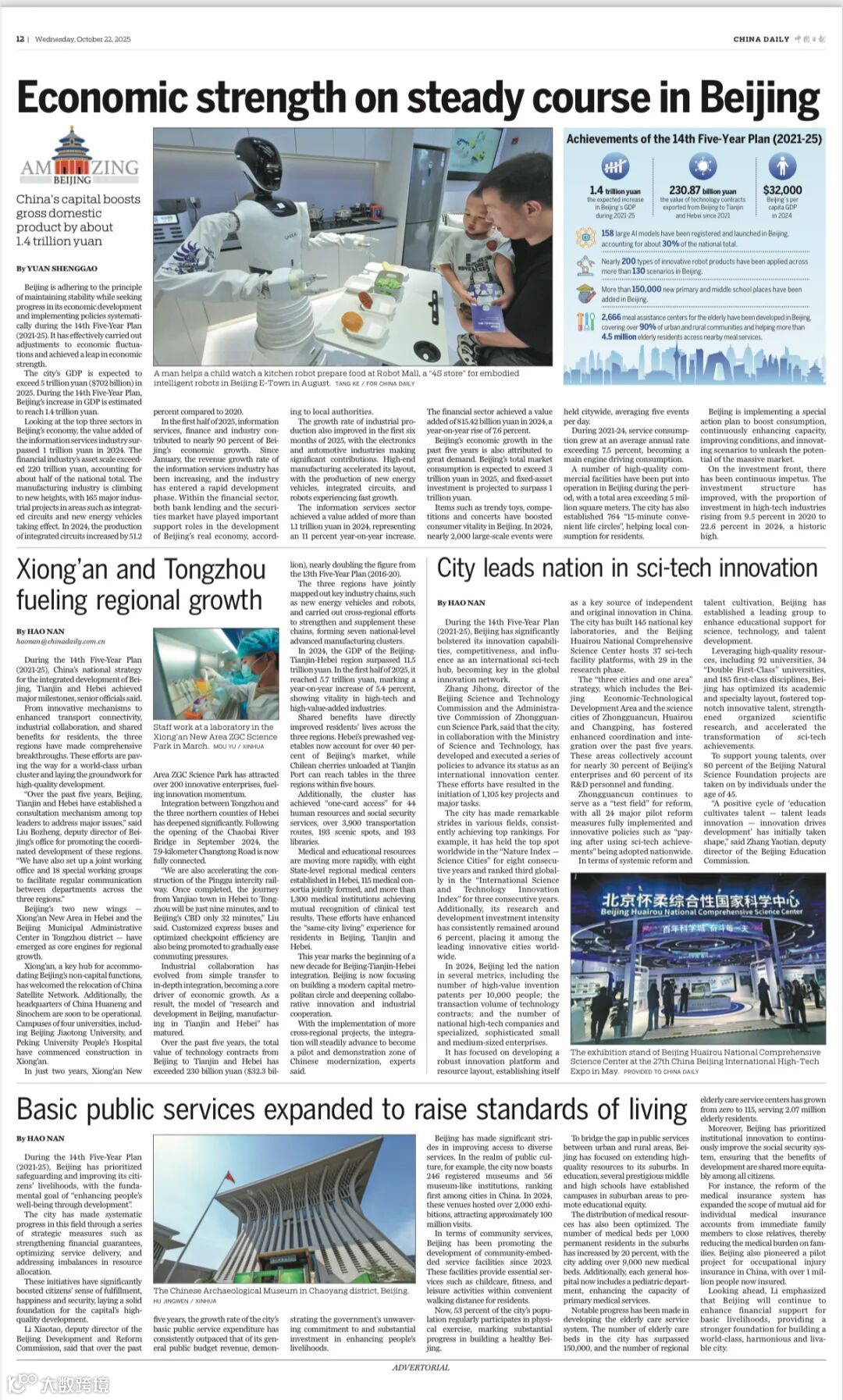
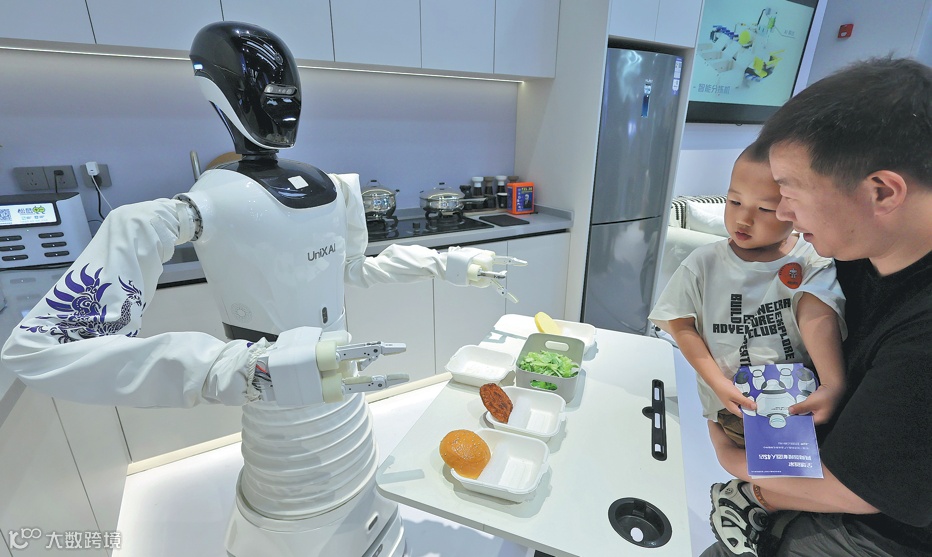
A man helps a child watch a kitchen robot prepare food at Robot Mall, a "4S store" for embodied intelligent robots in Beijing E-Town in August. TANG KE/FOR CHINA DAILY
Economic strength on steady course in Beijing
China's capital boosts gross domestic product by about 1.4 trillion yuan
Beijing is adhering to the principle of maintaining stability while seeking progress in its economic development and implementing policies systematically during the 14th Five-Year Plan (2021-25). It has effectively carried out adjustments to economic fluctuations and achieved a leap in economic strength.
The city's GDP is expected to exceed 5 trillion yuan ($702 billion) in 2025. During the 14th Five-Year Plan, Beijing's increase in GDP is estimated to reach 1.4 trillion yuan.
Looking at the top three sectors in Beijing's economy, the value added of the information services industry surpassed 1 trillion yuan in 2024. The financial industry's asset scale exceeded 220 trillion yuan, accounting for about half of the national total. The manufacturing industry is climbing to new heights, with 165 major industrial projects in areas such as integrated circuits and new energy vehicles taking effect. In 2024, the production of integrated circuits increased by 51.2 percent compared to 2020.
In the first half of 2025, information services, finance and industry contributed to nearly 90 percent of Beijing's economic growth. Since January, the revenue growth rate of the information services industry has been increasing, and the industry has entered a rapid development phase. Within the financial sector, both bank lending and the securities market have played important support roles in the development of Beijing's real economy, according to local authorities.
The growth rate of industrial production also improved in the first six months of 2025, with the electronics and automotive industries making significant contributions. High-end manufacturing accelerated its layout, with the production of new energy vehicles, integrated circuits, and robots experiencing fast growth.
The information services sector achieved a value added of more than 1.1 trillion yuan in 2024, representing an 11 percent year-on-year increase. The financial sector achieved a value added of 815.42 billion yuan in 2024, a year-on-year rise of 7.6 percent.
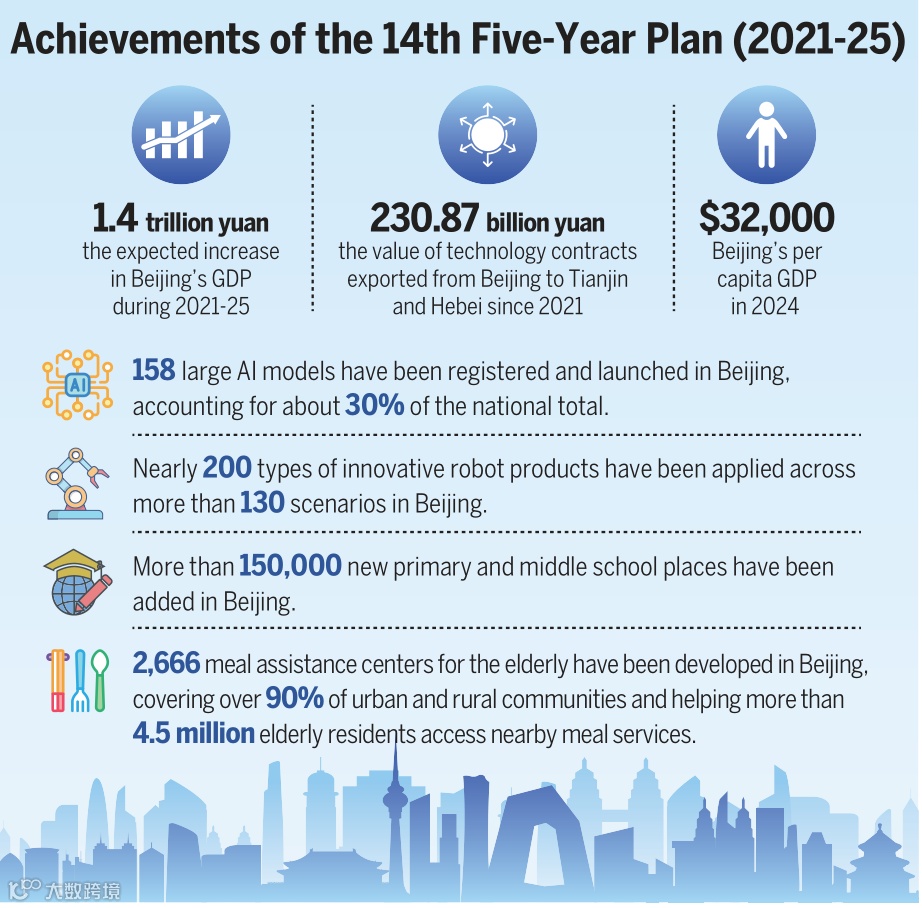
Achievements of the 14th Five-Year Plan (2021-25)
Beijing's economic growth in the past five years is also attributed to great demand. Beijing's total market consumption is expected to exceed 3 trillion yuan in 2025, and fixed-asset investment is projected to surpass 1 trillion yuan.
Items such as trendy toys, competitions and concerts have boosted consumer vitality in Beijing. In 2024, nearly 2,000 large-scale events were held citywide, averaging five events per day.
During 2021-24, service consumption grew at an average annual rate exceeding 7.5 percent, becoming a main engine driving consumption.
A number of high-quality commercial facilities have been put into operation in Beijing during the period, with a total area exceeding 5 million square meters. The city has also established 764 "15-minute convenient life circles", helping local consumption for residents.
Beijing is implementing a special action plan to boost consumption, continuously enhancing capacity, improving conditions, and innovating scenarios to unleash the potential of the massive market.
On the investment front, there has been continuous impetus. The investment structure has improved, with the proportion of investment in high-tech industries rising from 9.5 percent in 2020 to 22.6 percent in 2024, a historic high.
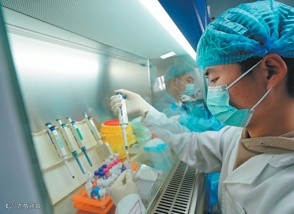
Staff work at a laboratory in the Xiong'an New Area ZGC Science Park in March. MOU YU/XINHUA
Xiong'an and Tongzhou fueling regional growth
During the 14th Five-Year Plan (2021-25), China's national strategy for the integrated development of Beijing, Tianjin and Hebei achieved major milestones, senior officials said.
From innovative mechanisms to enhanced transport connectivity, industrial collaboration, and shared benefits for residents, the three regions have made comprehensive breakthroughs. These efforts are paving the way for a world-class urban cluster and laying the groundwork for high-quality development.
"Over the past five years, Beijing, Tianjin and Hebei have established a consultation mechanism among top leaders to address major issues," said Liu Bozheng, deputy director of Beijing's office for promoting the coordinated development of these regions. "We have also set up a joint working office and 18 special working groups to facilitate regular communication between departments across the three regions."
Beijing's two new wings — Xiong'an New Area in Hebei and the Beijing Municipal Administrative Center in Tongzhou district — have emerged as core engines for regional growth.
Xiong'an, a key hub for accommodating Beijing's non-capital functions, has welcomed the relocation of China Satellite Network. Additionally, the headquarters of China Huaneng and Sinochem are soon to be operational. Campuses of four universities, including Beijing Jiaotong University, and Peking University People's Hospital have commenced construction in Xiong'an.
In just two years, Xiong'an New Area ZGC Science Park has attracted over 200 innovative enterprises, fueling innovation momentum.
Integration between Tongzhou and the three northern counties of Hebei has deepened significantly. Following the opening of the Chaobai River Bridge in September 2024, the 7.9-kilometer Changtong Road is now fully connected.
"We are also accelerating the construction of the Pinggu intercity railway. Once completed, the journey from Yanjiao town in Hebei to Tongzhou will be just nine minutes, and to Beijing's CBD only 32 minutes," Liu said. Customized express buses and optimized checkpoint efficiency are also being promoted to gradually ease commuting pressures.
Industrial collaboration has evolved from simple transfer to in-depth integration, becoming a core driver of economic growth. As a result, the model of "research and development in Beijing, manufacturing in Tianjin and Hebei" has matured.
Over the past five years, the total value of technology contracts from Beijing to Tianjin and Hebei has exceeded 230 billion yuan ($32.3 billion), nearly doubling the figure from the 13th Five-Year Plan (2016-20).
The three regions have jointly mapped out key industry chains, such as new energy vehicles and robots, and carried out cross-regional efforts to strengthen and supplement these chains, forming seven national-level advanced manufacturing clusters.
In 2024, the GDP of the Beijing-Tianjin-Hebei region surpassed 11.5 trillion yuan. In the first half of 2025, it reached 5.7 trillion yuan, marking a year-on-year increase of 5.4 percent, showing vitality in high-tech and high-value-added industries.
Shared benefits have directly improved residents' lives across the three regions. Hebei's prewashed vegetables now account for over 40 percent of Beijing's market, while Chilean cherries unloaded at Tianjin Port can reach tables in the three regions within five hours.
Additionally, the cluster has achieved "one-card access" for 44 human resources and social security services, over 3,900 transportation routes, 193 scenic spots, and 193 libraries.
Medical and educational resources are moving more rapidly, with eight State-level regional medical centers established in Hebei, 115 medical consortia jointly formed, and more than 1,300 medical institutions achieving mutual recognition of clinical test results. These efforts have enhanced the "same-city living" experience for residents in Beijing, Tianjin and Hebei.
This year marks the beginning of a new decade for Beijing-Tianjin-Hebei integration. Beijing is now focusing on building a modern capital metropolitan circle and deepening collaborative innovation and industrial cooperation.
With the implementation of more cross-regional projects, the integration will steadily advance to become a pilot and demonstration zone of Chinese modernization, experts said.
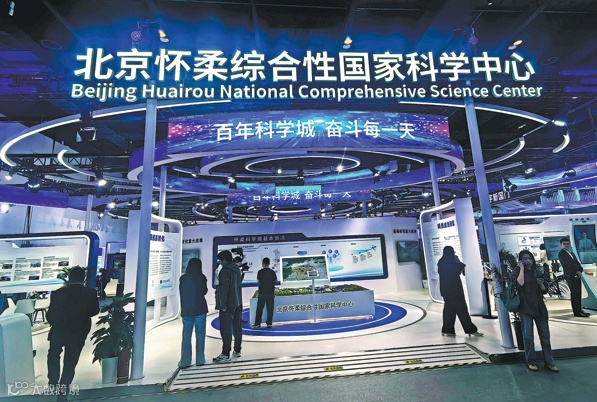
The exhibition stand of Beijing Huairou National Comprehensive Science Center at the 27th China Beijing International High-Tech Expo in May. CHINA DAILY
City leads nation in sci-tech innovation
During the 14th Five-Year Plan (2021-25), Beijing has significantly bolstered its innovation capabilities, competitiveness, and influence as an international sci-tech hub, becoming key in the global innovation network.
Zhang Jihong, director of the Beijing Science and Technology Commission and the Administrative Commission of Zhongguancun Science Park, said that the city, in collaboration with the Ministry of Science and Technology, has developed and executed a series of policies to advance its status as an international innovation center. These efforts have resulted in the initiation of 1,105 key projects and major tasks.
The city has made remarkable strides in various fields, consistently achieving top rankings. For example, it has held the top spot worldwide in the "Nature Index — Science Cities" for eight consecutive years and ranked third globally in the "International Science and Technology Innovation Index" for three consecutive years. Additionally, its research and development investment intensity has consistently remained around 6 percent, placing it among the leading innovative cities worldwide.
In 2024, Beijing led the nation in several metrics, including the number of high-value invention patents per 10,000 people; the transaction volume of technology contracts; and the number of national high-tech companies and specialized, sophisticated small and medium-sized enterprises.
It has focused on developing a robust innovation platform and resource layout, establishing itself as a key source of independent and original innovation in China. The city has built 145 national key laboratories, and the Beijing Huairou National Comprehensive Science Center hosts 37 sci-tech facility platforms, with 29 in the research phase.
The "three cities and one area "strategy, which includes the Beijing Economic-Technological Development Area and the science cities of Zhongguancun, Huairou and Changping, has fostered enhanced coordination and integration over the past five years. These areas collectively account for nearly 30 percent of Beijing's enterprises and 60 percent of its R&D personnel and funding.
Zhongguancun continues to serve as a "test field" for reform, with all 24 major pilot reform measures fully implemented and innovative policies such as "paying after using sci-tech achievements" being adopted nationwide.
In terms of systemic reform and talent cultivation, Beijing has established a leading group to enhance educational support for science, technology, and talent development.
Leveraging high-quality resources, including 92 universities, 34"Double First-Class" universities, and 185 first-class disciplines, Beijing has optimized its academic and specialty layout, fostered topnotch innovative talent, strengthened organized scientific research, and accelerated the transformation of sci-tech achievements.
To support young talents, over 80 percent of the Beijing Natural Science Foundation projects are taken on by individuals under the age of 45.
"A positive cycle of 'education cultivates talent — talent leads innovation — innovation drives development' has initially taken shape," said Zhang Yaotian, deputy director of the Beijing Education Commission.
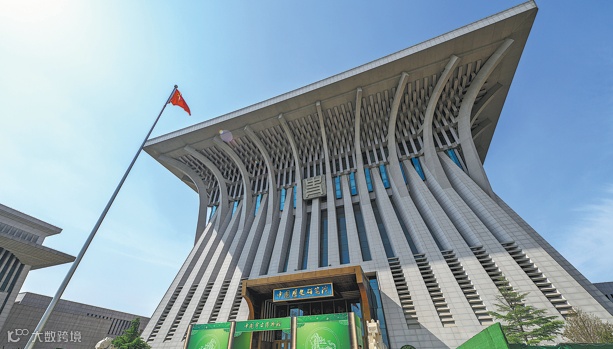
The Chinese Archaeological Museum in Chaoyang district, Beijing. HU JINGWEN/XINHUA
Basic public services expanded to raise standards of living
During the 14th Five-Year Plan (2021-25), Beijing has prioritized safeguarding and improving its citizens' livelihoods, with the fundamental goal of "enhancing people's well-being through development".
The city has made systematic progress in this field through a series of strategic measures such as strengthening financial guarantees, optimizing service delivery, and addressing imbalances in resource allocation.
These initiatives have significantly boosted citizens' sense of fulfillment, happiness and security, laying a solid foundation for the capital's high-quality development.
Li Xiaotao, deputy director of the Beijing Development and Reform Commission, said that over the past five years, the growth rate of the city's basic public service expenditure has consistently outpaced that of its general public budget revenue, demonstrating the government's unwavering commitment to and substantial investment in enhancing people's livelihoods.
Beijing has made significant strides in improving access to diverse services. In the realm of public culture, for example, the city now boasts 246 registered museums and 56 museum-like institutions, ranking first among cities in China. In 2024, these venues hosted over 2,000 exhibitions, attracting approximately 100 million visits.
In terms of community services, Beijing has been promoting the development of community-embedded service facilities since 2023.These facilities provide essential services such as childcare, fitness, and leisure activities within convenient walking distance for residents.
Now, 53 percent of the city's population regularly participates in physical exercise, marking substantial progress in building a healthy Beijing.
To bridge the gap in public services between urban and rural areas, Beijing has focused on extending high-quality resources to its suburbs. In education, several prestigious middle and high schools have established campuses in suburban areas to promote educational equity.
The distribution of medical resources has also been optimized. The number of medical beds per 1,000 permanent residents in the suburbs has increased by 20 percent, with the city adding over 9,000 new medical beds. Additionally, each general hospital now includes a pediatric department, enhancing the capacity of primary medical services.
Notable progress has been made in developing the elderly care service system. The number of elderly care beds in the city has surpassed 150,000, and the number of regional elderly care service centers has grown from zero to 115, serving 2.07 million elderly residents.
Moreover, Beijing has prioritized institutional innovation to continuously improve the social security system, ensuring that the benefits of development are shared more equitably among all citizens.
For instance, the reform of the medical insurance system has expanded the scope of mutual aid for individual medical insurance accounts from immediate family members to close relatives, thereby reducing the medical burden on families. Beijing also pioneered a pilot project for occupational injury insurance in China, with over 1 million people now insured.
Looking ahead, Li emphasized that Beijing will continue to enhance financial support for basic livelihoods, providing a stronger foundation for building a world-class, harmonious and livable city.