
Click the Text in Blue on the Top, Follow us!
Malaysia has introduced a Low Value Goods (“LVG”) Tax to ensure fairness in taxation between domestic and imported goods sold online. This tax aims to level the playing field for local businesses and strengthen the government’s revenue in the rapidly evolving e-commerce landscape.
This article provides an overview of the LVG Tax framework, its legislative basis, scope, applicable rates, and compliance requirements for businesses.
Legislative Background and Relationship with Import Duties
A. Legislative Background
The LVG Tax is grounded in the Sales Tax (Amendment) Act 2022 (referred to as “the Act”), governed under the Sales Tax Act 2018, and administered by the Royal Malaysian Customs Department (“RMCD”).
Three subsidiary legislations provide further clarity:
Sales Tax (Low Value Goods) Regulations 2022 [P.U.(A)408/2022] – sets out the detailed compliance and administrative requirements for LVG.
Sales Tax (Determination of Low Value Goods) Order 2023 [P.U.(A)403/2023]— defines what constitutes LVG.
Sales Tax (Rate of Tax for Low Value Goods) Order 2023 [P.U.(A)404/2023] — prescribes the applicable LVG Tax rate.
In addition, the official guide “Sales Tax on Low Value Goods (LVG)” (referred to as “the Guide”), published on 1 August 2024, consolidates the implementation details, clarifying effective dates, scope, and compliance obligations. Although the legislative framework commenced on 1 January 2023, the actual imposition of LVG Tax began on 1 January 2024.
B. Relationship with Import Duties and De Minimis Facility
Goods imported into Malaysia are subject to import duty, excise duty and sales tax on imports, depending on the Harmonized System Code (HS Code) of the items as listed in the Custom Duties Order 2022, Excise Duties Order 2022 and Sales Tax (Rates of Tax) Order 2022.
Malaysia provides a De minimis facility under which goods imported via air courier services (including postal services) with Cost, Insurance and Freight (CIF) value not exceeding RM500 per consignment, are exempted from import duty and sales tax on imports. This exemption is provided under the Custom Duties (Exemption) Order 2017 and the Sales Tax (Persons Exempted from Payment of Tax) Order 2018.
It is important to note that the LVG tax operates independently of the De Minimis facility. Even if goods qualify for exemption from import duty and sales tax on imports under the De Minimis threshold, LVG tax at 10% is still applies at the point of sale when the goods are purchased by consumers in Malaysia.
Scope of LVG Tax
Pursuant to Sales Tax (Determination of Low Value Goods) Order 2023, [P.U.(A)403/2023], LVG Tax applies to all tangible goods sold online and imported into Malaysia with a value of RM500 or below. The following items are specifically excluded as they remain subject to customs and excise duties:
Cigarettes and tobacco products
Intoxicating liquors
Smoking pipes (including pipe bowls)
Electronic cigarettes, vaping devices, and related liquids or gels (whether or not containing nicotine)
This scope ensures consistent treatment of low-value imports, regardless of the mode of entry, whether by land, sea or air, while protecting existing excise tax regimes.
Tax Rate
The LVG Tax is levied at a flat 10% rate, as stipulated in the Sales Tax (Rate of Tax for Low Value Goods) Order 2023 [P.U.(A)404/2023]. It is charged on the sale value of the goods, excluding delivery charges, insurance, customs duties or other costs.
For example:
A RM200 item with additional delivery charge of RM10, attracts RM20 in LVG Tax.
LVG tax will be charged based on the sale value per unit. Multiple items such as watch costing RM500 each will attract RM 50 for each unit.
For discounted items, price after discount is subject to LVG tax. Sneakers costing RM400 with a discount of RM50 will attract RM35 in LVG tax.
Vouchers will not be treated as discount and sales tax on LVG will be charged on the actual sale value.
This approach ensures clarity for both sellers and consumers when determining the final payable amount.
Registration and Compliance
A. Registration Requirement
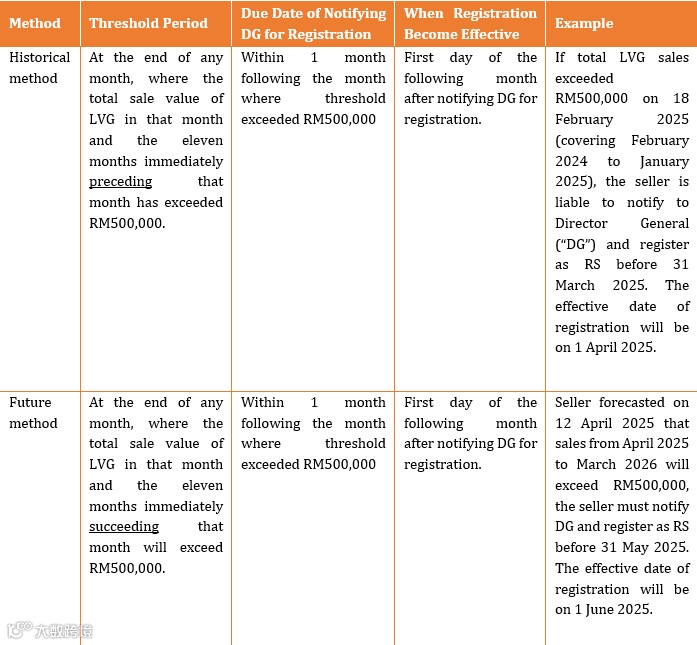
Any “seller” — whether in or outside Malaysia, who sells LVG on an online platform or operates an online marketplace for the sales and purchase of LVG — must register as a Registered Seller (“RS”) if the total value of sales exceeds RM500,000 in a 12-month period. The threshold can be measured using either the Historical Method (past 12 months) or Future Method (anticipated sales).
B. Registration Process
Registration is conducted online through the MyLVG System using LVG-01 form. Sellers may apply for registration starting 1 January 2023.
Once approved, the effective date of registration will be on the first day of the following month, after the month in which seller becomes liable to be registered.
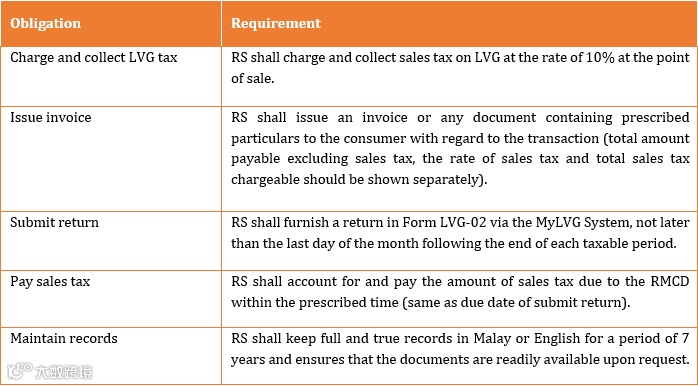
C. Obligations of Registered Sellers
A RS is required to comply with the following obligations:
D. Penalties and Reliefs
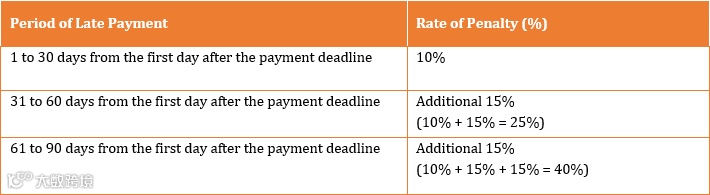
Under subsection 26(8) of the Act, penalty ranging between 10% - 40% will be imposed on the unpaid sales tax after the last day the tax is due and payable.
The penalty imposed is as below:
Additionally, RS who sells LVG may make a claim of refund under Section 39 of the Act, to the DG, if there is an error in the amount of sales tax payable under the following circumstances:
Has overpaid the amount due in the return; or
Erroneously paid; or
Entitled to the refund under subsection 41(3) of the Act – Remission of sales tax, etc.
Transitional Rules
The Guide clarifies that LVG purchased before 1 January 2024 are not subject to LVG Tax, even if the goods are delivered after this date. This transitional rule ensures the tax is not applied retrospectively and offers clarity for both businesses and consumers.
Conclusion
The Sales Tax on Low Value Goods regime, effective from 1 January 2024, represents Malaysia’s effort to modernise its tax framework in response to the growth of cross-border e-commerce. By taxing LVG at the point of sale, the government ensures fair treatment between local and overseas sellers while maintaining a sustainable revenue base.
For registered sellers, compliance requires timely registration, proper invoicing, and accurate filing of returns. With the publication of the Guide, businesses now have greater clarity to meet their obligations and avoid compliance risks.
KAIZEN Group, together with its associate firms in Malaysia, can help the clients to perform these compliances formalities so as to maintain the Malaysia company in good standing. Please call and talk to our professional accountants in Kaizen for further clarification.
Note
The original text of this article comes from the WeChat public account:
啓源KAIZEN


Kaizen CPA Limited
Wechat:kaizencpa
If you wish to obtain more information or assistance, please visit the official website of Kaizen CPA Limited at
www.kaizencpa.com
or contact us through the following and talk to our professionals:
Email:info@kaizencpa.com
Tel: +852 2341 1444
Mobile :+852 5616 4140
+86 152 1943 4614
WhatsApp/ Line/ WeChat:
+852 5616 4140
Skype: kaizencpa