



The statement of cash flows provides information that helps the reader in assessing the impact of operations on liquidity and assessing the relations among cash flows from operating,investing, and financing activities.
The statements of cash flows reports flows, or changes over time, whereas the balance sheet reports amounts at a moment in time.
Components of the Statement of Cash flows
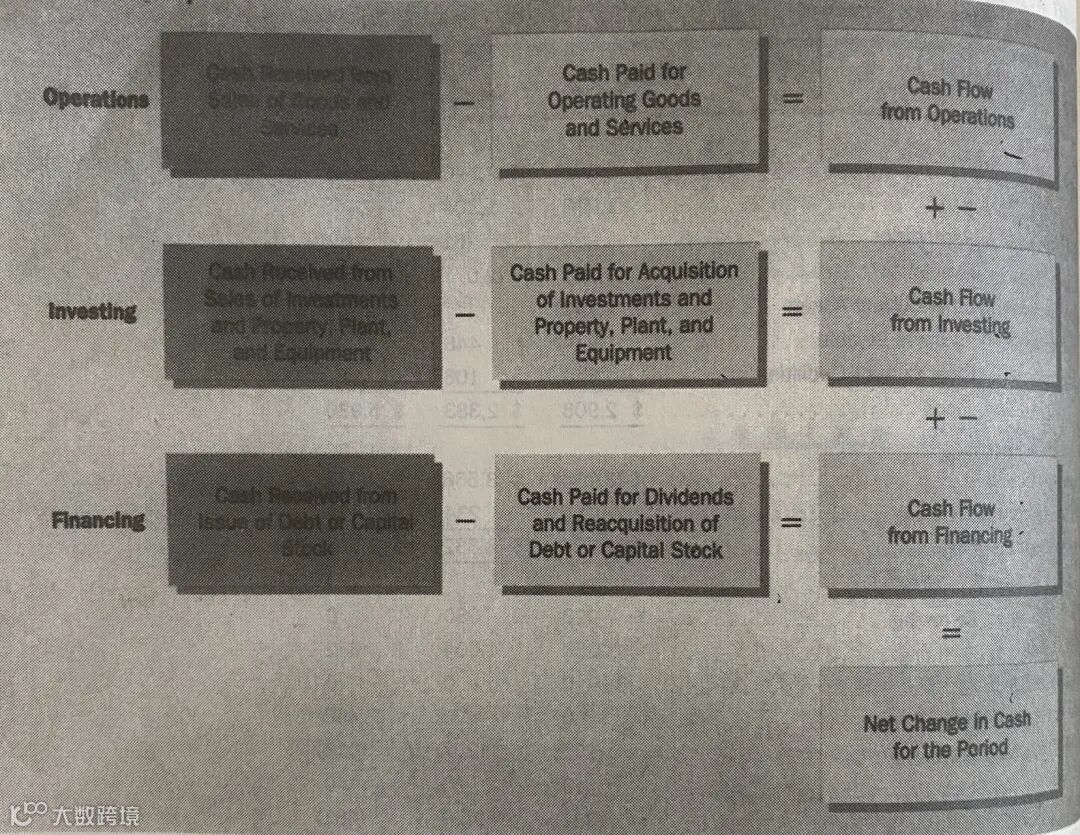
Preparing the Statement of cash flows
Two approaches:a columnar work sheet; a T-account work sheet
Algebraic formulation
Cash change equation:
🔺C=🔺L十🔺SE一🔺N$A
The equation states that the increases in cash(left-hand side) equal the increases in liabilities plus the increases in shareholders' equity less the increases in no cash assets (right-hand side).
We can identify the causes of the change in cash by studying the changes in noncash accounts and classifying those changes as operating, investing, and financial transactions.
Three steps in the preparation of the columnar work sheet:
Step 1: Compute the change in each balance sheet account between the beginning and the end of the year.
Step 2: Classify the change in each balance account as an operating, investing, or financing activity and enter it in the appropriate column of the work sheet using the same sign as in the first column.
Step 3: Sum the entries in the operations , investing, and financing columns and net the three sums to ensure that they equal the net change in cash.
The steps in the preparation of the columnar work sheet using the direct method:
Step 1: List the revenue and expense accounts from the income statement and enter their amounts for the year in the first column.
Step 2: For each of the work sheet entries in the operations column, identify the revenue or expense account to which it most closely relates.
The T-account work sheet approach for preparing the statement of cash flows provides built-in checks to ensure the full recognition of the effects of each transaction on various accounts.
The steps in the preparation of the T-account work sheet:
Step 1: Obtain balance sheets for the beginning and end of the period covered by the statement of cash flows.
Step 2: Prepare a T-account work sheet.
Step 3: Explain the change in the master cash account between the beginning and the end of the period by accounting for the change in each noncash account during the period.
Step 4: Use the information provided in the master T-account for cash in the completed work sheet to prepare a formal statement of cash flows.
To overcome some of these interpretative problems of the indirect method, the FASB permits firms to use the direct method in reporting cash flow from operations in the statement of cash flows. A note to the financial statements, however, must reconcile net income with cash flow from operations.
注:以上内容摘自《财务会计》英文版第9版,罗曼 L. 韦尔、克莱德 P. 斯蒂克尼著,机械工业出版社出版