Chemetall and Londian Wason commit to strategic partnership for implementing new Gardolene® D chromium-free and fluoride-free passivation technology for copper foils
Tianyu LI

Chemetall, a leading provider of innovative surface treatment solutions and the global surface treatment business unit of BASF Coatings, has signed a strategic partnership with Londian Wason (Shenzhen) Holdings Group Co., Ltd. (Londian Wason), a global leader in the new energy and electronic materials sector and one of the largest producers of lithium battery copper foil.
The agreement will enable the two companies to collaborate on the innovation and application of Chemetall's newly launched Gardolene D chromium-free and fluoride-free passivation technology for copper foils. This collaboration marks a milestone for Chemetall in supporting the green transformation, driven by the rapid growth of electric vehicles and the expanding demand for innovative energy generation and storage solutions – particularly in China and the Asia-Pacific region.
“Londian Wason is the first customer in China to use our new Gardolene D technology, proving our leading position in the surface treatment industry. This innovation is a key enabler for the green transformation, enhancing the performance of electric vehicles and energy storage systems. More importantly, it will empower our partner Londian Wason to achieve their sustainability goals and improve the performance of their solutions,” says Frank Naber, Senior Vice President Global Surface Treatment at BASF Coatings.
“We combine Chemetall’s global innovative surface treatment technology with London Wason’s 20 years of proven technical expertise in copper foil manufacturing. By building on our strengths, we drive breakthrough technology and sustainability to shape the future of the industry,” says Guangling Zhou, CEO of Londian Wason Group.
“China is the world's largest market for electric vehicles and the dominant global force in battery production. We are glad to partner with Londian Wason to enhance our regional footprint and accelerate market adoption to meet the evolving demands. Chemetall is committed to creating value for customers by providing innovative and more sustainable surface treatment solutions in growth markets like China and others in Asia Pacific,” says Evelyn Shen, Vice President, Chemetall Asia Pacific.
Gardolene D is the first global chromium-free and fluoride-free passivation technology for copper foils. This pioneering solution is unique in the industry and offers superior corrosion protection as well as improved performance of copper foils used in electric vehicle battery packs, energy generation and storage systems. It improves the surface energy, which enables better adhesion of anode active materials and reduces electrical resistivity, resulting in higher battery efficiency. Batteries treated with Gardolene D benefit from extended lifespans and better capacity retention, extending lifetime by up to 6 percent after 1,000 cycles at 25 degrees Celsius – a significant performance increase compared to batteries using copper foil pretreated with traditional chromium (VI) passivation methods.
The new solution is compatible with existing equipment and suitable for both electro-deposited and rolled annealed copper foil substrates used in the production of batteries for electric vehicles and a wide range of other energy generation and storage applications.■
The relationship between terminal coating thickness and salt spray time
laido.com.cn
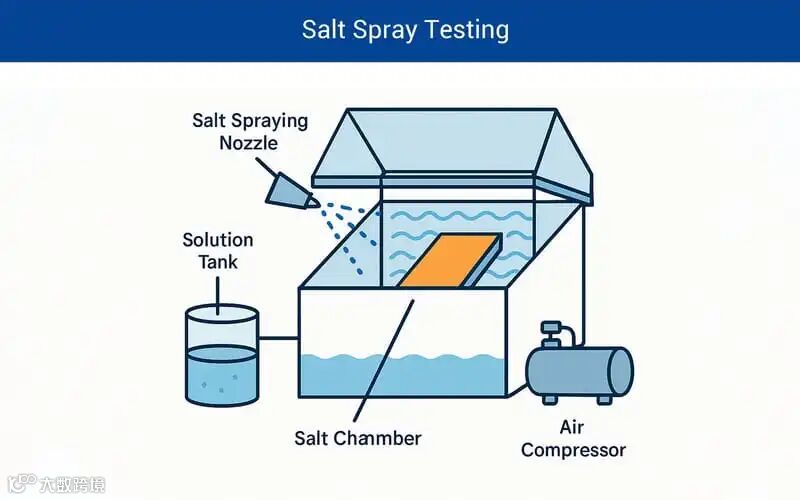
Under the same coating material and process, the coating thickness is basically proportional to the salt spray resistance time. The thicker the coating, the longer it provides corrosion protection, and the longer it can pass the salt spray test.
You can understand it as putting a “raincoat” on the metal substrate. The thicker the raincoat, the longer it takes to be soaked through in rainstorm (salt fog environment).
Detailed mechanism analysis
1.The function of coating: barrier and sacrifice
The coating mainly protects the internal substrate (usually copper or iron) in two ways:
Barrier protection: physically isolate the base metal from the corrosive environment. For example, the coatings of gold, tin, and silver are relatively stable and not easily corroded. Their main function is to form a dense barrier.
Sacrificial anode protection: A typical example is galvanizing. The chemical activity of zinc is higher than that of iron. When forming a primary battery, zinc is preferentially corroded as the anode, while iron is protected as the cathode. Even if the coating is damaged, corrosion will preferentially occur on the zinc layer until a large amount of zinc is consumed.
How does the thickness of the coating affect the corrosion process
Corrosion is a process that starts from the surface and gradually penetrates inward.
Corrosion initiation: The corrosive medium (salt spray containing Cl ⁻) begins to attack the surface of the coating. Even the densest coatings have microscopic pores or defects.
Corrosion Expansion:
For barrier type coatings such as gold plating and tin plating, corrosion will propagate “laterally” through these microscopic defects and find a path to reach the substrate. Once it reaches the substrate, it will form primary cell corrosion (such as tin copper primary cells, where copper as the anode is corroded), resulting in red copper rust. The thicker the coating, the longer the path for the corrosive medium to migrate, and the longer the time required to reach the substrate.
For sacrificial coatings (such as galvanizing), corrosion will uniformly or locally consume the zinc layer itself, generating white corrosion products such as zinc oxide and basic zinc chloride. The thicker the coating, the more sacrificial materials are available for consumption, and the longer the protection time naturally.
2.Key concepts: corrosion rate and time of “first appearance of red rust”
In engineering, an important evaluation criterion for salt spray testing is the time when the base metal corrosion (red rust) first appears.
Assuming the coating is dense and uniform, its protection time can be estimated using a simplified formula:
Protection time (hours) ≈ K × Coating thickness (μ m)
Among them, K is a coefficient that depends on the coating material, coating quality, substrate, and specific conditions of salt spray testing.
For example:
For the galvanized layer, it may be empirically assumed that K ≈ 24. This means:
A 5 μ m galvanized layer is expected to protect against red rust for approximately 24 × 5=120 hours.
An 8 μ m galvanized layer is expected to protect against red rust for approximately 24 × 8=192 hours.
For tin plating, due to its electrochemical potential difference with copper, corrosion will occur faster once it is damaged, but its barrier effect is still positively correlated with thickness.
Influencing factors and complexity in practice
Although the proportional relationship is fundamental, in practical applications, the situation is much more complex:
Coating quality is more important than thickness:
Porosity: A thick but porous coating with pinholes may not have the same protective performance as a thin but dense and uniform coating. Corrosive media will directly attack the substrate through these pores.
Uniformity: In protruding areas such as corners and edges of terminals, the current density is high and the coating is prone to thickening; In areas such as grooves and inner walls, the coating is prone to thinning. The failure of salt spray testing often starts from these weakest links. Therefore, the minimum local thickness is more instructive than the average thickness.
Coating combination (multi-layer coating):
High end connectors often use composite coatings, such as copper base+nickel intermediate layer+gold surface layer.
Nickel layer: plays a crucial role here. It is an excellent barrier layer that can effectively prevent the mutual diffusion between copper and gold, and is highly corrosion-resistant, greatly blocking the penetration of corrosive media into the interior. A thin gold layer (0.5-1.5 μ m) mainly provides low contact resistance and weldability, while the underlying nickel layer (3-5 μ m) is the main force for salt spray resistance. In this case, the thickness of the nickel layer has a much greater impact on the overall salt spray resistance time than the gold layer.
Coating type:
Galvanization: Its protection time has the most obvious linear relationship with thickness, as it is protected through self consumption.
Tin plating/silver: belongs to barrier protection, but its corrosion products have weak protection for the substrate. Once damaged, corrosion will occur quickly.
Gold plating: It has extremely stable chemical properties and is a perfect barrier layer. But the cost is high and usually made very thin, so the nickel layer below it is crucial.
Engineering Applications and Standards
In industry standards such as USCAR for the automotive industry and EIA for the electronics industry, clear regulations will be made on the material and minimum thickness of terminal coating for different application scenarios, which will be directly linked to the required salt spray test time.
For example, a specification may require:
Connectors used in engine compartments: gold-plated 0.8 μ m min over nickel 3.0 μ m min, must pass a 240 hour salt spray test, have no red rust on the appearance, and have a contact resistance increment of ≤ X%.
Connectors applied to the interior of the carriage: Tin plated 3.0 μ m min, required to pass a 96 hour salt spray test without red rust.
summary
The thickness of the coating is the primary factor determining the salt spray resistance time, but it is not the only factor.
When selecting and evaluating terminal coatings, the following logic should be followed:
Clarify the application environment: Determine how many hours of salt spray protection are needed (such as 48h, 96h, 240h).
Choose the appropriate coating system: choose pure tin for economical use, and choose tin/nickel/gold composite coating for high protection.
Specify key thickness: not only should the average thickness be specified, but also the local thickness at the thinnest point, especially for barrier type coatings (such as nickel layers), sufficient attention should be paid to the thickness.
Experimental verification: Ultimately, salt spray testing must be conducted to verify whether the overall scheme of “coating material thickness process” meets the design requirements.
Simply put, thickening the coating is one of the most direct and effective methods to improve salt spray resistance, but it must be done while ensuring the quality of the coating (dense and uniform).
https://lai-du.com/2025/10/24/the-relationship-between-terminal-coating-thickness-and-salt-spray-time/