

Press "PandaGuides" above to follow us!
AI-generated videos are blurring the line between imagination and history — and raising deep questions about creativity, ethics, and ownership.
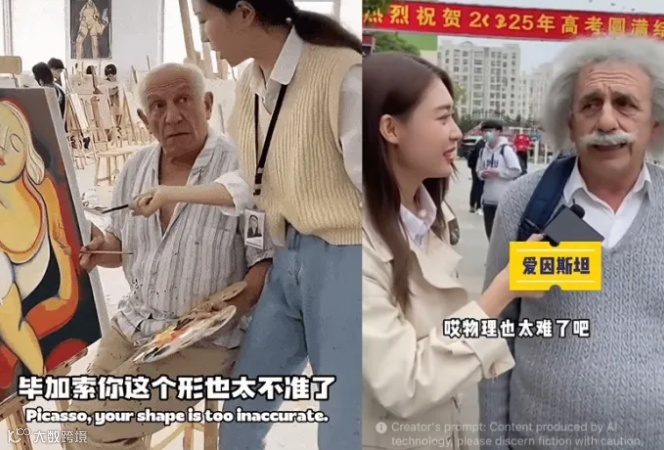
Recent viral clips show Albert Einstein stepping out of China’s college entrance exam (the gaokao), calmly answering reporters’ questions. Another features Picasso on trial by a Chinese art teacher, while Tang-dynasty poet Li Bai recites verses aboard a modern speedboat. These ultra-realistic scenes look so convincing that viewers momentarily forget: none of them ever happened. They were all created using Sora 2, OpenAI’s latest text-to-video model that can turn words into cinematic reality.
Within days of its release, the “Sora by OpenAI” app soared to the top of the U.S. App Store, overtaking ChatGPT and Google’s Gemini. Millions of users worldwide — including many in China — are testing its power by generating everything from historical reenactments to personal movie cameos.
Sora 2 represents a significant leap from earlier AI video generators. It produces smooth, physically accurate motion and coherent multi-scene stories — no need for manual editing or stitching. Its standout feature, Cameo, allows users to upload a short video of themselves (or someone who has consented) and instantly appear as an actor in any AI-generated film.
For digital creators and influencers, the implications are massive: anyone can now star in their own movie without cameras, crews, or sets. But that accessibility has also triggered a storm of ethical and legal controversies.
The realism of Sora 2 has led to a surge of videos depicting famous personalities — living or deceased — in fabricated scenarios. Deepfake versions of OpenAI CEO Sam Altman, Robin Williams, and George Carlin have gone viral, sparking outrage among families and fans.
“This isn’t creativity — it’s digital reincarnation, often without consent,” one Hollywood lawyer told U.S. media.
The outcry intensified when it emerged that, during Sora 2’s early rollout, copyrighted characters and celebrity likenesses were available for use unless rights holders opted out — effectively allowing their images to be used without prior consent. Major studios such as Disney and Warner Bros., along with talent agencies CAA and UTA, quickly objected, accusing AI companies of shifting legal risks onto creators.
Facing backlash, OpenAI CEO Sam Altman reversed course, announcing that Sora 2 would adopt an opt-in system — blocking all copyrighted material by default. Rights holders will soon gain more granular control, deciding when and how their intellectual property can appear in AI-generated scenes.
But many users are frustrated by the new restrictions, calling the app “nearly useless” without access to famous figures. Some have even begun bypassing filters by subtly altering names or appearances of copyrighted characters.
Beyond copyright, the Sora debate touches on a deeper philosophical question: who owns creativity in the AI era?
For decades, art and entertainment revolved around exclusivity — controlled by studios, publishers, and rights holders. But AI platforms like Sora 2 democratize creation, allowing anyone to produce professional-grade films in minutes. In this new landscape, companies like OpenAI act as “digital landlords,” controlling the platforms on which global creativity now depends.