![[Bad Decisions]: I Got Scammed at a Tea House Near the Bund](https://cdn.10100.com/user/99d7a4da515946eea6b0427b9156bc7d.png?x-oss-process=style/180x)
Don't Miss:

Shanghai -- and China more broadly -- is a remarkably safe place to live and travel. But even here, it pays to stay cautious. In Bad Decisions, we let people from the Shanghai community tell their stories of when things went sideways. Some got scammed. Some got played. Some just ignored their gut. All of them learned something the hard way. Read on so you don’t make the same mistakes.
 I'd been planning this trip to China for months. It was one of those long-standing, slow-burn fascinations -- dumplings, calligraphy, bamboo forests, the whole thing. I'd watched the YouTube videos. I'd downloaded Pleco. I'd even practiced a few phrases of Mandarin that I never got to use properly.
Shanghai was my first stop. I'd read somewhere that it was the New York of China -- cosmopolitan, fast, flashy. On day three, I felt like I was starting to get it. I'd mastered the metro. I'd made it through a meal without pointing at pictures. I'd even started developing an unearned sense of confidence.
Which is probably why I said yes to tea.
It happened on Nanjing East Road near the Bund. Early evening, golden hour, tourists everywhere, neon signs starting to glow. A girl in pink sneakers and a black baseball cap approached me: "Hi, can you take a photo of us?" She pointed to her friend.
Sure. Click, click.
"Where are you from?" she asked. "Do you like tea? We know a great local tea house -- authentic experience, not touristy. We're students. Just want to practice English."
They seemed nice. Harmless. Curious. And hey, a tea ceremony? That felt... cultural. Like something you're supposed to do in China. I mean, tea is a big deal here, right?
Turns out, not really. I've since learned that the whole "tea ceremony" thing is basically invented for tourists. I've met people who've lived here for twenty years and never once done a tea ceremony. My friend's Chinese wife has never done one either. But at the time, it felt like I was about to be let in on something special.
So I followed them.
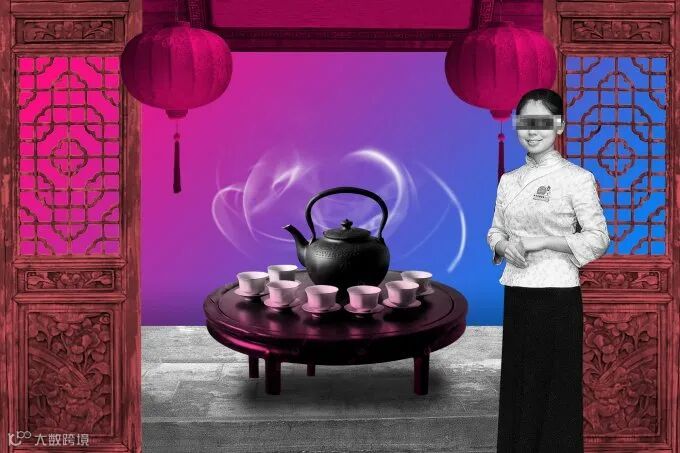
We ducked off the main road and into a quiet side street, then up a narrow staircase into a small, dimly-lit room. No sign, no customers. A woman in a cheongsam greeted us with too much enthusiasm. We sat at a low table. Still no menu. Just smiles and a kettle.
Tiny cups. Flowery names. Oolong. Ginseng. Something smoky. They poured, we sipped. They explained. I nodded. We laughed about zodiac signs. It was ... fine. I didn't love the tea, but I wasn't there for the flavor.
The girls suddenly said they had to go -- "class starting soon" -- and left with quick thank-yous and waves. Then the bill came.
2,980 RMB.
I blinked. "Service fee. Rare tea. Tasting experience. Private room."
I asked where the menu was. The woman didn't respond. Just pointed at the payment terminal.
And here's the thing: it is a clever scam. Because who actually knows what tea costs? Some of it genuinely goes for thousands of RMB. And it's just leaves in a tin, right? There's no sticker price like there is on a bottle of Moët. You can't argue about what "feels fair" when the whole thing is based on ceremony and mystique.
I thought about arguing. I thought about pretending I didn't have money. I thought about calling the police. But then I thought about being alone in a city where I didn't speak the language, stuck in a second-floor tea room with a woman glaring at me.
So I paid.
Afterwards, I sat by the river, scrolling through Reddit threads titled things like "Got scammed in Shanghai" and "Tea house rip-off—what now?" I saw the same script over and over. Same setup. Same street. Same receipt.
One detail kept popping up: the scammers always say they're students. And yeah, that makes sense. Tourists trust students. They're curious, friendly, harmless. But I've since learned: actual students in China don't hang around Nanjing Lu chatting with foreigners. They're usually buried in textbooks on campus, not leading strangers to second-floor tea parlors on a Tuesday afternoon.
It's easy to feel stupid after something like this. And honestly, I did. I thought I'd done enough research. I thought I'd be immune to the obvious stuff. But scams like this work precisely because they're wrapped in warmth and flattery and just enough cultural believability to disarm you.
Shanghai is a phenomenal city. But like anywhere, it has its hustles. Mine was polite, well-rehearsed, and wore pink sneakers.

Other Bad Decisions in Shanghai:
I Got Scammed on Tinder – It Cost Me 4,000 RMB - A smooth operator, a fancy restaurant, and one very expensive lesson in modern romance.
Lending Money to a Friend – A Shanghai Scam Story - He said he just needed help. Then he disappeared—with 10,000 RMB.
***