


Despite geopolitical headwinds and declining FDI, global companies are quietly increasing their innovation investment in China and redefining what “China for China” means in practice.
Introduction
While foreign direct investment (FDI) into the country continues to fall, multinational companies are not pulling back from innovation. In fact, most are moving in the opposite direction.
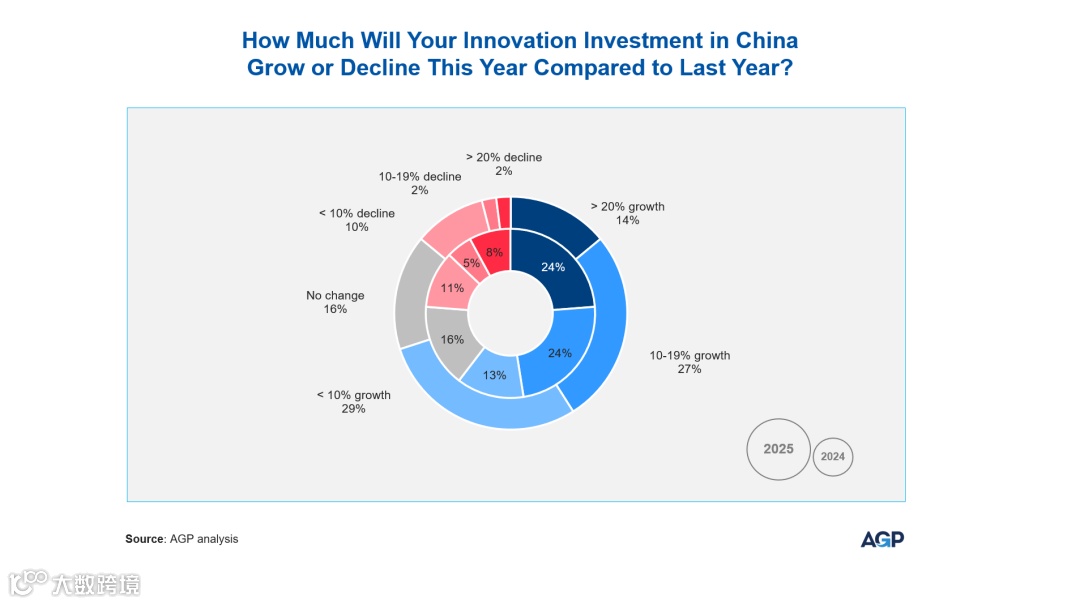
According to our 2025 Innovating in China benchmarking study, which surveyed 49 multinational corporations, seven in ten companies increased their local innovation budgets this year, while only 14 % reduced them.
Between 2025 and 2029, China alone is expected to contribute nearly 22 percent of total global GDP growth, adding more than USD 6.7 trillion in new output. Asia as a whole will account for more than two-fifths of global expansion during this period, with China at the center of it.
That momentum is supported by an increasingly sophisticated innovation system. China now ranks 11th in the Global Innovation Index, leads the world in international patent filings, and is home to 24 of the top 100 global science and technology clusters.
Its annual R&D spending has reached USD 780 billion, second only to the United States, and exceeding that of the entire European Union combined.
China’s innovation ecosystem is no longer a satellite of global R&D. It is a core node in the global network of innovation.
Pressure from Local Competitors
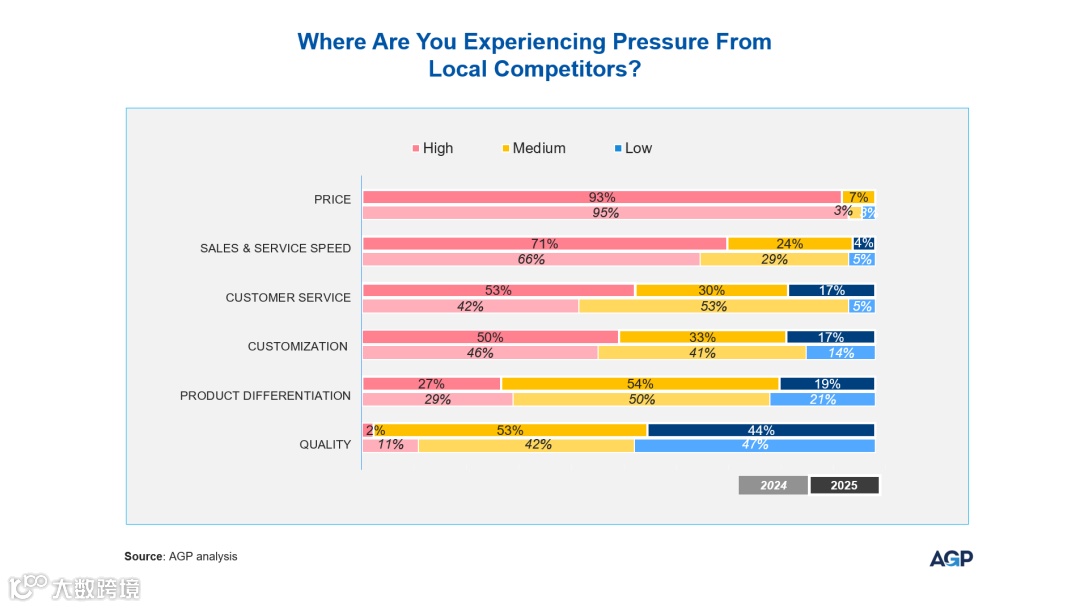
MNCs report the highest pressure from local competitors comes on price (93%) and speed of service (71%). Domestic firms have become adept at operating fast and lean, forcing foreign players to adapt.
Moderate pressure is felt in areas like customer service (53%) and customization (50%).
In contrast, product differentiation (27%) and quality (2%) are seen as less pressing, suggesting that MNCs retain relative strength in brand, innovation, and standards.
The Shift Toward Local Innovation
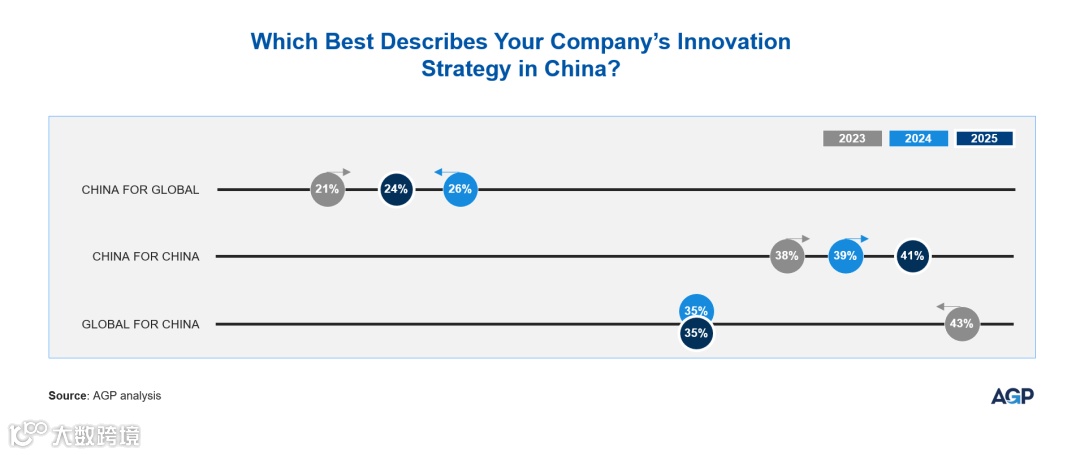
One of the findings from 2025 is the consolidation of “China for China” strategies, where innovations are designed, tested, and scaled primarily for local customers. Forty-one percent of companies surveyed now focus mainly on serving domestic demand, up slightly from 39% in 2024.
The share of firms pursuing a “China for Global” strategy (developing in China for international markets) declined to 24%, constrained in part by global political and regulatory headwinds.
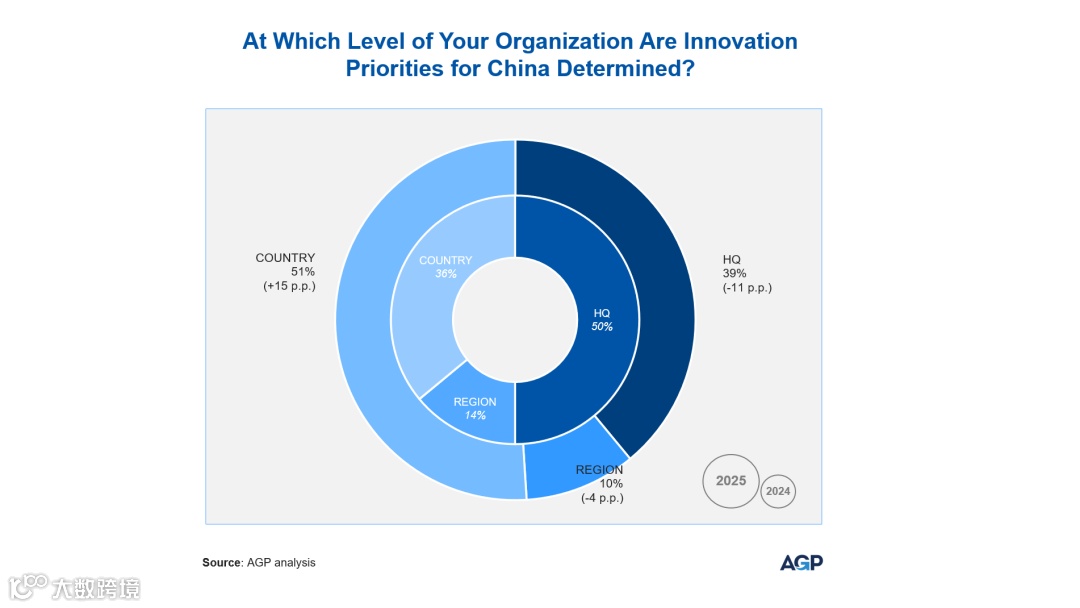
At the same time, decision-making is becoming more localized. More than half of multinationals now set their innovation priorities at the country level, up from 36% last year. Headquarters’ control has fallen to 39%. This decentralization signals growing confidence in local teams, and a pragmatic recognition that innovation in China must be managed in China.
Where Innovation Happens
The 2025 study shows that multinational companies are expanding the scope of their innovation activity in China but also confronting the reality that bold ideas don’t always meet expectations.
When asked which innovation horizons they prioritize, companies overwhelmingly point to the middle ground.
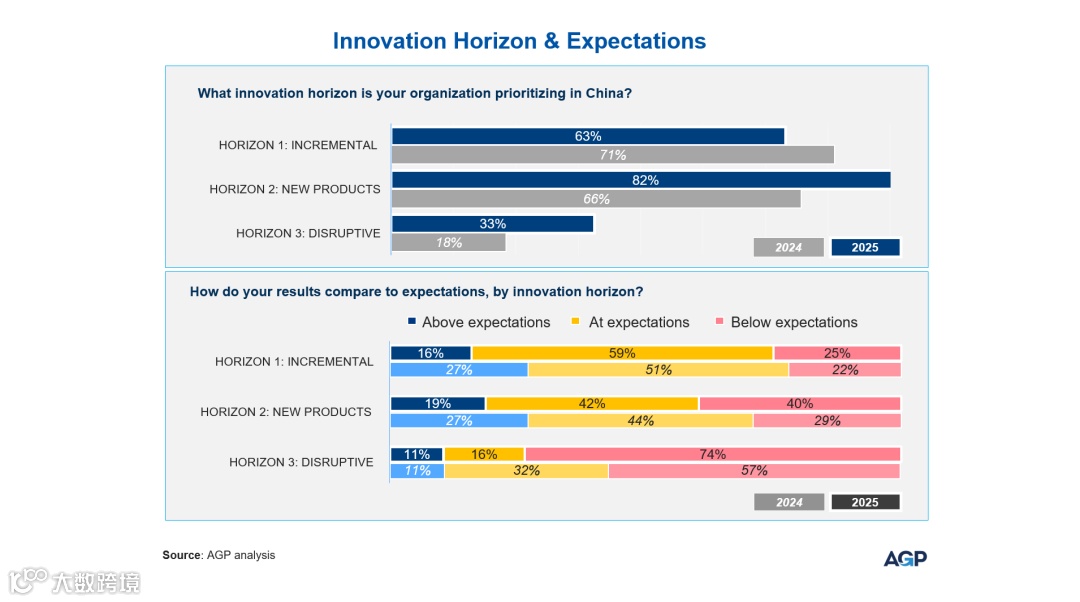
82% focus on Horizon 2. New products that bring measurable differentiation within existing categories.
Horizon 1. Incremental improvements remain important but declined from 71% to 63%, while one in three companies (33%) is now exploring Horizon 3. Disruptive innovation, up sharply from just 18% last year.
Yet ambition and outcomes are not fully aligned.
For disruptive innovation only 11% of projects are performing above expectations, while nearly three-quarters (74%) fall short.
For new product innovation, performance is more balanced: 19% exceed expectations, 42% meet them, and 40% underperform. Incremental innovation remains the most predictable: 59% meet expectations.
The data paints a clear picture: as companies in China push further into new and disruptive territory, they face a steep learning curve.
Still, this willingness to stretch beyond incremental change represents progress. Companies are moving from safe optimization to calculated experimentation, reflecting growing confidence in China’s ability to deliver not just cost efficiency but genuine innovation outcomes.
The study also sheds light on how companies are organizing their innovation portfolios.
Most resources still go into product and service innovation, followed by operational and commercial process improvements. Investment in business model and administrative innovation remains comparatively low.
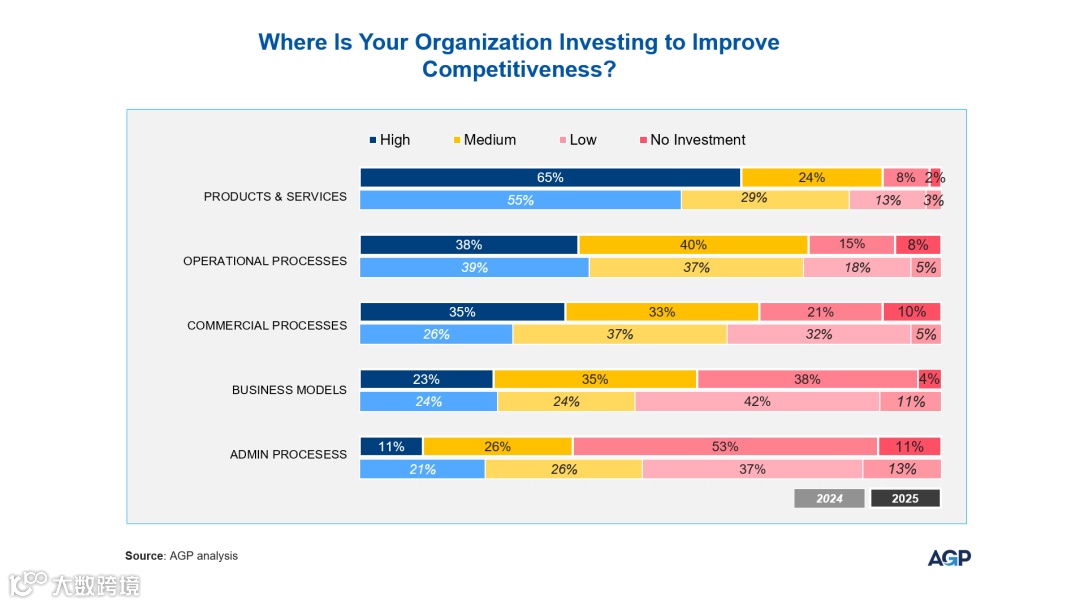
The emphasis on customer-facing innovation reflects an urgent drive to maintain relevance in a market where speed and adaptability are decisive.
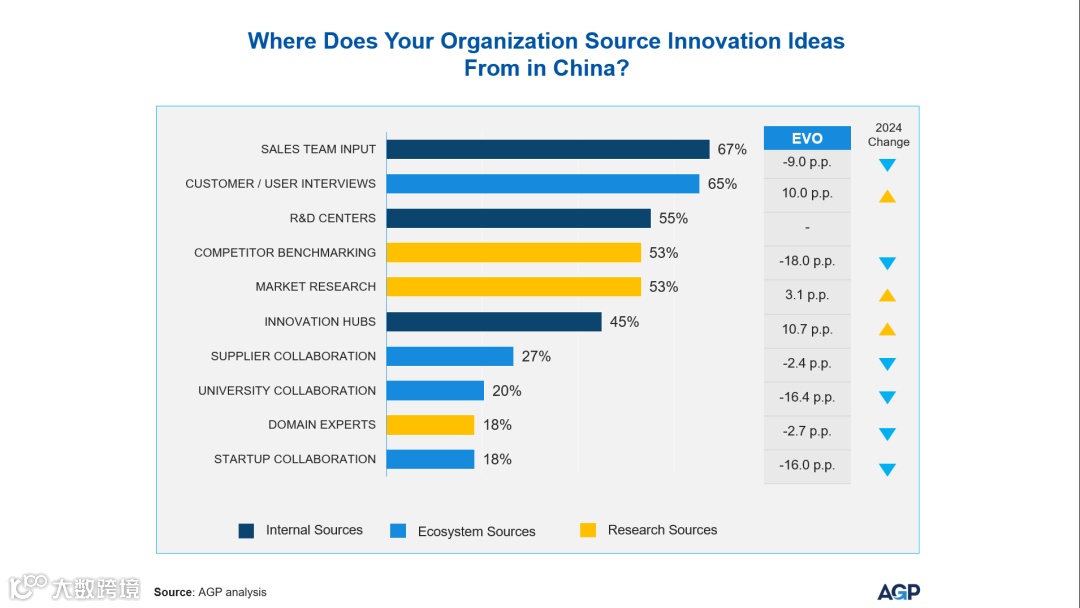
In terms of idea generation, the sources are mostly internal: sales teams’ input and R&D centers remain the dominant engines of innovation, together with external ecosystem collaboration with customer/user interviews. Other external ecosystem collaboration, with universities, suppliers, and startups, is less common but represents untapped potential for future breakthroughs.
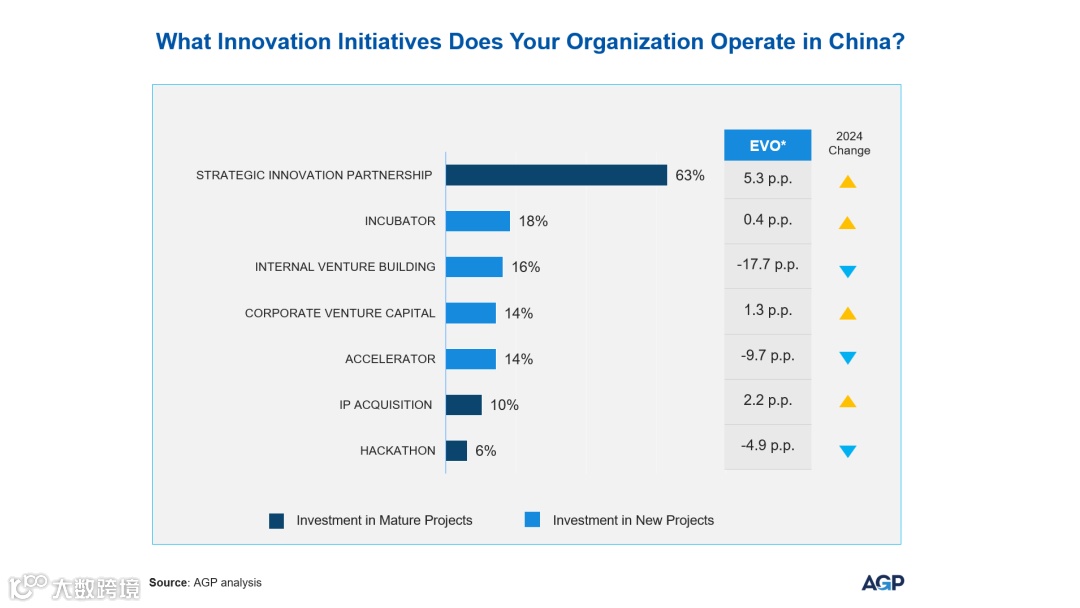
When it comes to execution, strategic partnerships remain the most widely used vehicle for innovation. Venture-style tools such as incubators, accelerators, and corporate venture capital are still niche, suggesting that most multinationals prefer predictable, partnership-based innovation over high-risk experimentation.
Challenges Evolve
The obstacles to innovation in China are shifting. In 2025, the biggest challenge is leadership alignment between headquarters and China teams.
Nearly one in four respondents said misalignment between global and regional priorities undermines innovation performance. Funding issues, by contrast, were mentioned by just 14% of companies.
Geopolitical tensions, an item included for the first time in this edition, was acknowledged only by 9% as challenge in their ability to innovate in China.
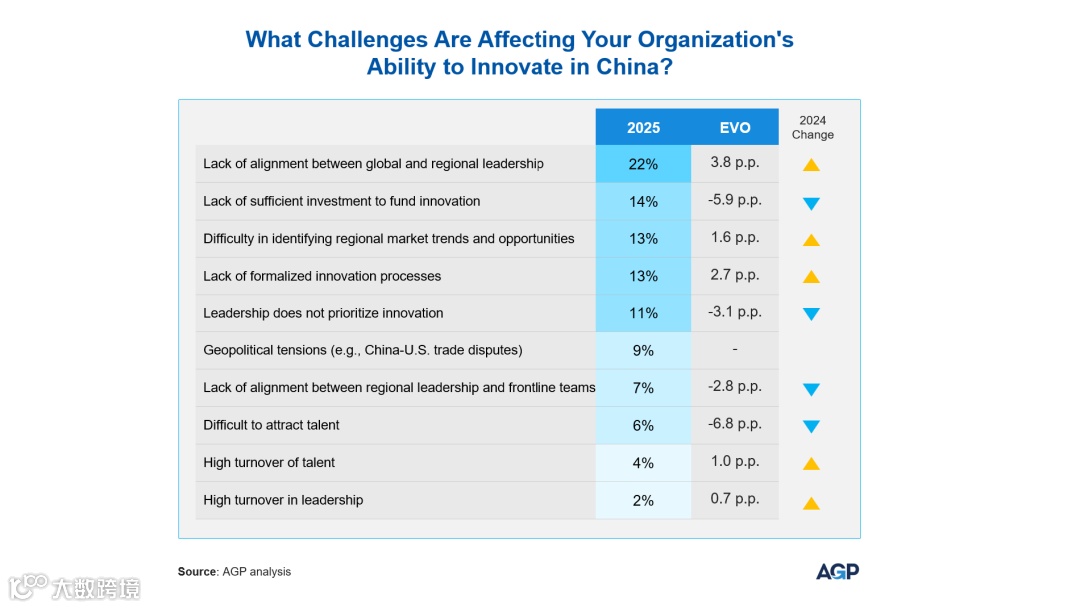
This evolution points to a more mature innovation landscape: the most challenging is no longer whether to invest in China, but how to coordinate and capture the value of that investment effectively.
The GenAI Moment
In 2025, 50% of companies increased their spending on AI and GenAI, while 35% maintained stable budgets and 14% cut back
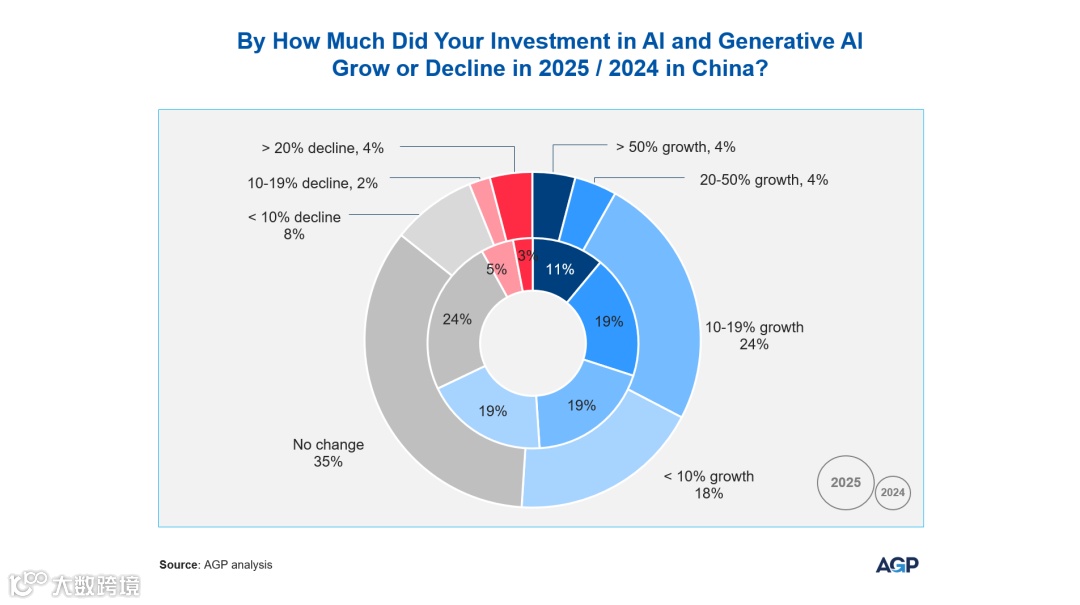
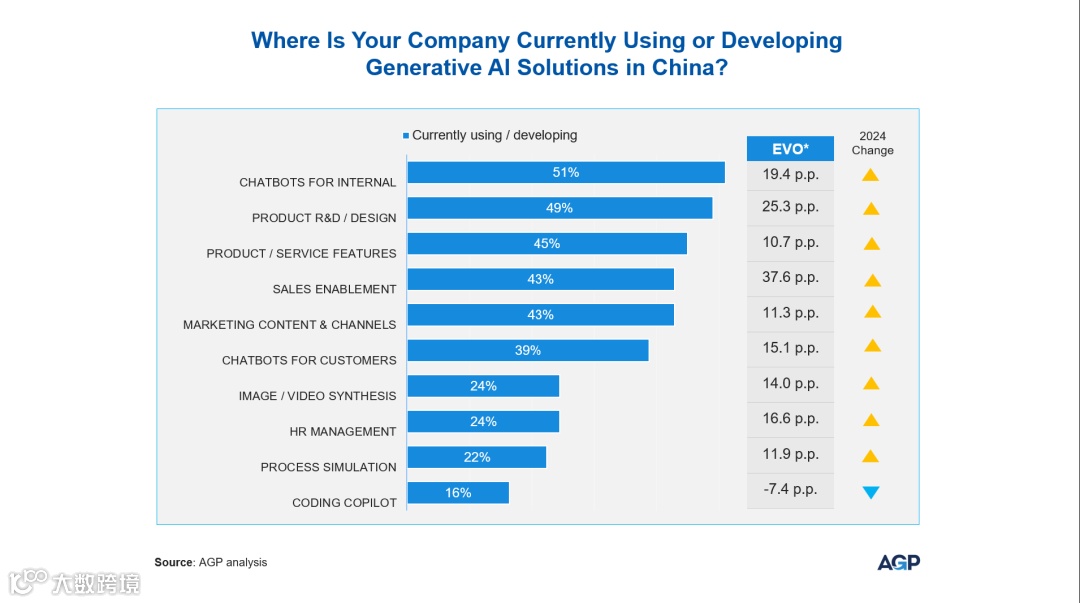
Adoption patterns are pragmatic: the most common applications involve internal chatbots, product design, sales enablement, and marketing content. Nearly half of surveyed firms are already deploying or developing solutions in these areas.
A New Maturity
Taken together, the 2025 findings depict a China innovation landscape that is maturing rather than contracting.
Investment remains strong. Competitive pressure continues to spur adaptation. And leadership challenges are shifting from questions of “why China” to “how to make China work better within the global organization.”
While geopolitics has made operating in China more challenging, the innovation case remains compelling. The scale of its market, the density of its industrial clusters, and the sophistication of its engineering base make it a unique environment for experimentation and learning.
For many MNCs, China is an integral part of their global innovation engine. One that tests their agility, sharpens their competitive instincts, and offers a window into the future of industrial transformation.
Looking Ahead
The study suggests that the companies most likely to succeed in the coming years will share these characteristics:
They localize authority, allowing Chinese teams to make rapid, informed decisions.
They align global and regional leadership, ensuring innovation priorities are shared rather than siloed.
They embrace digital acceleration, particularly in AI and automation.
About the Study
The 2025 Innovating in China benchmarking study was conducted by Asia Growth Partners, with the support of Direct HR.
The full report is available at https://asiagrowthpartners.com/insight/innovating-in-china-2025-mncs-find-opportunity-amid-slowdown/a120
About the Author

About Asia Growth Partners
We are a management consultancy dedicated to helping clients build successful businesses in Asia.
Our mission is to help our clients grow their core businesses and capture emerging opportunities in Asia. We do this by conducting detailed research, advising strategy, and providing agile capabilities to drive forward implementation.
Asia Growth Partners is headquartered in Shanghai, with teams in China, India, Southeast Asia, and Europe.