



BDI Index


Dry FFA


Bunker Price


Economy & Trade

U.S. Hints It Will Not Impose 100% Tariffs on China
13 October 2025, Washington D.C. – U.S. Treasury Secretary Scott Bessent told Fox Business that “100 percent tariffs on China are not a foregone conclusion.”
“The President has said the tariffs won’t take effect until 1 November,” Bessent said. “A 100 percent tariff is not inevitable. Despite last week’s announcement, the relationship is in a good place, the communication channels are back open, and we’ll see how things develop.”
Bessent added that President Trump “still expects to meet with China in South Korea at the end of this month.” More preparatory meetings are likely, he said, including working-level consultations this week in Washington on the sidelines of the World Bank / IMF annual meetings.
Vice-President JD Vance echoed the message, saying the President is “open to a rational negotiation” on tariffs and that “the door to a deal with China is wide open.”
U.S. Soybean Growers Feel Tariff Pain; China-Brazil Ties Deepen
The U.S. soybean harvest is now under way, but farmers say the trade war is boomeranging and rural America is “in deep trouble.”
Apart from China, America’s main buyers are Mexico, the EU, Japan and Indonesia. With Chinese orders shifting to Brazil and Argentina, Washington is pressing African and Asian governments to buy more; the Trump team is even pushing into markets such as India. The new demand, however, is nowhere near enough to replace China. In a September statement American Soybean Association president Ron Granger urged the administration to “prioritise an immediate soybean deal with China.”
While the White House sacrifices farmers’ interests for tariff leverage, other exporters are grabbing U.S. market share.
Brazil’s National Association of Grain Exporters expects soybean shipments from January through October 2025 to hit 102.2 million tonnes, eclipsing the previous full-year record set in 2023. Total 2025 exports are forecast at 110 million tonnes.
Meanwhile, China and Brazil will set up their first joint investment fund. On 2 October the Brazilian Development Bank (BNDES) and the Export-Import Bank of China signed an agreement to create a fund that will invest in energy transition, infrastructure, mining, agriculture and artificial-intelligence projects in Brazil through bonds and equities.

International Shipping

China Details Special Port Dues on U.S.-Linked Ships; Cape Rates Jump $5,000 a Day
In the early hours of 14 October China’s Ministry of Transport published the “Measures for the Collection of Special Port Dues on U.S.-Related Vessels”, effective the same day.
The dues target five categories of ships: those owned, operated or built by U.S. entities or individuals; ships flying the U.S. flag; and ships in which U.S. persons hold ≥25 % of voting equity or board seats. Ships built in China, in-ballast vessels entering Chinese yards only for repairs, and a handful of exempt cases are excluded.
Clarksons Research says the measure is Beijing’s “mirror response” to U.S. port-fee rules, but its reach is far wider, covering container, bulk, tanker and gas carriers. About 3,120 internationally trading U.S.-linked vessels—roughly 3 % of the world fleet—could be affected.
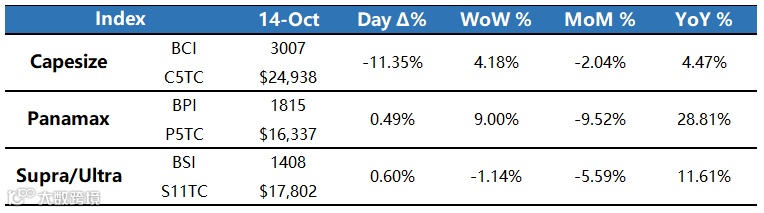
The Baltic Dry Index and its Capesize component (BCI) surged. Between 10 and 13 October the BCI leapt almost 600 points from 2,799 to 3,392, lifting the average daily hire for an 180,000-dwt Capesize from USD 23,216 to USD 28,132—up roughly USD 5,000 in the biggest weekly gain in months. Analysts say the rally is driven by an immediate tightening of available tonnage as some U.S.-linked ships avoid China; rates could stay elevated until owners reshuffle fleets and reroute voyages.
EPS Switches 14 Ammonia-Fuelled Bulkers to LNG Dual-Fuel
Singapore-based owner Eastern Pacific Shipping (EPS) has decided to convert all 14 ammonia-dual-fuel Newcastlemax bulkers on order at Qingdao Beihai Shipbuilding to LNG dual-fuel instead.
EPS confirmed the 210,000-dwt vessels will now use LNG dual-fuel engines rather than the originally planned second-generation ammonia units. The company called the move a “tactical adjustment” that reflects the technical, commercial and regulatory hurdles still facing ammonia. EPS still intends to deploy ammonia propulsion on four very-large ammonia carriers (VLACs) being built at Jiangnan and HD Hyundai Heavy Industries for delivery from 2027, and is pressing ahead with ammonia new-build projects for container and car carriers.

Commodities Market Brief

Iron Ore
From October 6 to October 12, 2025, Mysteel reported that the total global iron ore shipment volume was 32.075 million tons, a decrease of 715,000 tons from the previous week. The combined shipment volume from Australia and Brazil was 27.31 million tons, down 949,000 tons. Australia’s shipment volume was 19.163 million tons, down 636,000 tons, of which 15.845 million tons were sent to China, a decrease of 767,000 tons. Brazil’s shipment volume was 8.147 million tons, down 313,000 tons.
END