

#CantonFair #Guangzhou #trademark #brand #logo #law #IPR #infringement #exhibition #legal
In the wave of globalization, Chinese enterprises are becoming increasingly active. From the tropical rainforests of Southeast Asia to the classical streets of Europe, from the vast grasslands of Africa to the bustling cities of the Americas, Chinese-made products are penetrating global markets at an astonishing pace. However, when enterprises showcase their carefully developed products and ingenious designs at international exhibitions, a potential risk is quietly approaching—trademark hijacking. A leading home appliance giant once showcased its new smart refrigerator at the IFA (Internationale Funkausstellung Berlin) in Germany. Three months later, it discovered that a German company had applied to register the same trademark, nearly preventing its products from entering the EU market. A clothing brand faced a similar situation after unveiling its new collection at Paris Fashion Week. Its trademark was preemptively registered by a French agent, ultimately costing the brand millions of euros to reclaim its brand rights. Behind these cases lies a critical issue: How can enterprises protect their core assets through the right of priority in trademark registration at international exhibitions?
I. PRIORITY IS WEAPON
(A) The Legal Genes of the Right of Priority: From the Paris Convention to Chinese Practice
The right of priority system is not unique to China but originates from the Paris Convention for the Protection of Industrial Property, signed in 1883. Article 4 of the convention explicitly stipulates that nationals of any member country who first file a patent or trademark application in any member country may, within a certain period (12 months for invention patents and 6 months for trademarks), file identical applications in other member countries and enjoy the filing date of the first application as the filing date of subsequent applications. This system acts like a "time capsule," locking in an enterprise's innovative achievements on the date of the first application and preventing others from preemptively registering them.

After joining the Paris Convention in 1985, China gradually incorporated the right of priority system into its domestic legal framework. Articles 24 and 25 of the Trademark Law, revised in 2001, respectively stipulate "international priority" and "exhibition priority." The 2019 revision further refined the operational rules. For example, a new energy vehicle enterprise showcased its new car at the Oslo Auto Show in Norway and, relying on Article 25 of the Trademark Law, completed its trademark registration application in China within six months, successfully designating the exhibition date as the priority date and avoiding the risk of subsequent applications being rejected.
(B) The Dual Value of the Right of Priority: Legal Protection and Commercial Strategy
The value of the right of priority extends beyond the legal realm, profoundly influencing enterprises' commercial strategies. From a legal perspective, it provides enterprises with a "temporal buffer period," allowing them to conduct market research, product optimization, or financing preparations within six months of the first application before deciding whether to register trademarks in other countries. A medical device enterprise showcased its new ventilator at the MD&M (Medical Design & Manufacturing) show in the United States and, through the right of priority system, completed trademark registrations in the EU and Japan within six months, avoiding a rights vacuum caused by differing examination periods across countries.
From a commercial strategy perspective, the right of priority is a "first-move advantage" for enterprises' global layouts. At exhibitions, enterprises often need to showcase unreleased new products or technologies when their trademarks are not yet registered. However, through the right of priority system, enterprises can transform exhibition behaviors into legal grounds for trademark registration. A consumer electronics enterprise unveiled its first foldable smartphone at CES and immediately initiated global trademark registrations, using the right of priority to designate the exhibition date as the global application date and successfully seizing market opportunities.

II. PRIORITY FOR EXHIBITIONS
(A) Applicable Conditions for Exhibition Priority: Stringent but Feasible
According to Article 25 of the Trademark Law, the application of exhibition priority must meet three core conditions:
- First Use
The trademark must be first used on goods exhibited at the exhibition and must not have been used in any other context. A food enterprise launched its new brand "Wei Jixian" at the Anuga food fair in Cologne, Germany, but had previously conducted trial sales in domestic supermarkets, rendering it ineligible for priority. - Exhibition Qualifications
The exhibition must be an international exhibition hosted or recognized by the Chinese government. Currently, internationally recognized exhibitions by China's Ministry of Commerce include the Canton Fair, the China International Import Expo (CIIE), and the China International Consumer Products Expo. Enterprises' self-organized regional exhibitions do not meet the criteria. - Time Limit
An application must be filed within six months from the exhibition date. An enterprise that participated in the Paris Motor Show in October 2024 must complete its trademark registration application in China by April 2025; otherwise, the priority right expires.
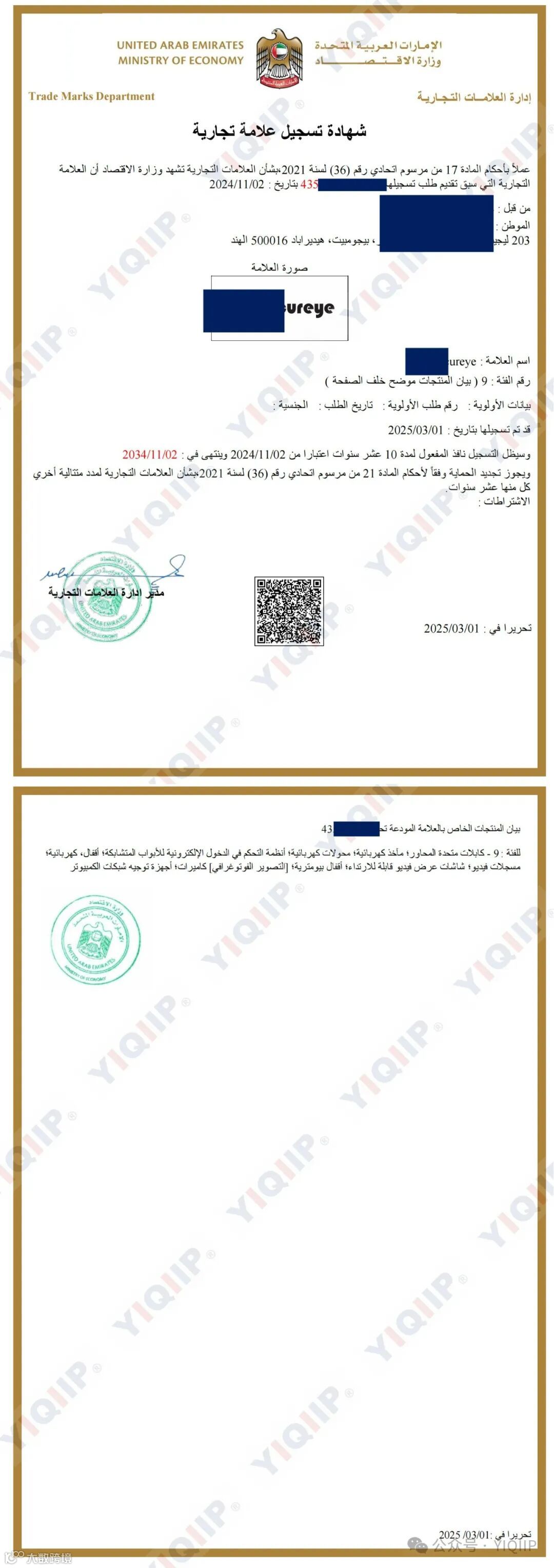
(UAE trademark certificate of a brand for a YIQIIP client)
(B) Operational Process: A "Three-Step Approach" from Written Declarations to Supporting Documents
- Declaration at Application
When submitting a trademark registration application, enterprises must explicitly declare their claim to priority in the application form and fill in details such as the name of the exhibition where the goods were first exhibited and the exhibition date. An enterprise once failed to check the "Priority Declaration" option in its application form, resulting in the need to resubmit the application and a three-month delay. - Submission of Supporting Documents within Three Months
Enterprises must submit documents such as booth certificates issued by the exhibition organizer, photographs of the exhibited goods, and evidence of trademark use within three months from the application date. An enterprise that participated in the Dubai International Security Exhibition failed to retain the physical labels of the exhibited goods and only provided brochure photographs, leading the Trademark Office to request supplementary evidence and nearly causing it to miss the priority deadline. - Certification of Materials
If the exhibition is held outside China, supporting documents must be certified by Chinese embassies or consulates abroad or notarized by a notary institution. An enterprise that participated in the International Security Exhibition in Dubai failed to have its exhibition certificate notarized, leading the Trademark Office to request resubmission and extending the application period by two months.
III. THE HIDDEN BATTLES
(A) Pitfall 1: Misjudgment of Exhibition Qualifications
Enterprises often mistakenly regard self-organized or regional exhibitions as "international exhibitions," rendering their priority claims invalid.
Avoidance Guide:
-
Confirm whether the exhibition is listed in the "International Exhibitions" announced by China's Ministry of Commerce (e.g., the Canton Fair, CIIE). -
If the exhibition is held outside China, verify whether it is an internationally recognized exhibition acknowledged by the Chinese government (e.g., CES, MWC).
(B) Pitfall 2: Insufficient Evidence of Trademark Use
Enterprises only provide brochures, posters, and other materials but fail to retain direct evidence such as physical labels or packaging of the exhibited goods.
Avoidance Guide:
-
Take close-up photographs of the goods during the exhibition, clearly showing the combination of the trademark and the goods. -
Retain booth contracts, invoices, and other materials proving the exhibition behavior. -
If possible, invite a notary institution to notarize the exhibition process.

(C) Pitfall 3: Late Submission of Supporting Documents
Enterprises fail to submit supporting documents within three months from the application date, causing the priority right to expire.
Avoidance Guide:
-
Establish internal processes to ensure the collection of supporting documents begins within one month after the application. -
Reserve one month for handling material certification, translation, and other matters. -
Commission a professional agency to track deadlines and avoid omissions.
(D) Pitfall 4: Confusion Between International Priority and Exhibition Priority
Enterprises mistakenly confuse "international priority" (filing in China within six months of a first foreign application) with "exhibition priority" (filing within six months of a first Chinese exhibition), leading to incorrect application strategies.
Avoidance Guide:
-
If an enterprise first exhibits at a Chinese exhibition and later needs to register trademarks abroad, apply exhibition priority. -
If an enterprise first applies abroad and later needs to register in China, apply international priority. -
Develop a global trademark registration roadmap to clarify the application sequence and priority type for each country.

(E) Pitfall 5: Inconsistency Between Trademark Specimens and Goods Categories
The trademark specimen or goods categories in the priority application differ from those exhibited, leading to the rejection of the priority claim.
Avoidance Guide:
-
Ensure the trademark specimen in the application is identical to that on the exhibited goods (including font, color, and proportions). -
The applied goods categories must cover the actual categories of the exhibited goods (e.g., if exhibiting a smartwatch, apply for Category 9 "wearable devices"). -
Avoid expanding or narrowing the scope of goods categories, as this may be deemed "non-first use."

IV. STRATEGIC UPGRADES
(A) Defensive Strategies: Building a Global Trademark "Firewall"
- Pre-registration Before Exhibitions
Before participating in international exhibitions, conduct "pre-registrations" for core trademarks by filing applications in China and declaring priority intentions to lay the groundwork for subsequent global registrations. - Simultaneous Multi-Country Applications
Leverage the Madrid Agreement or regional agreements (e.g., EU trademarks) to submit applications to multiple countries within the priority period, forming a "group warfare" advantage. - Competitor Monitoring
Use trademark monitoring services to track competitors' application dynamics in real-time and immediately initiate priority opposition procedures upon detecting hijacking attempts.

(B) Offensive Strategies: Seizing Market Opportunities Through "Temporal Advantages"
- Exhibition-Driven Sales
Showcase new products with unregistered trademarks at exhibitions and complete global registrations within six months through the right of priority, forming a closed loop of "exhibition-registration-sales." - Brand Premium
Ensure global trademark protection through priority rights to enhance bargaining power in negotiations (e.g., licensing, joint ventures). - Capital Operations
Complete trademark registrations within the priority period to provide legal safeguards for financing, listings, and other capital operations, boosting investor confidence.
In global trademark battles, the right of priority system is one of the sharpest weapons for enterprises. It is not only a legal defense line but also a commercial strategy. For Chinese enterprises, mastering the application techniques of the right of priority means seizing opportunities, avoiding risks, and enhancing value in global layouts. As digital technologies permeate, the right of priority system will continue to evolve, but its core logic remains unchanged—time is rights, and speed is competitiveness. In this war without smoke, whoever first grasps the "key" of the right of priority will unlock the doors to global markets.

YIQIIP short for YiQi Intellectual Property is a registered trademark and intellectual property legal service brand in China. YiQi in Chinese phonetically same as "Together" and literally same as " Perseverance and best wishs", perfectly conveys our values of long-term perspectives and sustainable development.
YIQIIP is a trademark agency certified by the Trademark Office of CNIPA (the National Intellectual Property Administration), providing consulting services to clients worldwide, focusing on trademark-related solutions including registration, strategy, translation, renewal, modification, transfer, review, response to opposition, pledge, management, notarization, monitoring, litigation, and rights protection, etc.
Our mission is to safeguard IP of brands and devote to flourishing of brands, We help brand minimize trademark related risks for stable development. We firmly believe in and emphasize the necessity of long-termism, forward-thinking strategies for brand development.

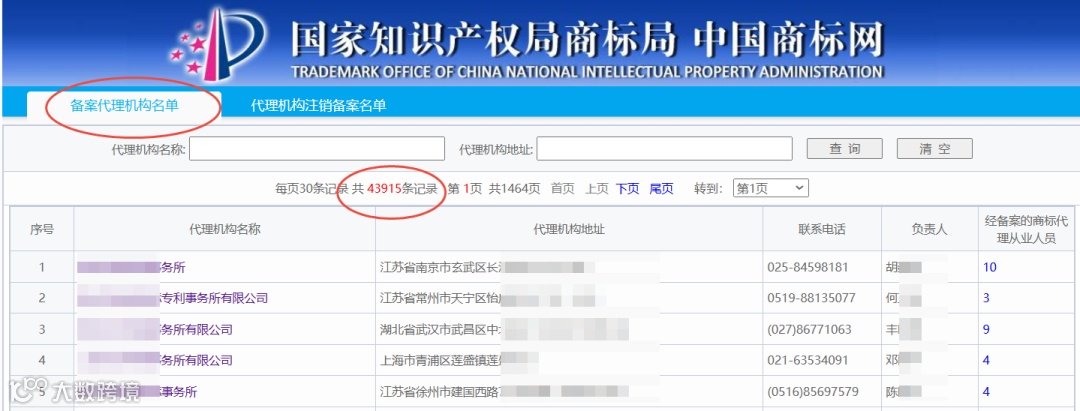
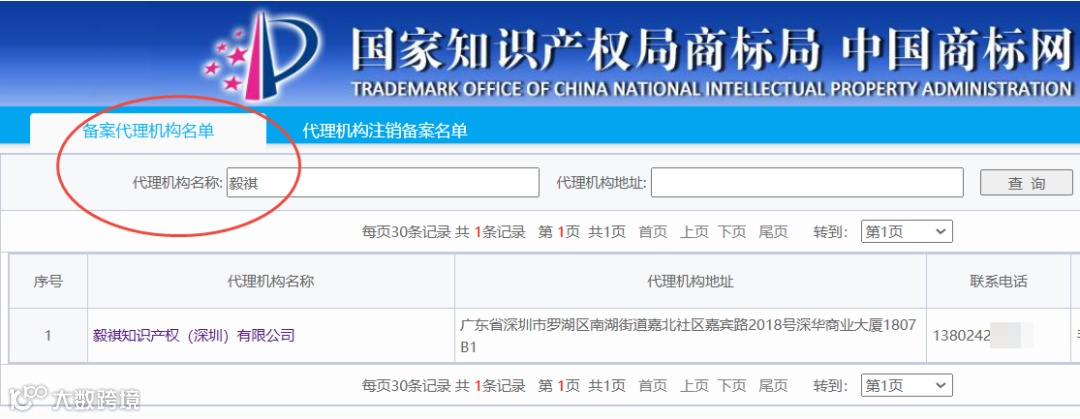
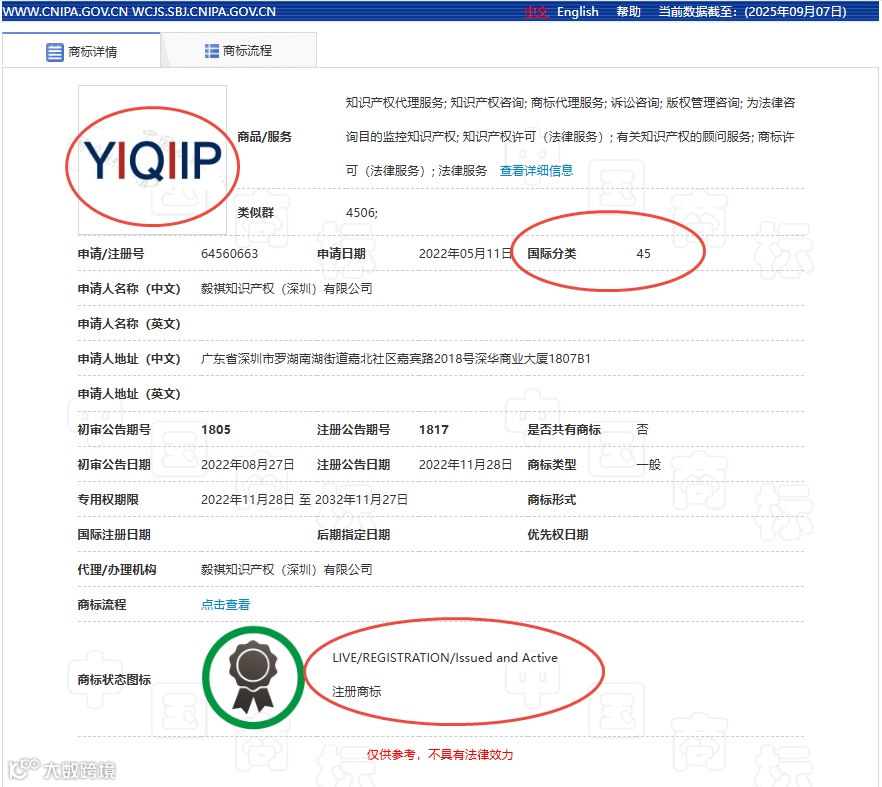
(source: CNIPA data on 09/09/20025)
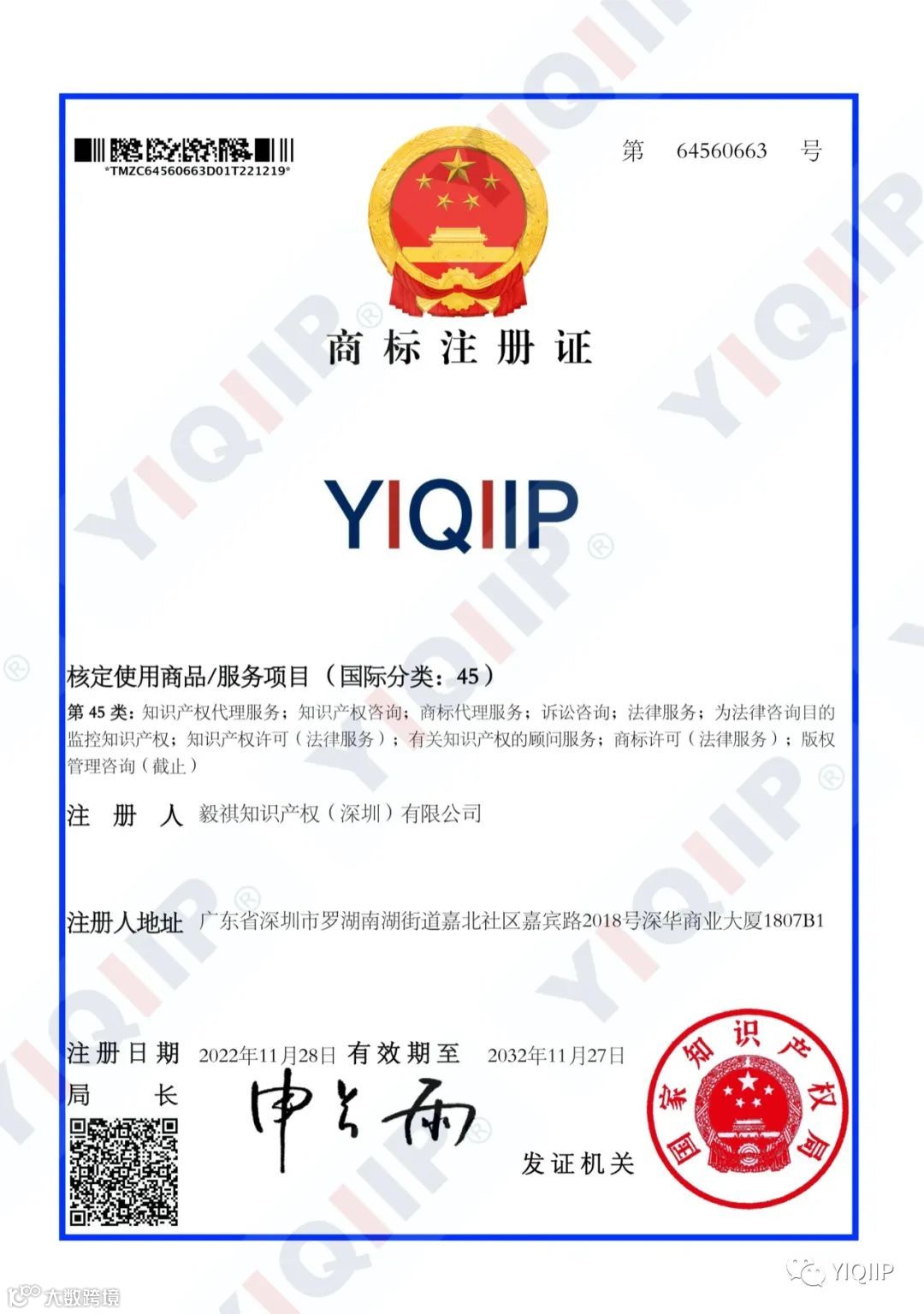
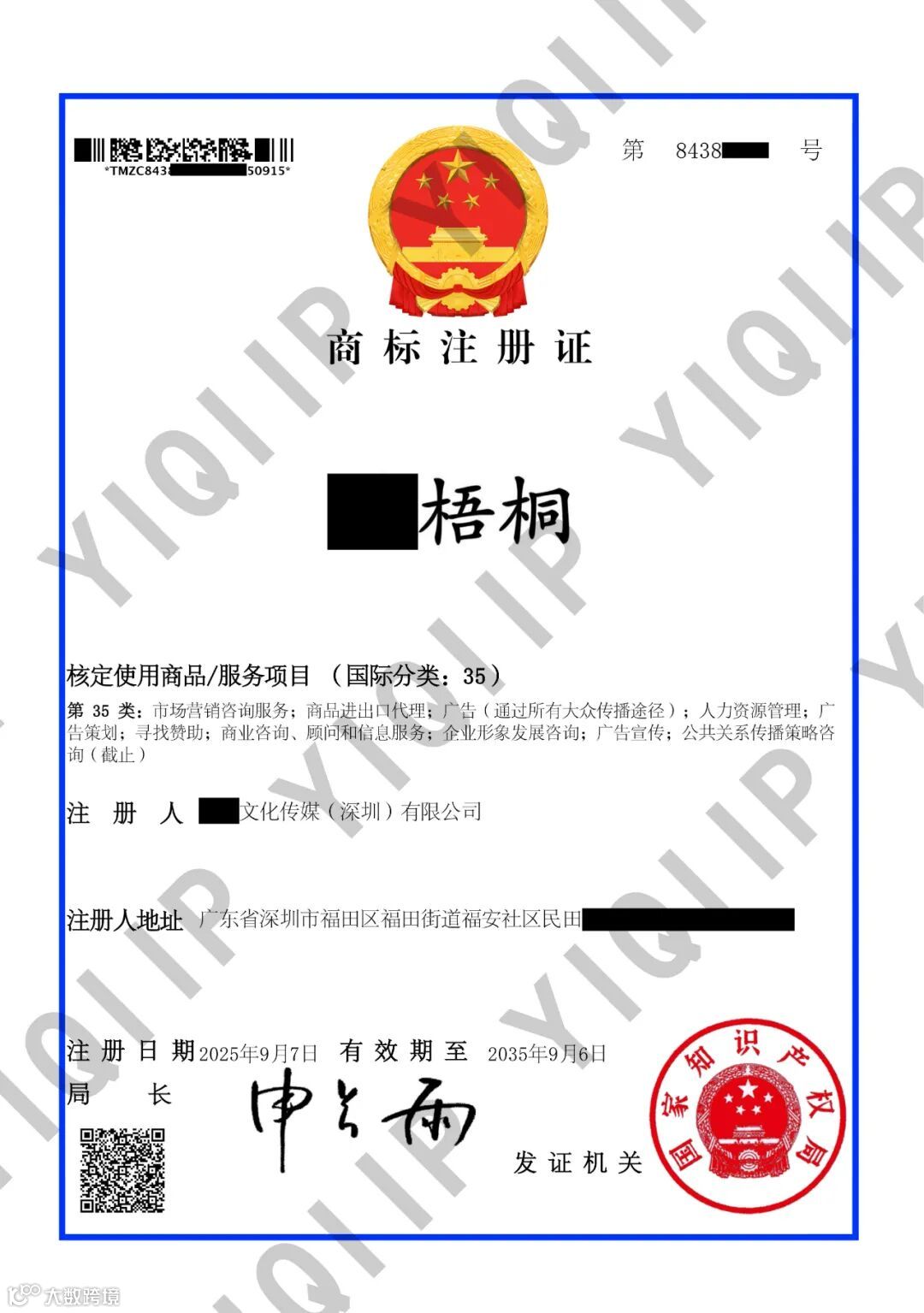
(Source: CNIPA, Chinese Trademark Registration Certificate)
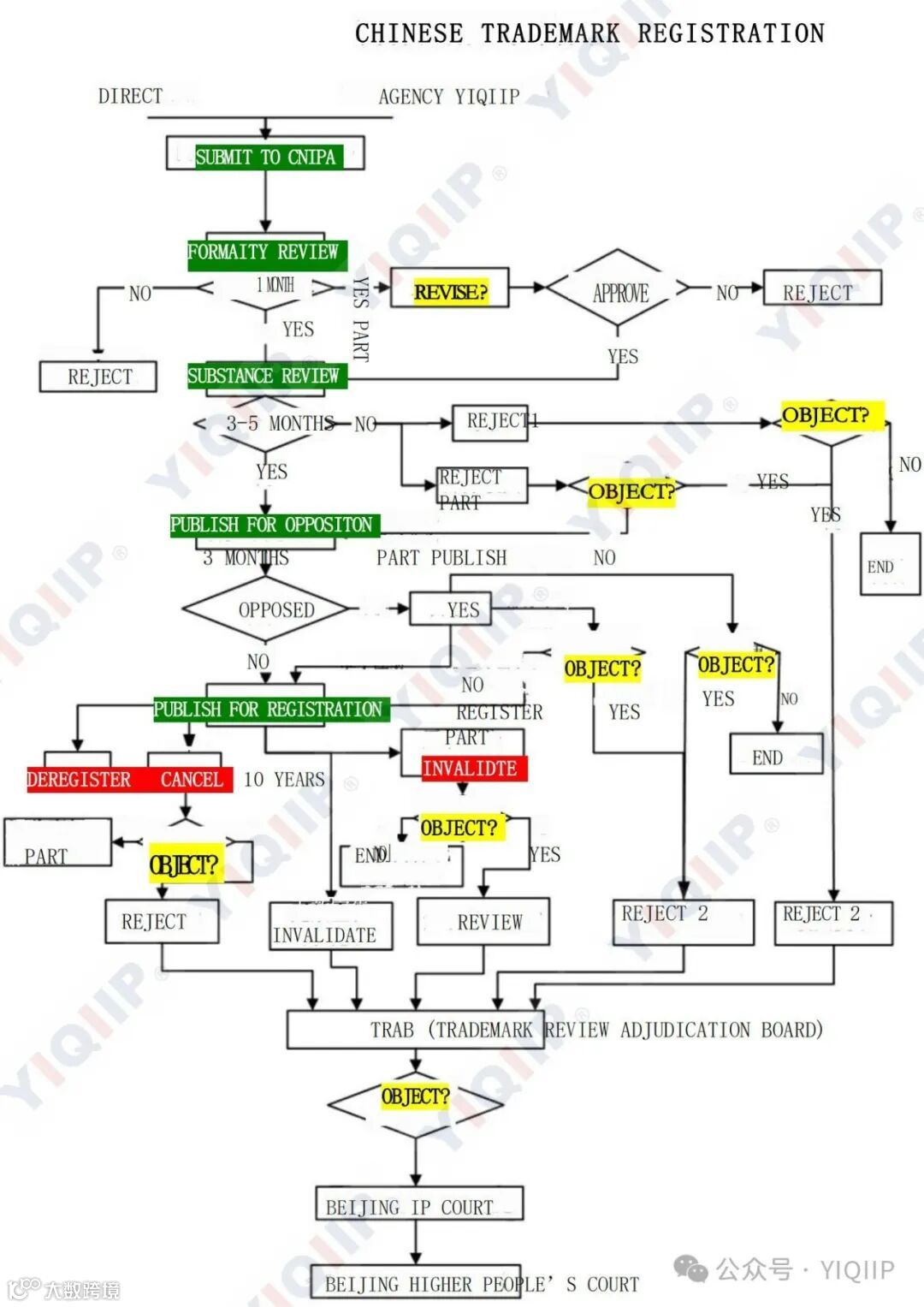

SERVICE REVIEW
CHINESE TRADEMARK REGISTRATION
SWISS BRAND FRENCH-CHINESE TRANSLATION
REVIEW TO TRAB FOR REJECTED APPLICATIONS
" We have worked through our brand registration in China wonderfully with the help of YIQI. Thanks to Margaret and Candice for being so available, proactive and patient to answer our questions and needs. The Chinese brand registration can be complicated for foreigners and YIQI team made the process efficient, clear and transparent. I truly recommend their services. "
——Mr. Jerome Bessard, Switzerland
Grangettes Switzerland Sàrl
https://www.grangettes.store/
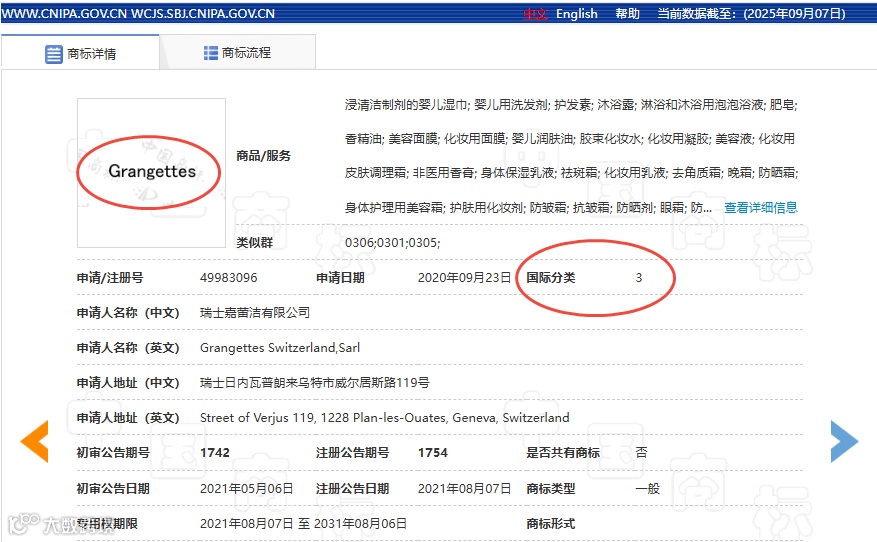
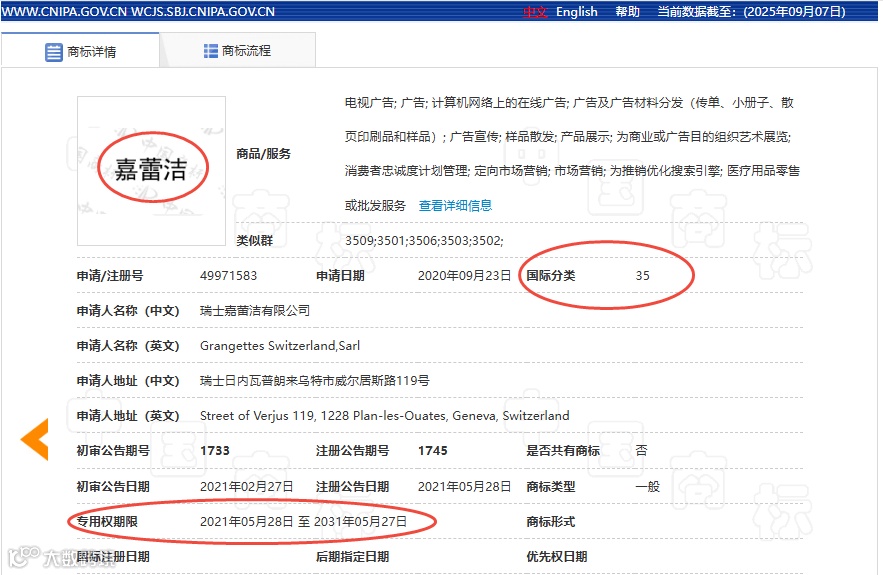
CHINESE TRADEMARK REGISTRATION
" YIQI is a great, fast and efficient way to protect our brand in Asia. The service was fast to answer, professional also. Communication was great through Wechat and Email. I recommend them to anyone who want to protect their brands. "
—— Mr. Andrea D Furlan, Geneva Switzerland
Andrea Furlan Le Studio
https://www.adreafurlan.ch/


Mr. Srinivas Dudam, India
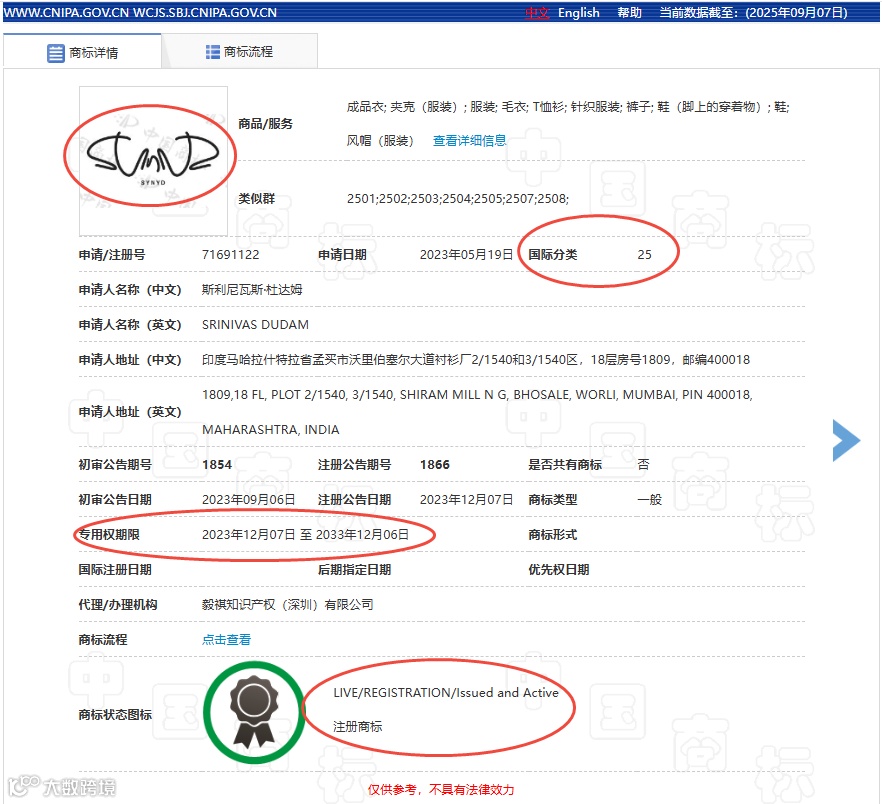
(Source: CNIPA)