


请点击标题下蓝色字体关注本号,欢迎转发
Distress Signals
遇险信号
RECEPTION OF SAFETY MESSAGES
安全信息的接收
Any message which you hear prefixed by one of the following words concerns SAFETY
您听到的以以下任一词语为前缀的任何信息均关乎安全
MAYDAY (Distress) - Indicates that a ship, aircraft or other vehicle is threatened by grave and imminent danger and requests immediate assistance.
MAYDAY(遇险)- 表示一艘船舶、飞机或其他运载工具受到严重且紧迫的危险威胁,并请求立即援助。
PAN PAN (Urgency) - Indicates that the calling station has a very urgent message to transmit concerning the safety of a ship, aircraft or other vehicle, or the safety of a person.
PAN PAN(紧急)- 表示呼叫台站有关于船舶、飞机或其他运载工具的安全或人员安全的非常紧急的信息需要发送。
SECURITE (Safety) - Indicates that the station is about to transmit a message concerning the safety of navigation or giving important meteorological warnings.
SECURITE(安全)- 表示该台站即将发送有关航行安全或重要气象警告的信息。
If you hear any of these words, pay particular attention to the message and call the master or the officer on watch.
如果您听到以上任何词语,请特别注意该信息,并呼叫船长或值班驾驶员。
COLREG Annex IV
《国际海上避碰规则》附则IV
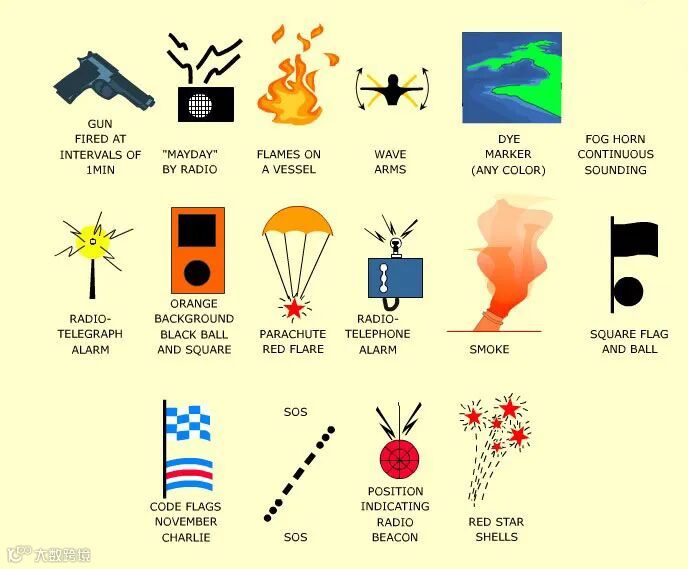
Distress signals
遇险信号
The following signals, used or exhibited either together or separately, indicate distress and need of assist.
以下信号,无论是一起使用或展示,还是分别使用或展示,均表示遇险并需要援助。
A gun or other explosive signals fired at intervals of about a minute;
约每隔一分钟鸣放一次枪炮或其他爆炸信号;
A continuous sounding with any fog-signaling apparatus;
使用任何雾号装置连续发声;
Rockets or shells, throwing red stars fired one at a time at short intervals;
火箭或炮弹,每次发射间隔短暂,能射出红色星簇;
A signal made by any signaling method consisting of the group ... --- ... (SOS) in the Morse Code;
通过任何信号方法发出的由莫尔斯电码组... --- ... (SOS) 组成的信号;
A signal sent by radiotelephony consisting of the spoken word "MAYDAY";
通过无线电话发送的包含口语词"MAYDAY"的信号;
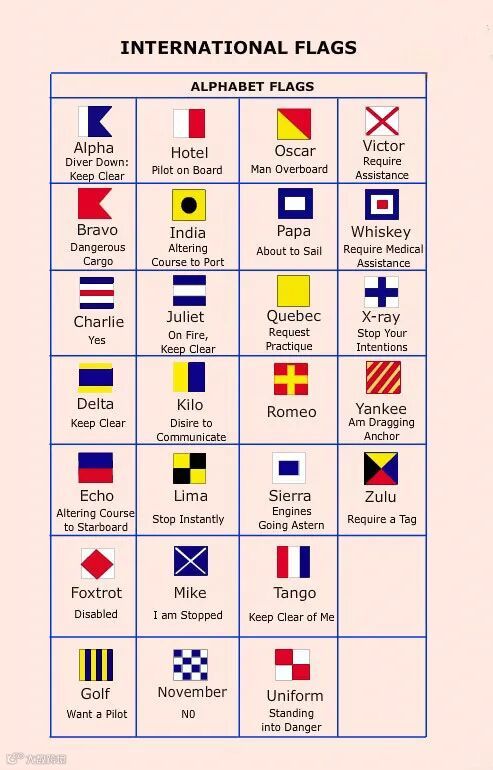
The International Code Signal of distress indicated by N.C.;
由N.C. 表示的国际遇险信号码;
A signal consisting of a square flag having above or below it a ball or anything resembling a ball;
由一方旗及其上方或下方有一个球体或任何类似球体的物体组成的信号;
Flames on the vessel (as from a burning tar barrel, oil barrel, etc.);
船上的火焰(例如来自燃烧的柏油桶、油桶等);
A rocket parachute flare or a hand-flare showing a red light;
显示红光的火箭降落伞火焰信号或手持火焰信号;
A smoke signal giving off orange-coloured smoke;
发出橙色烟雾的烟雾信号;
Slowly and repeatedly raising and lowering arms outstretched to each side;
缓慢并重复地将双臂向两侧伸直抬起和放下;
A distress alert by means of digital selective calling (DSC) transmitted on:
通过数字选择性呼叫(DSC)发送的遇险警报,传输于:
1. VHF channel 70, or
1. 甚高频 70 频道,或
2. MF/HF on the frequencies 2187.5 kHz, 8414.5 kHz, 4207.5 kHz, 6312 kHz, 12577 kHz or 16804.5 kHz;
2. 中频/高频的 2187.5 kHz、8414.5 kHz、4207.5 kHz、6312 kHz、12577 kHz 或 16804.5 kHz 频率上;
A ship-to-shore distress alert transmitted by the ship's Inmarsat or other mobile satellite service provider ship earth station;
由船舶的国际海事卫星或其他移动卫星业务提供商船舶地球站发送的船对岸遇险警报;
Signals transmitted by emergency position-indicating radio beacons;
由应急无线电示位标发送的信号;
Approved signals transmitted by radio communications systems, including survival craft radar transponders.
由无线电通信系统发送的经核准的信号,包括救生艇筏雷达应答器。
The use or exhibition of any of the foregoing signals, except for the purpose of indicating distress and need of assistance and the use of other signals which may be confused with any of the above signals, is prohibited.
除用于表示遇险和需要援助外,禁止使用或展示任何前述信号,也禁止使用可能与上述任何信号相混淆的其他信号。
Attention is drawn to the relevant sections of the International Code of Signals, the International Aeronautical and Maritime Search and Rescue Manual, Volume III and the following signals:
请注意《国际信号规则》、《国际航空和海上搜救手册》第三卷的相关章节以及以下信号:
A piece of orange-colored canvas with either a black square and circle or other appropriate symbol (for identification from the air);
一块橙色帆布,其上带有黑色正方形和圆形或其他适当符号(用于从空中识别);
A dye marker.
染色标志。
The following media explains about the COLREG Annex IV Distress Signals:
以下媒体解释了关于《国际海上避碰规则》附则IV 的遇险信号:
欢迎点击下方二维码,关注本号,欢迎推荐更多人
轮机资源 Marine Engineering Resource
船舶管理资源 Ship Management Resource