

Q4 China SBR Price to Face Headwinds in Rebounding
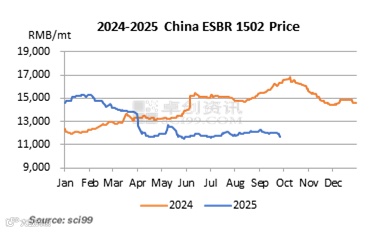
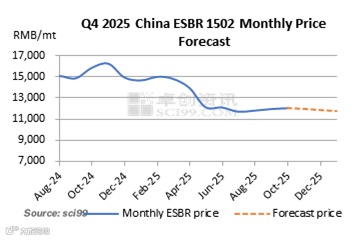
Introduction: In Q3, China’s SBR market price of SBR mainly moved sideways and averaged RMB 11,964.75/mt, down 0.49% QoQ and down 21.82% YoY. The “anti-involution” policy boosted the market atmosphere. However, the weak fundamentals dampened the price growth. In Q4, China’s average price of SBR is likely to drop MoM, lingering at RMB 11,500-12,300/mt.
In Q3 2025, China’s SBR market price mainly moved sideways, with the average price edging down. For example, the market price of ESBR 1502 in North China averaged RMB 11,964.75/mt in Q3, down 0.49% QoQ and down 21.82% YoY. The highest point occurred on September 8 at RMB 12,250/mt, while the lowest point appeared on July 7 at RMB 11,600/mt. From the perspective of SBR price fluctuation features, the SBR price in Q3 2025 was basically in line with the average level of the past 7 years.
The main reasons for the rise in the SBR price in Q3 were as follows. First, China introduced the “anti-involution” policy and prepared to propose work plans for maintaining stable growth in key industries in July. The long position funds boosted the commodity market atmosphere, driving up the spot SBR price. Second, the feedstock butadiene price fluctuated upwards, underpinning the bottom of the SBR price. Third, the price of NR feedstock displayed a continuous uptrend due to the weather and geopolitical issues in Southeast Asia, triggering a rise in the spot NR price, which drove up the SBR market price.
The main pressures on the SBR price in Q3 were as follows. In Q3, the SBR unit of PetroChina Fushun began to take maintenance on August 15, but the SBR supply circulating in the market was stable. Yet, the demand dropped slightly due to the influence of the tariff issue and the market performance. Besides, downstream application enterprises, including tire makers, mainly purchased SBR on rigid demand, and the spot negotiation atmosphere was weak. The tepid fundamentals suppressed the uptrend of the SBR price. Traders were cautious and mainly operated flexibly.
The average price of SBR in Q4 2025 is expected to be lower than in Q3.
SCI reckons that the average price of SBR in Q4 is likely to move down from Q3. The SBR price may rebound in certain periods, but the growth is expected to be limited. Overall, the SBR price in Q4 is estimated at RMB 11,500-12,300/mt. The decline in cost may weigh on the SBR price in Q4. Besides, the NR price trend and SBR supply-demand fundamentals may fail to bolster the SBR price effectively. Therefore, the average price of SBR in Q4 is predicted to drop from Q3. Attention should be paid to the influence of macro factors on the SBR price.
NR: The market price of NR is expected to trend down in Q4. From October to November, the globe may enter the NR production peak season, and the influence of weather issues will likely ebb. Thus, the output increase may weigh on the NR price. In December, the decrement in the NR price is likely to narrow, as the rubber tapping work in Vietnam and China production areas may gradually come to an end. Attention should be paid to the support from the information of strategic reserve purchases. The NR price trend will likely affect the SBR market atmosphere, while it may have no substantial influence in terms of the downstream feedstock substitution.
Cost: The average price of butadiene in Q4 is predicted to be lower than that in Q3. From October to December, although the butadiene unit at Sinopec Zhenhai Refining & Chemical may take maintenance as scheduled, the output of the newly added butadiene unit of PetroChina Jilin and Shandong Yulong Petrochemical is likely to be released. Thus, the butadiene supply will likely move up, weakening the support for the butadiene price. As the supply growth may exceed that in demand, the butadiene price is expected to go downwards in Q4. The lowest point in Q4 is anticipated to appear in December. Overall, the cost changes will likely suppress the SBR price.
Supply: The SBR output in Q4 is predicted to grow by 3.09% QoQ. The SBR unit at PetroChina Fushun Petrochemical was shut down on August 15 and is scheduled to be restarted in late October. After the restart, the SBR supply is expected to increase. The SBR unit at Huizhou LCY Elastomers may take maintenance in November, which may last for 20 days. The other SBR units are likely to run steadily. Overall, the SBR supply in Q4 will likely move up. The influence of the unit maintenance of Huizhou LCY Elastomers is anticipated to be limited on the SBR supply.
Demand: In Q4, the total output of semi-steel tires is likely to fall by 1.5% compared with Q3. As some export orders to the EU have been overdrawn, the exports in Q4 may lack new growth drivers, dampening the operating rate of tire production. The output of all-steel tires in Q4 may fall by 7.58% from Q3. The demand in Q4 usually hits a low point of the year, leading to a decline in the support for the all-steel tire output. The all-steel tire inventory will likely increase, while there may be no new support for the tire output growth. In summary, the tire industry may enter the demand slack season in Q4, causing a weaker demand for SBR.
On the whole, the supply and demand of SBR in Q4 are both expected to be weak, failing to drive up the SBR price.
All information provided by SCI is for reference only, which shall not be reproduced without permission.
Please click "Read more" for the full article.